Irrigation in India: Types, Efficiency and Water Management
12 Nov 2026
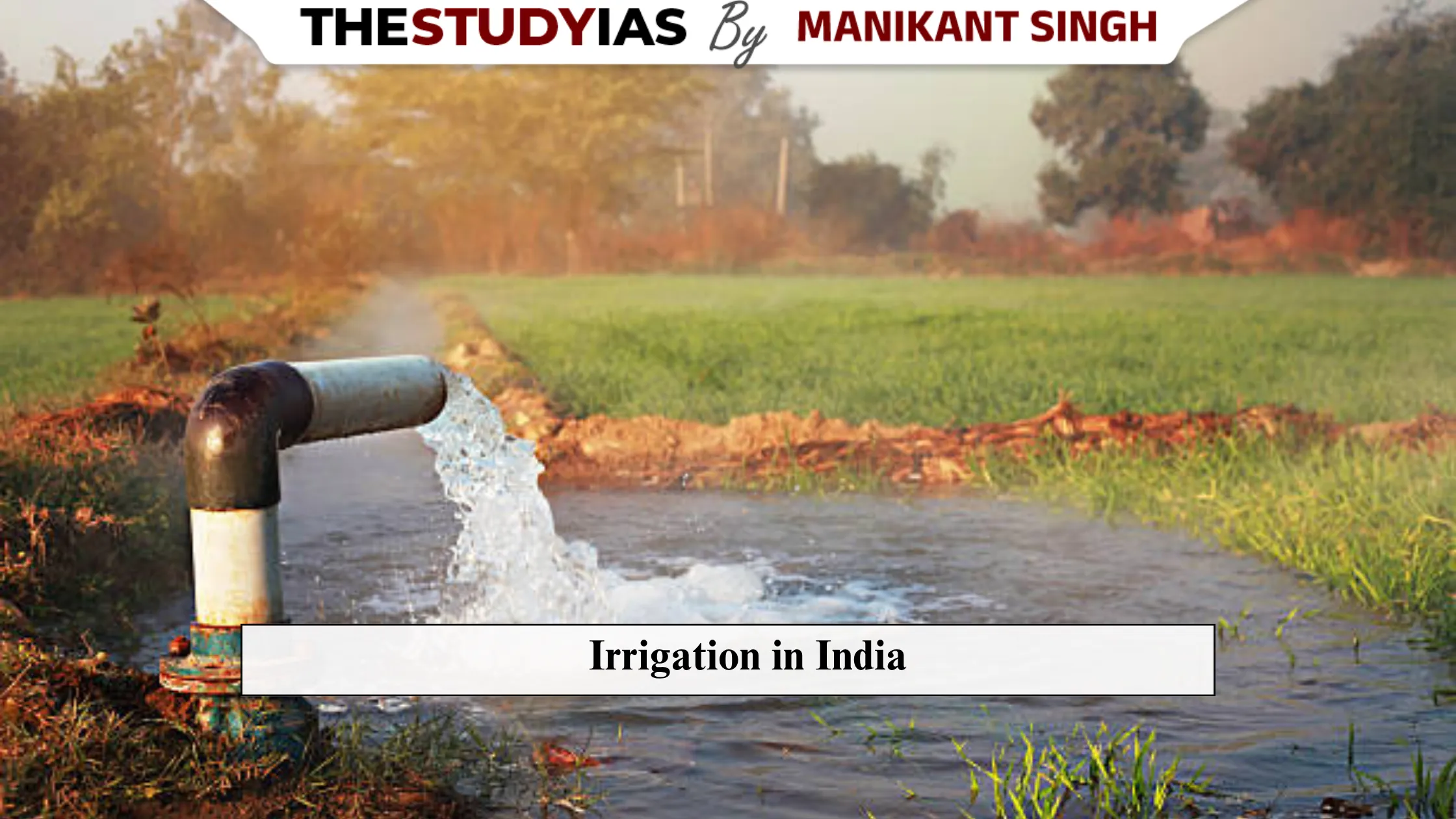
Irrigation in India: Types, Efficiency and Water Management
Agriculture is the backbone of India's rural economy, but its productivity depends heavily on the availability and efficient use of water. Although the Indian monsoon provides a major share of the country's agricultural water, its uneven distribution, seasonal nature and increasing variability make irrigation essential for stable agricultural production.
Irrigation refers to the artificial application of water to agricultural land to support crop growth when rainfall is insufficient or irregular. It reduces dependence on the monsoon, enables multiple cropping, improves agricultural productivity and strengthens food security.
India has developed an extensive irrigation network through canals, tanks, wells, tube wells and modern micro-irrigation systems. However, challenges such as groundwater depletion, inefficient water distribution, regional disparities, waterlogging and inadequate maintenance continue to affect the sustainability of irrigation.
The focus of agricultural policy must therefore shift from simply expanding irrigation infrastructure to improving water-use efficiency, equitable distribution and sustainable water management.
Importance of Irrigation in Indian Agriculture
Reducing Dependence on the Monsoon
Indian agriculture remains vulnerable to variations in rainfall. Delayed monsoons, droughts, dry spells and uneven rainfall distribution can damage crops and reduce farm incomes. Irrigation provides an alternative source of water and reduces farmers' dependence on uncertain rainfall, thereby improving agricultural stability.
Increasing Agricultural Productivity
Adequate water availability at critical stages of crop growth improves plant development, crop yields and agricultural output. Irrigation also enables farmers to adopt improved seeds, fertilisers and modern agricultural practices more effectively.
Promoting Multiple Cropping
In rainfed areas, farmers may cultivate only one crop during the monsoon season. Reliable irrigation enables cultivation during the Rabi and Zaid seasons, increasing cropping intensity and overall agricultural production.
Supporting Food Security
Irrigation contributes to the stable production of foodgrains, pulses, oilseeds, vegetables and other agricultural commodities. It helps reduce fluctuations in agricultural output and strengthens the country's food-security system.
Supporting Rural Employment and Income
Improved irrigation can increase agricultural activities, create employment opportunities and improve farm incomes. It also supports allied activities such as dairy farming, fisheries and horticulture where appropriate water resources are available.
Promoting Agricultural Diversification
Reliable water availability allows farmers to diversify towards horticulture, vegetables, fruits, pulses and other high-value crops, depending on local agro-climatic conditions. However, irrigation expansion must be accompanied by sustainable cropping choices to avoid excessive pressure on water resources.
Types of Irrigation in India
Irrigation systems in India can be broadly classified according to their water sources, methods of water distribution and technologies used.
Classification Based on Sources of Irrigation
Canal Irrigation
Canal irrigation involves supplying water to agricultural fields through an artificial network of channels connected to rivers, reservoirs or dams.
Canals may be classified into:
Perennial canals: Receive water from perennial rivers, reservoirs or regulated storage systems and can provide irrigation throughout the year, subject to water availability.
Inundation canals: Traditionally draw water from rivers during periods of high water levels, particularly during floods.
Advantages: Canal irrigation can cover large agricultural areas, support multiple cropping and reduce dependence on groundwater.
Challenges: It requires substantial investment, regular maintenance and efficient water distribution. Seepage, waterlogging, salinity and unequal access between head-reach and tail-end farmers are major concerns.
Well and Tube-Well Irrigation
Groundwater irrigation is one of the most important sources of agricultural water in India.
Well irrigation uses water drawn from open or dug wells, while tube-well irrigation uses deeper boreholes fitted with pumping systems to extract groundwater.
Advantages: It provides farmers with greater control over the timing and quantity of irrigation. It is particularly useful where surface-water infrastructure is limited.
Challenges: Excessive groundwater extraction can lower the water table, increase pumping costs and create long-term water insecurity. Unequal access to electricity and pumping equipment also affects small and marginal farmers.
Tank Irrigation
Tank irrigation involves storing rainwater and surface runoff in natural or artificial reservoirs for agricultural use. It has traditionally been important in regions with uneven rainfall and undulating terrain, particularly in parts of southern India.
Advantages: Tanks support local water storage, groundwater recharge and irrigation. They can also help reduce runoff and improve community-level water management.
Challenges: Siltation, encroachment, damaged feeder channels and inadequate maintenance reduce their storage capacity and effectiveness.
River-Lift Irrigation
In river-lift irrigation, water is directly lifted from rivers or other surface-water sources using pumps and supplied to agricultural fields. It is particularly useful where agricultural land is located at a higher elevation than the water source and gravity-based irrigation is not feasible.
Advantages: It can extend irrigation access to areas that cannot be served easily by conventional canals.
Challenges: It requires energy, pumping infrastructure, regular maintenance and reliable water availability.
Classification Based on Methods of Water Application
Surface Irrigation
Surface irrigation involves allowing water to flow over the soil surface through gravity. It is one of the oldest and most widely practised irrigation methods in India.
Its common forms include:
Flood Irrigation: Water is allowed to spread over the agricultural field without precise control over its distribution. It is relatively inexpensive but can result in considerable water loss.
Basin Irrigation: The field is divided into small basins surrounded by bunds, allowing water to collect around crops or trees. It is commonly used in orchards and certain field crops.
Furrow Irrigation: Water flows through small channels or furrows between crop rows. It is suitable for crops such as sugarcane, cotton and maize under appropriate soil and field conditions.
Border Strip Irrigation: Agricultural land is divided into long strips separated by raised boundaries. Water flows along the strips under gravity.
Surface irrigation is relatively simple and affordable, but poor field levelling and improper water management can lead to runoff, evaporation, waterlogging and uneven distribution.
Sprinkler Irrigation
Sprinkler irrigation distributes water through a network of pipes and nozzles, spraying it over crops in a manner similar to rainfall. It is particularly useful in areas with uneven terrain, sandy soils and crops that require controlled water application.
Advantages:
Reduces water wastage compared with poorly managed surface irrigation.
Provides relatively uniform water distribution.
Requires less land levelling.
Can be adapted to different crops and field conditions.
Limitations: Initial installation costs, energy requirements, wind interference and nozzle maintenance can restrict adoption.
Drip Irrigation
Drip irrigation is a micro-irrigation technique in which water is supplied slowly and directly to the root zone of plants through pipes, emitters and drippers.
It reduces unnecessary wetting of the soil surface and enables precise water application.
Advantages:
Improves water-use efficiency.
Reduces evaporation and surface runoff.
Supports fertigation, which involves applying fertilisers through irrigation water.
Reduces weed growth in areas outside the wetted root zone.
Can improve crop productivity and input efficiency.
Limitations: High initial investment, emitter clogging, maintenance requirements and the need for technical knowledge can limit adoption, particularly among small farmers.
Comparison of Major Irrigation Methods
Irrigation Efficiency and Water-Use Efficiency
Irrigation efficiency refers to how effectively irrigation water is conveyed, distributed and used by crops without unnecessary losses. In India, improving irrigation efficiency is essential because a substantial share of water resources is used for agriculture, while groundwater depletion and competing demands are increasing.
Water-use efficiency (WUE) refers broadly to the amount of agricultural output or crop production obtained per unit of water consumed or applied. Its precise measurement depends on the definition and stage of the water-use process.
Types of Irrigation Efficiency
Conveyance Efficiency: It measures the efficiency with which water is transported from its source to the agricultural field. Seepage and leakage from canals and channels reduce conveyance efficiency.
Application Efficiency: It measures how effectively water delivered to a field is stored in the crop root zone and made available for plant use.
Distribution Efficiency: It measures how uniformly irrigation water is distributed across the agricultural field.
Overall Irrigation Efficiency: It reflects the combined performance of water conveyance, distribution and application systems.
Factors Affecting Irrigation Efficiency
Several factors influence the efficient use of irrigation water:
Soil characteristics: Sandy soils have higher infiltration rates, while clayey soils generally retain more water.
Climate: High temperatures, wind and low humidity can increase evaporation.
Crop selection: Different crops have different water requirements.
Irrigation methods: Poorly managed flood irrigation can result in substantial water losses.
Field conditions: Uneven land surfaces can cause waterlogging and unequal distribution.
Infrastructure: Damaged canals, leaking pipelines and inadequate drainage reduce efficiency.
Farm management: Irrigation scheduling, soil-moisture monitoring and appropriate water application improve efficiency.
Major Irrigation Challenges in India
Groundwater Depletion
Groundwater is a critical source of irrigation, particularly in states such as Punjab, Haryana, Rajasthan and parts of Uttar Pradesh. Excessive extraction through tube wells and pumps has resulted in declining groundwater levels in several regions.
The Dynamic Ground Water Resources Assessment 2025 estimated annual groundwater extraction for all uses at 247 billion cubic metres (BCM). Of this, approximately 215 BCM, or 87%, was used for irrigation.
This highlights the importance of groundwater conservation and efficient irrigation practices.
Regional Disparities in Irrigation Access
Irrigation facilities are unevenly distributed across India. Some states have extensive canal and groundwater networks, while several rainfed and drought-prone regions continue to face limited irrigation access.
This creates disparities in agricultural productivity, cropping intensity and farmers' incomes.
Inefficient Traditional Irrigation Practices
Flood irrigation and poorly managed surface irrigation can result in water losses through evaporation, runoff and deep percolation. Although surface irrigation is not inherently inefficient in every situation, inadequate field levelling, poor scheduling and unsuitable soil conditions can reduce its effectiveness.
Waterlogging and Soil Salinity
Excessive irrigation, inadequate drainage and seepage from canals can raise groundwater levels and cause waterlogging. In dry regions, evaporation may leave dissolved salts behind in the soil, resulting in soil salinity. This reduces soil fertility and affects crop productivity.
Inadequate Maintenance of Irrigation Infrastructure
Many irrigation canals, tanks, distributaries and water-storage structures suffer from siltation, leakage and inadequate maintenance. The gap between irrigation potential created and irrigation potential actually utilised also reduces the benefits of public investment.
Energy Consumption and Financial Burden
Groundwater irrigation depends heavily on electric and diesel pumps. Excessive pumping increases energy consumption and can create financial pressure on farmers and electricity distribution companies. Subsidised or poorly metered electricity, combined with weak groundwater regulation, can also encourage excessive extraction in some regions.
Climate Change and Water Stress
Changing rainfall patterns, rising temperatures, prolonged dry spells and extreme weather events are increasing uncertainty in water availability. Climate change is likely to intensify competition between agricultural, industrial, domestic and ecological water requirements.
Fragmented Landholdings and High Technology Costs
Small and marginal farmers may find it difficult to invest in drip irrigation, sprinklers, automated irrigation systems and water-monitoring technologies. The lack of technical support, credit and maintenance facilities further limits the adoption of modern irrigation methods.
Government Initiatives for Irrigation and Water Management in India
Pradhan Mantri Krishi Sinchayee Yojana (PMKSY)
Launched in 2015-16, PMKSY aims to expand irrigation coverage, improve water-use efficiency and promote sustainable water management. Its guiding principle is Har Khet Ko Pani (Water to Every Field) and Per Drop More Crop.
Major components include:
Accelerated Irrigation Benefits Programme (AIBP): Supports the completion of major and medium irrigation projects to create additional irrigation potential.
Har Khet Ko Pani (HKKP): Focuses on expanding irrigation access through minor irrigation, water-body restoration and related interventions.
Command Area Development and Water Management (CADWM): Aims to improve the utilisation of irrigation potential through better water distribution and field-level infrastructure.
Watershed Development Component (WDC-PMKSY): Promotes rainwater harvesting, soil and moisture conservation, watershed treatment and groundwater recharge, particularly in rainfed and degraded areas.
Per Drop More Crop (PDMC)
The Per Drop More Crop programme promotes micro-irrigation technologies such as drip and sprinkler systems to improve water-use efficiency at the farm level. It provides financial assistance to farmers for installing micro-irrigation systems, subject to scheme guidelines. According to the Government of India, more than 115 lakh hectares had been brought under micro-irrigation through PDMC by July 2026.
An important administrative distinction is that PDMC was implemented as a component of PMKSY from 2015-16 to 2021-22. From 2022-23, it has been implemented under the Rashtriya Krishi Vikas Yojana (RKVY) framework.
Atal Bhujal Yojana
The Atal Bhujal Yojana (Atal Jal) focuses on sustainable groundwater management through community participation. It encourages groundwater budgeting, water conservation, demand-side management and the preparation of community-led water security plans in participating areas. Its approach recognises that groundwater management requires participation from local communities, farmers and institutions.
Pradhan Mantri Krishi Sinchayee Yojana – Modernisation of Command Area Development and Water Management
The Modernisation of Command Area Development and Water Management (M-CADWM) initiative seeks to modernise irrigation water-supply networks and improve on-farm water-use efficiency. It aims to connect existing water sources and canal networks to farm-level infrastructure, including pressurised pipe systems, while encouraging the adoption of micro-irrigation.
Jal Shakti Abhiyan: Catch the Rain
The Jal Shakti Abhiyan: Catch the Rain campaign promotes rainwater harvesting and water conservation through local participation. Its activities include renovation of traditional water bodies, creation of rainwater-harvesting structures, reuse of water and watershed development.
National Water Mission
The National Water Mission, under the National Action Plan on Climate Change, seeks to conserve water, minimise wastage and ensure more equitable distribution across and within states.
One of its key objectives is to improve water-use efficiency by 20%.
Watershed Development Programmes
Watershed development programmes focus on conserving soil and water within a defined geographical drainage area. They involve measures such as contour bunding, check dams, farm ponds, afforestation and groundwater recharge.
These interventions are particularly important in rainfed and drought-prone regions.
Traditional Water Conservation and Irrigation Systems in India
India has a long history of community-based water management. Traditional irrigation structures demonstrate how local communities adapted to regional geography, rainfall and water availability.
Reviving traditional water systems can strengthen local water security, improve groundwater recharge and reduce dependence on large irrigation infrastructure.
Strategies for Improving Irrigation Efficiency and Water Management
Expanding Micro-Irrigation
Drip and sprinkler systems should be promoted in regions where they are technically and economically suitable. Greater access to affordable equipment, subsidies, credit, maintenance facilities and farmer training can improve adoption.
Promoting Crop Diversification
Agricultural policies should encourage farmers to shift towards less water-intensive crops such as millets, pulses and suitable oilseeds, particularly in water-stressed regions. Crop diversification should be based on agro-climatic suitability, market access and farmer income considerations.
Strengthening Groundwater Governance
Groundwater management must move beyond individual extraction towards community-based resource management. Groundwater budgeting, aquifer mapping, monitoring of extraction and local water-security plans can improve long-term sustainability.
Improving Canal Infrastructure
Canal lining where technically justified, pipeline distribution, automated gates, regular desilting and improved field channels can reduce conveyance losses. Water distribution should also be made more equitable between head-reach and tail-end farmers.
Promoting Rainwater Harvesting
Farm ponds, check dams, recharge structures, percolation tanks and rooftop rainwater harvesting can help conserve rainfall and improve local water availability.
Adopting Precision Irrigation Technologies
Soil-moisture sensors, weather-based irrigation scheduling, satellite-based monitoring and automated irrigation systems can help farmers apply water according to crop requirements. These technologies can reduce unnecessary irrigation and improve productivity per unit of water.
Encouraging Participatory Irrigation Management
Water User Associations (WUAs) can involve farmers in the operation, maintenance and distribution of irrigation water. Community participation can improve accountability, reduce conflicts and ensure more equitable access to water.
Integrating Energy and Water Policies
Electricity pricing, solar pumps and groundwater regulations should be designed to discourage excessive water extraction. Solar-powered irrigation should be accompanied by incentives for farmers to conserve water or sell surplus electricity, rather than encouraging unlimited pumping.
Reusing Treated Wastewater
Treated wastewater can be used for suitable agricultural and non-potable purposes, subject to safety standards and monitoring. This can reduce pressure on freshwater resources, particularly near urban and peri-urban agricultural areas.
Irrigation in India: Way Forward
India needs to adopt an integrated approach that treats water as a limited and shared natural resource rather than an unlimited agricultural input. The priority should be to improve irrigation efficiency rather than merely expanding irrigated area. This requires modernisation of canals, adoption of micro-irrigation, revival of traditional water bodies and better maintenance of existing infrastructure.
Groundwater management must become a central part of agricultural policy. Community participation, aquifer-based planning, water budgeting and appropriate regulation can help prevent over-extraction. At the farm level, crop diversification, precision irrigation, soil-moisture conservation and climate-resilient agricultural practices should be encouraged.
Finally, irrigation planning must be integrated with energy policy, agricultural pricing, watershed management and local water governance. Only a coordinated approach can ensure water security, sustainable agricultural growth and long-term food security.
UPSC Relevance: Irrigation and GS Paper 3
GS Paper 3 - Indian Economy and Agriculture
Major crops and cropping patterns in various parts of the country.
Irrigation systems and types of irrigation.
Storage, transport and marketing of agricultural produce.
E-technology in the aid of farmers.
Technology missions and agricultural infrastructure.
Environmental pollution and degradation.
Conservation and environmental protection.
Disaster management, including droughts and floods.
Important Mains dimensions: Groundwater depletion, irrigation efficiency, regional disparities, micro-irrigation, climate change, water governance, crop diversification, participatory irrigation management and sustainable agriculture.
Important Keywords for UPSC Mains Answer Writing
Water-Use Efficiency (WUE): Agricultural output or crop production obtained per unit of water used.
Micro-Irrigation: Precise application of water through drip and sprinkler systems.
Groundwater Depletion: Decline in groundwater reserves due to excessive extraction.
Waterlogging: Saturation of agricultural soil due to excessive water accumulation.
Soil Salinity: Accumulation of soluble salts in soil, affecting crop growth.
Command Area: Agricultural area intended to receive irrigation water from a particular irrigation project.
Irrigation Potential Created (IPC): Irrigation capacity developed through infrastructure.
Irrigation Potential Utilised (IPU): Irrigation capacity actually used for agricultural purposes.
Participatory Irrigation Management: Involvement of farmers and local institutions in irrigation management.
Aquifer Management: Scientific management of underground water-bearing geological formations.
Crop Water Productivity: Agricultural output produced per unit of water consumed.
Conjunctive Use of Water: Planned and coordinated use of surface water and groundwater.
Prelims Practice Questions
Q1. With reference to micro-irrigation, consider the following statements:
Drip irrigation supplies water directly to or near the root zone of plants.
Sprinkler irrigation distributes water through nozzles in the form of droplets.
Micro-irrigation can facilitate the application of fertilisers through irrigation water.
Which of the statements given above are correct?
(a) 1 and 2 only
(b) 2 and 3 only
(c) 1 and 3 only
(d) 1, 2 and 3
Answer: (d) 1, 2 and 3
Explanation: Drip and sprinkler irrigation are micro-irrigation methods. Drip systems can also facilitate fertigation, improving the efficiency of water and nutrient application.
Q2. Which of the following traditional water-harvesting systems is associated with Bihar?
(a) Zing
(b) Ahar-Pyne
(c) Khadin
(d) Bamboo Drip Irrigation
Answer: (b) Ahar-Pyne
Explanation: Ahar-Pyne is a traditional water-management system of Bihar. It combines water-storage structures called Ahars with channels called Pynes.
Q3. Consider the following statements regarding PMKSY:
It was launched in 2015-16.
Its guiding principles include Har Khet Ko Pani and Per Drop More Crop.
The Per Drop More Crop component has been implemented under the RKVY framework since 2022-23.
Which of the statements given above are correct?
(a) 1 and 2 only
(b) 2 and 3 only
(c) 1 and 3 only
(d) 1, 2 and 3
Answer: (d) 1, 2 and 3
Explanation: PMKSY was launched in 2015-16. PDMC was implemented as a component of PMKSY until 2021-22 and shifted under the RKVY framework from 2022-23.
Q4. Which of the following is the primary objective of the Atal Bhujal Yojana?
(a) Construction of major dams
(b) Sustainable groundwater management through community participation
(c) Expansion of canal irrigation in coastal areas
(d) Promotion of deep-sea fishing
Answer: (b) Sustainable groundwater management through community participation
Explanation: Atal Bhujal Yojana focuses on community-led groundwater management, water budgeting and sustainable use of groundwater resources.
UPSC Mains Practice Questions
Q1. Irrigation has played a significant role in increasing agricultural productivity in India, but its benefits remain unevenly distributed. Discuss the major challenges associated with irrigation development. (150 words)
Q2. Groundwater depletion has emerged as a major threat to sustainable agriculture in India. Examine its causes and suggest suitable water-management strategies. (250 words)
Q3. Discuss the role of micro-irrigation in improving water-use efficiency and promoting sustainable agriculture in India. (250 words)
Q4. Explain the importance of traditional water-harvesting systems in addressing India's growing water crisis. How can they be integrated with modern irrigation practices? (250 words)
Frequently Asked Questions (FAQs)
What are the main types of irrigation in India?
The major irrigation sources in India include canals, wells, tube wells, tanks and river-lift systems. Based on water application methods, irrigation can be classified into surface irrigation, sprinkler irrigation and drip irrigation.
Which irrigation method is considered more water-efficient?
Drip irrigation is generally considered highly water-efficient because it supplies water directly to the root zone of plants. However, actual efficiency depends on crop type, soil conditions, system maintenance and irrigation management.
What is the difference between drip and sprinkler irrigation?
Drip irrigation supplies water slowly near the roots of plants through emitters, while sprinkler irrigation distributes water through nozzles in the form of droplets. Both are micro-irrigation methods designed to improve water-use efficiency.
What is the main objective of PMKSY?
Pradhan Mantri Krishi Sinchayee Yojana aims to expand irrigation coverage, improve water-use efficiency, strengthen water conservation and promote sustainable irrigation infrastructure. Its guiding principles are Har Khet Ko Pani and Per Drop More Crop.
Why is groundwater depletion a major concern in India?
Groundwater depletion occurs when extraction exceeds natural recharge over time. Excessive use for irrigation lowers the water table, increases pumping costs and threatens long-term agricultural and drinking-water security.
What is participatory irrigation management?
Participatory Irrigation Management involves farmers and local institutions in the distribution, operation and maintenance of irrigation systems. Water User Associations are an important institutional mechanism for improving local water governance.
Conclusion
Irrigation is essential for India's agricultural productivity, food security and rural development. However, expanding irrigation infrastructure without addressing water-use efficiency and resource sustainability can intensify groundwater depletion, soil degradation and regional water stress. India must move towards a water-efficient and climate-resilient irrigation system through micro-irrigation, groundwater conservation, traditional water-body restoration, crop diversification and participatory water governance.
The ultimate objective should not simply be to provide more water to agriculture, but to ensure more agricultural output and better livelihoods from every drop of water.
For more UPSC-oriented articles and preparation resources, explore The Study IAS.
Subscribe to our Youtube Channel for more Valuable Content –TheStudyias
Download the App to Subscribe to our Courses –Thestudyias
The Source’s Authority and Ownership of the Article is Claimed ByTHE STUDY IAS BY MANIKANT SINGH
Comments (0)
Leave a Comment