Punjab and Haryana at 60: The 1966 Reorganisation, Linguistic Identity and Federalism
17 Nov 2026
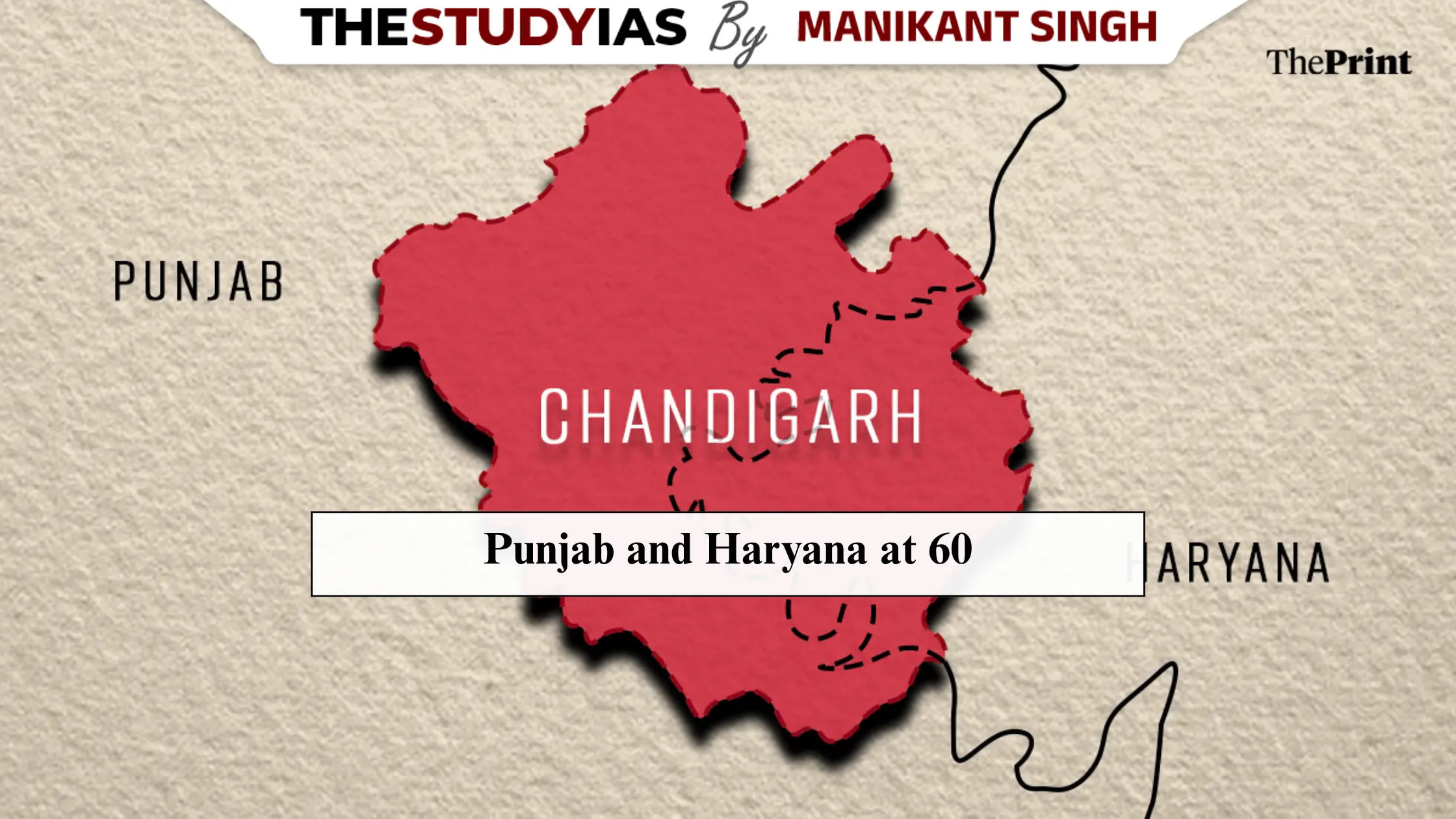
Punjab and Haryana at 60: The 1966 Reorganisation, Linguistic Identity and Federalism
1 November 2026 marks 60 years since the reorganisation of Punjab and the formation of Haryana. On this day in 1966, the Punjab Reorganisation Act, 1966 came into effect, creating Haryana as a separate state, establishing Chandigarh as a Union Territory and transferring several hill areas to Himachal Pradesh.
The reorganisation was the outcome of a prolonged political and linguistic movement. It reflected the demand for administrative recognition of Punjabi-speaking and Hindi-speaking regions, while also raising difficult questions about territorial boundaries, capital-sharing, river-water distribution and the federal relationship between states.
Six decades later, the legacy of 1966 remains visible in debates over Chandigarh, the Sutlej-Yamuna Link (SYL) Canal, Ravi-Beas water sharing and inter-state relations. The anniversary is therefore an opportunity to understand not only how Punjab and Haryana were reorganised but also how regional aspirations continue to shape Indian federalism.
Historical Background: Undivided Punjab After Independence
At the time of Independence in 1947, the partition of India divided the historical Punjab region between India and Pakistan. The Indian portion became East Punjab, with its capital initially located at Shimla and later shifted to Chandigarh.
The region was linguistically and culturally diverse. Punjabi-speaking and Hindi-speaking populations lived across different districts, creating competing demands regarding language, administration and political representation.
The question was whether Punjab should remain a bilingual state or be reorganised to reflect its linguistic regions. Over time, the demand for a Punjabi-speaking state gained momentum, while leaders in the Hindi-speaking areas also began advocating a separate administrative unit.
The resulting political developments eventually led to the reorganisation of Punjab in 1966.
Punjabi Suba Movement: The Demand for a Punjabi-Speaking State
The Punjabi Suba Movement was a major political movement led primarily by the Shiromani Akali Dal. It demanded the creation of a separate Punjabi-speaking state, commonly described as Punjabi Suba.
The movement gained momentum during the 1950s. Its supporters argued that linguistic reorganisation would protect Punjabi language and culture and provide a more effective political voice to Punjabi-speaking people.
However, the demand was politically sensitive. The question of Punjabi language was closely intertwined with religious identity, particularly because of the association of Gurmukhi-script Punjabi with the Sikh community. At the same time, many Punjabi Hindus identified Hindi as their mother tongue in the 1961 Census, adding complexity to the linguistic classification of the region.
The movement was therefore not simply a debate about language. It involved questions of political representation, cultural identity, religious concerns and the administrative future of the region.
Sachar Formula, 1949
The Sachar Formula, introduced in 1949, attempted to address linguistic tensions by dividing the region into Punjabi-speaking and Hindi-speaking zones for educational and administrative purposes. However, the arrangement did not satisfy all groups. It failed to resolve the fundamental demand for a separate Punjabi-speaking state and the growing demand for a distinct Hindi-speaking state.
Regional Formula, 1956
After the States Reorganisation Commission did not recommend a separate Punjabi-speaking state in 1955, the Regional Formula was adopted in 1956. It provided for Punjabi and Hindi regional committees within a single reorganised Punjab. The arrangement attempted to accommodate linguistic demands without dividing the state.
However, tensions continued, and the political demand for Punjabi Suba remained active.
Formation of Haryana: The Demand for a Separate State
The demand for a separate Haryana emerged from the Hindi-speaking regions of the erstwhile Punjab. Supporters argued that these areas had distinct linguistic, cultural and administrative characteristics and required a separate political identity. The demand was also influenced by concerns about regional development, administrative representation and the distribution of political power within the bilingual state.
By the mid-1960s, the Union Government recognised that the existing arrangement was becoming increasingly difficult to sustain. In March 1966, the decision to reorganise Punjab was announced.
Shah Commission, 1966
The Government of India appointed a Boundary Commission in April 1966 under the chairmanship of Justice J.C. Shah, with S. Dutt and M.M. Philip as its other members. The Commission examined the territorial boundaries of the proposed Punjabi-speaking and Hindi-speaking states and recommended how different areas should be allocated.
Its report was submitted on 31 May 1966. The recommendations formed an important basis for the subsequent reorganisation, although some boundary decisions remained politically contentious. The Commission's work illustrates how linguistic reorganisation involved complex questions of territorial demarcation rather than simply dividing areas according to language.
Punjab Reorganisation Act, 1966: The Legal Foundation
The Punjab Reorganisation Act, 1966 (Act No. 31 of 1966) was enacted by Parliament on 18 September 1966. Its appointed day was 1 November 1966. The Act reorganised the existing state of Punjab and provided for the creation of Haryana, the Union Territory of Chandigarh and the transfer of specified territories to Himachal Pradesh.
Formation of Haryana
Under Section 3, Haryana was created as a separate state from the territories specified in the Act. These included the districts of Hisar, Rohtak, Gurgaon, Karnal and Mahendragarh, along with specified areas from the erstwhile Sangrur and Ambala districts. Haryana became the 17th state of the Indian Union. Bhagwat Dayal Sharma became its first Chief Minister.
Creation of Chandigarh as a Union Territory
Under Section 4, Chandigarh was constituted as a Union Territory with effect from 1 November 1966. Chandigarh had served as the capital of Punjab before the reorganisation. After the division, both Punjab and Haryana claimed it as their capital. The Union Government retained Chandigarh as a Union Territory and made it the shared capital of both states.
This arrangement was intended to address the immediate administrative requirements of the two successor states, but the question of Chandigarh's permanent status remained unresolved.
Transfer of Hill Areas to Himachal Pradesh
Under Section 5, specified hill areas of the erstwhile Punjab were transferred to Himachal Pradesh, which was then a Union Territory. These included areas such as Shimla, Kangra, Kullu and Lahaul-Spiti, along with other specified territories.
The transfer helped consolidate the hill regions under a more geographically and administratively coherent unit. Himachal Pradesh subsequently became a full-fledged state on 25 January 1971.
Reorganised Punjab
Under Section 6, the remaining territories of the erstwhile Punjab constituted the reorganised State of Punjab. The resulting state had a predominantly Punjabi-speaking population, while Haryana emerged as a separate Hindi-speaking state. The reorganisation was therefore not simply a division into two states. It involved a wider territorial adjustment among Punjab, Haryana, Chandigarh and Himachal Pradesh.
Punjab and Haryana at 60: Major Issues That Remain Unresolved
The 1966 reorganisation created separate political and administrative units, but it did not settle every question arising from the division. Several disputes continue to influence Centre-State relations and regional politics.
Chandigarh: The Shared Capital Question
Chandigarh remains a Union Territory and serves as the capital of both Punjab and Haryana. The arrangement was originally intended to address the administrative requirements of the two states after reorganisation.
However, the issue of transferring Chandigarh to Punjab has remained politically sensitive. Punjab has repeatedly asserted its claim, while Haryana has maintained its own position regarding the city's status and its role as the state's capital.
The issue has become a recurring example of the difficulty of resolving territorial questions through political negotiation.
Sutlej-Yamuna Link Canal Dispute
The Sutlej-Yamuna Link (SYL) Canal is one of the most significant inter-state disputes between Punjab and Haryana.
The canal was envisaged to facilitate the transfer of Haryana's allocated share of Ravi-Beas waters. Following Haryana's creation, the distribution and management of river waters became a major issue between the two states. The 1981 agreement among Punjab, Haryana and Rajasthan revised the allocation of Ravi-Beas waters. The construction of the SYL Canal became central to implementing the arrangement.
Punjab opposed the canal's completion, arguing that the state's water availability and agricultural requirements had to be considered. Haryana, on the other hand, has maintained that it is entitled to its allocated share.
The dispute has involved political negotiations, legislation and judicial proceedings. In its 2016 advisory opinion, the Supreme Court held that Punjab's Punjab Termination of Agreements Act, 2004 was constitutionally invalid. The dispute demonstrates the importance of constitutional and judicial mechanisms in resolving inter-state resource conflicts.
Ravi-Beas Water Sharing
The division of undivided Punjab created questions about the distribution of river waters and the management of irrigation infrastructure. Sections 78, 79 and 80 of the Punjab Reorganisation Act, 1966 dealt with the distribution of water and related arrangements concerning the Bhakra-Nangal and Beas projects.
These provisions became the legal foundation for subsequent disagreements over water allocation, project management and the respective rights of the successor states. Water-sharing disputes are particularly significant because agriculture remains an important part of both states' economies. The issue is also connected with groundwater depletion, irrigation sustainability and regional food security.
Distribution of Assets and Administrative Institutions
The division of Punjab also required the distribution of government employees, financial liabilities, public assets, administrative institutions and infrastructure. The Act provided for the legal and administrative arrangements necessary to ensure continuity of governance in the successor states. However, the division of shared institutions and resources has continued to require coordination between Punjab, Haryana and the Union Government.
Economic and Social Transformation After Reorganisation
The formation of separate states created distinct opportunities for regional planning and administrative development. Haryana gradually emerged as an important centre of agriculture, automobile manufacturing, industrial development and services. Its proximity to Delhi and the growth of Gurugram contributed to its integration into the National Capital Region's economy.
Punjab continued to play a major role in India's agricultural development. Its contribution to the Green Revolution helped transform foodgrain production and strengthen national food security.
However, both states also face significant challenges. Punjab confronts concerns related to groundwater depletion, agricultural diversification, rural indebtedness and industrial competitiveness. Haryana faces regional development disparities, urban pressure, groundwater stress and the need for employment diversification.
The experience of both states shows that statehood alone does not guarantee balanced development. Effective governance, fiscal capacity, infrastructure and sustainable resource management remain essential.
Constitutional Significance: Article 3 and the Reorganisation of States
The reorganisation of Punjab and the formation of Haryana are directly connected with Article 3 of the Indian Constitution.
Article 3 empowers Parliament to form new states and alter the area, boundaries or names of existing states.
A Bill under Article 3 can be introduced only on the recommendation of the President. Where the proposal affects a state's area, boundaries or name, the President refers it to the concerned State Legislature for its views.
However, the views of the State Legislature are not binding on Parliament. Parliament retains the final authority to enact the law.
The Punjab Reorganisation Act, 1966 is an important example of the exercise of this constitutional power. It demonstrates the flexibility of India's federal structure and the Union Parliament's role in accommodating regional and linguistic demands.
Why the 60th Anniversary Matters for Indian Federalism
The reorganisation of Punjab and the creation of Haryana offer important lessons for the functioning of India's federal system.
First, the experience demonstrates that linguistic and cultural identities can influence state formation. Recognising regional aspirations within constitutional institutions can strengthen democratic participation and national integration.
Second, the unresolved disputes over Chandigarh and river waters show that territorial reorganisation cannot automatically resolve questions involving shared resources and infrastructure.
Third, the experience highlights the importance of cooperative federalism. Punjab and Haryana must coordinate with each other and the Union Government on water management, transport, power, environmental protection and infrastructure.
Finally, the continuing disputes demonstrate the need for effective institutional mechanisms, evidence-based negotiations and respect for constitutional and judicial processes.
Way Forward: Strengthening Punjab-Haryana Relations
Resolving the long-standing issues between Punjab and Haryana requires sustained dialogue rather than political confrontation. The two states should prioritise negotiations based on constitutional provisions, judicial decisions, hydrological data and the changing realities of water availability.
The management of shared river systems must account for ecological sustainability, groundwater depletion, agricultural requirements and drinking-water needs. Water conservation, crop diversification and efficient irrigation can reduce pressure on existing resources. The question of Chandigarh also requires a clear and mutually acceptable political settlement. Until such a settlement emerges, the administrative arrangements governing the Union Territory should remain stable and transparent.
The Union Government can play a constructive role by facilitating negotiations and strengthening inter-state institutions. The Inter-State Council, established under Article 263, and other appropriate institutional mechanisms can support consultation and coordination. The broader objective should be to transform a history of territorial disagreement into a framework of practical cooperation.
UPSC Mains Perspective
GS Paper II - Indian Constitution and Federalism
The topic is relevant to the federal structure, Centre–State relations, Parliament's power to reorganise states, inter-state disputes and cooperative federalism.
GS Paper I - Post-Independence Consolidation and Reorganisation
The Punjabi Suba Movement, formation of Haryana, linguistic reorganisation and the territorial consolidation of India are important historical dimensions.
GS Paper III - Agriculture and Water Resources
The SYL Canal dispute, Ravi-Beas water sharing, groundwater depletion, irrigation management and agricultural sustainability connect the topic with resource management and food security.
Important analytical keywords: Linguistic reorganisation, Punjabi Suba Movement, territorial federalism, Article 3, Shah Commission, inter-state water dispute, cooperative federalism, riparian rights, resource-sharing and regional development.
Conclusion
The reorganisation of Punjab in 1966 and the formation of Haryana were significant milestones in India's post-Independence political development. They demonstrated how linguistic and regional aspirations could be accommodated through constitutional and parliamentary processes.
However, the unresolved questions surrounding Chandigarh, river-water distribution and shared infrastructure remind us that the creation of separate states is only one stage in the evolution of federal governance.
As Punjab and Haryana complete 60 years since the 1966 reorganisation, the larger challenge is to move beyond historical disagreements and strengthen cooperation based on constitutional principles, sustainable resource management and mutual respect. The real success of federalism lies not merely in drawing boundaries, but in ensuring that those boundaries do not become barriers to cooperation.
For more UPSC-oriented articles and preparation resources, explore The Study IAS.
Subscribe to our Youtube Channel for more Valuable Content –TheStudyias
Download the App to Subscribe to our Courses –Thestudyias
The Source’s Authority and Ownership of the Article is Claimed ByTHE STUDY IAS BY MANIKANT SINGH
Comments (0)
Leave a Comment