Poverty: The Silent Crisis
9 Apr 2026
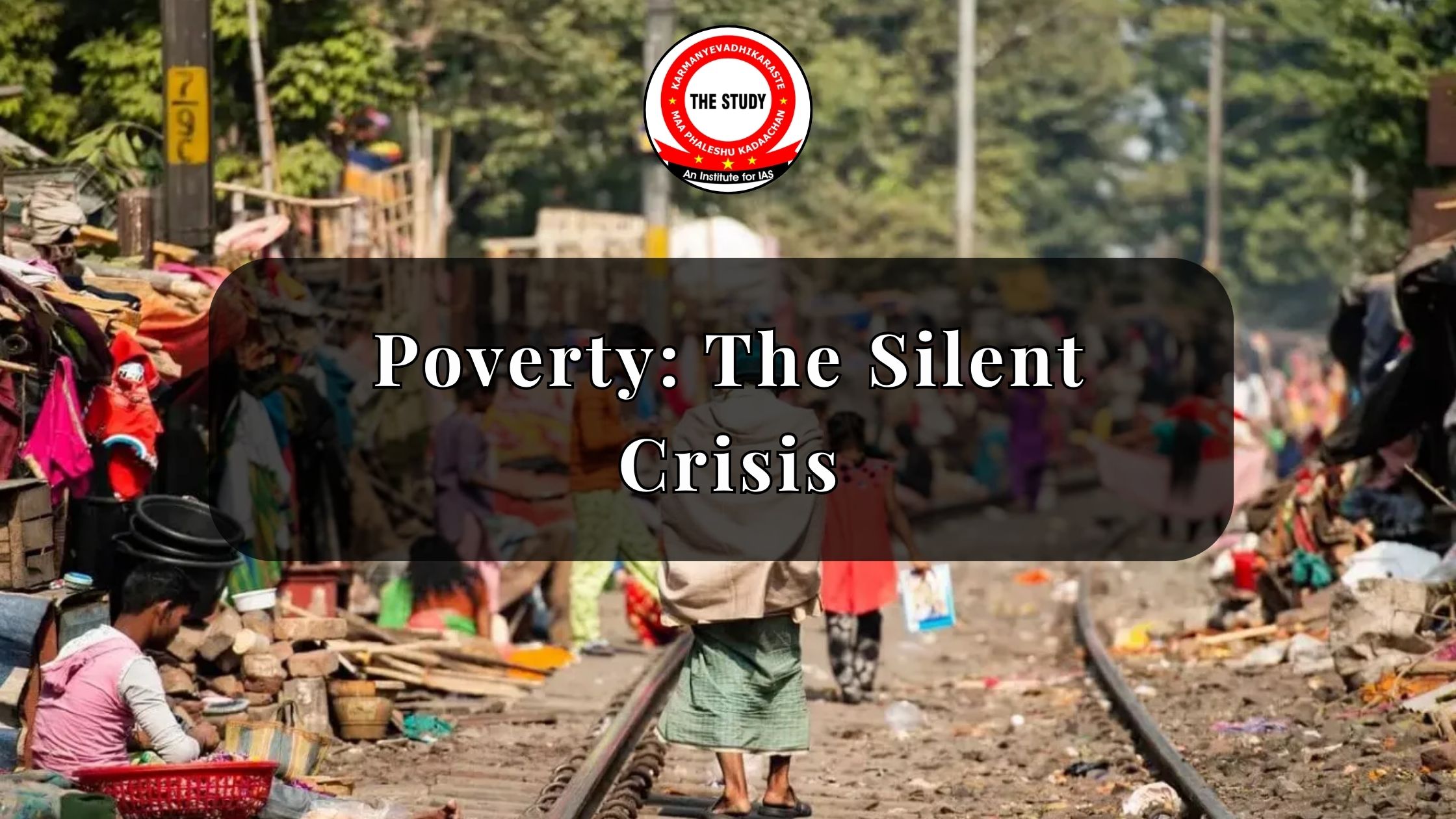
Poverty: The Silent Crisis
Poverty is not just the lack of money; it is not having the capability to realise one’s full potential as a human being.
~ Amartya Sen
What Is Poverty?
Poverty, at its most fundamental, is "pronounced deprivation in well-being."It describes a condition where individuals or groups lack sufficient income or essential resources to maintain basic living standards, adequate housing, clean water, nutritious food, and access to healthcare. It is not merely an absence of money; it is an absence of dignity, opportunity, and choice.
Economists and policymakers typically measure poverty through two lenses. Absolute poverty compares a person's income against the minimum amount needed to fulfil basic needs such as food, clothing, and shelter. Relative poverty, on the other hand, measures whether an individual can meet a minimum standard of living compared to others in their society. The definition of relative poverty, therefore, shifts from country to country and community to community.
But how exactly do we define and measure poverty, and who gets to draw that line? In India, this has been a question debated, revised, and refined for over a century, reflecting the country's evolving understanding of what it truly means to be poor. From a colonial-era estimate rooted in bare survival to modern multidimensional frameworks, the journey of India's poverty line tells a story of growing ambition and deepening compassion in addressing deprivation.
Evolution of Poverty Line in India
- 1901 – Dadabhai Naoroji estimated the poverty line based on the minimum “jail cost of living”, focusing on bare subsistence needs.
- 1938 – The National Planning Committee suggested a poverty line of ₹15–₹20 per month per person.
- 1944 – The Bombay Plan proposed a minimum income of ₹75 per capita per year.
- 1962 – The Planning Commission of India introduced separate poverty lines for rural and urban areas.
- 1971 – V. M. Dandekar and N. Rath defined poverty based on a minimum intake of 2,250 calories per day.
- 1979 – The Alagh Committee refined the poverty line by linking nutrition norms with inflation adjustments.
- 1993 – The Lakdawala Committee recommended state-specific poverty lines based on the Consumer Price Index (CPI).
- 2009 – The Tendulkar Committee moved beyond calorie norms and included broader consumption patterns.
- 2014 – The Rangarajan Committee further expanded the framework by including health, education, and sanitation expenses.
Why Is Poverty a Concerning Matter?
Poverty is not merely a lack of income; it is a multidimensional condition that undermines human well-being, dignity, and societal progress. Its consequences ripple across every aspect of human life, from the health of a newborn child to the stability of entire nations. To truly understand why poverty demands urgent attention, one must look beyond the numbers and into the lives it shapes.
At its most fundamental level, poverty is a violation of human rights and dignity. It represents a denial of basic choices and opportunities, stripping individuals of their ability to participate meaningfully in social, economic, and political life. When a person cannot afford food, shelter, or education, they are not simply poor, they are excluded from the very fabric of society, rendered invisible in the decisions that shape their own future.
This exclusion has devastating consequences for health and survival. Hunger and malnutrition, affecting over a billion people worldwide, are among the leading causes of child mortality. Limited access to clean water, sanitation, and healthcare further shortens life expectancy and leaves entire communities vulnerable to diseases that are entirely preventable. For the poor, falling ill is not just a health crisis, it is often a financial one too, pushing families even deeper into destitution.
What makes poverty particularly alarming is that it does not end with one generation. Children growing up in poor households face malnutrition, inadequate education, and severely limited opportunities.These early disadvantages constrain their future earning potential, making it extraordinarily difficult to break free from the circumstances of their birth. Poverty, in this sense, is not just inherited, it is systematically reproduced, generation after generation. The burden of this cycle falls most heavily on those who are already marginalised. Poverty disproportionately affects women, children, and minority communities, deepening existing inequalities and silencing the very voices that most need to be heard. It excludes individuals from decision-making processes, reducing their social status and stripping them of agency over their own lives. Far from being a level playing field, society becomes increasingly tilted against those at the bottom.
Beyond the individual, poverty takes a profound psychological toll. The persistent stress of financial insecurity leads to anxiety, depression, and a creeping sense of hopelessness. In children, this chronic stress actively impairs cognitive development, affecting their ability to learn and limiting their long-term productivity. A child who grows up in poverty does not just lack material resources, they are often robbed of the mental and emotional foundations needed to thrive. At a broader level, widespread poverty is a threat to economic and social stability itself.It reduces productivity, depletes human capital, and stunts economic growth. In fragile regions, it fuels higher crime rates, social unrest, and political instability, creating a dangerous cycle where poverty breeds conflict and conflict deepens poverty.
Finally, those living in poverty are the least equipped to face the growing threats of climate change and natural disasters. With limited resources and virtually no financial cushion, they are the first to lose their livelihoods when floods, droughts, or disasters strike, and the last to recover. In a world of accelerating environmental crises, poverty is not just a social problem; it is a matter of survival.
Taken together, these dimensions reveal a sobering truth: poverty is not a single problem with a single solution. It is a web of interconnected deprivations that feeds on itself, quietly undermining the potential of individuals, communities, and nations alike. Addressing it is not an act of charity, it is an urgent moral and economic imperative.
What Measures Have Been Taken to Address Poverty?
India has adopted a multifaceted approach to eliminating poverty and hunger, recognising that no single intervention can address the complexity of deprivation. The country's strategy has evolved logically over decades from generating employment, to providing basic amenities, to building financial systems, and finally to empowering communities at the grassroots level.
The earliest and most fundamental recognition was that poverty is rooted in the lack of stable income. Without a steady wage, families cannot afford food, healthcare, or education, and the cycle of deprivation deepens with every passing generation. This understanding gave birth to the Mahatma Gandhi National Rural Employment Guarantee Act (MGNREGA), which guarantees at least 100 days of wage employment per year to every rural household. In Maharashtra, the poverty headcount ratio fell dramatically from 47.9% in 2004-05 to 17.4% in 2011-12, in significant part due to this intervention. However, employment alone was not sufficient poverty is not merely about income but also about access to the basic conditions that allow human beings to live with dignity.
This realisation led to the second major strand of India's approach investing in basic amenities such as education, healthcare, and sanitation. Kerala stands as the most celebrated example, achieving a literacy rate of over 96% and an HDI value of 0.782, well above the national average of 0.645. Programmes like Kudumbashree empowered women through microfinance and skill development, creating a community-led safety net. Kerala's journey reached its most remarkable milestone in November 2025, when the state announced the complete elimination of extreme poverty through the Extreme Poverty Eradication Programme (EPEP), demonstrating that deprivation can be defeated even with modest economic growth, provided social priorities are bold and community participation is genuine.
Yet even as employment and basic amenities addressed the immediate symptoms of poverty, a deeper structural barrier remained the exclusion of the poor from formal financial systems. Recognising this gap, India launched the Pradhan Mantri Jan Dhan Yojana (PMJDY) in 2014, opening over 500 million zero-balance bank accounts for the previously unbanked poor. This enabled direct benefit transfers and subsidies to reach intended beneficiaries without leakage, making PMJDY the financial backbone upon which several other welfare schemes could effectively operate.
Building on this foundation, India recognised that access to community-level credit particularly for women could be a powerful engine of economic independence. Institutions like NABARD and the Grameen Bank enabled millions to access small loans for entrepreneurial ventures. This was further institutionalised through the Deendayal Antyodaya Yojana - National Rural Livelihoods Mission (DAY-NRLM), organising over 90 million rural poor women into Self-Help Groups, making it one of the largest women-led poverty alleviation initiatives in the world.
However, credit and employment could only go so far if people lacked marketable skills. The Pradhan Mantri Kaushal Vikas Yojana (PMKVY) addressed this by providing free, industry-relevant vocational training to youth, particularly school dropouts and the unemployed, demonstrating that investing in human capital is among the most sustainable long-term strategies for breaking the cycle of poverty.
As economic foundations strengthened, India also turned its attention to shelter and health, two dimensions of poverty that income alone cannot resolve. The Pradhan Mantri Awas Yojana (PMAY), launched in 2015, constructed millions of pucca houses for below-poverty-line families, restoring dignity alongside stability. Complementing this, Ayushman Bharat (PM-JAY), launched in 2018, provided health insurance coverage of up to ₹5 lakh per family per year to over 500 million vulnerable citizens, ensuring that a medical emergency would no longer permanently trap families in poverty.
Finally, cutting across all these interventions was the need for technology to ensure benefits reached the right people efficiently. Platforms like eNAM (National Agriculture Market) connected farmers directly with buyers, reducing middleman exploitation, while the Aadhaar identity programme streamlined welfare delivery across all schemes, reducing exclusion errors and ensuring aid reached those who needed it most. Together, technology and robust policy delivery systems became the connective tissue holding India's entire poverty alleviation architecture together.
The World's Greatest Poverty Miracle-China
Over four decades, China lifted more than 800 million people out of extreme poverty, accounting for roughly 75% of global poverty reduction between 1981 and 2020. What made it extraordinary was its precision: for the first time in history, every poor household had its causes of poverty and specific needs registered with the government, enabling truly targeted interventions. Rather than blanket solutions, assistance was tailored to each family's unique circumstances. China recognised that poverty alleviation goes beyond raising incomes; investments in infrastructure, healthcare, and social services were equally critical. The result? In 2021, China declared complete victory against absolute poverty, achieving the UN's 2030 goal a full decade ahead of schedule.
Conclusion
Poverty is not inevitable. It is the product of specific historical, structural, and policy choices and it can be undone through deliberate, sustained action. The Kerala model shows that even a state with modest industrial development can eliminate extreme poverty when it prioritises human dignity, community participation, and consistent investment in health and education. As Mahatma Gandhi observed, "Poverty is the worst form of violence." Eliminating it is not just an economic imperative it is a moral one.
Subscribe to our Youtube Channel for more Valuable Content – TheStudyias
Download the App to Subscribe to our Courses – Thestudyias
The Source’s Authority and Ownership of the Article is Claimed By THE STUDY IAS BY MANIKANT SINGH
Comments (0)
Leave a Comment