The Silent Crisis: Why Are Indian Women Farming the Land But Not Owning It?
24 Aug 2026
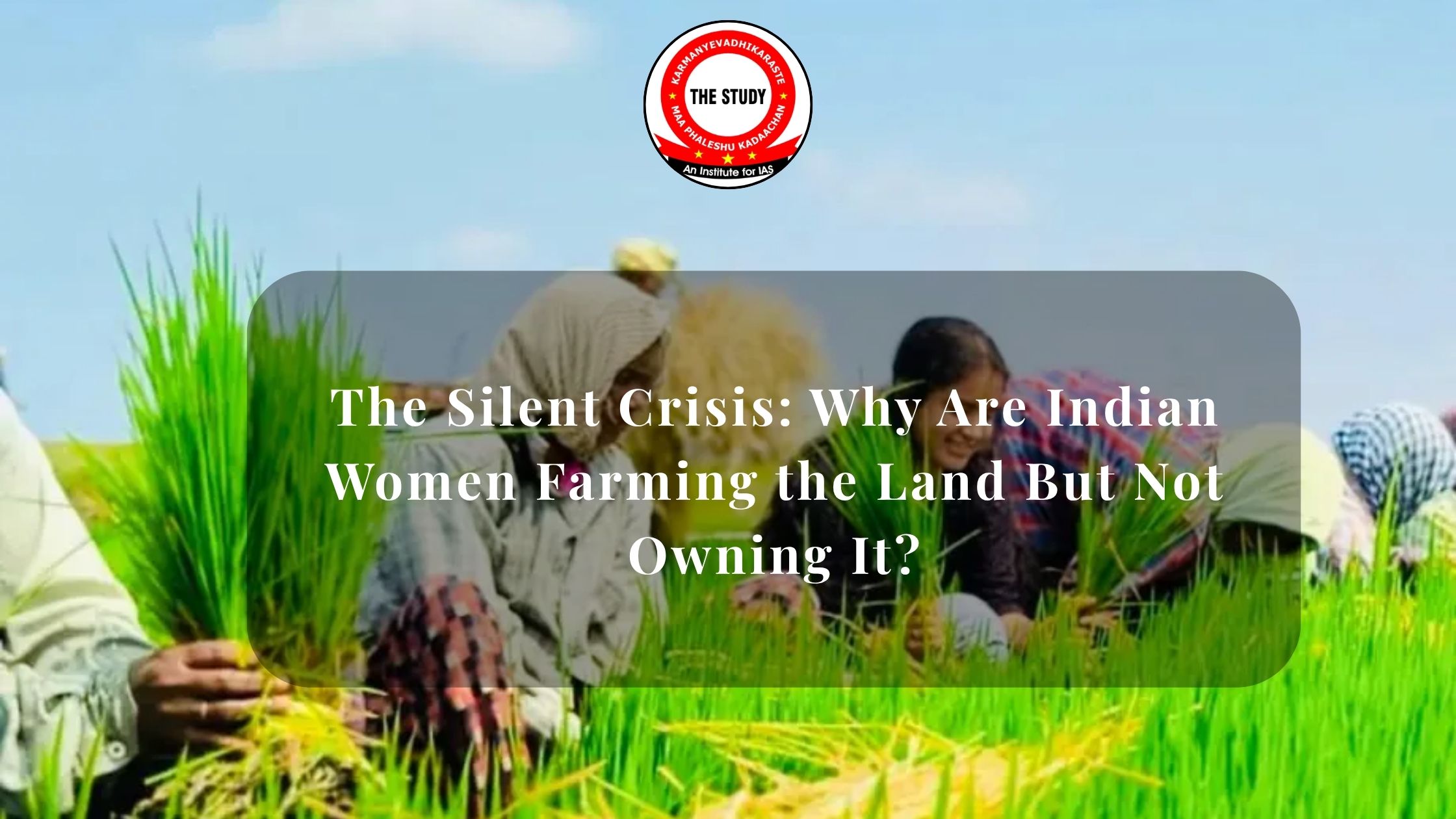
The Silent Crisis: Why Are Indian Women Farming the Land But Not Owning It?
Introduction
A woman sowing seeds, transplanting paddy, feeding cattle, harvesting crops or managing post-harvest work is a familiar picture of rural India. Yet when the same household is asked “Whose land is this?”, the answer is far more likely to point to a man.
This is the paradox at the heart of India's agricultural economy: women contribute substantially to farming, but their legal, recorded and effective control over agricultural land remains much weaker than their labour contribution.
According to an ICAR publication using Census 2011 data, women accounted for 55% of female agricultural workers as agricultural labourers and 24% as cultivators, while women owned only about 12.8% of operational holdings.
The problem is therefore not simply “women do not own land”. It is a deeper gap between work, ownership, control and economic power.
This matters for UPSC because the issue connects agriculture, gender justice, land reforms, inheritance law, rural development, poverty, financial inclusion, constitutional rights and women's empowerment.
The most important lesson for an aspirant is this: a woman can be an agricultural worker without being recognised as a farmer in the same economic and legal sense as a male landholder.
Why Does the Gender Gap in Agricultural Land Ownership Persist Despite Legal Reform?
1. Why Are Indian Women Doing Agricultural Work Without Owning the Land?
Women participate across almost the entire agricultural value chain—from sowing and transplanting to weeding, harvesting, livestock management, processing and post-harvest activities. Yet ownership is concentrated disproportionately in male names.
This distinction is critical:
Agricultural work ≠ land ownership ≠ land control ≠ decision-making power.
A woman may cultivate family land but lack a title. She may possess an informal right to use land but be unable to mortgage it. She may inherit a share legally but surrender it to brothers because of social pressure.
Recent research using digital land records from 12 States and Union Territories found persistent gender bias even among women who appear as landowners: women often hold smaller shares, smaller parcels and fewer single-title holdings, with implementation gaps and social customs limiting the impact of legal reforms.
This explains why simply asking “Do women have a legal right to land?” is insufficient.
The better question is:
Do women actually possess, control and benefit from that right?
2. What Has the Hindu Succession Act 2005 Changed for Women Farmers?
The Hindu Succession (Amendment) Act, 2005 was a major step towards correcting historical discrimination.
It amended Section 6 of the Hindu Succession Act and made daughters coparceners by birth, placing them on the same footing as sons in Mitakshara coparcenary property. The amendment also gave daughters equal rights and liabilities in coparcenary property.
This is extremely important for agricultural land because historically the interaction between personal succession law and State-level agricultural land laws created significant inequalities.
The 2005 amendment also removed Section 4(2), which had allowed certain State-level laws concerning agricultural land to operate outside the Hindu Succession Act framework.
However, legal equality does not automatically produce social equality.
A daughter may have a legal share but still face pressure to “leave the land for her brother”. Families may avoid formal partition. Revenue records may not be updated. Women may lack awareness or resources to pursue their claims.
This is the classic UPSC distinction between de jure rights and de facto rights.
3. Why Has Law Not Completely Eliminated the Land Ownership Gap?
There are at least four layers to the problem.
First, patriarchy: Land is often viewed as a family asset that should remain within the male lineage.
Second, marriage and residence: A daughter who marries may be socially expected to relinquish her parental property even when the law gives her a claim.
Third, administrative barriers: Legal entitlement must eventually be reflected through mutation, land records, partition and possession.
Fourth, economic vulnerability: A woman may avoid litigation because challenging family members can threaten social relationships and household security.
Research from NCAER similarly highlights the continuing gap between women's legal inheritance rights and actual agricultural land ownership.
This is why legal reform must be accompanied by legal literacy, accessible administration and social acceptance.
4. How Does Lack of Land Ownership Affect Women's Economic Empowerment?
Land is not merely a productive asset. It can provide income, collateral, bargaining power, food security and social status.
When women lack ownership, several disadvantages can follow:
- Limited access to institutional agricultural credit
- Weaker bargaining power within households
- Difficulty accessing land-based government benefits
- Reduced ability to make independent production decisions
- Greater vulnerability after widowhood, divorce or household breakdown
- Lower capacity to invest in agriculture independently
Research from Odisha has found that female ownership of land is associated with greater participation in agricultural decision-making, while joint ownership can also improve women's decision-making power.
Thus, land ownership is not simply a property issue. It is a power issue.
For a Mains answer, this creates a strong analytical chain:
Land ownership → economic security → bargaining power → decision-making → empowerment.
5. Why Is Joint Land Titling an Important Policy Solution?
One practical solution is joint titling, where land or housing assets are registered in the names of both spouses.
The logic is straightforward: if women contribute to household agriculture but rarely receive independent titles, joint ownership can improve their formal recognition without necessarily fragmenting the family asset.
It can also improve access to institutional support and strengthen women's claim to the asset.
But joint titling should not become another box-ticking exercise.
A woman's name on a document is valuable only when she has effective control, knowledge of her rights and the ability to exercise them.
Therefore, a better policy package is:
Joint titling + updated digital records + legal literacy + accessible grievance redressal + credit access + women's collectives.
World Bank-supported work on strengthening women's land rights in West Bengal has similarly highlighted legal land literacy and joint titling as practical interventions.
6. Can Women Farmers Become More Powerful Through SHGs, FPOs and Digital Land Records?
Yes—but institutional support must complement ownership rights.
Self-Help Groups (SHGs) can improve collective bargaining, financial inclusion and awareness.
Farmer Producer Organisations (FPOs) can give small producers greater bargaining power in input procurement, marketing and value addition.
Digital land records can reduce ambiguity over ownership and make records easier to access, although digitisation alone does not eliminate discriminatory social practices.
The important distinction is:
Digitising an unequal record does not automatically create an equal land system.
Therefore, land-record modernisation must include gender-disaggregated monitoring, transparent mutation processes and mechanisms through which women can challenge incorrect records.
7. Why Is This Issue Important for UPPSC and Other Competitive Exams?
The topic has direct relevance for UPSC GS-I, GS-II, GS-III, Essay and Ethics, as well as UPPSC PCS and other State-level examinations.
For UPPSC especially, candidates should connect women's agricultural land rights with:
- Rural poverty
- Agriculture and land reforms
- Women's empowerment
- SHGs
- Panchayati Raj Institutions
- Financial inclusion
- Uttar Pradesh's rural economy
- Revenue administration
- Social justice
For a Mains answer, avoid writing only:
“Women should be given land rights.”
Instead, establish the structural problem and provide implementable solutions:
Equal inheritance → mutation in women's names → joint titling → legal literacy → institutional credit → collective farming/marketing → grievance redressal.
That demonstrates governance thinking rather than generic gender commentary.
8. What Are the Quick Facts for UPPSC Prelims, Previous Year Exam-Oriented Points and FAQ?
Quick Facts for UPPSC Prelims
- Hindu Succession Act: 1956
- Hindu Succession (Amendment) Act: 2005
- Daughters became coparceners by birth under the amended Section 6.
- Section 4(2) of the Hindu Succession Act was omitted through the 2005 amendment.
- Women's land ownership remains substantially below their participation in agricultural work.
- Land is a State subject under the Seventh Schedule, while succession and related legal questions involve the Concurrent List framework.
- Joint titling is an important tool for strengthening women's tenure security.
- Land rights influence women's economic and household decision-making power.
Previous Year Exam-Oriented Points
For UPSC/UPPSC preparation, focus on these recurring analytical themes:
- Feminisation of agriculture.
- Women's land ownership and empowerment.
- Hindu Succession Amendment Act, 2005.
- Land reforms and gender justice.
- SHGs and women's economic empowerment.
- Financial inclusion of women farmers.
- Digital land records and governance.
- Joint ownership and inheritance.
- Customary practices versus statutory rights.
- Women's access to agricultural credit and government schemes.
Conclusion: Can India Call Its Agriculture Inclusive Without Giving Women Control Over Land?
India cannot achieve genuine rural transformation if millions of women remain workers without assets, cultivators without titles and producers without bargaining power.
The central problem is not simply that women lack land. It is that the contribution of women to agriculture and their ownership of agricultural assets remain disconnected.
The Hindu Succession Amendment Act, 2005 created a powerful legal foundation. Yet evidence shows that the journey from legal entitlement to actual ownership and control remains incomplete.
The next generation of reforms must therefore move beyond counting how many women have been given schemes or training.
It must ask a harder question:
Who owns the productive asset on which rural prosperity is built?
If women farm the land, participate in agricultural decisions and sustain rural households, then recognising their rights to land is not merely a welfare measure.
It is a question of economic efficiency, social justice and India's development strategy itself.
The real goal should not be women merely working on farms. It should be women having the assets, rights, voice and institutional power to shape the farms they sustain.
FAQ
Do women have equal inheritance rights in agricultural property?
The legal position has significantly improved, particularly after the 2005 Hindu Succession Amendment, but actual outcomes vary because land administration, State laws, social practices and implementation affect effective ownership.
Does being a farmer mean owning land?
No. A woman can cultivate land as a tenant, labourer, family worker or cultivator without holding formal ownership.
Why is land more important than simply providing employment?
Because land can provide a durable productive asset, economic security and bargaining power.
Is joint titling sufficient?
No. It should be combined with effective control, awareness, access to credit and functioning land-record and grievance systems.
Can this issue be used in an Essay?
Absolutely. It can support arguments on gender justice, inclusive growth, rural transformation, property rights and women's empowerment.
Subscribe to our Youtube Channel for more Valuable Content – TheStudyias
Download the App to Subscribe to our Courses – Thestudyias
The Source’s Authority and Ownership of the Article is Claimed By THE STUDY IAS BY MANIKANT SINGH
Comments (0)
Leave a Comment