Best World History Book for UPSC GS Paper 1: World History (Advance) by Manikant Singh
26 Nov 2026
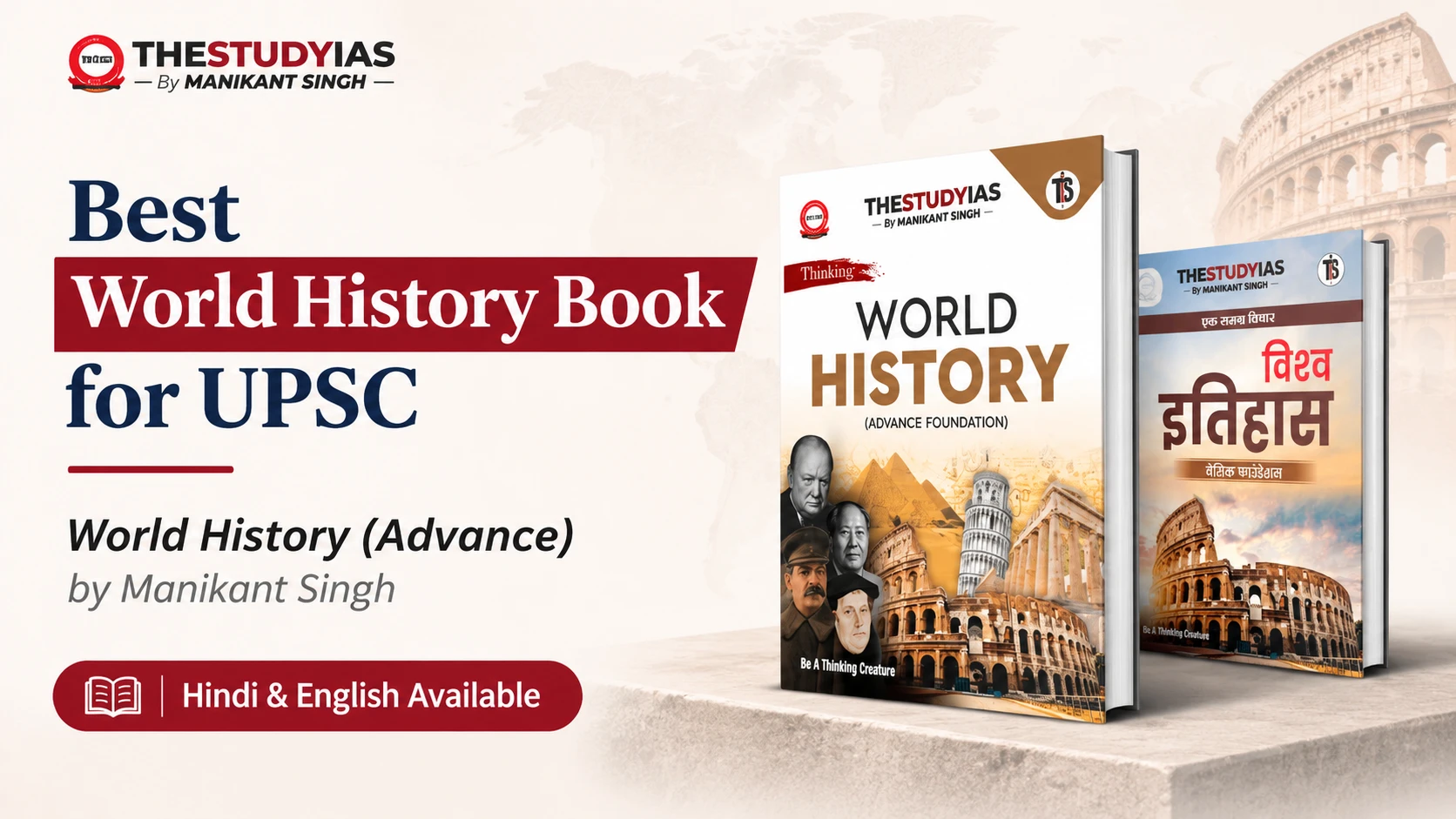
For most UPSC aspirants, World History is the quiet trap inside GS Paper 1. It looks small on paper, but the questions are rarely factual they ask you to analyse revolutions, ideologies, and the making of the modern world. The problem is not effort. It is the source. Aspirants juggle foreign textbooks written decades ago, thin NCERT summaries, and scattered PDFs, none of them built for the way UPSC actually questions this section.
World History (Advance) by Manikant Singh, published by The Study Publications, was written to close exactly that gap a single, exam-ready book that takes a beginner from the ancient world to the present and teaches them to write answers along the way.
Master World History for UPSC Mains GS Paper 1
Complete syllabus coverage, conceptual clarity, maps, illustrations and solved UPSC Mains PYQs all in one volume by Manikant Singh.
Available in Hindi & English Medium
Why World History Needs the Right Book, Not More Books
World History in the UPSC Mains GS Paper 1 syllabus covers events from the 18th century onwards the Industrial Revolution, world wars, the redrawal of national boundaries, colonisation and decolonisation, and political philosophies like communism, capitalism, and socialism, along with their forms and effects on society.
What Does UPSC Actually Demand?
The catch is that questions here are analytical, not descriptive. UPSC wants causes, consequences, and connections why the French Revolution mattered beyond France, or how the interwar crises of capitalism produced fascism. A candidate who has only memorised events will freeze in front of a "critically examine" or "substantiate" question.
Most recommended books were never designed for this. Popular references are often written for a general or foreign readership, stop well short of the contemporary period, and leave the aspirant to figure out the exam connection alone. What Indian aspirants — especially beginners — actually need is one book that explains the concept simply, links it to the syllabus, and shows how to convert it into marks.
World History (Advance): A One-Stop Solution for GS Paper 1
World History (Advance) is a 2024 first-edition title spanning 18 chapters, structured to mirror the GS Paper 1 syllabus from start to finish. What makes it different is not just coverage it is who wrote it and how.
About the Author: Manikant Singh
The book is personally written and compiled by Manikant Singh, a mentor with 33+ years of experience guiding UPSC aspirants, whom students across Hindi and English medium affectionately call the "God of History."
That teaching experience shows on every page: complex global events are narrated in plain, sequential language a first-time reader can follow, then anchored to what the exam demands.
What Makes It the Easiest World History Book for Beginners
Here is what sets World History (Advance) apart from a stack of reference books:
01. Simple Narrative Style
The book reads like a well-taught classroom lecture, not a dense academic text. Events unfold as a story of change over time, which makes retention far easier for aspirants starting from zero.
02. Written by a Single Expert Hand
Authored by one experienced mentor rather than stitched from multiple sources, the explanation, emphasis, and answer approach stay consistent throughout the way a good teacher builds one idea onto the next.
03. Maps and Illustrations
World History is impossible to grasp without geography. Shifting empires, war theatres, and redrawn boundaries are supported with maps and visuals, so aspirants see the change rather than only read about it.
04. Exhaustive, Yet Exam-Focused
It is comprehensive enough to be your only World History source for GS Paper 1, while staying tight enough to revise before the exam the balance most standalone books miss.
Complete Syllabus Coverage: From the Ancient World to the Present
The book is organised into a logical arc that follows how the modern world actually took shape:
01. Historical Foundations
A brief background of the Ancient and Medieval world, so beginners have context before the modern period begins.
02. The Age of Revolutions
The Enlightenment, the American Revolution, the French Revolution, and Europe after 1815 liberalism and nationalism.
03. Industry, Ideology and Empire
The Industrial Revolution, socialism and Marxism, colonialism and imperialism, and the First World War.
04. The Interwar Collapse
The Paris Peace Conference, the crises of capitalism, the Great Depression, and the rise of fascism and Nazism.
05. The Post-War and Contemporary World
Europe after the Second World War, the shape of the post-war order, the contemporary world, the post-Cold War order (1991–2008-09), and events from 2008-09 onwards.
Beyond Traditional World History Textbooks
That final stretch matters. Many popular World History books end at the mid-20th century, leaving aspirants exposed on decolonisation, the post-Cold War order, and recent global shifts. World History (Advance) carries the story into the contemporary period, covering important historical themes relevant to GS Paper 1.
Every UPSC Mains PYQ, Answered
The strongest feature of the book is that it does not stop at content. All relevant UPSC Mains previous year questions (PYQs) covered in the edition are answered within the book, complete with question analysis and model answers.
Learn How to Approach UPSC Mains Questions
- Question-Type Analysis: Understand whether the question is argumentative, hypothetical or analytical.
- Keyword Identification: Identify important keywords and understand the actual demand of the question.
- Analytical Understanding: Develop the ability to explain historical causes, consequences and connections.
- Answer Structuring: Learn how to present historical arguments in a structured manner.
- Model Answers: Understand how to translate historical knowledge into exam-oriented answers.
For each question, the book breaks down the type of question argumentative, hypothetical, analytical identifies the keywords to attack, and demonstrates a structured answer. This turns World History (Advance) into a self-contained answer-writing trainer, not just a reading text. An aspirant learns the event and how to write about it in the same sitting, which is precisely where most self-study preparation breaks down.
Build Concepts. Practise PYQs. Improve Answer Writing.
Explore World History (Advance Foundation) by Manikant Singh.
Who Should Use This Book?
World History (Advance) is built for:
Beginners
Aspirants who want to start World History from scratch without prior background.
GS Paper 1 Aspirants
Aspirants looking for a single, reliable source instead of five half-read references.
Self-Study Candidates
Candidates who need answer-writing guidance built into their reading.
Revision-Stage Aspirants
Aspirants who want maps, structure, and PYQs in one place before the exam.
Preparing for UPSC History Optional?
Because World History overlaps with the History Optional syllabus, aspirants preparing the optional will also find the narrative and PYQ approach valuable as a foundation.
How to Use It in Your Preparation
Read each chapter once for the storyline, then re-read while underlining the cause-and-effect logic UPSC rewards. After every chapter, attempt the PYQs before checking the model answer. Two focused revisions of this single book can help aspirants consolidate their preparation for the World History portion of GS Paper 1.
A Step-by-Step World History Preparation Strategy
Step 1 - Understand the Storyline
Read each chapter to understand the sequence of historical events and their background.
Step 2 - Develop Analytical Understanding
Focus on the causes, consequences and connections between historical developments.
Step 3 - Attempt Previous Year Questions
Attempt the relevant UPSC Mains PYQs independently before referring to the model answers.
Step 4 - Revise Maps and Important Themes
Revisit geographical changes, political ideologies, revolutions and major historical turning points.
Step 5 - Consolidate and Revise
Complete focused revisions and practise writing structured answers within the examination time limit.
Frequently Asked Questions
Which is the best World History book for UPSC GS Paper 1?
World History (Advance) by Manikant Singh is a strong one-stop choice for GS Paper 1. It is written in a simple narrative style, covers the syllabus from the 18th century to the contemporary period, includes maps, and answers relevant Mains PYQs with model answers.
Is World History difficult to prepare for UPSC?
World History is analytical rather than fact-heavy, which makes it feel difficult with the wrong source. A single well-structured book that explains causes and consequences and trains answer writing — like World History (Advance) — makes the section more manageable.
Is this book suitable for beginners?
Yes. The book is written specifically for beginners in a simple, story-like narrative and starts from a brief background of the ancient and medieval world, so no prior history knowledge is needed to follow it.
Does the book cover previous year questions?
Yes. All relevant UPSC Mains PYQs covered in the edition are answered inside the book, with question-type analysis and model answers, making it an answer-writing guide as well as a study text.
Is World History (Advance) useful for History Optional aspirants?
While the book is designed for GS Paper 1, World History overlaps with the History Optional syllabus, so optional aspirants can use it to build a strong conceptual and answer-writing foundation in the subject.
Is the World History book available in Hindi and English?
Yes. World History (Advance Foundation) by Manikant Singh is available in both Hindi medium and English medium on the official The Study IAS online bookstore.
Start Your World History Preparation the Right Way
You do not need a shelf of half-finished reference books. World History (Advance) by Manikant Singh gives you comprehensive GS Paper 1 syllabus coverage, maps, and solved Mains PYQs - in one beginner-friendly volume from The Study Publications.
THE STUDY PUBLICATIONS
World History (Advance Foundation)
By Manikant Singh
Get your copy of World History (Advance) today and turn a tricky section into a scoring one.
Available on the official The Study IAS online bookstore.
Explore More UPSC Preparation Resources
Strengthen your UPSC preparation with books, study material and specialised courses by Manikant Singh at The Study IAS.
Explore Advance Foundation Books for UPSC → Explore Basic Foundation Books for UPSC → Explore History Optional Books for UPSC → History Optional Course by Manikant Singh → Explore All UPSC Courses at The Study IAS →
Comments (0)
Leave a Comment