Best Modern History Book for UPSC GS Paper 1: Modern History (Advance) by Manikant Singh
26 Nov 2026
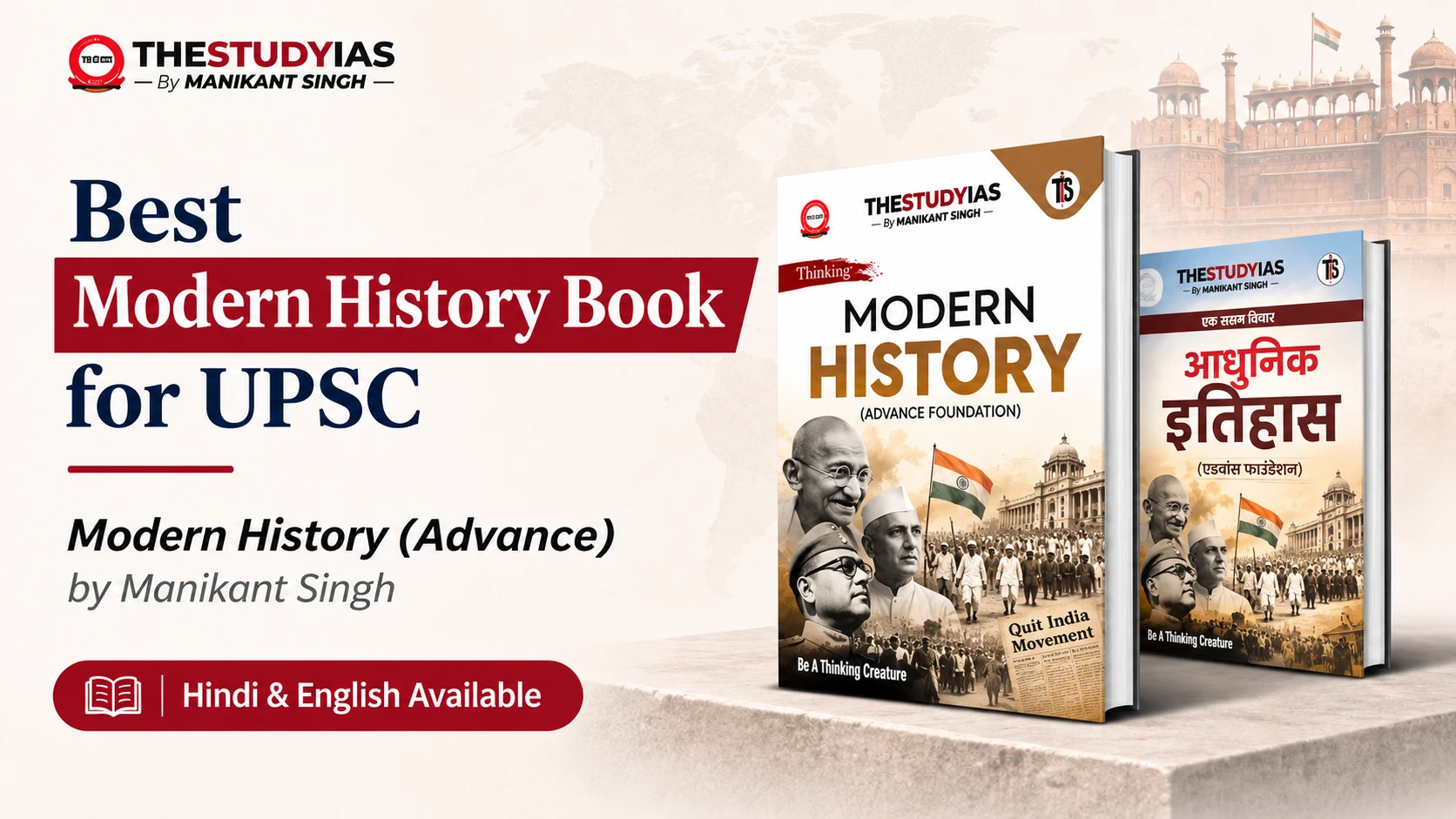
Modern Indian History is the single most rewarding part of the History syllabus, and the one where most aspirants read the most and retain the least. The reason is an old, familiar trap: one book gives you the facts but not the analysis, another gives you the analysis but runs to a thousand dense pages. So aspirants read two books, make two sets of notes, and still struggle to write a Mains answer that goes beyond "who did what, when."
Modern History (Advance) by Manikant Singh, published by The Study Publications, was written to close that gap. It delivers the analytical depth UPSC rewards in Mains, in a simple, revisable, beginner-friendly form that works for Prelims too. One book instead of two.
Master Modern Indian History for UPSC Prelims & Mains
Complete Modern Indian History syllabus coverage, analytical explanations, historian perspectives, maps, illustrations and solved UPSC Mains PYQs in one comprehensive book by Manikant Singh.
Hindi & English Medium Editions
Why Modern History Needs the Right Book, Not Two
Modern Indian History runs from roughly the mid-18th century to the post-independence period, covering the decline of the Mughals, the stages of colonial rule, the freedom struggle, and India after Independence. It is one of the most rewarding History areas in the examination.
UPSC Prelims GS Paper 1
Modern Indian History regularly contributes questions on British colonial rule, the freedom struggle, socio-religious reform movements, constitutional developments and important historical personalities.
UPSC Mains GS Paper 1
Modern History forms an important part of GS Paper 1, requiring aspirants to analyse colonial policies, nationalist movements, social transformations and post-independence consolidation.
UPSC Essay Paper & Personality Test
Understanding India's colonial experience, reform movements, nationalist thinking and post-independence development also provides valuable historical context for the Essay paper and the UPSC interview.
The problem is the standard approach. Aspirants are told to pair a concise, point-wise book for Prelims facts with a lengthy, analytical classic for Mains depth. The first is easy to revise but thin on the "why"; the second builds analytical muscle but is bulky and hard to revisit before the exam.
What Does UPSC Actually Demand?
The gap between factual knowledge and analytical understanding is exactly where aspirants can lose marks. Mains questions on Modern History often require more than remembering historical events.
- Evaluate the drain of wealth under British colonial rule.
- Weigh the causes and consequences of the Revolt of 1857.
- Assess the significance of socio-religious reform movements.
- Examine the evolution of Indian nationalism and the freedom struggle.
Facts alone will not carry these answers. Aspirants need conceptual clarity, historical perspectives and cause-and-effect reasoning.
Modern History (Advance): A One-Stop Solution for Prelims and Mains
This 2024 first-edition title is the modern instalment in The Study Publications' structured History series, following the Ancient and Medieval volumes. It studies the period through four analytical sections, treating history as a chain of socio-economic change rather than a list of dates.
Four Dimensions of Modern Indian History
Understand India's transformation from the 18th century to the post-independence period through four interconnected sections.
What sets its tone is a genuinely analytical frame. The book opens by examining how historians have periodised India's past, moves through the mercantile, industrial, and financial phases of colonialism, and presents competing historians' explanations for events like the decline of the Mughal Empire.
Understand History Through Multiple Historian Perspectives
The book introduces aspirants to different historical interpretations, including the perspectives of:
This historiographical depth helps aspirants understand competing explanations and build more balanced analytical arguments in UPSC Mains answers.
This is the historiographical depth that Mains answers need, delivered in plain, sequential language, with facts deliberately rationed so understanding stays clear.
About the Author: Manikant Singh
The book is personally written and compiled by Manikant Singh, a mentor with 33+ years of experience guiding UPSC aspirants, known to students across Hindi and English medium as the "God of History."
His analytical teaching approach makes complex historical developments easier to understand, while maintaining consistency in explanation, conceptual clarity and answer-writing methodology throughout the book.
What Makes It the Best Modern History Book for Beginners
Here is what sets it apart from the usual two-book stack:
01. Analytical, Perspective-Driven Approach
Events are explained through causes, consequences, and competing historian viewpoints, including the drain theory, the phases of colonialism, and the debate over Mughal decline. This trains the analytical thinking UPSC Mains rewards.
02. Depth Without the Bulk
It brings classic-textbook analysis into a manageable 124-page volume you can actually revise before the exam, bridging the gap between a facts-only revision book and a thousand-page reference.
03. Facts Deliberately Rationed
Data is kept lean so concepts stay memorable. This directly addresses the overloaded, hard-to-retain feel of conventional Modern History preparation and reduces dependence on superficial rote learning.
04. Covers India after Independence
The book carries the story past 1947 into post-independence consolidation, covering an important part of the UPSC Mains GS Paper 1 syllabus that conventional Modern History preparation often under-serves.
05. Written by a Single Expert Hand
Authored by Manikant Singh, a mentor with 33+ years of experience, the explanation, emphasis and answer-writing approach stay consistent from the first page to the last.
06. Maps and Illustrations
Maps and illustrations support the geography of colonial expansion and the freedom movement, making historical developments, regional powers and territorial changes easier to understand and retain.
Modern History (Advance Foundation) at a Glance
124
Pages
4
Analytical Sections
33+
Years of Teaching Experience
2
Language Editions
Complete Modern Indian History Coverage: What's Inside
The book maps the GS Paper 1 Modern History syllabus across its four analytical sections:
01. The 18th Century
The decline of the Mughal Empire, the rise of regional powers such as the Marathas, Mysore, and the successor states, and the political revolution in Bengal.
- Decline of the Mughal Empire
- Different historical interpretations of Mughal decline
- Emergence of regional kingdoms
- The Marathas and Mysore
- Political developments in Bengal
02. Colonialism
The mercantile phase (1757 to 1813), the industrial phase (1813 to 1858), and the financial phase (1858 onwards), with the economic drain, land revenue systems, and the transformation of the Indian economy under British rule.
- Mercantile colonialism
- Industrial colonialism
- Financial colonialism
- Drain of wealth and economic exploitation
- British land revenue systems
- Transformation of the Indian economy
03. Nationalism
The growth of nationalism, the Great Revolt of 1857, the socio-religious reform movements of the 19th century, the rise of the Indian National Congress, and the mass movements of the freedom struggle.
- Growth of Indian nationalism
- The Revolt of 1857
- Socio-religious reform movements
- Rise of the Indian National Congress
- Nationalist politics and mass movements
- The Indian freedom struggle
04. India after Independence
Post-independence consolidation and the making of modern India, including the challenges of nation-building and India's development after achieving independence.
- Post-independence consolidation
- Nation-building
- Political and economic developments after Independence
- India's emergence in the international system
Because each phase is shown driving the next, an aspirant learns to connect a colonial economic policy to the resistance it provoked. This develops the connected, cause-and-effect reasoning needed to write stronger analytical answers in UPSC Mains.
Understand the Three Phases of British Colonialism
One of the most important analytical features of Modern History (Advance Foundation) is its explanation of the changing character of British colonial rule in India.
1757 to 1813
Mercantile Phase
Understand the expansion of commercial interests, political control and revenue extraction during the early phase of British rule.
1813 to 1858
Industrial Phase
Examine the relationship between British industrial development, colonial trade policies and the transformation of India's economy.
1858 Onwards
Financial Phase
Explore the role of British capital, investment and financial interests in shaping the later colonial economy.
Understanding these phases helps aspirants connect colonial economic policies with political developments, social changes and the growth of Indian nationalism.
Every Relevant UPSC PYQ, Answered
The book pairs explanation with practice. Relevant UPSC Mains previous year questions are answered within it, with question analysis and model answers, including questions from years such as 2017, 2019, 2020 and 2021.
UPSC Previous Year Questions Covered
Selected previous year questions with analytical explanations and model answers.
Learn How to Approach UPSC Mains Modern History Questions
- Understand the Question: Identify the central theme and actual demand of the question.
- Develop Conceptual Clarity: Understand historical causes, consequences and analytical connections rather than memorising isolated facts.
- Use Historian Perspectives: Examine different historical interpretations to develop balanced and evidence-based arguments.
- Structure Your Response: Organise historical arguments, relevant facts and examples into a coherent answer.
- Study Model Answers: Understand how historical knowledge can be converted into examination-oriented responses.
For each question, the book identifies the demand of the question and demonstrates how to structure the response, turning it into a built-in answer-writing guide rather than a text you read passively.
Build Concepts. Understand Colonialism. Master Answer Writing.
Prepare with Modern History (Advance Foundation) by Manikant Singh.
Who Should Use This Modern Indian History Book?
Modern History (Advance) is built for:
UPSC Prelims Aspirants
Aspirants who want reliable, exam-relevant Modern History coverage in a single revisable source without unnecessary factual overload.
UPSC Mains GS Paper 1 Aspirants
Candidates who need analytical depth for Mains without wading through a thousand-page classic or managing multiple overlapping reference books.
Beginners
Aspirants starting Modern Indian History from scratch, thanks to the simple narrative, conceptual explanations and rationed facts.
History Optional Aspirants
Candidates who want to build a clear conceptual and answer-writing foundation in Modern Indian History before moving to specialised optional reading.
Revision-Stage Candidates
Aspirants who want historical analysis, historian perspectives, maps, structured explanations and relevant UPSC PYQs together in one concise volume.
Looking for a Prelims-Specific Modern History Book?
Aspirants looking for additional objective examination-oriented preparation can also explore the dedicated Modern Indian History Preliminary Examination Advance Foundation Book by The Study IAS.
Explore Modern History Book for UPSC Prelims →Preparing for UPSC History Optional?
Modern Indian History forms an important part of the History Optional syllabus. Aspirants can use this Advance Foundation book to develop conceptual clarity before progressing to specialised History Optional books and courses by Manikant Singh.
How to Use It in Your UPSC Preparation
Read each section once for the argument, then re-read while marking the cause-and-effect links, particularly how a colonial phase produced a nationalist response. Attempt each PYQ before checking the model answer, and note the historian perspectives you can cite.
Two focused passes of this single book can help consolidate your Modern History preparation for Prelims and strengthen your approach to analytical questions in Mains.
A Step-by-Step Modern History Preparation Strategy
Step 1: Understand the Historical Narrative
Read each section to understand the major historical developments, the decline of the Mughals, the emergence of colonial rule and the growth of Indian nationalism.
Step 2: Focus on Causes and Consequences
Identify the cause-and-effect relationships between colonial economic policies, social transformations, political developments and nationalist responses.
Step 3: Note Important Historian Perspectives
Make concise notes on competing historical interpretations, important debates and analytical perspectives that can strengthen your UPSC Mains answers.
Step 4: Attempt Previous Year Questions
Attempt relevant UPSC Mains PYQs independently before referring to the model answers provided in the book.
Step 5: Revise and Consolidate
Revisit maps, historical phases, important concepts and historian perspectives. Supplement your revision with Prelims practice questions and timed Mains answer writing.
Frequently Asked Questions
Which is the best book for Modern Indian History for UPSC?
Modern History (Advance) by Manikant Singh is a strong one-stop choice for GS Paper 1. It combines analytical, historian-driven depth with a simple narrative and rationed facts, covers the syllabus from the 18th century to post-independence, and answers relevant Mains PYQs with model answers.
Is Modern History important for UPSC Prelims and Mains?
Yes. Modern Indian History is one of the most important History areas in the examination. It contributes to the History section of Prelims, forms an important part of Mains GS Paper 1, and supports preparation for the Essay paper and interview.
Can one book cover both Prelims and Mains for Modern History?
Modern History (Advance) is designed to provide Mains-level analysis in a form concise enough for Prelims revision. Aspirants can use it as their primary analytical source rather than juggling a facts-only book and a lengthy classic, while supplementing it with examination-specific PYQ practice.
Is this Modern Indian History book suitable for beginners?
Yes. It is written in a simple, narrative style with facts kept lean so concepts stay clear, making it easy to follow even for aspirants studying Modern History for the first time.
Does the book include UPSC previous year questions?
Yes. Relevant UPSC Mains PYQs are answered inside the book with question analysis and model answers, so aspirants learn the concept and its answer-writing approach together.
Does the book cover India after Independence?
Yes. Modern History (Advance Foundation) includes a dedicated section on India after Independence, covering post-independence consolidation and the making of modern India, an important component of the UPSC Mains GS Paper 1 syllabus.
Is Modern History (Advance Foundation) useful for History Optional aspirants?
Yes. History Optional aspirants can use this book to build a strong conceptual foundation in colonialism, nationalism, historical interpretations and post-independence developments before moving to detailed optional-level study material.
Is the Modern History book available in Hindi and English?
Yes. Modern History (Advance Foundation) by Manikant Singh has both Hindi medium and English medium editions listed on the official The Study IAS online bookstore. Visit the respective product pages to check current stock availability.
Start Your Modern History Preparation the Right Way
You do not need one book for facts and another for analysis. Modern History (Advance) by Manikant Singh gives you comprehensive GS Paper 1 Modern History syllabus coverage, from the 18th century to post-independence, with analytical depth, maps, and answered PYQs, in one simple, revisable volume from The Study Publications.
THE STUDY PUBLICATIONS
Modern Indian History
Advance Foundation
By Manikant Singh
Get your copy today and turn one of the most rewarding History sections into your strongest one.
Explore both language editions on the official The Study IAS online bookstore.
Explore More UPSC History Books & Preparation Resources
Build a strong foundation in History with the complete range of UPSC books, study material and specialised courses by Manikant Singh at The Study IAS.
Ancient Indian History & Culture (Advance Foundation) → Medieval Indian History & Culture (Advance Foundation) → World History (Advance Foundation) by Manikant Singh → Modern Indian History Book for UPSC Prelims → Ancient, Medieval & Modern Indian History Prelims Book Combo → Explore All Advance Foundation Books for UPSC → Modern India History Optional Book by Manikant Singh → Explore History Optional Books for UPSC → History Optional Course by Manikant Singh → Explore All UPSC Courses at The Study IAS →
Comments (0)
Leave a Comment