Best Medieval Indian History Book for UPSC: Medieval Indian History (Advance Foundation) by Manikant Singh
26 Nov 2026
Ask any aspirant which portion of History drains the most time for the least return, and Medieval India usually tops the list. The syllabus stretches across dynasties, sultans, and empires; the standard book is a dense 2007 text most people find dry and hard to remember; and then a second book is needed just for the art and culture that Mains actually rewards. The result is weeks of reading and shaky recall in the exam hall.
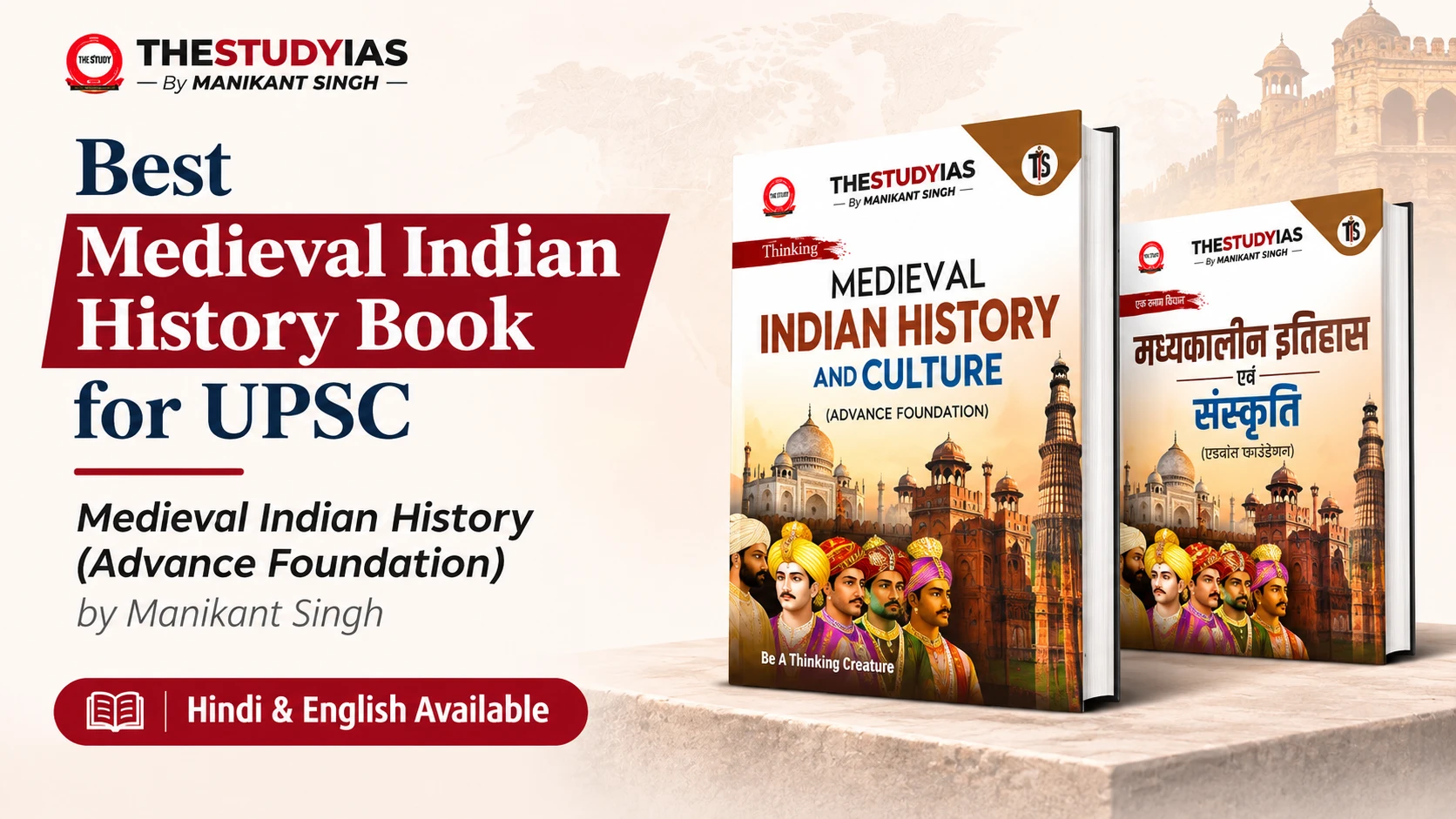
Medieval Indian History (Advance Foundation) by Manikant Singh, published by The Study Publications, was written to fix precisely this. It is a single, analytical, beginner-friendly book that folds Medieval history and its art and culture into one thematic narrative, built for how UPSC actually tests this period across Prelims and Mains.
Master Medieval Indian History for UPSC Prelims & Mains
Medieval History, Art & Culture, conceptual explanations, maps, illustrations and solved UPSC Mains PYQs in one comprehensive book by Manikant Singh.
Available in Hindi & English Medium
Why Medieval India Needs the Right Book, Not More Books
Medieval Indian History runs roughly from the 13th to the 18th century, covering the Delhi Sultanate, the Mughals, regional kingdoms, and the deep cultural churn of the Bhakti and Sufi age. It matters at two levels.
UPSC Prelims GS Paper 1
History is an important component of UPSC Prelims GS Paper 1. Ancient and Medieval Indian History regularly contribute questions on political developments, religious movements, administration, literature and cultural traditions.
UPSC Mains GS Paper 1
The medieval period enters Mains chiefly through Art and Culture, including architecture, music, literature, painting and syncretic traditions, where questions often demand analytical understanding rather than factual recall alone.
This dual demand is where most preparation goes wrong. Aspirants lean on a dense standard text that reads like a reference volume, memorise long lists of rulers, and study dynasties in isolation from the culture they produced. Then they run a separate art-and-culture book on top of it.
What Does UPSC Actually Demand?
UPSC preparation requires more than knowing who ruled and when. Aspirants must understand why a system emerged, how society and culture shifted, and what a movement signified. A fact-heavy, two-book approach can leave aspirants over-read and under-prepared.
Medieval Indian History (Advance Foundation): A One-Stop Solution
This 2024 first-edition title is the medieval instalment in The Study Publications' structured History series, picking up the narrative directly after the Ancient India book. Instead of marching chronologically through kings, it studies the entire period through five analytical rubrics, showing how each dimension shaped the others.
Five Dimensions of Medieval Indian History
A thematic approach to understanding historical changes and continuities.
That structure is deliberate. As the book itself puts it, analysing history through "changes and continuities" means you no longer depend on superficial rote learning. Facts and data are consciously rationed so that understanding, rather than memorisation, carries the weight.
It is, by design, one of the simplest books on Medieval Indian history and culture an aspirant will come across.
About the Author: Manikant Singh
The book is personally written and compiled by Manikant Singh, a mentor with 33+ years of experience guiding UPSC aspirants, known to students across Hindi and English medium as the "God of History."
His analytical teaching approach makes complex historical developments easier to understand, while maintaining consistency in explanation, conceptual clarity and answer-writing methodology throughout the book.
What Makes It the Simplest Medieval History Book for Beginners
Here is what sets it apart from the standard stack of medieval texts:
01. Analytical Changes and Continuities Approach
The period is explained as a connected story of transformation across politics, economy, society, and culture. This develops the analytical understanding that UPSC questions demand, rather than presenting a timeline to be memorised.
02. History and Art & Culture in One Book
The Cultural section is the largest in the book, covering architecture, music, literature, painting, and the Bhakti, Sufi and Ganga-Jamuni Tehzeeb traditions. Aspirants can study medieval history and its cultural developments from a single integrated source.
03. Facts Deliberately Rationed
Data is kept lean so concepts stay clear and memorable. This directly addresses the overloaded, hard-to-retain feel of conventional medieval texts and reduces dependence on rote learning.
04. Written by a Single Expert Hand
Authored by Manikant Singh, a mentor with 33+ years of experience, the explanation, emphasis and answer-writing approach stay consistent from the first page to the last.
05. Maps and Illustrations
Empires, invasions and trade routes are supported visually, which makes the geography of the medieval world far easier to understand and retain. Aspirants can connect geographical developments with political, economic and cultural changes.
Complete Medieval Indian History Coverage: What's Inside
The book maps the whole period through its five thematic chapters:
01. Medieval Political System: State, Empire & Dynasty
The emergence of Islam and Arab invasions, the establishment and consolidation of the Delhi Sultanate, its major dynasties, regional kingdoms, and the rise of the Mughals.
02. Administration during the Medieval Period
The machinery of the Sultanate and Mughal state, including governance, revenue administration, administrative institutions and military systems.
03. Economy during the Medieval Period
Agrarian structure, trade, urbanisation, and economic change across the medieval era.
04. Society during the Medieval Period
Social organisation, communities, and the shifts that reshaped medieval Indian life.
05. Culture during the Medieval Period
The book's largest and particularly exam-relevant section, covering architecture, painting, music, literature, and the Bhakti and Sufi movements that form an important part of UPSC Mains Art & Culture preparation.
Because these dimensions are shown influencing one another, an aspirant learns to link a political shift to its social and cultural consequences. This develops the connected thinking needed to write stronger analytical answers in UPSC Mains.
Medieval Indian Art & Culture for UPSC Mains GS Paper 1
One of the strongest features of Medieval Indian History (Advance Foundation) is its dedicated coverage of the cultural developments of the medieval period.
- Medieval Indian Architecture: Architectural developments during the Sultanate and Mughal periods.
- Indian Painting: Artistic traditions and developments during medieval India.
- Music: Evolution of musical and cultural traditions.
- Literature: Literary developments, languages and intellectual traditions.
- Bhakti and Sufi Movements: Religious, social and philosophical developments.
- Ganga-Jamuni Tehzeeb: Cultural interaction and the evolution of syncretic traditions.
By integrating these topics with political, administrative, economic and social history, the book helps aspirants prepare medieval Indian culture without unnecessarily duplicating their study material.
Every Relevant UPSC PYQ, Answered
The book does not stop at explanation. Relevant UPSC Mains previous year questions are answered within it, complete with model answers, including Art & Culture questions from years such as 2012, 2014, 2015, 2017, 2018, 2021 and 2022, with their word limits noted.
UPSC Previous Year Questions Covered
Selected previous year questions, model answers and prescribed word limits.
Learn How to Approach UPSC Mains Questions
- Understand the Question: Identify the central theme and actual demand of the question.
- Develop Conceptual Clarity: Understand historical changes and continuities instead of memorising isolated facts.
- Connect Multiple Dimensions: Link political, social, economic and cultural developments.
- Structure Your Response: Present relevant arguments and historical examples within the prescribed word limit.
- Study Model Answers: Understand how historical knowledge can be converted into examination-oriented responses.
For each question, the book demonstrates how to structure a response and where to place the analysis, turning the Cultural section in particular into a built-in answer-writing trainer. An aspirant reads the concept and immediately sees how UPSC has asked it, and how to write it, in the same place.
Understand Medieval India. Master Art & Culture. Practise PYQs.
Prepare with Medieval Indian History (Advance Foundation) by Manikant Singh.
Who Should Use This Medieval Indian History Book?
Medieval Indian History (Advance Foundation) is built for:
UPSC Prelims Aspirants
Aspirants who need reliable, exam-relevant medieval history coverage without wading through a dense reference text.
UPSC Mains GS Paper 1 Aspirants
Candidates who want medieval history and its art and culture in a single analytical source.
Beginners
Aspirants starting the period from scratch, thanks to the simple narrative, conceptual explanations and rationed facts.
History Optional Aspirants
Candidates who want to build a clear conceptual foundation in medieval Indian history before moving to specialised optional reading.
Revision-Stage Candidates
Aspirants who want maps, structured explanations, cultural developments and relevant UPSC PYQs together in one concise volume.
Preparing for UPSC History Optional?
Medieval Indian History forms an important part of the History Optional syllabus. Aspirants can use this Advance Foundation book to develop conceptual clarity before progressing to specialised History Optional books and courses by Manikant Singh.
How to Use It in Your UPSC Preparation
Read each thematic chapter once for the argument, then re-read while noting the cause-and-effect links between politics, economy, society, and culture. Give the Cultural section extra attention and attempt each PYQ before checking the model answer.
Two focused passes of this single book can help consolidate your preparation for the medieval period in Prelims and strengthen your understanding of Art & Culture questions in Mains.
A Step-by-Step Medieval History Preparation Strategy
Step 1: Understand the Historical Narrative
Read each thematic chapter to understand the major historical developments, political changes and the evolution of medieval Indian society.
Step 2: Focus on Changes and Continuities
Identify cause-and-effect relationships between political, administrative, economic, social and cultural developments.
Step 3: Prioritise Art & Culture
Give additional attention to architecture, literature, painting, music and the Bhakti and Sufi traditions for UPSC Mains GS Paper 1.
Step 4: Attempt Previous Year Questions
Attempt relevant UPSC Mains PYQs independently before referring to the model answers provided in the book.
Step 5: Revise and Consolidate
Revisit maps, important concepts, cultural developments and historical connections. Supplement your revision with Prelims practice questions and timed Mains answer writing.
Frequently Asked Questions
Which is the best book for Medieval Indian History for UPSC?
Medieval Indian History (Advance Foundation) by Manikant Singh is a strong one-stop choice. It covers the political, administrative, economic, social, and cultural dimensions of the period in a simple analytical style, integrates art and culture, and answers relevant Mains PYQs with model answers.
Is Medieval History important for UPSC Prelims and Mains?
Yes. Medieval India is an important part of the History section in Prelims, and it enters Mains GS Paper 1 mainly through Art and Culture, including architecture, music, literature, and the Bhakti and Sufi traditions. Aspirants should therefore include medieval history in their preparation for both stages.
Is this Medieval Indian History book suitable for beginners?
Yes. It is written in a simple, narrative style with facts deliberately kept lean so concepts stay clear, making it easy to follow even for aspirants studying the medieval period for the first time.
Does the book cover Medieval Indian Art and Culture?
Yes. The Cultural section is the largest chapter, covering medieval architecture, painting, music, literature, and the Bhakti and Sufi movements. These are important topics for UPSC Mains GS Paper 1. Its integrated coverage reduces the need for a separate art-and-culture book specifically for the medieval period.
Does the book include UPSC previous year questions?
Yes. Relevant UPSC Mains PYQs are answered inside the book with model answers, so aspirants learn the concept and its answer-writing approach together. Selected questions also include their prescribed word limits.
Is Medieval Indian History (Advance Foundation) useful for History Optional aspirants?
Yes. History Optional aspirants can use this book to build a strong conceptual foundation in medieval Indian history, administration, economy, society and culture before moving to detailed optional-level study material.
Is the Medieval Indian History book available in Hindi and English?
Yes. Medieval Indian History and Culture (Advance Foundation) by Manikant Singh is available in both Hindi medium and English medium on the official The Study IAS online bookstore.
Start Your Medieval History Preparation the Right Way
You do not need a dense reference text and a second culture book to master this period. Medieval Indian History (Advance Foundation) by Manikant Singh gives you medieval history, art and culture, maps, and answered PYQs in one simple, analytical volume from The Study Publications.
THE STUDY PUBLICATIONS
Medieval Indian History & Culture
Advance Foundation
By Manikant Singh
Get your copy today and turn Medieval India from a memory drain into a scoring section.
Available on the official The Study IAS online bookstore.
Explore More UPSC History Books & Preparation Resources
Build a strong foundation in History with the complete range of UPSC books, study material and specialised courses by Manikant Singh at The Study IAS.
Ancient Indian History & Culture (Advance Foundation) → World History (Advance Foundation) by Manikant Singh → Ancient, Medieval & Modern Indian History Book Combo → Explore All Advance Foundation Books for UPSC → Explore History Optional Books for UPSC → History Optional Course by Manikant Singh → Explore All UPSC Courses at The Study IAS →
Comments (0)
Leave a Comment