Vijayanagara Empire's Nayankara System: Origins, Working and Significance
14 Nov 2026
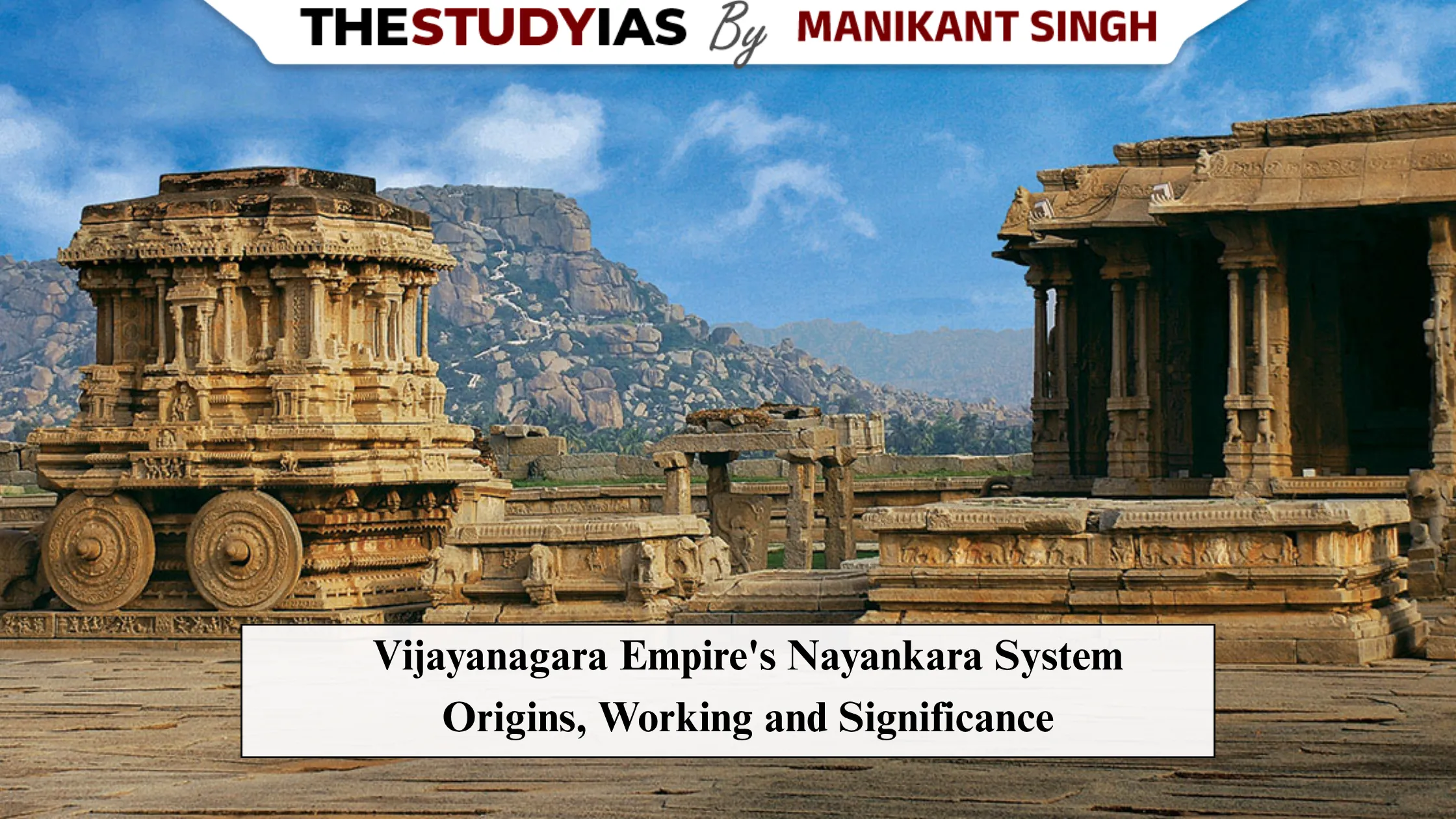
Vijayanagara Empire's Nayankara System: Origins, Working and Significance
The Nayankara System of the Vijayanagara Empire was an important part of its military and administrative organisation. Under this system, military chiefs known as nayakas or amaranayakas were given control over particular territories called amaram. In return, they were expected to collect revenue, maintain troops, manage their territories and support the Vijayanagara ruler during military campaigns.
The system became especially important as the Vijayanagara Empire expanded across large parts of southern India. It allowed the rulers to maintain military resources across distant territories without depending entirely on a centrally maintained army. At the same time, the growing power of the nayakas could become a challenge to the central authority when the political strength of the ruler declined.
For UPSC History Optional, the Nayankara System is important because it helps explain Vijayanagara Empire administration, military organisation, revenue collection and the relationship between the king and regional chiefs. It also forms part of the wider debate on the nature of the Vijayanagara state.
What Was the Nayankara System?
The Nayankara System was a system of territorial and military administration in which Vijayanagara rulers assigned territories to military chiefs called nayakas or amaranayakas. These chiefs exercised administrative and revenue rights in their assigned areas and were responsible for maintaining military forces.
The territory associated with a nayaka was known as an amaram. The assignment gave the nayaka access to the revenue of the territory, which helped him meet his military and administrative responsibilities. It was not simply a private grant of land.
The nayakas performed several functions. They collected taxes, maintained troops, helped maintain order and supported the ruler during military campaigns. They could also contribute to temples, irrigation works and other local activities.
Thus, the Nayankara System connected three important aspects of Vijayanagara rule: territorial administration, revenue collection and military service.
Origins of the Nayankara System
The exact origins of the Nayankara System remain a matter of historical debate. Some of its features had parallels in earlier political traditions of the Deccan and South India, where military chiefs exercised authority over territories and were expected to provide military support.
The system developed further under the Vijayanagara rulers as the empire expanded. A large empire required an organised military force and an effective method of governing territories located far from the capital. The assignment of territories to military chiefs helped address both requirements.
The system became particularly important during the reign of Krishnadeva Raya, when the Vijayanagara Empire reached a high point of political and military power. Nayakas controlled territories outside the central region and provided military support to the ruler when required.
The development of the system therefore needs to be understood in the context of Vijayanagara's territorial expansion and its need for a strong military organisation.
Who Were the Nayakas?
The nayakas were military chiefs who exercised authority over assigned territories. They played an important role in both the expansion and administration of the Vijayanagara Empire.
Many nayakas controlled forts and maintained armed followers. Their position gave them considerable influence within their territories. Some also encouraged cultivation and settlement in areas under their control.
The authority of the nayakas depended partly on their relationship with the Vijayanagara ruler. Strong rulers could supervise them more effectively, while powerful nayakas could become increasingly independent when central authority weakened.
The nayakas were therefore more than ordinary military officers. They acted as important links between the central government and the territories under their control.
Amaram and Amaranayaka
The term amaram is central to understanding the Nayankara System. It referred to a territory or revenue assignment associated with a nayaka.
An amaranayaka was a military chief who held such an assignment. The resources obtained from the territory helped the nayaka maintain troops and meet other administrative responsibilities.
The system connected territorial revenue with military service. The nayaka used the income generated from the assigned territory to support his military establishment and fulfil his obligations towards the Vijayanagara ruler.
This arrangement helped the state mobilise military resources across a large territory without having to maintain every military unit directly through the central treasury.
Working of the Nayankara System
The functioning of the Nayankara System can be understood through the responsibilities of the ruler and the nayaka.
1. Assignment of Territory: The Vijayanagara ruler assigned a particular territory to a nayaka. The territory provided the economic resources needed to meet his military and administrative responsibilities. The assignment gave the nayaka rights over revenue and administration, rather than simple private ownership of all land within the territory.
2. Collection of Revenue: Nayakas collected taxes and other dues from the territories under their control. Agriculture formed an important part of the revenue system, while taxes could also be collected from artisans, traders and other groups. Revenue provided the economic foundation for maintaining the local administration and military forces.
3. Maintenance of Troops: Maintaining troops was one of the most important responsibilities of a nayaka. Revenue from the assigned territory helped finance soldiers and military equipment. These forces could be called upon by the Vijayanagara ruler during military campaigns.
4. Obligations towards the King: Nayakas were expected to support the ruler through military service and financial contributions. Their relationship with the king also involved demonstrating loyalty and recognising the authority of the central monarchy. This helped maintain political links between the court and regional military chiefs.
5. Administrative Responsibilities: Nayakas exercised considerable authority within their assigned territories. They helped maintain order, managed military resources and took part in local administration. Their role therefore extended beyond military service and included important aspects of territorial governance.
6. Religious and Public Works: Nayakas could also support temples, irrigation facilities and other local works. Tanks, agricultural development and temple institutions were important parts of the economic and social life of many Vijayanagara territories. Such activities also helped the nayakas build relationships with local communities.
Main Features of the Nayankara System
The Nayankara System of Vijayanagara had several features that made it important to the functioning of the empire.
1. Military Character: The system had a strong military foundation. Nayakas received territorial assignments while carrying military responsibilities. Their troops increased the military strength available to the Vijayanagara rulers.
2. Territorial Assignments: Nayakas exercised authority over specific territories known as amaram. The revenue generated from these territories provided the resources required for military and administrative activities.
3. Revenue Rights: Nayakas had rights to collect revenue from their assigned territories. A part of this revenue supported their military and administrative responsibilities, while they were also expected to meet obligations towards the ruler.
4. Political Loyalty: The system depended on the relationship between the Vijayanagara king and the nayakas. The nayakas were expected to accept the authority of the ruler and provide support during military campaigns.
5. Administrative Role: Nayakas participated in the administration of their territories. They maintained order, managed resources and exercised authority over local affairs.
6. Transfer of Nayakas: Vijayanagara rulers could transfer nayakas from one territory to another. Such transfers helped the central authority prevent individual military chiefs from becoming too powerful in a particular region.
7. Growth of Local Power: The system also created powerful regional elites. When central authority weakened, some nayakas were able to use their military and economic resources to increase their independence.
Nayankara System under Krishnadeva Raya
The reign of Krishnadeva Raya was an important period in the development of the Vijayanagara Empire. During his rule, the empire expanded considerably and maintained a strong military establishment.
Nayakas played an important role in controlling territories outside the central areas of the empire. They maintained military contingents that could be used during imperial campaigns. This gave the ruler access to military resources across a large geographical area.
The system also helped the Vijayanagara state govern distant regions through local military chiefs. However, dependence on powerful nayakas created a potential political problem because these chiefs could accumulate considerable influence in their territories.
Accounts of Vijayanagara by foreign travellers such as Domingo Paes and Fernao Nuniz provide useful information about the empire's political and military organisation during the sixteenth century.
Relationship between Nayakas and the Vijayanagara King
The relationship between the king and the nayakas was based on both cooperation and control.
The ruler provided territorial assignments and recognised the authority of the nayakas over their assigned areas. In return, the nayakas were expected to maintain troops, provide financial contributions and support the ruler during military campaigns.
This relationship was not always stable. Powerful nayakas could resist royal authority or rebel against the ruler. The Vijayanagara kings therefore attempted to maintain control over them through supervision and, in some cases, transfers between territories.
The relationship reveals an important feature of Vijayanagara Empire administration. The state depended on regional military elites to govern a large territory, but the central ruler also had to prevent these elites from becoming independent centres of power.
Role of the Nayankara System in Military Organisation
Military organisation was one of the main purposes of the Nayankara System.
The Vijayanagara Empire faced military competition from several neighbouring powers. Maintaining a strong army was therefore essential for protecting and expanding the empire. Nayakas provided an important part of this military strength.
They maintained soldiers along with horses, elephants and other military resources. These forces could be mobilised when the ruler undertook military campaigns.
The system also reduced the need for the central government to directly finance every military unit. However, this arrangement made the military structure partly dependent on the loyalty and resources of regional chiefs.
Role in Revenue Administration
Revenue collection was another important function of the Nayankara System.
Nayakas collected taxes and other dues from the people living in their territories. Agricultural revenue formed an important part of the economic base, while artisans, traders and other groups could also contribute to the revenue system.
The system therefore connected agriculture, taxation, military service and territorial administration. A productive territory provided greater resources to the nayaka, while the state benefited from the military forces maintained from those resources.
The arrangement could also encourage the expansion of cultivation. Increasing agricultural production meant greater revenue, which strengthened the economic position of both the local authority and the wider political system.
Nayankara System and Local Administration
The Nayankara System helped the Vijayanagara rulers extend their authority into distant regions.
The empire covered a large geographical area, making direct administration from the capital difficult. Nayakas helped bridge this administrative gap by exercising authority over territories located away from the political centre.
They maintained order, collected revenue, managed military resources and supported local institutions. Their activities also influenced irrigation, settlement and temple institutions.
However, the Nayankara System was not the only form of local administration in Vijayanagara. Existing village institutions and other local structures continued to function. The system should therefore be viewed as one part of the broader administrative organisation of the empire.
Nayankara System and Temples
Temples played an important economic and social role in Vijayanagara society, and nayakas often supported them.
Nayakas could provide resources for temple maintenance and construction. Temples were not only places of worship but also important institutions that held land, employed people and participated in local economic activities.
Support for temples also helped nayakas establish their social and political legitimacy. Patronage could strengthen their relationship with local communities and religious institutions.
Nayakas also supported activities such as irrigation works, tank construction and the reclamation of wasteland. These activities contributed to agricultural development and strengthened the economic base of their territories.
Advantages of the Nayankara System
The Nayankara System offered several advantages to the Vijayanagara Empire.
1. Military strength: Nayakas maintained troops that could be mobilised during imperial campaigns.
2. Administration of distant territories: Regional military chiefs helped the rulers govern areas that were difficult to control directly from the capital.
3. Revenue mobilisation: Territorial revenue provided resources for military and administrative activities.
4. Territorial expansion: Nayakas helped establish and maintain Vijayanagara authority in newly conquered or developing regions.
5. Local development: Some nayakas supported temples, irrigation works, agricultural expansion and the reclamation of wasteland.
These advantages made the system particularly useful when the central monarchy was strong and capable of supervising regional chiefs.
Limitations of the Nayankara System
The strengths of the system also created certain limitations.
Nayakas controlled territory, revenue and military resources. This gave powerful chiefs considerable influence over their regions. Their position could become a challenge to the central government if royal authority weakened.
A strong Vijayanagara ruler could supervise the nayakas and transfer them when necessary. A weak ruler, however, faced greater difficulty in controlling powerful regional chiefs.
Over time, some nayakas gained greater independence and established their own political centres. This development became more visible during the later history of Vijayanagara.
Nayankara System and the Decline of Vijayanagara
The decline of the Vijayanagara Empire had several causes, and it would be incorrect to attribute it only to the Nayankara System. However, the growing power of regional nayakas became an important political development in the later period.
As central authority weakened, some nayakas increased their independence. Several important Nayaka states emerged in southern India, including Madurai, Thanjavur, Ikkeri and Mysore.
This development highlights the dual nature of the Nayankara System. Under a strong ruler, regional military chiefs could strengthen imperial administration and military power. Under weaker central authority, the same regional structure could encourage political fragmentation.
Was the Nayankara System Feudal?
The nature of the Nayankara System has been debated by historians. Some scholars have identified feudal characteristics because military chiefs received territorial rights and were expected to provide military service.
T. V. Mahalingam highlighted the feudal elements of the system and connected territorial assignments with military obligations and financial contributions.
However, the Nayankara System should not be treated as identical to European feudalism. The political and social conditions of South India were different from those of medieval Europe. The institutional features associated with European feudalism cannot simply be applied to Vijayanagara without considering these differences.
Burton Stein questioned a straightforward feudal interpretation and developed the idea of Vijayanagara as a segmentary state. Other historians have also challenged the idea that the Vijayanagara ruler exercised only symbolic or ritual authority.
For UPSC History Optional, the safest approach is to present the debate rather than giving a one-sided conclusion. The Nayankara System had certain feudal-like features, but it developed within the distinctive political conditions of medieval South India.
Nayankara System and Iqta System
The Nayankara System is often compared with the Iqta System of the Delhi Sultanate because both linked territorial or revenue rights with military responsibilities.
Under the Iqta System, officials received revenue rights over assigned territories in return for administrative and military duties. Similarly, the amaram system connected territorial resources with military service under Vijayanagara.
However, the two systems developed in different political environments and should not be treated as identical. The Iqta was an important institution of the Delhi Sultanate, while the Nayankara System formed part of Vijayanagara's distinctive political and military structure.
The comparison is useful for UPSC because it helps students identify similarities and differences between two important medieval Indian systems of territorial and military administration.
The comparison shows that both systems connected revenue resources with military service, but their institutional contexts were different.
Historians' Views on the Vijayanagara State
The Nayankara System is closely connected with the debate over the nature of the Vijayanagara state.
1. Feudal Interpretation: Some historians emphasised the relationship between territorial assignments and military obligations and therefore identified feudal elements in the system.
2. Military State Interpretation:K. A. Nilakanta Sastri emphasised the strong military character of Vijayanagara and its dependence on military organisation.
3. Segmentary State Interpretation:Burton Stein used the concept of the segmentary state to explain the relationship between the central ruler and regional authorities. He gave considerable importance to the ritual role of the king and the autonomy of local political units.
4. Criticism of the Segmentary Model: Later scholarship questioned whether the Vijayanagara ruler's authority was mainly ritual. Evidence from inscriptions, administration and regional political structures suggests that the central state exercised significant political and administrative authority in several areas.
This debate is important for UPSC History Optional because it allows candidates to analyse the Vijayanagara state instead of merely describing its administrative institutions.
Significance of the Nayankara System
The Nayankara System of Vijayanagara was significant because it connected military power with territorial administration and revenue collection.
It helped the rulers maintain troops, mobilise resources and govern distant territories. The system was particularly useful for an empire that covered a large geographical area and faced continuous military challenges.
At the same time, the system strengthened regional military elites. When the central monarchy was strong, these elites could support imperial power. When central authority weakened, some of them became increasingly autonomous.
The Nayankara System therefore had a dual impact. It contributed to the strength of the Vijayanagara Empire while also creating conditions for regional political fragmentation in its later history.
Prelims Facts to Remember
1. Nayaka: A military chief associated with the Vijayanagara political and administrative system.
2. Amaram: A territory or revenue assignment associated with a nayaka.
3. Amaranayaka: A military chief who held an amaram and was responsible for maintaining troops.
4. Nayankara System: A system that connected territorial administration, revenue collection and military service.
5. Krishnadeva Raya: One of the most powerful rulers of the Vijayanagara Empire, associated with the empire's political and military expansion.
6. Domingo Paes and Fernao Nuniz: Portuguese travellers whose accounts provide valuable information about Vijayanagara.
7. Iqta: A revenue assignment associated with the administrative and military structure of the Delhi Sultanate.
8. Nayaka States: Several regional Nayaka powers became prominent during the later period of Vijayanagara.
UPSC History Optional Relevance
The Nayankara System of Vijayanagara is relevant to questions on Vijayanagara administration, military organisation, revenue systems, regional elites and the nature of the Vijayanagara state.
For a Mains answer, a simple definition is not enough. The answer should explain how the system worked and then examine its wider political impact.
A well-structured answer can discuss four major aspects:
Military: Nayakas maintained troops and supported the ruler during military campaigns.
Revenue: They collected revenue from their assigned territories and used it to meet military and administrative obligations.
Administration: They helped the central government exercise authority over distant territories.
Political impact: Their power could strengthen the empire under strong rulers but encourage regional autonomy when central authority weakened.
This balanced approach is useful for questions asking whether the Nayankara System strengthened the Vijayanagara state or contributed to its political fragmentation.
Conclusion: Vijayanagara Empire's Nayankara System
The Nayankara System of the Vijayanagara Empire was an important institution that brought together military service, revenue collection and territorial administration. By assigning territories to military chiefs, the Vijayanagara rulers could mobilise military resources and extend their authority over a large region.
The system worked most effectively when the central ruler could supervise the nayakas and maintain their loyalty. However, the concentration of military and economic resources in the hands of regional chiefs also created a potential challenge to central authority.
The later emergence of independent Nayaka powers shows this dual character clearly. The Nayankara System was therefore not simply a military arrangement. It was an important part of Vijayanagara Empire administration and helps explain the relationship between central power, regional elites, military organisation and revenue administration in medieval South India.
FAQs: Vijayanagara Empire's Nayankara System
1. What was the Nayankara System of Vijayanagara?
The Nayankara System was a system under which Vijayanagara rulers assigned territories to military chiefs known as nayakas or amaranayakas. These chiefs collected revenue, maintained troops and performed administrative duties.
2. What was an Amaram?
An amaram was a territory or revenue assignment associated with a nayaka. The resources from the territory helped the nayaka meet military and administrative responsibilities.
3. Who were the Nayakas?
Nayakas were military chiefs who controlled assigned territories and performed military, administrative and revenue-related functions.
4. What was the main purpose of the Nayankara System?
The main purpose was to connect territorial revenue with military service and administration. It helped Vijayanagara rulers maintain troops and govern distant territories.
5. Was the Nayankara System a feudal system?
Historians have different views. The system had some features that can be compared with feudal arrangements, but it should not be treated as identical to European feudalism.
6. How did the Nayankara System help the Vijayanagara Empire?
It helped maintain military forces, collect revenue, administer distant territories and support the expansion of Vijayanagara authority.
7. How did the system contribute to political fragmentation?
Powerful nayakas controlled territory, revenue and military resources. When central authority weakened, some of them became increasingly autonomous and established independent political centres.
8. What is the difference between the Nayankara and Iqta systems?
Both linked territorial or revenue rights with military responsibilities. The Iqta System belonged to the Delhi Sultanate, while the Nayankara System developed under Vijayanagara.
9. Who were Domingo Paes and Fernao Nuniz?
They were Portuguese travellers who visited Vijayanagara and left accounts that provide information about the empire's political, social and military organisation.
10. Why is the Nayankara System important for UPSC?
It helps explain Vijayanagara administration, military organisation, revenue collection, regional power structures and the debate over the nature of the Vijayanagara state.
For more UPSC-oriented articles and preparation resources, explore The Study IAS.
Subscribe to our Youtube Channel for more Valuable Content –TheStudyias
Download the App to Subscribe to our Courses –Thestudyias
The Source’s Authority and Ownership of the Article is Claimed ByTHE STUDY IAS BY MANIKANT SINGH
Comments (0)
Leave a Comment