Mauryan vs Gupta Administration: A Comparative Analysis for UPSC History Optional
14 Nov 2026
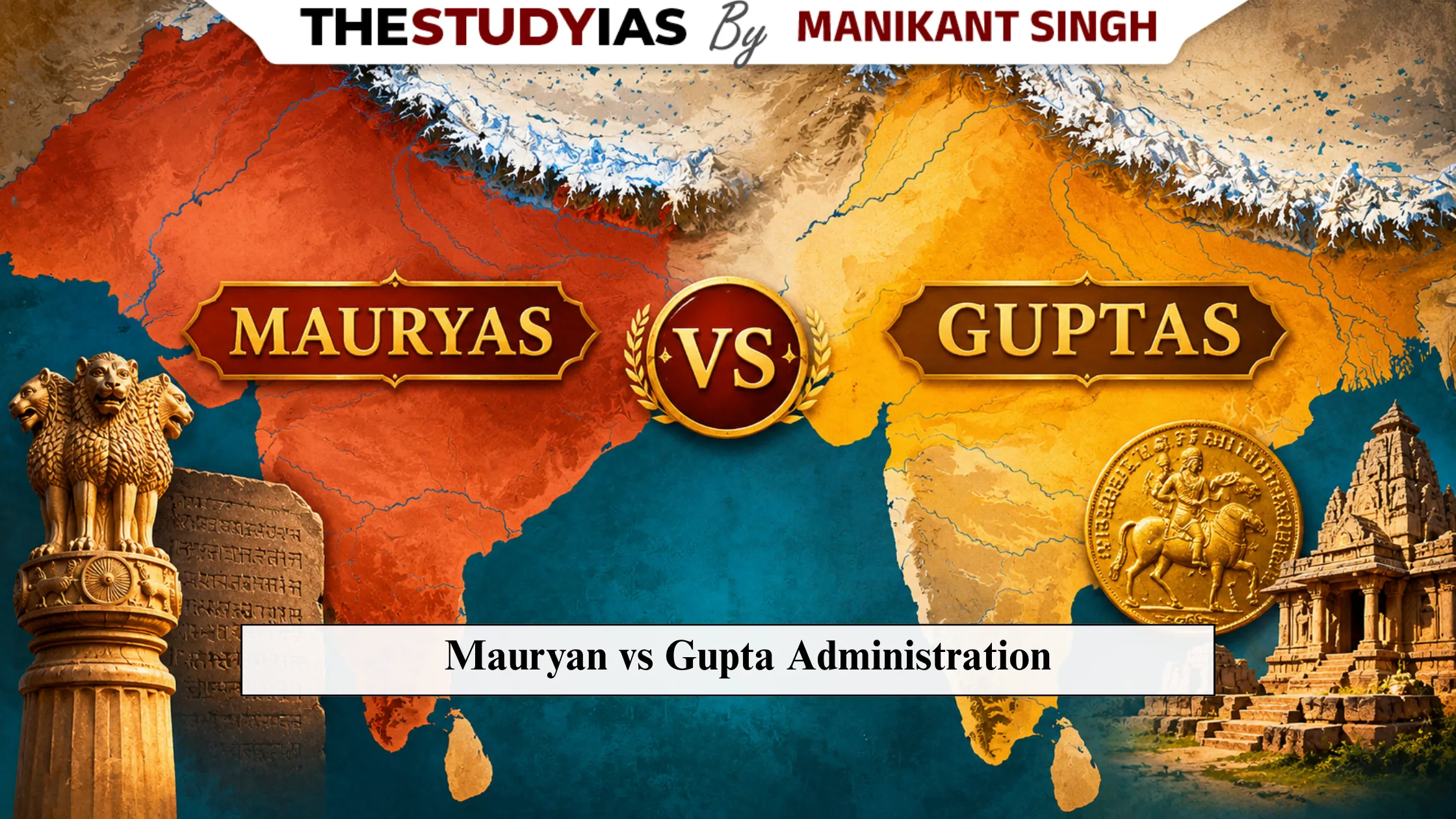
Mauryan vs Gupta Administration: A Comparative Analysis for UPSC History Optional
The Mauryan vs Gupta Administration comparison is one of the most useful topics for UPSC History Optional because it shows how the nature of the state changed between two major phases of ancient Indian history.
The Mauryan Empire, established by Chandragupta Maurya in the 4th century BCE, created a large territorial empire supported by a strong monarchy, organised bureaucracy, provincial administration and a systematic revenue structure.
The Gupta Empire, which rose several centuries later, also had a powerful monarchy, but its administration worked through a different combination of royal officials, provincial authorities, local institutions, subordinate rulers and land grants.
For UPSC, the comparison should not be reduced to the statement that “Mauryan administration was centralised whereas Gupta administration was decentralised.” That is useful as a starting point, but it is not enough for a History Optional answer.
The better approach is to examine how the two states collected revenue, controlled provinces, appointed officials, managed villages, dealt with local elites and exercised authority over territories that were not under the same degree of direct control.
The Mauryan system is reconstructed from sources such as the Arthashastra, Megasthenes' account, Ashokan inscriptions and archaeological evidence. NCERT notes that Megasthenes' Indika, along with the Arthashastra and other literary sources, provides important information about Mauryan administration and economic activity.
The Gupta administrative system is particularly well documented through inscriptions and copper-plate grants. ASI notes that inscriptions are important for reconstructing political, social, economic and administrative history, while its Bharat SHRI database specifically identifies the Damodarpur copper plate of Kumaragupta I as an important source for understanding Gupta provincial administration.
Mauryan Administration: Key Features and Structure
The Mauryan Empire represented one of the earliest large-scale attempts to establish an imperial state over a substantial part of the Indian subcontinent. The king occupied the centre of political authority, while a hierarchy of officials helped implement royal decisions.
The administration had several important features:
A strong monarchy
A large body of officials
Provincial administration
Systematic revenue collection
Military organisation
Considerable state interest in economic activities
The Arthashastra gives detailed information about the organisation of the state, although UPSC candidates should remember that it is a normative text and should not automatically be treated as a direct administrative manual of Chandragupta Maurya's reign. Megasthenes' account and Ashokan inscriptions provide additional evidence.
1. Central Administration
The Mauryan king was the highest political authority. He was expected to supervise administration, justice, revenue, military affairs and foreign policy. The king did not simply issue broad orders and leave administration to local authorities. The Mauryan system placed considerable emphasis on supervision.
The Arthashastra describes a large administrative structure with ministers, high officials and specialised superintendents. Among the important officials associated with Mauryan administration were the Amatyas, Mantrins, Senapati, Samaharta and Sannidhata.
The Samaharta was associated with revenue collection, while the Sannidhata was connected with the treasury and storage of state resources. The Arthashastra also mentions several adhyakshas, or superintendents, responsible for different economic and administrative activities.
This gives us an important picture of the Mauryan state:
Central authority was supported by a specialised administrative machinery.
2. Provincial Administration
The Mauryan Empire was too large to be governed directly from Pataliputra alone. Therefore, important regions were organised into provinces with major administrative centres.
Taxila, Ujjain, Tosali and Suvarnagiri are generally associated with major Mauryan provincial centres. Royal princes and senior officials could be placed in charge of important provinces.
Ashokan inscriptions provide particularly valuable evidence about the functioning of officials. The Ashokan edicts were not simply religious statements. They also communicated royal instructions and referred to officials responsible for implementing the king's policies. ASI describes Ashoka's edicts as a distinct class of inscriptions that conveyed moral and administrative guidance to his subjects.
3. District and Local Administration
Below the provincial level, officials played an important role in maintaining administration, collecting revenue and ensuring law and order. The state was interested in agricultural production, population, economic resources and revenue.
This does not mean that every village was micromanaged by Pataliputra. Local institutions continued to exist. However, compared with the Gupta system, the Mauryan state appears to have maintained a stronger direct administrative presence.
4. Mauryan Revenue System
Revenue was the financial foundation of the Mauryan state. Agriculture was particularly important, but the state also derived income from trade, forests, mines, crafts and other economic activities.
The Arthashastra gives detailed attention to taxation and state revenue. The Mauryan state also exercised significant control over economic resources and activities.
For UPSC, the important point is not to memorise every tax mentioned in the Arthashastra. Instead, understand the larger picture:
The Mauryan state required a strong revenue base to support its bureaucracy, army and large territorial empire.
5. Economic Regulation under the Mauryas
One of the distinctive features of the Mauryan model was the considerable role of the state in economic life. The Arthashastra discusses agriculture, mines, forests, trade, weights and measures, irrigation and several other economic activities.
This does not mean that the Mauryan state controlled every economic transaction. Rather, it shows that the state had a much stronger interest in regulating and supervising economic resources than is generally associated with the Gupta administrative structure.
Gupta Administration: Key Features and Structure
The Gupta Empire emerged in a different political environment. The Gupta rulers established a powerful empire in northern India, particularly under rulers such as Samudragupta and Chandragupta II.
The Gupta administrative system retained the monarchy and bureaucracy but relied more strongly on provincial officials, local authorities, subordinate rulers and land grants.
The most important evidence comes from inscriptions, copper plates and other records. The Allahabad Pillar inscription of Samudragupta is particularly important for understanding his conquests and political relationships. The inscription is described as a major source for the political history of Samudragupta.
The Damodarpur copper plates are equally important for administrative history. ASI's Bharat SHRI records that a Damodarpur copper plate of Kumaragupta I, dated 443 CE, provides information about the hierarchy of provincial administration, including the Uparika, Vishayadhikarana, Kumaramatya and important local representatives.
Gupta Central Administration
The Gupta king remained the supreme authority. Gupta rulers used grand titles such as Maharajadhiraja, reflecting their imperial claims.
The central administration included important officials such as Kumaramatyas. However, the administrative system appears less elaborate and less directly interventionist than the model described in the Arthashastra.
This does not mean that the Gupta administration was weak. It means that the Gupta rulers often achieved political control through a combination of direct administration and indirect political relationships.
That distinction is extremely important for UPSC.
Gupta Provincial Administration
The Gupta Empire was divided into administrative units commonly referred to as Bhuktis, with Vishayas functioning as important district-level units.
The Damodarpur evidence provides concrete evidence of this structure. The record mentions an Uparika, who headed the province or Bhukti, and officials associated with the Vishaya. It also mentions the Kumaramatya and important local representatives.
This is valuable because it moves the discussion beyond general statements about “decentralisation” and gives an actual inscriptional example of how Gupta administration worked.
Gupta Local Administration and the Role of Local Groups
One of the most important features of Gupta administration was the participation of local groups in administration.
The Damodarpur copper plate refers to officials and local representatives including the Nagara-shreshthin or chief merchant, Sarthavaha, Prathama-Kulika and Prathama-Kayastha. This shows that urban and commercial interests could have a role in local administrative processes.
For History Optional, this evidence can be used to demonstrate that Gupta administration was not simply a top-down bureaucracy. It involved interaction between royal officials and influential local groups.
Mauryan vs Gupta Administration: Major Differences
The table should be used for revision, but the actual UPSC answer should explain the reasons behind these differences.
Mauryan vs Gupta Administration: Centralisation and Decentralisation
The most common comparison is between Mauryan centralisation and Gupta decentralisation.
The Mauryan state developed an extensive administrative system because it needed to manage a large empire through officials directly connected with the central authority. Revenue collection, military organisation and economic regulation required a strong bureaucratic structure.
The Gupta state, on the other hand, increasingly operated through a combination of royal officials and intermediate authorities. The existence of Bhukti and Vishaya administration shows that the centre continued to exercise authority. At the same time, local elites, landholders and subordinate rulers became more important.
Therefore: Gupta decentralisation should be understood as relative, not absolute.
This is a crucial UPSC point.
Writing “Gupta administration was completely decentralised” is incorrect. Gupta kings continued to appoint officials, issue grants, collect revenue, conduct military campaigns and exercise authority over their territories. The better argument is that the nature of central control changed.
Mauryan vs Gupta Administration: Revenue System
Revenue provides one of the clearest ways to understand the difference between the two administrative systems.
The Mauryan state depended heavily on a systematic revenue structure. Agriculture was the major economic base, while other sources included trade, forests, mines and crafts. The Arthashastra provides extensive information on revenue collection and state economic activities.
During the Gupta period, agrarian revenue remained important, but land grants became increasingly significant. Copper-plate inscriptions are particularly important evidence for understanding this development. ASI notes that copper-plate inscriptions commonly record land grants to Brahmanas and educational institutions.
The Damodarpur records are especially useful because they show how land transactions were processed through administrative authorities. One Damodarpur record describes an application concerning the purchase of land and identifies officials involved in the process.
Thus, land grants should not be treated merely as religious donations. They also provide evidence about revenue rights, administration and the changing relationship between the state and rural society.
Land Grants and the Gupta Administrative System
The growing importance of land grants is one of the most important developments for understanding Gupta and post-Gupta polity.
A land grant could involve more than simply transferring ownership of land. Depending on the particular grant, beneficiaries could receive exemptions from certain taxes or rights connected with revenue and administration.
This had an important political consequence: some functions that had earlier been performed more directly by state officials could increasingly be exercised through beneficiaries or local authorities.
This development is one reason why historians have discussed the Gupta period in the context of the Indian feudalism debate.
For UPSC, however, avoid making a simplistic statement such as:Land grants caused the collapse of the Gupta administration.”
A better formulation is: The expansion of land grants strengthened intermediate rights and contributed to decentralising tendencies, although the extent of this process varied across regions and did not eliminate royal authority.
That gives your answer both factual accuracy and historiographical balance.
Mauryan vs Gupta Administration: Role of Feudatories
The Gupta political system also differed from the Mauryan system in the way it dealt with subordinate rulers.
The Allahabad Pillar inscription of Samudragupta is especially useful here. It does not present all conquered territories in the same manner. Different rulers and regions had different political relationships with Samudragupta.
This indicates a flexible imperial strategy.
Some territories were brought under more direct control, while others retained local rulers who accepted Gupta supremacy.
This allowed the Guptas to exercise imperial influence without establishing a uniform Mauryan-style administrative structure everywhere.
This is a very useful analytical line for History Optional: Mauryan imperialism tended towards territorial incorporation and direct administration, while Gupta imperialism often accommodated varying degrees of political autonomy under imperial supremacy.
The distinction should not be exaggerated, but it is useful for explaining the different structures of the two empires.
Mauryan vs Gupta Administration: Bureaucracy
The Mauryan state had a more extensive bureaucratic structure. The Arthashastra describes numerous officials and specialised departments. This reflects the need for close administrative supervision.
Gupta administration also had a hierarchy of officials, but the system was less dependent on a large central bureaucracy. The Damodarpur evidence shows the presence of provincial and district officials along with local representatives.
Another important development was the growing importance of hereditary or locally entrenched offices in some areas. This strengthened the position of local power groups.
Thus:
Mauryan model: Central bureaucracy as the main instrument of governance.
Gupta model: Central bureaucracy working alongside local institutions and intermediate authorities.
Mauryan vs Gupta Administration: Economic Regulation
The difference is particularly visible in the economic role of the state.
The Mauryan state, especially as represented in the Arthashastra, showed strong interest in economic regulation. Agriculture, mines, forests, trade, weights and measures and other activities received considerable administrative attention.
The Gupta state appears to have relied more on taxation, land revenue, local institutions and private economic activity rather than maintaining such an extensive system of direct economic regulation.
This does not mean that the Gupta state had no economic role. Rather, the balance between direct state control and indirect extraction was different.
For an analytical answer, connect this difference to the administrative structure: A highly centralised bureaucracy required greater direct fiscal and economic control, while a more decentralised political structure could rely more heavily on local intermediaries and land-based revenue arrangements.
Mauryan vs Gupta Administration: Village and Local Society
The village was an important unit of economic life in both periods, but the state's relationship with rural society changed.
Mauryan administration placed considerable emphasis on agricultural production and revenue. Officials were expected to maintain order and ensure the collection of state dues.
In the Gupta period, land grants and the increasing importance of local beneficiaries could create stronger intermediate authority in rural areas.
This did not mean that the village lost all autonomy or that the state disappeared from the countryside. Rather, the channels through which royal authority reached rural society became more layered.
This is a useful way to connect administration with the larger transition from ancient to early medieval polity.
Similarities Between Mauryan and Gupta Administration
Despite the differences, the two administrative systems had several important similarities.
Both were monarchical states in which the king occupied the highest position. Both maintained officials for revenue collection, military affairs and administration. Both divided their territories into smaller administrative units. Both depended heavily on agriculture and land revenue. Both used inscriptions and royal orders to communicate political authority. Both maintained armies and used military power to expand or defend their territories.
Therefore, Gupta administration should not be presented as a complete break from Mauryan administration. There was continuity in the basic institution of monarchy and territorial administration, but a change in the degree and method of central control.
Sources for Mauryan and Gupta Administration
For UPSC History Optional, source awareness can significantly improve the quality of an answer.
Sources for Mauryan Administration
Arthashastra: Important for understanding statecraft, taxation, administration, economy, espionage and military organisation. It should be used as a normative text and not automatically assumed to describe the Mauryan state exactly as it existed.
Megasthenes' Indika: Provides information about Mauryan society, administration and Pataliputra. NCERT identifies Megasthenes as an important source for Mauryan administration.
Ashokan Edicts: Direct inscriptional evidence for Ashoka's policies, officials, communication with subjects and administrative concerns. ASI identifies Ashokan edicts as an important class of inscriptions for reconstructing Mauryan history.
Sources for Gupta Administration
Allahabad Pillar Inscription: Major source for Samudragupta's conquests, political relationships and imperial ideology.
Damodarpur Copper Plates: Important evidence for provincial and district administration, officials, land transactions and local administrative participation.
Gupta Copper Plates and Inscriptions: Useful for understanding land grants, administrative terminology and royal authority. ASI notes that copper plates are particularly important records of land grants.
Fa Xian: Provides information about society and conditions in India during the Gupta period. NCERT specifically identifies Fa Xian as a source for understanding Gupta-period society and economy.
Historiographical Debate: Was Gupta Administration Feudal?
The Gupta administrative system is closely connected with the debate over Indian feudalism.
Historian R.S. Sharma placed considerable emphasis on land grants, the transfer of revenue and administrative rights, growth of intermediaries and the decline of direct state control in explaining the emergence of Indian feudalism.
However, the Gupta period cannot be reduced to a simple story of administrative decline. The evidence also shows continued royal authority, functioning provincial administration, active political expansion and sophisticated administrative practices.
The better UPSC approach is to present land grants as an important decentralising tendency while acknowledging regional variation and continuing royal power.
A balanced answer can state:
The Gupta period witnessed the growth of institutions that encouraged political and fiscal decentralisation, but this should not be interpreted as the complete disappearance of central authority.
Mauryan vs Gupta Administration: UPSC Analytical Framework
For a 15 or 20-mark question, organise the answer around five broad themes:
1. Nature of the State
Mauryan state had stronger centralising tendencies; Gupta state combined central authority with intermediate political structures.
2. Bureaucracy
Mauryan administration had a more elaborate and specialised bureaucracy; Gupta administration depended more on provincial officials and local authorities.
3. Revenue
Mauryan state emphasised direct and systematic fiscal administration; Gupta administration increasingly used land grants and indirect revenue arrangements.
4. Local Power
Mauryan administration maintained stronger central supervision; Gupta administration gave greater space to local elites, institutions and subordinate rulers.
5. Political Control
Mauryan rule generally sought stronger territorial incorporation, whereas Gupta rulers often accepted different degrees of subordination and autonomy.
This framework is more useful than memorising a long list of officials because it allows you to adapt your answer to different questions.
Important Terms for UPSC History Optional
Samaharta: Important Mauryan revenue official.
Sannidhata: Associated with the treasury and state stores in the Arthashastra.
Amatya: High-ranking official in the Mauryan administrative framework.
Rajuka: Important official mentioned in Ashokan inscriptions.
Pradeshika: Mauryan official associated with provincial or district-level administration.
Bhukti: Major provincial division in Gupta administration.
Vishaya: District-level administrative unit.
Uparika: Provincial governor or head of a Bhukti in Gupta records.
Kumaramatya: Important Gupta administrative official.
Nagara-shreshthin: Chief merchant associated with urban administration.
Sarthavaha: Leader of merchants or caravan traders.
Prathama-Kulika: Senior representative associated with artisans or craft groups in Gupta administrative records.
Prathama-Kayastha: Senior record-keeping or administrative official.
The Damodarpur copper plate is particularly useful for remembering the Gupta administrative hierarchy because ASI's description connects the Uparika, Vishayadhikarana, Kumaramatya and urban representatives in a single administrative context.
Prelims Revision: Mauryan vs Gupta Administration
For Prelims, remember the following associations:
Mauryan Empire → Pataliputra
Chandragupta Maurya → Megasthenes
Mauryan administration → Arthashastra
Ashoka → Edicts
Samaharta → Revenue
Sannidhata → Treasury
Gupta Empire → Bhukti and Vishaya
Uparika → Provincial administration
Vishayapati/Vishaya administration → District level
Kumaramatya → Gupta administration
Damodarpur plates → Gupta administrative and land records
Allahabad Pillar inscription → Samudragupta
Fa Xian → Gupta-period India
Conclusion: Mauryan vs Gupta Administration
The Mauryan vs Gupta Administration comparison reflects a broader transformation in the structure of the ancient Indian state. The Mauryan Empire developed a strong central bureaucracy supported by systematic revenue collection, provincial administration and significant state involvement in economic activities. The Gupta state retained a powerful monarchy and an organised administrative structure but increasingly worked through provincial authorities, local groups, land grants and subordinate rulers.
The most important point for UPSC History Optional is therefore not to present the two systems as completely opposite models. There was considerable institutional continuity, but the degree and method of state control changed.
The Mauryan system can be broadly understood through the relationship: Central monarchy, bureaucracy, direct administration, systematic revenue extraction
The Gupta system can be understood through: Central monarchy, provincial administration, local institutions, land grants and subordinate authorities, relative decentralisation
This transition is important because it helps explain the changing nature of political power from the Mauryan period to the Gupta and post-Gupta period. For a high-quality History Optional answer, combine institutional comparison, inscriptional evidence, land grants, local administration, and historiographical debate rather than simply listing administrative terms.
Quick Revision: Mauryan vs Gupta Administration
Mauryan Administration: Strong central authority, elaborate bureaucracy, direct revenue administration, extensive economic regulation, strong provincial supervision and a large imperial military structure.
Gupta Administration: Strong monarchy, Bhukti-Vishaya structure, important provincial officials, greater role of local groups, growing importance of land grants, subordinate rulers and relative decentralisation.
Best analytical line for Mains:
The Gupta administrative system did not represent the disappearance of central authority; rather, it represented a shift from predominantly direct bureaucratic control towards a more layered system of governance involving provincial officials, local institutions, landed beneficiaries and subordinate rulers.
For more UPSC-oriented articles and preparation resources, explore The Study IAS.
Subscribe to our Youtube Channel for more Valuable Content –TheStudyias
Download the App to Subscribe to our Courses –Thestudyias
The Source’s Authority and Ownership of the Article is Claimed ByTHE STUDY IAS BY MANIKANT SINGH
Comments (0)
Leave a Comment