Partition of Bengal - 1905
6 Aug 2026
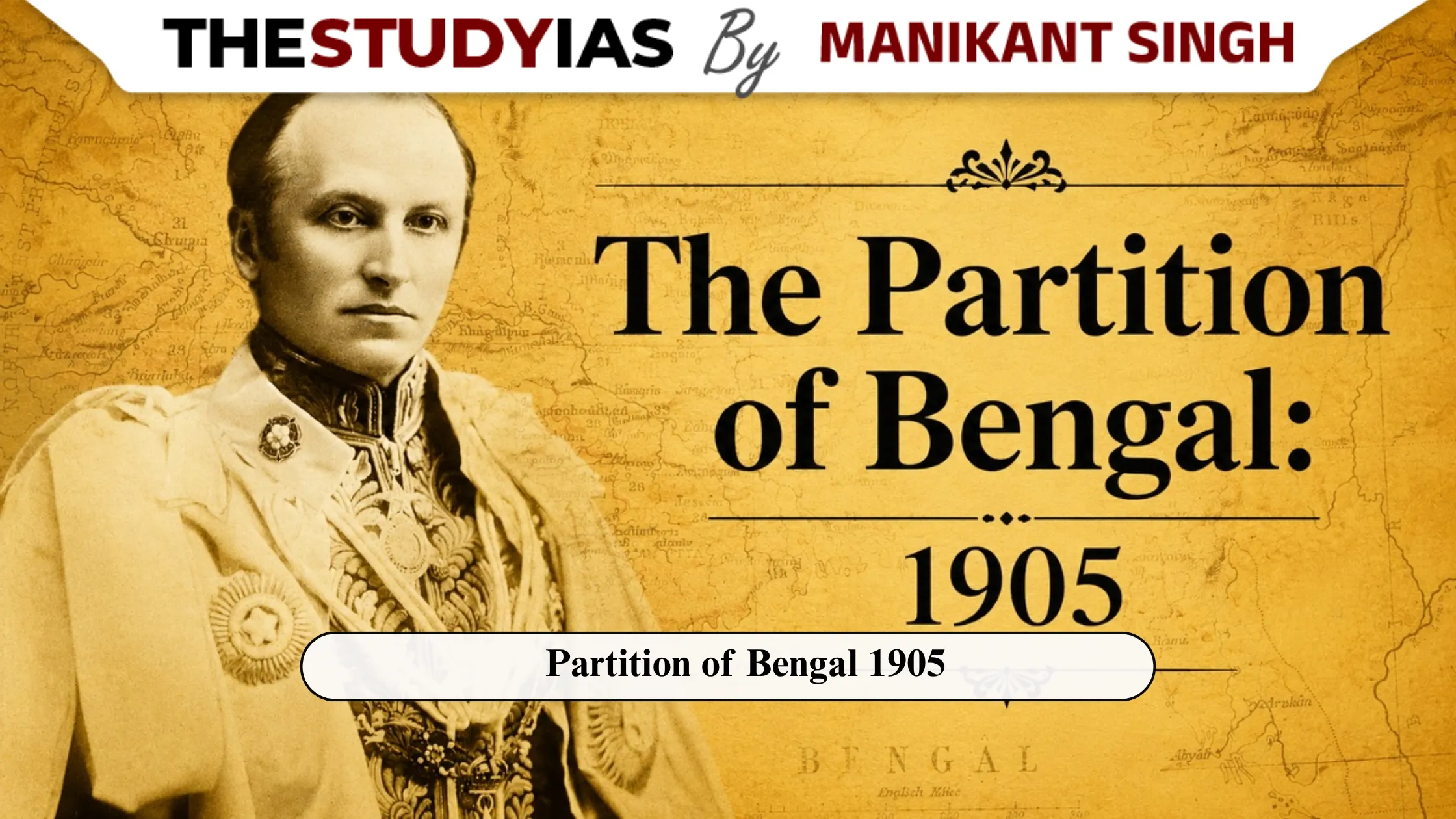
Partition of Bengal - 1905 : Causes, Events, Impact & Significance
Introduction
The Partition of Bengal (1905) was one of the most significant events in India's freedom struggle. Announced by Lord Curzon, the partition came into effect on 16 October 1905. Officially, it was presented as an administrative measure to improve governance in the vast Bengal Presidency. However, many Indian nationalists believed it was a deliberate attempt to divide people along religious lines and weaken the growing nationalist movement.
The partition sparked widespread protests and led to the Swadeshi Movement, making it a turning point in the Indian independence movement.
Background of the Partition
Before 1905, the Bengal Presidency was one of the largest provinces under British rule. It included present-day:
- West Bengal
- Bangladesh (then East Bengal)
- Bihar
- Odisha
- Parts of Assam
With a population of nearly 80 million, the British claimed that the province had become too large to administer effectively.
Reasons for the Partition of Bengal
1. Administrative Reason (Official Explanation)
The British government argued that Bengal's large size made governance inefficient. Dividing the province would improve administration, law enforcement, and public services.
2. Political Motive (Real Objective)
Many historians believe the real aim was the "Divide and Rule" policy. Bengal had become the center of Indian nationalism, and the British wanted to weaken the unity of educated Indians leading the freedom movement.
3. Religious Division
The partition created:
- Eastern Bengal and Assam (Muslim-majority)
- Western Bengal (Hindu-majority)
This religious division was seen as an attempt to create communal differences between Hindus and Muslims.
How Bengal Was Divided
- Eastern Bengal and Assam
- Capital: Dacca (now Dhaka)
- Majority Population: Muslim
- Western Bengal
- Capital: Calcutta (now Kolkata)
- Majority Population: Hindu
The new province of Eastern Bengal and Assam had Dacca as its capital, while Calcutta remained the capital of Western Bengal.
Public Reaction
The announcement triggered widespread opposition across Bengal and other parts of India.
Major forms of protest included:
- Boycott of British goods
- Promotion of Swadeshi (indigenous) products
- Public meetings and demonstrations
- Burning of foreign cloth
- National education movement
- Singing patriotic songs such as "Vande Mataram"
Students, lawyers, teachers, women, and businessmen actively participated in the movement.
The Swadeshi Movement
The Swadeshi Movement became one of the strongest responses to the partition.
Its objectives were:
- Boycott imported British goods
- Encourage Indian industries
- Promote national education
- Develop economic self-reliance
- Strengthen Indian nationalism
The movement spread beyond Bengal to Maharashtra, Punjab, Madras, and other regions.
Leaders Who Opposed the Partition
Several prominent leaders strongly opposed the partition, including:
- Surendranath Banerjea
- Bal Gangadhar Tilak
- Bipin Chandra Pal
- Aurobindo Ghosh
- Lala Lajpat Rai
These leaders inspired mass participation through speeches, newspapers, and public campaigns.
Impact of the Partition
Positive Impacts
- Rise of Indian nationalism.
- Beginning of the Swadeshi and Boycott Movements.
- Growth of indigenous industries.
- Increased political awareness among Indians.
- Greater participation of students and women in the freedom struggle.
Negative Impacts
- Increased communal tensions.
- Strengthened the British "Divide and Rule" policy.
- Political polarization in some regions.
Annulment of the Partition
Due to continuous protests and widespread opposition, the British government decided to cancel the partition.
- Year of Annulment:1911
- During the Delhi Durbar, the British announced:
- The reunification of Bengal.
- The transfer of the capital of British India from Calcutta to Delhi.
Although the partition was reversed, the political awakening it created had a lasting impact on India's struggle for independence.
Significance of the Partition of Bengal
The Partition of Bengal marked the beginning of mass political participation in India's freedom movement. It transformed nationalism from an elite movement into a people's movement by involving students, women, workers, and merchants. It also demonstrated the power of economic resistance through the boycott of foreign goods and the promotion of indigenous industries.
The event became a milestone in the history of the Indian independence movement and influenced later campaigns led by national leaders.
Important Facts for UPPSC Prelims
- Year of Partition: 1905
- Effective Date: 16 October 1905
- Viceroy: Lord Curzon
- Official Reason: Administrative convenience
- Real Motive: Divide and Rule policy
- New Province Created: Eastern Bengal and Assam
- Capital of Eastern Bengal and Assam: Dacca (now Dhaka)
- Major Protest Movement: Swadeshi Movement
- Partition Annulled: 1911
- Capital of British India Shifted: From Calcutta to Delhi (1911)
Frequently Asked Questions (FAQs)
1. Why was Bengal partitioned in 1905?
Officially, the British cited administrative convenience due to the province's large size. However, many Indian nationalists believed the real objective was to weaken the nationalist movement through the "Divide and Rule" policy.
2. Who partitioned Bengal in 1905?
The partition was carried out by Lord Curzon, the Viceroy of India.
3. What was the main result of the Partition of Bengal?
The partition led to the Swadeshi Movement, widespread protests, and a stronger nationalist movement across India.
4. When was the Partition of Bengal cancelled?
The British annulled the partition in 1911 after sustained public opposition.
5. Why is the Partition of Bengal important for UPPSC?
It is a frequently asked topic in UPPSC Prelims because it covers modern Indian history, the freedom movement, the Swadeshi Movement, and important constitutional and political developments before independence.
Subscribe to our Youtube Channel for more Valuable Content – TheStudyias
Download the App to Subscribe to our Courses – Thestudyias
The Source’s Authority and Ownership of the Article is Claimed By THE STUDY IAS BY MANIKANT SINGH
Comments (0)
Leave a Comment