Indian National Movement Timeline
16 Mar 2026
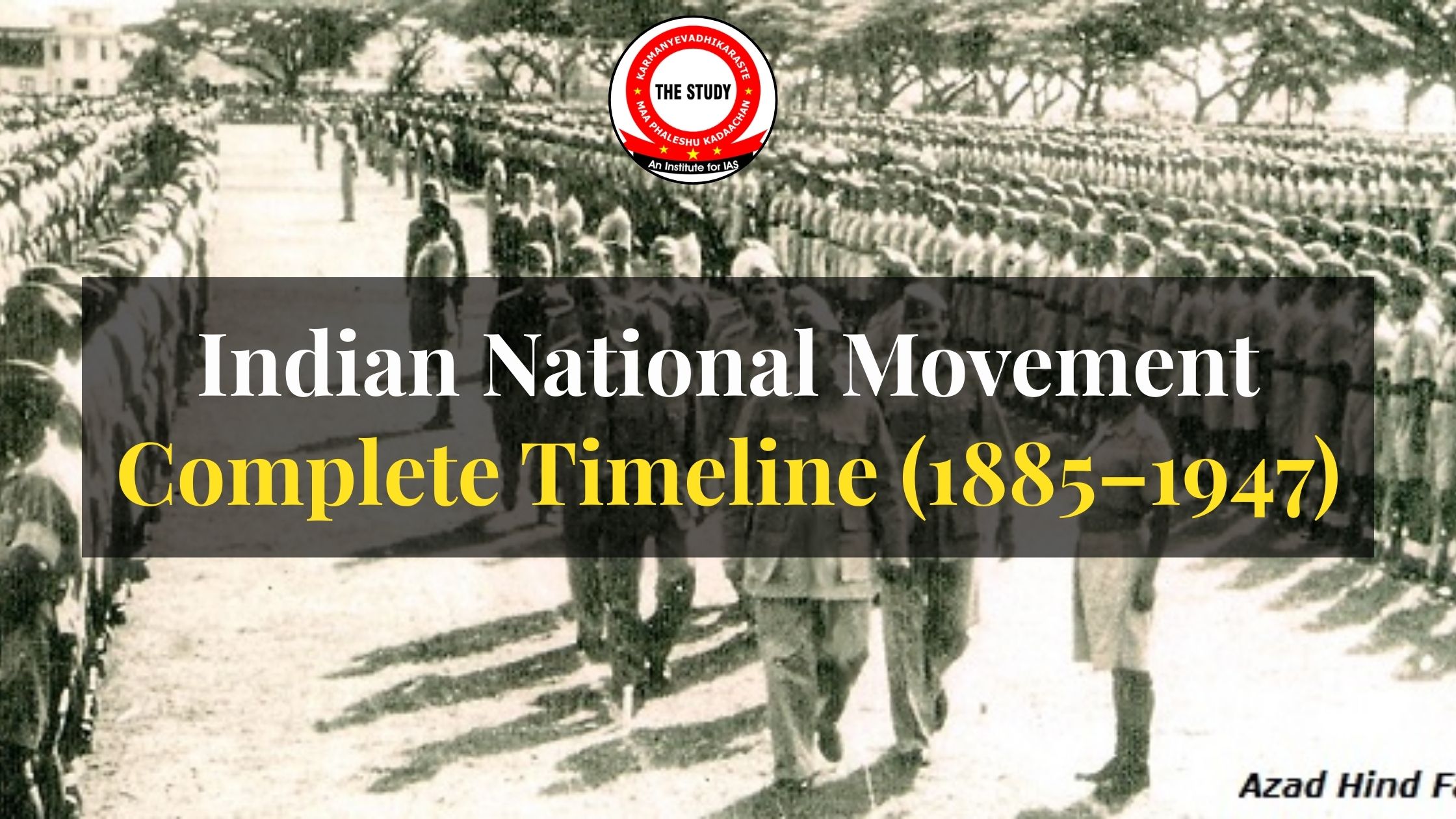
Indian National Movement Complete Timeline (1885–1947): The Ultimate 62-Year Struggle That Won India Freedom
Indian National Movement Complete Timeline (1885–1947)
The Indian National Movement Complete Timeline (1885–1947) tells the powerful story of India’s struggle against British colonial rule. Over a period of sixty-two years, millions of Indians united across religions, languages, and regions to demand freedom and self-governance.
This movement was not a single event but a series of political campaigns, mass protests, revolutionary activities, and negotiations. From moderate political petitions in the late nineteenth century to large-scale civil disobedience movements led by national leaders, every stage contributed to the final achievement of independence in 1947.
The journey toward independence was long and complex. It involved leaders, activists, students, farmers, workers, and ordinary citizens who believed that India deserved freedom and dignity.
Understanding the Indian National Movement Complete Timeline (1885–1947) helps students, researchers, and readers appreciate how India transformed from a colonised nation into the world’s largest democracy.
Causes of the Indian National Movement
Before exploring the Indian National Movement Complete Timeline (1885–1947), it is important to understand the factors that triggered nationalism in India.
Several political, economic, and social conditions encouraged Indians to demand independence.
- Economic Exploitation
British colonial policies heavily exploited India's resources. High taxes, destruction of local industries, and the export of raw materials severely damaged the Indian economy.
Indian economist Dadabhai Naoroji described this situation through the famous Drain Theory, explaining how wealth was transferred from India to Britain.
- Racial Discrimination
Indians were often treated unfairly by the British administration. Important government positions were mostly reserved for British officials, and Indians faced discrimination in employment and governance.
- Spread of Education
Western education introduced ideas of democracy, liberty, and equality. Educated Indians began questioning colonial rule and demanding political rights.
- Development of Communication
Railways, telegraph lines, and newspapers helped spread political awareness across the country. These developments made it easier to organise national movements.
- Influence of Global Events
Events such as World War I and World War II weakened European powers and inspired colonial nations to demand independence.
All these factors together laid the foundation for the Indian National Movement Complete Timeline (1885–1947).
Phase 1: Early Nationalism – Era of Moderates (1885–1905)
The first phase of the Indian National Movement Complete Timeline (1885–1947) began with the formation of the Indian National Congress in 1885.
During this period, moderate leaders believed that reforms could be achieved through constitutional and peaceful methods.
Formation of the Indian National Congress
The Indian National Congress (INC) was founded in 1885 by A.O. Hume, a retired British civil servant, along with Indian leaders.
The organisation aimed to create a platform where Indians could discuss political issues and demand reforms from the British government.
Key Moderate Leaders
Important leaders of this period included:
- Dadabhai Naoroji
- Gopal Krishna Gokhale
- Surendranath Banerjee
- Pherozeshah Mehta
These leaders were highly educated and believed in peaceful dialogue with the British government.
Methods Used by Moderates
Moderate leaders used constitutional methods such as:
- Petitions to British authorities
- Public meetings and speeches
- Writing articles in newspapers
- Passing resolutions in Congress sessions
Major Demands
Their main demands included:
- Expansion of legislative councils
- Indian representation in administration
- Civil service reforms
Reduction in military expenditure
Although their demands were limited, this phase played a crucial role in developing political awareness among Indians.
However, many young nationalists soon felt that these methods were ineffective. This dissatisfaction led to the rise of more aggressive nationalist leaders.
Phase 2: Rise of Extremism and Swadeshi Movement (1905–1919)
The second stage in the Indian National Movement Complete Timeline (1885–1947) began with the Partition of Bengal in 1905.
The British government divided Bengal into two regions, claiming administrative convenience. However, Indians believed the move aimed to weaken nationalist unity.
This decision triggered massive protests and started the Swadeshi Movement.
Swadeshi Movement
The Swadeshi Movement encouraged Indians to use locally produced goods instead of British products.
Major actions included:
- Boycotting British goods
- Promoting Indian industries
- Burning foreign clothes
- Establishing national schools
This movement strengthened national pride and economic independence.
Rise of Extremist Leaders
A new group of leaders emerged during this period who believed that stronger action was necessary to achieve freedom.
These leaders included:
- Bal Gangadhar Tilak
- Bipin Chandra Pal
- Lala Lajpat Rai
They were popularly known as the Lal-Bal-Pal trio. Bal Gangadhar Tilak declared the famous slogan:
“Swaraj is my birthright and I shall have it.”
Revolutionary Nationalism
Some young revolutionaries believed armed struggle was necessary.
Revolutionary organisations formed secret societies and carried out activities such as:
- Attacks on colonial officials
- Distribution of revolutionary literature
- Planning armed uprisings
Although limited in scale, revolutionary activities increased pressure on British authorities.
The Indian National Movement Complete Timeline (1885–1947) shows that this phase transformed nationalism into a mass political movement.
Phase 3: Gandhian Era and Mass Movements (1919–1935)
The most significant phase in the Indian National Movement Complete Timeline (1885–1947) began when Mahatma Gandhi became the leader of the freedom struggle.
Gandhi introduced the concept of Satyagraha, which means non-violent resistance based on truth and justice.
His leadership transformed the movement into a nationwide campaign.
Jallianwala Bagh Massacre (1919)
In April 1919, British troops under General Dyer opened fire on a peaceful gathering in Amritsar’s Jallianwala Bagh. Hundreds of innocent people were killed. The massacre shocked the nation and destroyed the remaining trust in British rule.
Non-Cooperation Movement (1920–1922)
After the massacre, Gandhi launched the Non-Cooperation Movement.
The movement urged Indians to withdraw support from British institutions.
Activities included:
- Boycotting government schools and colleges
- Refusing to purchase British goods
- Resigning from government positions
- Promoting khadi and local industries
Millions of Indians participated in this movement.
Civil Disobedience Movement and Salt March (1930)
The Salt March became one of the most symbolic events in the Indian National Movement Complete Timeline (1885–1947).
Gandhi marched nearly 240 miles from Sabarmati Ashram to Dandi to protest the British salt tax.
After reaching the sea, he made salt from seawater, breaking the colonial law.
This act inspired nationwide protests and civil disobedience.
Across India people:
- Manufactured illegal salt
- Refused to pay taxes
- Organised demonstrations
The movement gained international attention and increased pressure on the British government.
Phase 4: Final Phase – Towards Independence (1935–1947)
The final stage of the Indian National Movement Complete Timeline (1885–1947) witnessed significant political developments.
Government of India Act 1935
This act introduced provincial autonomy and allowed Indian leaders to form governments in provinces.
However, real authority still remained with the British.
World War II and Political Crisis
In 1939, Britain involved India in World War II without consulting Indian leaders.
This decision angered nationalist leaders and intensified demands for independence.
Quit India Movement (1942)
In August 1942, the Indian National Congress launched the Quit India Movement. Gandhi gave the powerful call: “Do or Die.”
The movement involved:
- Nationwide strikes
- Student protests
- Public demonstrations
Although the British government suppressed the movement, it made it clear that colonial rule could not continue.
Independence and Partition (1947)
After World War II, Britain decided to transfer power to Indian leaders. However, religious tensions led to the partition of the subcontinent. On 15 August 1947, India finally achieved independence. Two separate nations were created:
- India
- Pakistan
This marked the end of the Indian National Movement Complete Timeline (1885–1947).
Complete Timeline of Major Events
1885 – Formation of Indian National Congress,
1905 – Partition of Bengal,
1905–1908 – Swadeshi Movement,
1919 – Jallianwala Bagh Massacre,
1920 – Non-Cooperation Movement,
1930 – Salt March,
1935 – Government of India Act,
1942 – Quit India Movement,
1947 – Independence and Partition.
Key Leaders of the Indian National Movement
Several leaders played crucial roles in the freedom struggle. Important leaders include:
- Mahatma Gandhi
- Jawaharlal Nehru
- Subhas Chandra Bose
- Bal Gangadhar Tilak
- Sardar Vallabhbhai Patel
- Dadabhai Naoroji
Their leadership united millions of Indians and strengthened the independence movement.
Impact of the Indian National Movement
The Indian National Movement Complete Timeline (1885–1947) had lasting impacts on India and the world. Major outcomes include:
- Establishment of democratic governance
- Adoption of the Indian Constitution
- Expansion of civil liberties
- Rise of national unity
- Inspiration for other independence movements
India’s freedom struggle influenced many countries in Asia and Africa seeking independence.
Conclusion
The Indian National Movement Complete Timeline (1885–1947) represents a historic journey of courage, unity, and determination.
Over sixty-two years, Indians fought colonial rule through political negotiations, mass movements, and revolutionary activism. Each phase contributed to the eventual achievement of independence.
Today, this movement stands as one of the most inspiring struggles for freedom in world history. It reminds us that unity, persistence, and belief in justice can transform the destiny of a nation.
Frequently Asked Questions (FAQs)
What was the Indian National Movement?
The Indian National Movement was a political and social struggle by Indians to end British colonial rule and achieve independence.
When did the Indian National Movement begin?
The organised movement began in 1885 with the formation of the Indian National Congress.
Who led the Indian freedom struggle?
Major leaders included Mahatma Gandhi, Jawaharlal Nehru, Subhas Chandra Bose, Bal Gangadhar Tilak, and Sardar Patel.
Why was the Salt March important?
The Salt March challenged the British salt tax and became a powerful symbol of non-violent resistance.
What was the Quit India Movement?
The Quit India Movement of 1942 demanded immediate independence from British rule.
When did India gain independence?
India gained independence on 15 August 1947.
Subscribe to our YouTube Channel for more Valuable Content – TheStudyias
Download the App to Subscribe to our Courses – Thestudyias
The Source’s Authority and Ownership of the Article is Claimed By THE STUDY IAS BY MANIKANT SINGH
Comments (0)
Leave a Comment