Food Processing Industry in India: Potential, Challenges and Policy Support
13 Nov 2026
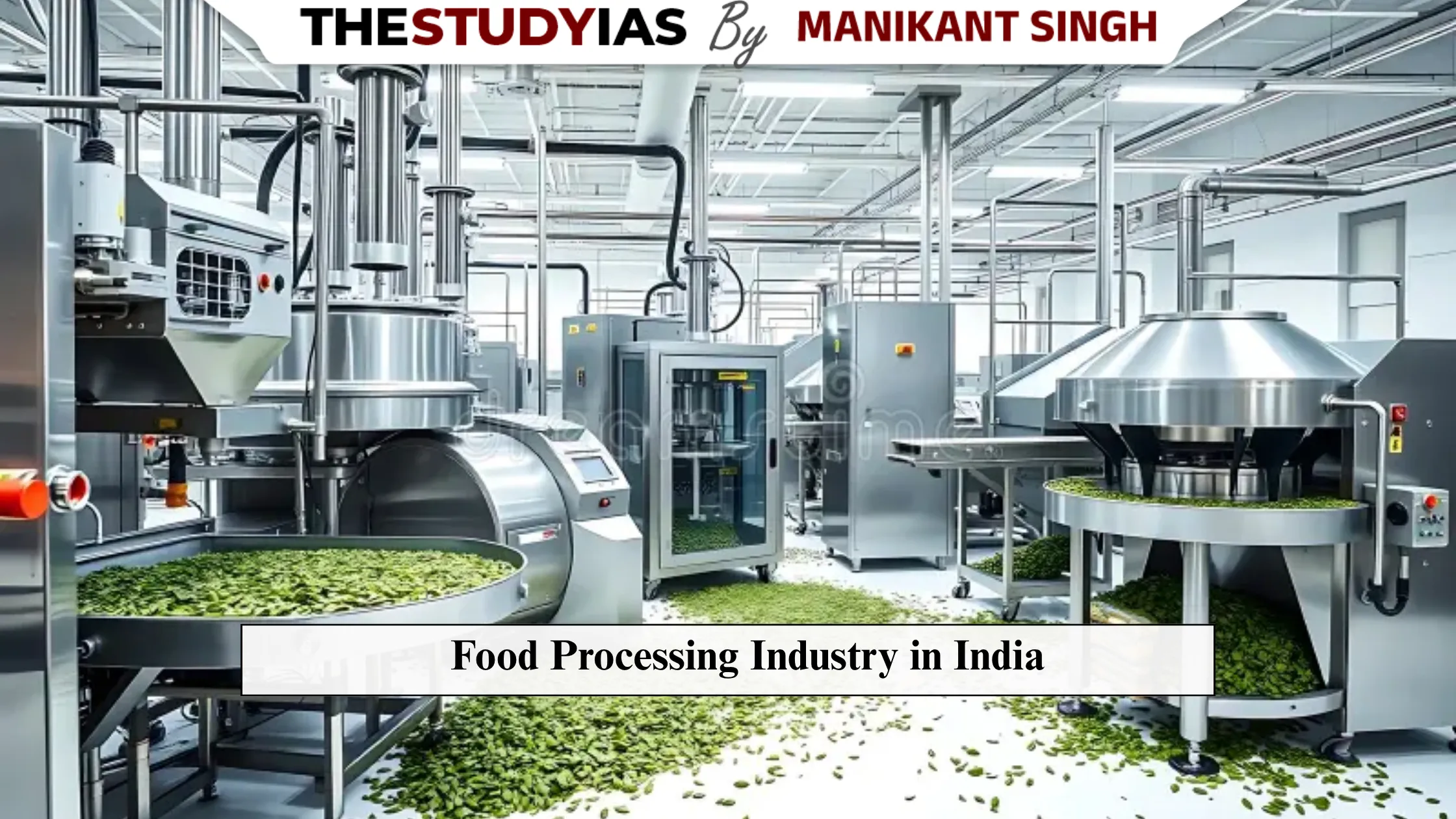
Food Processing Industry in India: Potential, Challenges and Policy Support
The food processing industry plays a crucial role in connecting agriculture with manufacturing, trade and consumption. It involves transforming agricultural and allied-sector produce, such as cereals, fruits, vegetables, milk, meat, fish and poultry, into products that are suitable for consumption, storage, transportation and commercial distribution.
India has a large agricultural production base, but a significant part of its potential remains underutilised because of inadequate processing facilities, fragmented supply chains, insufficient cold storage and limited value addition. Food processing can address these challenges by reducing post-harvest losses, increasing farmers' incomes, generating rural employment and strengthening India's position in global food markets. It is therefore an important instrument for agricultural transformation, industrial growth and inclusive development.
UPSC Relevance: GS Paper III - Indian Economy (Food Processing, Agricultural Marketing, Food Supply Chains, Infrastructure and Employment Generation); GS Paper II - Governance (Government Policies, Industrial Development and Welfare Initiatives); GS Paper I - Indian Society (Rural Development, Poverty Reduction and Inclusive Growth).
Understanding the Food Processing Industry
Food processing refers to the conversion of raw agricultural and allied products into processed or semi-processed food products through physical, chemical, biological or mechanical methods. It includes activities such as cleaning, grading, sorting, milling, preservation, freezing, packaging, fermentation and manufacturing of ready-to-eat or ready-to-cook products.
Types of Food Processing
Primary Processing: It involves basic operations that make agricultural produce suitable for storage, transportation or further processing. Examples include cleaning, grading, sorting, drying, milling and milk chilling.
Secondary Processing: It converts primary processed materials into consumable products. Examples include making bread from flour, cheese from milk, fruit juice from fruits and edible oil from oilseeds.
Tertiary Processing: It involves manufacturing ready-to-eat, ready-to-cook and convenience food products through advanced processing and packaging techniques. Examples include frozen meals, packaged snacks, instant noodles and processed food combinations.
The development of all three levels is important for building an integrated food processing ecosystem.
Status of the Food Processing Industry in India
India has emerged as an important food processing destination because of its diverse agro-climatic conditions, large agricultural output, growing domestic market and expanding food consumption patterns.
According to the Ministry of Food Processing Industries (MoFPI), the sector's Gross Value Added (GVA) increased from approximately ₹1.34 lakh crore in 2014-15 to ₹2.24 lakh crore in 2023-24, based on the First Revised Estimates.
The sector recorded an average annual growth rate of approximately 6.55% during the nine years ending 2023-24, reflecting its growing importance in India's economy.
Potential of the Food Processing Industry in India
India's food processing sector has considerable potential to transform the agricultural economy and create new opportunities across the rural and industrial sectors.
Reduction in Post-Harvest Losses
Agricultural produce, particularly fruits, vegetables, milk and fish, is highly perishable. Inadequate storage, transportation and processing facilities can lead to significant post-harvest losses. Food processing technologies such as refrigeration, freezing, dehydration, canning and packaging can extend product shelf life and reduce wastage. This helps improve the availability of agricultural products throughout the year and strengthens food supply chains.
Higher Income for Farmers
Food processing increases the value of agricultural produce by converting raw materials into higher-value products. For example, processing tomatoes into puree, milk into cheese and fruits into juices or jams creates additional commercial value. It also provides farmers with opportunities to connect directly with processors, Farmer Producer Organisations (FPOs), cooperatives and organised retail chains. This can reduce dependence on traditional intermediaries and improve farmers' bargaining power.
Employment Generation
The food processing industry is labour-intensive and creates employment opportunities across multiple stages of the value chain.
It generates jobs in:
Agricultural procurement and sorting.
Food manufacturing and processing.
Packaging and labelling.
Warehousing and cold-chain management.
Transportation and logistics.
Quality testing and food safety.
Marketing and retail distribution.
The sector also creates opportunities for women, rural youth and micro-entrepreneurs, particularly in food-based enterprises.
Promotion of Rural Industrialisation
Food processing units can be established close to agricultural production centres, reducing transportation costs and strengthening rural economies. Agro-processing clusters, food parks and common processing facilities can encourage the development of small industries in rural and semi-urban areas. This promotes decentralised industrialisation and reduces excessive dependence on major urban industrial centres.
Export Promotion and Foreign Exchange Earnings
Processed food products have the potential to increase India's participation in global value chains. Products such as processed fruits and vegetables, dairy products, spices, marine products, ready-to-eat foods and packaged agricultural products can expand India's export basket. Food processing also enables India to move beyond exporting raw agricultural commodities towards exporting higher-value products.
Crop Diversification
A strong processing industry can create demand for a wider range of agricultural products, including millets, pulses, fruits, vegetables, spices and oilseeds. This can encourage farmers to diversify away from the traditional rice-wheat cropping pattern. It also supports climate-resilient agriculture by creating markets for crops that require relatively fewer water resources.
Strengthening Food and Nutritional Security
Processing and preservation technologies improve the shelf life, availability and distribution of food products. Fortification, appropriate preservation and improved packaging can also support the availability of nutritious food products. However, food processing must prioritise nutritional quality and food safety rather than merely increasing the supply of packaged products.
Major Challenges Facing the Food Processing Industry
Despite its significant potential, the sector faces structural, technological, financial and institutional challenges.
Inadequate Infrastructure
A major constraint is the lack of integrated infrastructure connecting farms with processing facilities and consumer markets. Inadequate cold storage, refrigerated transportation, warehouses, testing laboratories and modern processing units increase operational costs and post-harvest losses. The absence of an efficient farm-to-fork supply chain particularly affects small farmers and micro-enterprises.
Low Level of Processing and Value Addition
A substantial proportion of agricultural produce is sold in raw or minimally processed form. Limited processing capacity prevents farmers and businesses from capturing the full economic value of agricultural output. The sector requires greater investment in advanced processing technologies, preservation facilities and product innovation.
Fragmented Supply Chains
Indian agriculture is characterised by small and fragmented landholdings, scattered production centres and inconsistent supply volumes. Food processing industries often require a continuous supply of standardised raw materials in large quantities. Weak linkages between farmers, FPOs, processors, aggregators and retailers make procurement difficult and increase transaction costs.
Limited Access to Finance
Small and medium food processing enterprises often face difficulties in accessing affordable credit. High initial investment requirements, collateral constraints, uncertain market demand and working-capital requirements discourage entrepreneurs from establishing or expanding processing units.
Technological Constraints
Many micro and small enterprises continue to depend on traditional processing methods and outdated machinery. Limited access to automation, modern packaging, food preservation technologies, research and development affects productivity and product quality.
Quality Standards and Food Safety Compliance
Food processing businesses must comply with food safety, hygiene, labelling, packaging and quality standards. Small enterprises often lack the financial resources and technical expertise required to meet these requirements. Inadequate testing facilities and limited awareness of international standards can also restrict export opportunities.
Skilled Workforce Deficit
The sector requires trained professionals in food technology, food engineering, quality assurance, packaging, refrigeration, supply-chain management and food safety. However, skill gaps and limited access to specialised training affect the productivity and competitiveness of the industry.
Regulatory and Compliance Burden
Food processing enterprises may need to comply with multiple regulatory requirements relating to food safety, taxation, environmental clearances, labour laws and business registration. Complex approval procedures and administrative delays can discourage investment, particularly among smaller enterprises.
Global Competition and Export Barriers
Indian processed food products face competition from countries with advanced processing technologies, established global brands and efficient logistics networks. Stringent sanitary and phytosanitary standards, traceability requirements and changing international food regulations can create additional barriers to exports.
Environmental Sustainability
Food processing activities can generate significant quantities of wastewater, organic waste, packaging waste and energy consumption. Without appropriate waste management, water conservation and renewable energy adoption, industrial expansion may create environmental challenges.
Government Policy Support for Food Processing in India
The Government of India, through the Ministry of Food Processing Industries (MoFPI), has introduced several initiatives to strengthen infrastructure, improve technology, encourage investment and support food processing enterprises.
Pradhan Mantri Kisan SAMPADA Yojana (PMKSY)
The Pradhan Mantri Kisan SAMPADA Yojana, launched in 2017, aims to develop modern infrastructure for food processing and preservation. It seeks to establish an integrated supply chain from the farm gate to the retail outlet.
Its major components include:
Integrated Cold Chain and Value Addition Infrastructure.
Creation or Expansion of Food Processing and Preservation Capacities.
Infrastructure for Agro-Processing Clusters.
Food Safety and Quality Assurance Infrastructure.
Human Resources and Institutional Support.
Operation Greens.
The scheme supports the development of processing facilities, cold chains, warehouses, testing infrastructure and agro-processing clusters. Its broader objective is to reduce agricultural wastage, increase value addition and create employment opportunities.
Pradhan Mantri Formalisation of Micro Food Processing Enterprises (PMFME)
The PMFME Scheme was launched in June 2020 under the Aatmanirbhar Bharat Abhiyan. It focuses on upgrading and formalising micro food processing enterprises, particularly those operating in the unorganised sector.
Major features include:
Credit-linked Capital Subsidy: Eligible individual micro-enterprises can receive a subsidy of 35% of the eligible project cost, subject to a maximum of ₹10 lakh per unit.
Seed Capital Support: Assistance is provided to Self-Help Groups (SHGs) for working capital and the purchase of small tools and equipment, subject to scheme guidelines.
One District One Product (ODOP): The scheme promotes district-specific products to encourage specialisation, branding, procurement and marketing.
Support for FPOs, SHGs and Cooperatives: Financial, technical and business support is provided to strengthen collective food processing activities.
Capacity Building: Training and technical assistance help entrepreneurs improve product quality, business management and market access.
The scheme aims to improve competitiveness and bring micro food processing enterprises into the formal economy.
Production Linked Incentive Scheme for Food Processing Industry (PLISFPI)
The Production Linked Incentive Scheme for Food Processing Industry was introduced in 2021 with an approved outlay of ₹10,900 crore for the period 2021-22 to 2026-27. Its primary objective is to strengthen India's manufacturing capabilities, encourage investment and promote Indian food brands in domestic and international markets.
The scheme focuses on major food product segments, including:
Ready-to-cook and ready-to-eat foods.
Processed fruits and vegetables.
Marine products.
Mozzarella cheese.
Innovative and organic products, as specified under the scheme.
It provides incentives linked to incremental sales and supports the development of globally competitive food manufacturing enterprises.
Operation Greens
Operation Greens was initially introduced to stabilise the supply and prices of Tomato, Onion and Potato (TOP) crops. It was subsequently expanded to cover a wider range of notified fruits and vegetables under specified interventions. The initiative seeks to reduce post-harvest losses, improve storage and transportation facilities, strengthen farmer-producer linkages and promote value addition.
Mega Food Parks
The Mega Food Park concept aims to create modern food processing infrastructure through a cluster-based approach. It provides facilities such as common processing centres, storage, cold chains, logistics, testing laboratories and other support infrastructure. The objective is to create efficient linkages between farmers, processors and markets.
Note: Mega Food Parks were an important component of earlier PMKSY implementation. The current PMKSY framework has undergone restructuring, so Mega Food Parks should not automatically be described as a newly open or independent scheme component.
Agriculture Infrastructure Fund (AIF)
The Agriculture Infrastructure Fund, launched in 2020, supports investment in post-harvest management infrastructure and community farming assets. It provides financing support for projects such as warehouses, cold storage, sorting and grading facilities, primary processing units and supply-chain infrastructure. The fund helps strengthen the agricultural infrastructure ecosystem on which food processing industries depend.
Other Supporting Initiatives
FSSAI: The Food Safety and Standards Authority of India regulates food safety and quality through standards, licensing, inspection and compliance mechanisms.
Agriculture Export Policy, 2018: Aims to promote agricultural exports through infrastructure development, improved quality standards and better market access.
PM Gati Shakti: Supports integrated infrastructure planning and logistics connectivity, which can improve the movement of agricultural produce and processed food products.
Make in India: Encourages manufacturing investment, technology adoption and domestic production, including in the food processing sector.
Role of Food Processing in Doubling Farmers' Income
Food processing can contribute to higher farm incomes by creating additional value beyond primary agricultural production. It enables farmers to participate in value chains through FPOs, cooperatives, contract-based procurement arrangements and direct linkages with processors. Processing also creates demand for agricultural products that may otherwise face seasonal price fluctuations or limited market access.
For example, converting surplus fruits into pulp, vegetables into frozen products and milk into value-added dairy products can reduce distress sales and improve the commercial value of agricultural output. However, food processing alone cannot guarantee higher farm incomes. Its benefits depend on fair procurement arrangements, competitive markets, efficient infrastructure and farmers' bargaining power.
Food Processing and India's Export Competitiveness
India has a strong agricultural resource base and significant opportunities in processed food exports. The expansion of processing facilities can improve product quality, consistency, shelf life, traceability and compliance with international standards.
Major export opportunities exist in:
Processed fruits and vegetables.
Marine and seafood products.
Dairy-based products.
Ready-to-eat and ready-to-cook foods.
Spices and spice-based products.
Millet-based and organic food products.
However, improving export competitiveness requires investment in testing laboratories, certification, cold-chain infrastructure, branding, packaging and international market intelligence.
Way Forward
India needs to develop a globally competitive and sustainable food processing ecosystem by addressing infrastructure gaps, improving technology and strengthening farmer-industry linkages.
Strengthening Farm-to-Fork Infrastructure: Integrated cold chains, modern warehouses, refrigerated transportation and decentralised processing facilities should be expanded to reduce post-harvest losses.
Promoting FPOs and Farmer-Processor Linkages: Farmer Producer Organisations and cooperatives should be connected with processing units through transparent procurement arrangements, aggregation facilities and long-term market partnerships.
Supporting MSMEs and Start-ups: Affordable credit, simplified compliance, technical assistance and incubation facilities can help small enterprises modernise and scale their operations.
Promoting Research and Innovation: Investment in food biotechnology, packaging, preservation, automation and product development can improve productivity and global competitiveness.
Improving Food Safety Standards: Testing laboratories, traceability systems, quality certification and food safety training should be strengthened to meet domestic and international standards.
Encouraging Crop Diversification: Processing demand should be developed for millets, pulses, fruits, vegetables and other region-specific crops to support sustainable agricultural practices.
Promoting Sustainable Processing: Renewable energy, water-efficient technologies, waste recycling and circular-economy practices should be integrated into food processing units.
Strengthening Skill Development: Training programmes in food technology, processing, packaging, logistics and quality control should be aligned with industry requirements.
Improving Export Infrastructure: Dedicated export clusters, efficient ports, cold-chain facilities and international branding can help Indian products compete in global markets.
Conclusion
The food processing industry is an important link between agriculture, manufacturing and trade. It has the potential to reduce post-harvest losses, increase farmers' incomes, generate employment, promote rural industrialisation and strengthen India's export competitiveness. Government initiatives such as PMKSY, PMFME and PLISFPI provide an important policy framework for developing processing infrastructure, supporting micro-enterprises and attracting investment.
However, infrastructure gaps, fragmented supply chains, limited access to finance, technological constraints and quality compliance challenges continue to restrict the sector's full potential. India must move from being primarily a major producer of agricultural commodities towards becoming a globally competitive producer of value-added food products. A strong food processing ecosystem can contribute to the vision of Viksit Bharat, while making agriculture more remunerative, industry more competitive and rural development more inclusive.
Prelims Facts to Remember
MoFPI: Ministry of Food Processing Industries is the nodal ministry responsible for promoting food processing in India.
PMKSY: Launched in 2017 to develop modern food processing and preservation infrastructure.
PMFME: Launched in June 2020 to support the formalisation and upgradation of micro food processing enterprises.
PLISFPI: Launched in 2021 with an approved outlay of ₹10,900 crore for 2021-22 to 2026-27.
ODOP: One District One Product promotes district-specific products and value chains.
Operation Greens: Initially focused on Tomato, Onion and Potato (TOP) crops.
FSSAI: Established under the Food Safety and Standards Act, 2006.
PMFME subsidy: Eligible individual micro-enterprises can receive a 35% credit-linked capital subsidy, subject to a maximum of ₹10 lakh per unit.
AIF: Supports investment in post-harvest management infrastructure and community farming assets.
Food processing exports: Processed food exports accounted for 20.4% of India's agri-food exports in 2024-25, according to MoFPI.
UPSC Mains Practice Questions
Question 1. Examine the role of the food processing industry in increasing farmers' income, reducing post-harvest losses and generating rural employment in India. (15 Marks)
Question 2. Despite its significant potential, the food processing industry in India faces several infrastructural and institutional challenges. Discuss the major challenges and suggest suitable policy measures. (15 Marks)
Question 3. Discuss the objectives and significance of PMKSY, PMFME and the Production Linked Incentive Scheme for Food Processing Industry in strengthening India's food processing ecosystem. (10 Marks)
Frequently Asked Questions (FAQs)
1. What is the food processing industry?
The food processing industry involves converting agricultural and allied-sector products into processed or semi-processed food items through activities such as cleaning, grading, milling, preservation, freezing, packaging and manufacturing.
2. What is the importance of food processing in India?
Food processing reduces post-harvest losses, increases value addition, improves farmers' incomes, generates employment, promotes rural industrialisation and strengthens agricultural exports.
3. What is the PMKSY scheme?
Pradhan Mantri Kisan SAMPADA Yojana is a Ministry of Food Processing Industries initiative launched in 2017 to develop modern food processing infrastructure, integrated cold chains and agro-processing facilities.
4. What is the PMFME scheme?
The Pradhan Mantri Formalisation of Micro Food Processing Enterprises scheme was launched in June 2020 to support micro food processing enterprises through credit-linked subsidies, technical assistance, branding, training and the One District One Product approach.
5. What is the Production Linked Incentive Scheme for Food Processing Industry?
PLISFPI is a government incentive scheme introduced in 2021 with an approved outlay of ₹10,900 crore for 2021-22 to 2026-27. It aims to promote manufacturing, investment, employment and globally competitive Indian food brands.
For more UPSC-oriented articles and preparation resources, explore The Study IAS.
Subscribe to our Youtube Channel for more Valuable Content –TheStudyias
Download the App to Subscribe to our Courses –Thestudyias
The Source’s Authority and Ownership of the Article is Claimed ByTHE STUDY IAS BY MANIKANT SINGH
Comments (0)
Leave a Comment