Chola Local Self-Government: Uttaramerur Inscriptions Explained
14 Nov 2026
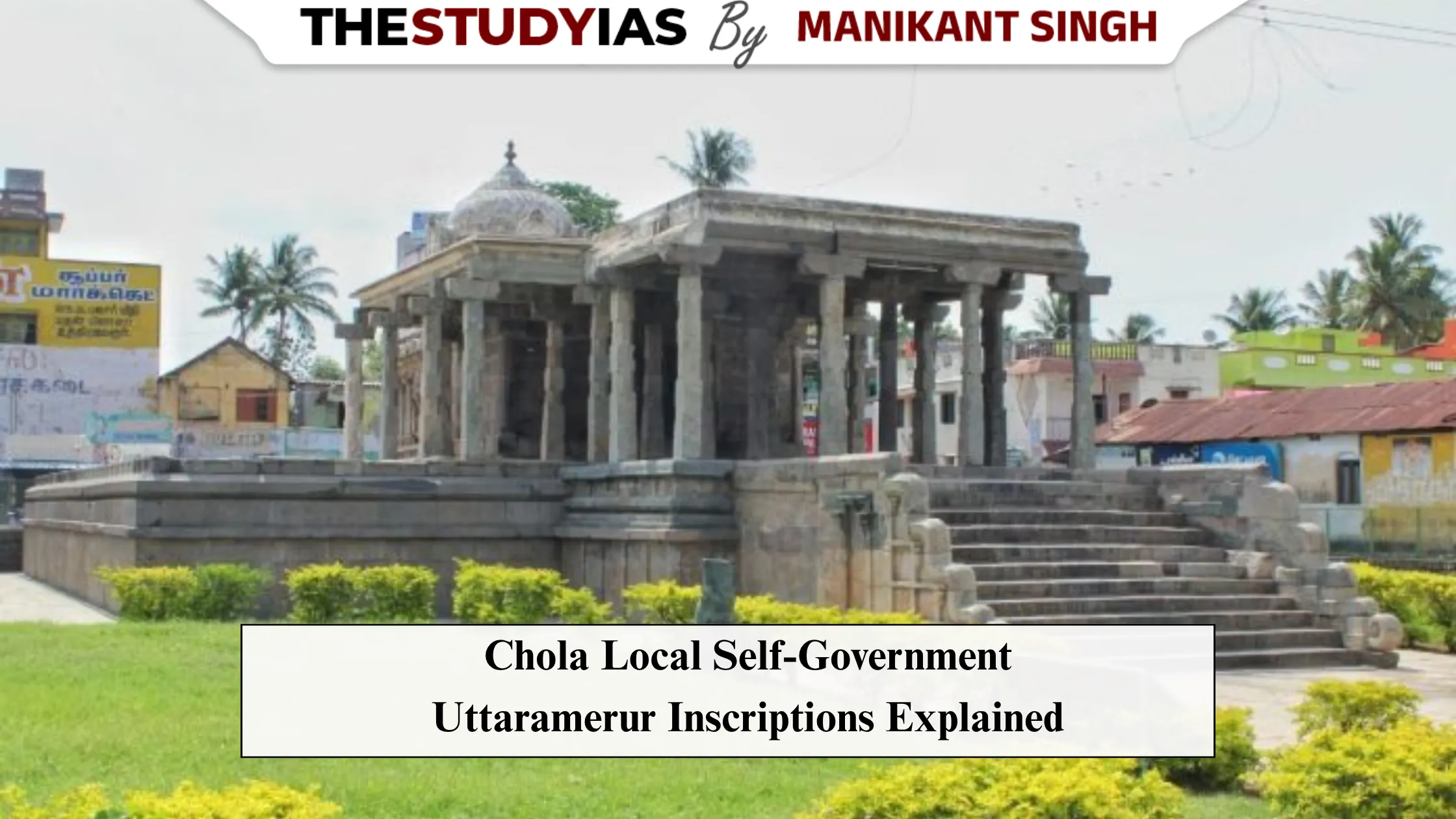
Chola Local Self-Government: Uttaramerur Inscriptions Explained
The Chola local self-government system is an important topic for UPSC History Optional, particularly for understanding Chola administration, village institutions and the relationship between the state and local society. The Uttaramerur inscriptions provide detailed evidence about the functioning of village assemblies, selection of committee members, qualifications, disqualifications and local administrative responsibilities.
The inscriptions show that the Cholas combined a strong monarchy with organised local institutions. However, Uttaramerur should not be presented as modern democracy. It represents a structured system of local participation and corporate administration within the wider Chola political framework.
Why Is Uttaramerur Important for UPSC?
The Uttaramerur inscriptions are important because they provide detailed inscriptional evidence about Chola village administration. They help historians understand how local institutions functioned and how responsibilities were distributed among different committees.
For UPSC History Optional, the topic can be used under the following themes:
Chola administration and polity
Local self-government in medieval India
Village assemblies and local institutions
Kudavolai system
Agrarian and irrigation administration
Brahmadeya settlements
Relationship between central authority and local institutions
Social and economic organisation of Chola villages
Uttaramerur: Location and Historical Background
Uttaramerur is located in present-day Kanchipuram district of Tamil Nadu. Historically, it developed as an important settlement in the Tamil region and was known as Uttaramerur Chaturvedimangalam, indicating its association with a Brahmin settlement.
The site is particularly famous for inscriptions found on the walls of the Vaikunta Perumal Temple. These inscriptions, especially those issued during the reign of Parantaka I, provide detailed information about the organisation and functioning of the village assembly.
The Uttaramerur inscriptions are therefore valuable not simply because they mention local administration, but because they provide specific rules regarding selection, qualifications, disqualifications and committee responsibilities.
Uttaramerur Inscriptions of Parantaka I
Two important inscriptions from the reign of Parantaka I are associated with the administrative system at Uttaramerur.
The inscription from the 12th regnal year describes rules for the selection of members for village committees.
The inscription from the 14th regnal year introduced modifications and provides further details about qualifications and disqualifications.
The modification of rules is significant because it indicates that local administrative arrangements could evolve according to practical requirements.
What Was the Sabha?
The Sabha was an important village assembly, particularly associated with Brahmadeya villages. At Uttaramerur, it played a major role in managing local affairs through different committees.
The Sabha should not be equated with a modern elected local government. Participation was subject to specific conditions relating to property, age, education and conduct.
For UPSC, the safest interpretation is that the Sabha represented an organised form of local corporate administration and participation within the Chola state.
Sabha, Ur and Nagaram
Chola local administration included different types of corporate institutions depending on the nature of the settlement.
Sabha: An assembly mainly associated with Brahmadeya villages.
Ur: An assembly associated with ordinary agricultural villages.
Nagaram: An organisation associated with urban and commercial centres.
These institutions show that Chola local administration was not based on one uniform model. Different communities and settlements had their own forms of organisation.
Kudavolai System
The Kudavolai system is the most famous feature of the Uttaramerur inscriptions. The term refers to a method of selecting members for village committees using a pot and written tickets.
The village was divided into wards. Names of eligible candidates were prepared, written on tickets and placed in a pot. Selection was then carried out according to the prescribed procedure.
The Kudavolai system demonstrates:
Ward-based organisation
Defined eligibility criteria
Institutional selection of representatives
Formation of specialised committees
Rules for disqualification
Administrative accountability
However, it is important to avoid describing Kudavolai simply as a modern electoral system because participation was restricted by specific eligibility conditions.
Qualifications for Committee Membership
The Uttaramerur inscriptions provide detailed rules regarding who could become a committee member. These conditions show that participation in local administration was regulated.
1. Age
The inscriptions prescribed specific age requirements for candidates. The later regulations required candidates to be above 35 and below 70 years of age.
2. Land Ownership
Candidates were expected to possess taxable land and a house on a legally owned site. This shows the connection between landholding, taxation and participation in local administration.
3. Education
Educational qualifications were also important. The inscriptions refer to knowledge of Vedic and related textual traditions.
4. Conduct
Candidates were expected to have a good reputation and be capable of fulfilling administrative responsibilities.
Thus, eligibility was based on a combination of age, property, education and conduct.
Disqualifications and Administrative Accountability
The Uttaramerur inscriptions also specify circumstances in which individuals could be disqualified from holding office.
A person who had previously served on a committee but failed to properly submit accounts could face disqualification. Certain restrictions could also extend to specified relatives.
This demonstrates that local administration involved not only participation but also accountability.
Chola Village Committees
The Uttaramerur inscriptions mention specialised committees responsible for different areas of village administration.
1. Annual Committee: The Annual Committee handled important general responsibilities within the village administration.
2. Garden Committee: The Garden Committee dealt with the management of gardens and related resources.
3. Tank Committee: The Tank Committee was responsible for matters related to irrigation tanks and water management.
The Tank Committee is particularly important because irrigation was closely connected with agriculture, revenue and the functioning of the agrarian economy.
Irrigation and Chola Local Administration
Irrigation played an important role in the agrarian economy of South India. Tanks and other water resources required regular maintenance and collective management.
The existence of a Tank Committee shows that local administration dealt with practical economic requirements rather than only political or social matters. Therefore, Uttaramerur can be used in UPSC answers to connect political administration with agrarian and economic history.
Land, Society and Local Administration
Land was central to Chola society and administration. The landholding requirement for committee membership shows that property ownership influenced participation in local institutions.
This connects several aspects of Chola society:
Land ownership
Taxation
Social status
Administrative participation
Agrarian production
Therefore, Uttaramerur is useful not only for studying administration but also for understanding the relationship between land, society and political participation.
Uttaramerur and Brahmadeya Settlements
Uttaramerur was a Chaturvedimangalam, a type of settlement associated with Brahmins learned in the four Vedas.
The Sabha described in the inscriptions must therefore be understood within this particular social context. Its system of participation cannot automatically be treated as representative of every village in the Chola Empire. This is an important limitation to mention in a History Optional answer.
Was Chola Local Administration Democratic?
The Uttaramerur system had certain features that may appear similar to representative institutions, such as selection of committee members, ward-based organisation, eligibility rules, rotation and disqualification.
However, it was not modern democracy. Participation was restricted by conditions relating to property, age, education and social position.
Therefore, a balanced UPSC formulation would be: Uttaramerur represents an organised system of local corporate administration and participation rather than modern democratic self-government. This distinction makes the answer more historically accurate.
Was Chola Administration Decentralised?
The Uttaramerur inscriptions are often used as evidence of decentralisation in Chola administration. However, decentralisation should not be understood as complete local autonomy.
The Chola state retained strong royal authority, territorial administration and control over broader political and revenue structures. At the same time, village assemblies handled several local responsibilities.
This combination is one of the most important analytical points for UPSC History Optional.
Chola Central Administration and Local Institutions
The Chola administrative structure operated at several levels. The king remained the central political authority, while regional and local institutions handled different administrative responsibilities.
At the village level, institutions such as the Sabha, Ur and Nagaram played important roles.
This arrangement allowed the Chola state to maintain broader political authority while relying on local institutions for several everyday administrative functions.
Importance of Uttaramerur as a Historical Source
The importance of the Uttaramerur inscriptions lies in their detailed nature. They do not merely praise a ruler or describe a military achievement. Instead, they provide specific information about how a local institution functioned.
They provide evidence about:
Village assemblies
Committee selection
Eligibility conditions
Disqualifications
Administrative responsibilities
Landholding
Irrigation management
Local accountability
This makes Uttaramerur one of the most important inscriptional sources for understanding Chola local administration.
Limitations of Uttaramerur Evidence
Despite its importance, Uttaramerur should not be treated as a universal model of Chola village administration.
The evidence comes from a specific settlement with particular social and institutional characteristics. Uttaramerur was a Brahmadeya settlement, and the inscriptions primarily describe the functioning of its Sabha.
Therefore, the system cannot automatically be assumed to have operated in exactly the same manner in every Chola village.
This qualification can add depth to a History Optional answer.
Uttaramerur and Temple Institutions
The inscriptions are preserved on the walls of the Vaikunta Perumal Temple, making the temple an important source for reconstructing Chola administrative history.
More broadly, Chola temples were important social and economic institutions. Their inscriptions provide information about land, donations, administrative arrangements, local institutions and economic activities.
Thus, temple inscriptions are an important source for studying the wider relationship between religion, economy, society and administration in South India.
Uttaramerur: Important Terms for UPSC
Uttaramerur for UPSC History Optional
The Uttaramerur inscriptions can be used across several themes in History Optional.
Chola Administration: Use them to explain village assemblies, committees and local institutions.
Local Self-Government: Use them as evidence of organised local participation, while avoiding the modern-democracy analogy.
Agrarian Economy: Use the landholding and irrigation aspects to connect administration with agriculture.
Social History: Use eligibility conditions to discuss the role of property, education and social status.
State Formation: Use Uttaramerur to explain how strong royal authority could coexist with developed local institutions.
How to Use Uttaramerur in a Mains Answer
Instead of simply writing that “the Cholas had local self-government,” build the argument around evidence.
Argument: The Chola state combined strong monarchical authority with developed local institutions.
Evidence: The Uttaramerur inscriptions of Parantaka I describe the Sabha, Kudavolai system, committees, qualifications and disqualifications.
Analysis: This demonstrates significant institutional participation at the village level, but participation was restricted by specific social and economic conditions.
Conclusion: Chola administration therefore combined central political authority with substantial local corporate organisation.
This approach is more effective for History Optional because it combines argument, evidence and analysis.
Prelims Quick Revision
Uttaramerur: Tamil Nadu and Chola administration
Parantaka I: Associated with the important Uttaramerur inscriptions
Kudavolai: Method of selecting committee members
Sabha: Assembly associated particularly with Brahmadeya villages
Ur: Assembly associated with ordinary agricultural villages
Nagaram: Urban and commercial organisation
Tank Committee: Irrigation and water management
Vaikunta Perumal Temple: Important site of Uttaramerur inscriptions
Key theme: Local administration within a strong Chola monarchy
Important caution: Uttaramerur should not be equated with modern democracy
Conclusion
The Uttaramerur inscriptions provide detailed evidence of the institutional structure of Chola local administration. They show how village assemblies, specialised committees and defined selection procedures operated within the wider Chola political system.
The Kudavolai system, eligibility conditions, disqualifications and committee structure demonstrate an organised form of local participation and administrative accountability. At the same time, participation was shaped by property, age, education and social conditions.
The real significance of Uttaramerur, therefore, lies not simply in the phrase “Chola local self-government.” It demonstrates how strong monarchical authority and local corporate institutions could function together.
For UPSC History Optional, Uttaramerur should be used as evidence for the complex relationship between state authority, village institutions, land, irrigation, social structure and local administration in medieval South India.
Frequently Asked Questions About Chola Local Self-Government
1. What is the Uttaramerur inscription?
The Uttaramerur inscriptions are important Chola-period inscriptions that provide detailed information about village administration, local assemblies, committee selection, qualifications and disqualifications. They are mainly associated with the reign of Parantaka I.
2. Where is Uttaramerur located?
Uttaramerur is located in present-day Kanchipuram district of Tamil Nadu. It was known as Uttaramerur Chaturvedimangalam and is particularly famous for inscriptions found at the Vaikunta Perumal Temple.
3. What is the Kudavolai system?
The Kudavolai system was a method used to select members for village committees. Names of eligible candidates were written on tickets and placed in a pot, from which selection was carried out according to the prescribed procedure.
4. What was the Sabha in Chola administration?
The Sabha was a village assembly, particularly associated with Brahmadeya settlements. It managed various local affairs through specialised committees and played an important role in Chola village administration.
5. Was Uttaramerur a democratic system?
Uttaramerur should not be equated with modern democracy. It provided an organised system of local participation and administration, but participation was restricted by conditions relating to property, age, education and social status.
6. What were the major committees mentioned in the Uttaramerur inscriptions?
The inscriptions mention specialised committees dealing with different areas of village administration. Important examples include the Annual Committee, Garden Committee and Tank Committee.
7. Who issued the Uttaramerur inscriptions?
The important Uttaramerur inscriptions describing village administration belong to the reign of Parantaka I Chola. The inscriptions from his 12th and 14th regnal years are particularly important for understanding the system.
8. What is the importance of Uttaramerur for UPSC History Optional?
Uttaramerur is important for understanding Chola local administration, village assemblies, Kudavolai, irrigation management, agrarian society and the relationship between central authority and local institutions.
9. What is the difference between Sabha, Ur and Nagaram?
The Sabha was mainly associated with Brahmadeya villages, the Ur with ordinary agricultural villages, and the Nagaram with urban and commercial centres.
10. Why are the Uttaramerur inscriptions historically important?
They provide detailed inscriptional evidence about the functioning of local institutions, including selection procedures, eligibility conditions, disqualifications and committee responsibilities. They therefore help historians understand the institutional nature of Chola village administration.
11. Does Uttaramerur prove that Chola administration was completely decentralised?
No. The evidence suggests that local institutions had significant administrative responsibilities, but they functioned within a wider Chola monarchy and territorial administrative structure. It is more accurate to describe the system as local institutional participation within a strong monarchical framework.
12. What is the most important point to remember about Uttaramerur for UPSC?
The key point is that the Chola state combined strong central political authority with organised local institutions. Uttaramerur provides detailed evidence of this relationship through the Sabha, Kudavolai system and village committees.
For more UPSC-oriented articles and preparation resources, explore The Study IAS.
Subscribe to our Youtube Channel for more Valuable Content –TheStudyias
Download the App to Subscribe to our Courses –Thestudyias
The Source’s Authority and Ownership of the Article is Claimed ByTHE STUDY IAS BY MANIKANT SINGH
Comments (0)
Leave a Comment