WHAT IS UPSC CSE ?
UPSC CSE is the national, three-stage examination conducted by the Union Public Service Commission to recruit to the All India Services (IAS, IPS, IFoS) and Central Civil Services. It consists of Preliminary (objective), Mains (descriptive), and Personality Test (Interview). Official structure and rules are defined in the annual CSE Notification and FAQs issued by UPSC.
UPSC CSE Prelims — Structure, Nature & What It Measures
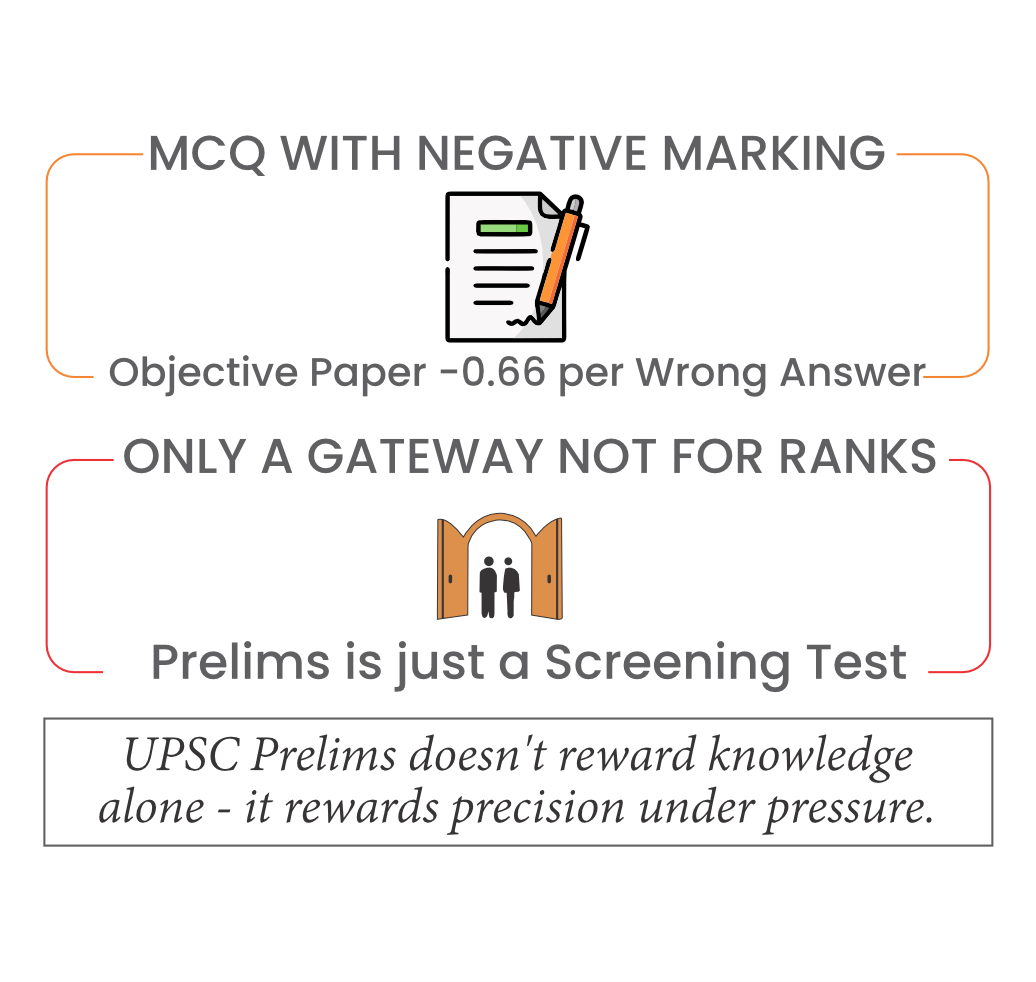
One day, two objective papers (OMR). Each paper is 200 marks / 2 hours. GS Paper-II (CSAT) is qualifying at 33%; only GS Paper-I is used to decide who moves to Mains. Question papers are set in English and Hindi. Negative marking is one-third for wrong answers.
Paper 1: General Studies (GS) — Merit Screen (200 marks)
Nature: Objective, broad-spectrum general studies. OMR based. Historically ~100 questions (varying year to year).
Objective:what UPSC is actually checking:
- Conceptual breadth across History, Geography, Polity, Economy, Environment, Science.
- Current events linkage—applying static concepts to contemporary issues.
- Precision under risk (because of negative marking). Syllabus heads are listed verbatim in the official notice (current events; Indian History & National Movement; Indian & World Geography; Polity & Governance; Economic & Social Development; Environment & Ecology; General Science).
Scoring logic: Your GS-I score alone decides shortlisting to Mains (subject to CSAT qualification). Cut-off PDFs explicitly state: “Cut-off marks on the basis of GS Paper-I only. GS Paper-II is qualifying (33%).”
Paper 2: CSAT (General Studies-II) — Qualifying (200 marks)
Nature: Objective aptitude test; ~80 questions historically. Areas: comprehension, interpersonal skills, logical/analytical reasoning, decision-making, basic numeracy, data interpretation.
Objective: Verify a minimum floor of aptitude for administration—reading accuracy, reasoning discipline, and essential numeracy under time pressure. It is qualifying at 33%; fail this and your GS-I isn’t even considered.
Brutal truth: many otherwise strong candidates miss the cycle on CSAT. Treat it as a risk to be neutralised, not as an afterthought. (Rule is explicit: 33% minimum).
Marking, Language & Logistics (the non-negotiables)
- Negative marking: 1/3rd of the question’s marks deducted per wrong answer; multiple marked answers = wrong; blanks get no penalty.
- Medium: Question papers in Hindi and English (language papers apart).
- Mode: OMR, black ball-point pen only; do not bring banned items (mobiles / smart watches / IT gadgets).
- PwBD support: Scribe (as eligible) and compensatory time = 20 minutes per hour of the exam for notified categories—check the year’s notice and PwBD FAQ.
Who Qualifies for Mains?
UPSC calls about 12–13× the vacancies to the Mains stage, subject to minimum qualifying standards—this ratio is stated in the exam notice. Your CSAT must be qualified; shortlisting rank is by GS-I score only.
Who Qualifies for Mains?
UPSC publishes official answer keys and cut-offs only after the entire CSE cycle concludes (i.e., post final result). Example: CSE-2024 official answer keys were released after results; cut-off PDFs also reiterate the GS-I rule.
Exam-Day Checklist (keep this ruthlessly simple)
- E-Admit Card + valid ID, report early; obey frisking.
- Two black ball-point pens (no gel/ink), simple transparent stationery.
- No mobile/smartwatch/IT gadgets; leave valuables at home.
- OMR hygiene: fill bubbles cleanly; encode booklet series/roll number exactly as shown.
100 Questions · 2 Hours · 200 Marks
80 Questions · 2 Hours · 200 Marks
Here’s the lowdown on the UPSC CSE Mains exam pattern—straight from the rulebook, no fluff.
UPSC CSE Mains — Structure, Subjects & What They Measure
About 12–13× the vacancies are called for this stage. It has 9 papers, including 2 qualifying language papers (any Indian language and English), and an optional subject of your choice (from the given list). Papers are descriptive, and the marking is subjective.
Qualifying Papers (Not counted in merit):
- Paper A: Indian Language (300 marks)
- Paper B: English (300 marks)
Objective: Assess basic language skills, comprehension, and ability to express ideas clearly and effectively in the medium of the exam.
Merit Papers (Counted in merit):
- Paper 1: Essay (250 marks)
- Paper 2: General Studies I (Indian Heritage, History, and Geography of the World and Society) (250 marks)
- Paper 3: General Studies II (Governance, Constitution, Polity, Social Justice and International relations) (250 marks)
- Paper 4: General Studies III (Technology, Economic Development, Bio-diversity, Environment, Security and Disaster Management) (250 marks)
- Paper 5: General Studies IV (Ethics, Integrity, and Aptitude) (250 marks)
- Optional Subject Papers 1 & 2 (from the selected optional subject) (250 marks each)
Objective: Evaluate understanding, analytical ability, and critical thinking on a wide range of topics. The essay tests your ability to articulate thoughts coherently and engage with complex issues.
Who Qualifies for the Interview?
UPSC calls about twice the number of vacancies for the Interview (Personality Test) based on Mains merit. Both Mains and Interview marks are considered for the final ranking.
Exam-Day Checklist (Mains)
- Same as Prelims, plus any allowed items for the exam as per the latest guidelines.
UPSC MAINS EXAM — PAPERS
The Personality Test carries 275 marks (no minimum qualifying mark). Its score is added to the 1750 Mains marks to form the final 2025. You are interviewed by a Board that has your record (DAF) before it and asks on matters of general interest to judge your suitability for public service.
What UPSC actually evaluates
UPSC explicitly lists the qualities it looks for: mental alertness; critical powers of assimilation; clear and logical exposition; balance of judgment; variety and depth of interests; ability for social cohesion and leadership; intellectual and moral integrity. Translation: it’s about how you think, not how much you can recite.
Medium of the interview (your choice)
You indicate your language medium for the Interview in the DAF. Candidates may take the interview in Hindi or an Indian language (Eighth Schedule) or English; UPSC’s FAQs and reports document this practice. Pick a medium you can argue crisply in.
DAF-II & scheduling (non-negotiables)
- After Mains, UPSC opens DAF-II. Failure to submit within the window leads to cancellation of candidature; the Commission publishes the Interview schedule via notices.
- The Interview is conducted in New Delhi (Dholpur House); official notices carry venue details.
Documents & verification
UPSC conducts original-document verification at/around the Personality Test stage. You must upload and produce proofs (age, degree, category, PwBD, EWS I&AC, etc.) as per instructions in the DAF and relevant notices. If you can’t substantiate a claim, you risk cancellation.
Travel allowance (TA)
For the CSE Interview, UPSC’s Interview notices specify TA claim instructions (e.g., submit both-way ticket printouts with fare details along with the prescribed TA form). Don’t expect reimbursement without proof.
Format & flow (what to expect)
- Board has your DAF; questions often pivot around your education, work, home state, interests, current affairs, service preferences, and how you reason through trade-offs.
- The interaction is conversational; grandstanding or ideological rants are penalised—they’re testing judgment under light pressure, not theatrics. (UPSC’s own wording—”The Interview/Personality Test is intended to judge the mental calibre of a candidate… an assessment of intellectual qualities, social traits and interest in current affairs.”—makes this clear.)
Scoring reality
- No sectional cut-offs within the Interview; it’s a single 275-mark assessment added to Mains.
- A strong Interview can significantly move your rank; a poor one can sink an otherwise decent Mains total—because final merit = 1750 + 275.
Ruthless, exam-safe prep list (what actually helps)
- Audit your DAF line-by-line. If it’s written there, it’s fair game—have evidence-based, balanced positions. (UPSC Board explicitly has your record.)
- Practise clear, short answers that show structure: stance → reason → example → risk/limit → policy sense.
- Medium discipline. Choose the interview language you can argue in—not the one you think looks “smart.” UPSC allows choice via DAF.
- Know the rules. Track Interview notices for your batch (dates, reporting time, TA, document lists). Don’t rely on Telegram forwards.
Day-of checklist
- E-summon letter + valid ID, reach early; obey frisking/security.
- Originals + photocopies as instructed (age, degree, caste/EWS/PwBD, etc.).
- TA form + tickets if you plan to claim TA.
- Consistent medium (as per your DAF) and a calm, balanced tone—they reward judgment.
If you want, I can bolt this into your page with anchors and add a compact Interview FAQ (e.g., “Can I switch the medium?” “What if my DAF has a mistake?”) using only UPSC-verifiable answers.
Eligibility: Age, Attempts, Education, Nationality
- Educational Qualification: a Bachelor’s degree from a recognised university; final-year candidates may apply subject to proof before Mains.
- Age limit (as per latest notifications): 21–32 years for General category on the crucial date; relaxations apply—+3 years OBC, +5 years SC/ST, +10 years for PwBD (combinable as applicable) up to the prescribed maxima.
- Number of attempts: General/EWS – 6, OBC – 9, SC/ST – till age limit, PwBD as per category rules.
- Nationality: Indian for IAS/IPS; detailed rules vary for other services. These specifics are codified only in the official CSE Notification each year—always check the current cycle. Subscribe to our Notification and stay updated with Latest UPSC CSE news.
PERSONALITY TEST (INTERVIEW)
- Held — January - February (Post-Mains)
- Marks — 275 (Added to Mains total)