History Optional by Manikant Sir
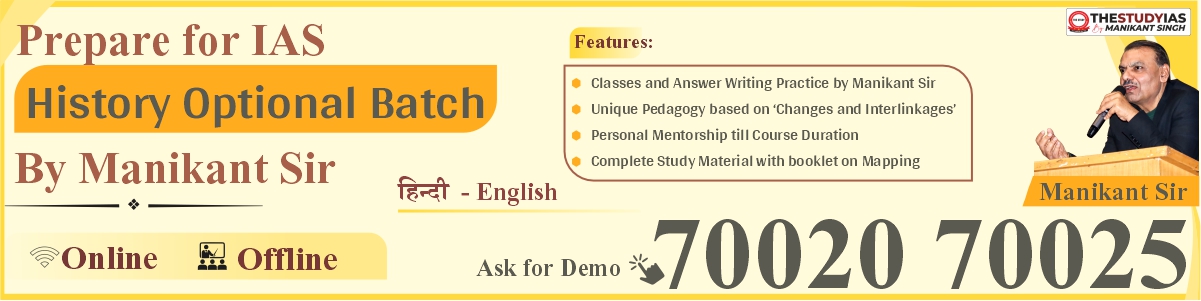
History Optional by Manikant Sir
History Optional by Manikant Sir
About the UPSC History Optional Course by Manikant Singh
The UPSC History Optional Course by The Study IAS is a complete Paper I and Paper II preparation programme personally taught by Manikant Singh. It is designed for aspirants who want to prepare History as an analytical optional subject rather than as a collection of dates, facts and disconnected notes.
The programme is suitable for complete beginners as well as repeat aspirants. Students are taken from foundational understanding to Mains-level application through conceptual sequencing, historiography, map integration, PYQ analysis, answer writing and personalised academic guidance.
Structure Before Speed
History Optional becomes difficult when aspirants read widely without first understanding the structure of the syllabus, the relationship between periods and the way UPSC frames questions. This programme begins by organising the subject into a coherent system so that every topic has a place, a context and a clear examination purpose.
The focus is not on memorising more content. It is on understanding what changed, why it changed, what continued, what caused the change and how one development connects with another. This “Changes & Interlinkages” approach is central to the way Manikant Singh teaches History Optional.
Personally Taught by Manikant Singh
The complete History Optional course is positioned around direct teaching by Manikant Singh himself. Existing programme materials specifically state that he covers the full syllabus, including map practice and answer-writing orientation, creating continuity in the way Ancient, Medieval, Modern Indian and World History are taught.
Answer Writing from Day One
Answer writing is not postponed until the syllabus is complete. The current programme introduces writing from the beginning and integrates it into the teaching process. Students learn to interpret the exact demand of a question, organise arguments, use relevant historical evidence, bring historiographical viewpoints into answers and write within UPSC time and word constraints.
Previous Year Questions are used not merely as practice material but as a way to understand recurring themes, question language, depth and examiner expectations.
Historiography and Use of Historians’ Views
A strong History Optional answer needs more than narrative. Students are trained to understand different interpretations, schools of thought, debates and historians’ perspectives so that answers become analytical and academically grounded rather than descriptive.
The objective is to learn where a historian’s view adds value, how to use it naturally and how to balance competing interpretations without turning an answer into a collection of quotations.
Mapping Integrated with the Subject
Map preparation is taught alongside the relevant historical themes rather than treated as a disconnected final-stage exercise. A separate mapping booklet and topic-wise map integration help students connect locations with archaeological sites, political centres, cultural developments, trade routes and other syllabus areas.
Complete Paper I and Paper II Coverage
The programme covers the complete UPSC History Optional framework across Ancient India, Medieval India, Modern India, post-Independence themes and World History, together with the art, culture, sources, historiography and map-based dimensions required for the examination.
Personalised Mentorship and Academic Support
The course includes personalised academic guidance supported by a mentor system. Mentorship is used to resolve doubts, identify weak areas, improve answer-writing quality, plan revision and keep preparation aligned with the demands of Paper I and Paper II.
Study Material Designed for Revision and Application
Course resources include exam-oriented notes and learning material, PYQs, thematic/class handouts and mapping support. The purpose of the material is to reduce random source collection and provide a structured base that students can repeatedly revise and use in answer writing.
History Optional and GS / Essay Overlap
History Optional preparation naturally strengthens several areas of General Studies, particularly History and Culture in GS Paper I, and can also enrich Essay through historical examples, comparative perspectives and long-term social, political and economic context. This overlap should be treated as a secondary benefit; the course itself remains fully focused on Optional-level depth.
Who Should Join?
- Complete beginners who have selected History Optional and need a structured starting point
- Aspirants who find History bulky because their preparation is based on scattered sources
- Students who know content but struggle to convert it into analytical answers
- Repeat candidates who need stronger historiography, interlinkages, maps, PYQ analysis or writing practice
- Hindi or English medium aspirants looking for Offline, Live-Online or Recorded learning options
Current Post-Foundation Support
The current History Optional foundation-program positioning includes access to the History Optional Performance Enhancement Program (PEP) for the Mains stage. Because package inclusions can change between admission cycles, PEP access should be confirmed in the active batch configuration before it is hard-coded as a permanent entitlement.
Course Curriculum & Modules
Module 1: History Optional Orientation & Syllabus Decoding
Understanding Paper I and Paper II, syllabus depth, topic hierarchy, PYQ trends, source discipline and the relationship between reading, revision and answer writing.
Module 2: Ancient India
Sources, prehistory and protohistory, Indus/Harappan civilisation, Vedic developments, state formation, religious movements, Mauryan and post-Mauryan developments, Gupta and post-Gupta themes, regional formations, society, economy, religion, art and culture.
Module 3: Medieval India
Early medieval transition, regional powers, Delhi Sultanate, Vijayanagara and Bahmani developments, Mughal state and economy, Marathas, society, religion, Bhakti-Sufi traditions, agrarian structures, culture and historical interpretations.
Module 4: Modern Indian History
European penetration, British expansion, colonial state, economy and society, reform movements, resistance, 1857, nationalism, Gandhian phase, constitutional developments, communalism, independence and related historiographical debates.
Module 5: Post-Independence Themes
Nation-building, consolidation, reorganisation and other post-1947 historical themes relevant to the notified History Optional syllabus.
Module 6: World History
Enlightenment and revolutions, industrialisation, nationalism, imperialism and colonialism, world wars, Russian Revolution, inter-war developments, decolonisation, post-war political and economic transformations and major international historical processes.
Module 7: Historiography & Historical Debates
Schools of historical interpretation, historians’ viewpoints, source criticism, competing explanations and the use of historiography in UPSC answers.
Module 8: Mapping for History Optional
Integrated map practice linked with historical sites, regions, political centres, trade routes, cultural locations and syllabus themes, supported by dedicated mapping material.
Module 9: PYQ Analysis & Topic Mapping
Reverse-engineering previous UPSC questions to identify recurring themes, depth, language, repetition, conceptual linkages and likely areas requiring deeper preparation.
Module 10: Answer Writing from Day One
Question-demand decoding, introductions, argument structure, chronology, cause-effect analysis, continuity and change, historiography, maps, examples, conclusions and time-bound writing.
Module 11: Revision & Retention System
Theme-based revision, recall, short-note consolidation, syllabus tracking, PYQ-led revision and converting extensive course learning into exam-usable material.
Module 12: Personalised Mentorship
Doubt resolution, weak-area diagnosis, answer-review guidance, preparation planning, revision strategy and Paper I/Paper II balance.
Teaching Pedagogy & Approach
The course follows a concept → change → cause → consequence → interlinkage → historiography → application learning cycle. Historical developments are taught in sequence but are constantly connected across periods and themes so that students understand continuity, transformation and comparison.
Manikant Singh’s approach places particular emphasis on changes and interlinkages. Students are encouraged to study vertically within a topic and horizontally across related developments. This reduces fragmented learning and helps build arguments for analytical UPSC questions.
Historiography, sources and maps are integrated into the relevant topic rather than added at the end. PYQs are used to understand how UPSC converts syllabus terms into questions, while answer writing starts from the beginning so that knowledge and expression develop together.
The programme is therefore designed as a complete Optional preparation system rather than a lecture-only course: learn, connect, write, receive guidance, revise and reapply.
Key Highlights
- Complete History Optional Paper I + Paper II
- Personally Taught by Manikant Singh
- Suitable for Beginners and Repeat Aspirants
- Changes & Interlinkages Pedagogy
- Answer Writing from Day One
- In-Class Answer Writing Orientation
- Historiography & Historians’ Views
- PYQ Analysis and Topic Mapping
- Integrated Map Practice
- Dedicated Mapping Booklet / Material
- Ancient + Medieval + Modern India + Post-Independence + World History
- Exam-Oriented Notes and Learning Material
- Personalised Mentorship / Mentor Support
- Current Foundation Positioning Includes PEP Support for the Mains Stage — package confirmation required
Frequently Asked Questions (FAQs)
Is the History Optional Course suitable for complete beginners?
Yes. The current programme is explicitly designed as a foundation course for beginners as well as repeat aspirants. It does not assume an academic background in History.
Who teaches the History Optional Course?
The course is positioned as being personally taught by Manikant Singh, including the major syllabus modules, mapping and answer-writing orientation.
Does the course cover both History Optional papers?
Yes. It is a complete Paper I and Paper II course covering Ancient, Medieval and Modern Indian History, post-Independence themes and World History along with historiography, maps, PYQs and answer writing.
When does answer writing begin?
Answer writing is introduced from Day One and is built into the course pedagogy rather than being postponed until syllabus completion.
Is mapping included?
Yes. Mapping is integrated with the relevant historical topics and is supported by dedicated mapping material/booklet.
Is historiography taught?
Yes. The programme teaches historians’ interpretations, debates and different schools of thought and trains students to use them appropriately in Mains answers.
Are Previous Year Questions included?
Yes. PYQs are used for topic mapping, question-demand analysis and answer-writing practice.
Is the course available online?
Yes. The current programme offers Offline, Live-Online and Recorded options in Hindi and English.
What are the current fees?
The current public campaign lists ₹55,000 for Hindi Offline, ₹65,000 for English Offline, ₹20,000 + GST for Live-Online and ₹15,000 + GST for Recorded. GST wording on the same campaign page is internally inconsistent, so the final admin-panel tax configuration should be confirmed before publication.
How long is the course?
The existing complete-course description records a duration of approximately 5–6 months. The active batch calendar should be checked before displaying an exact duration or completion date.
Is mentorship included?
Yes. Personalised academic guidance and mentor support are part of the programme structure described in existing course materials.
Does History Optional help with General Studies and Essay?
Yes. History preparation overlaps particularly with History and Culture in GS Paper I and can provide useful historical examples and perspective for Essay. The Optional course, however, is taught at a substantially deeper level than GS History.
Is PEP included with the foundation course?
The current programme page states that students receive access to the History Optional Performance Enhancement Program for the Mains stage. Confirm this against the active package before making it a permanent website promise.