GS Manthan - Current Affairs by Manikant Sir
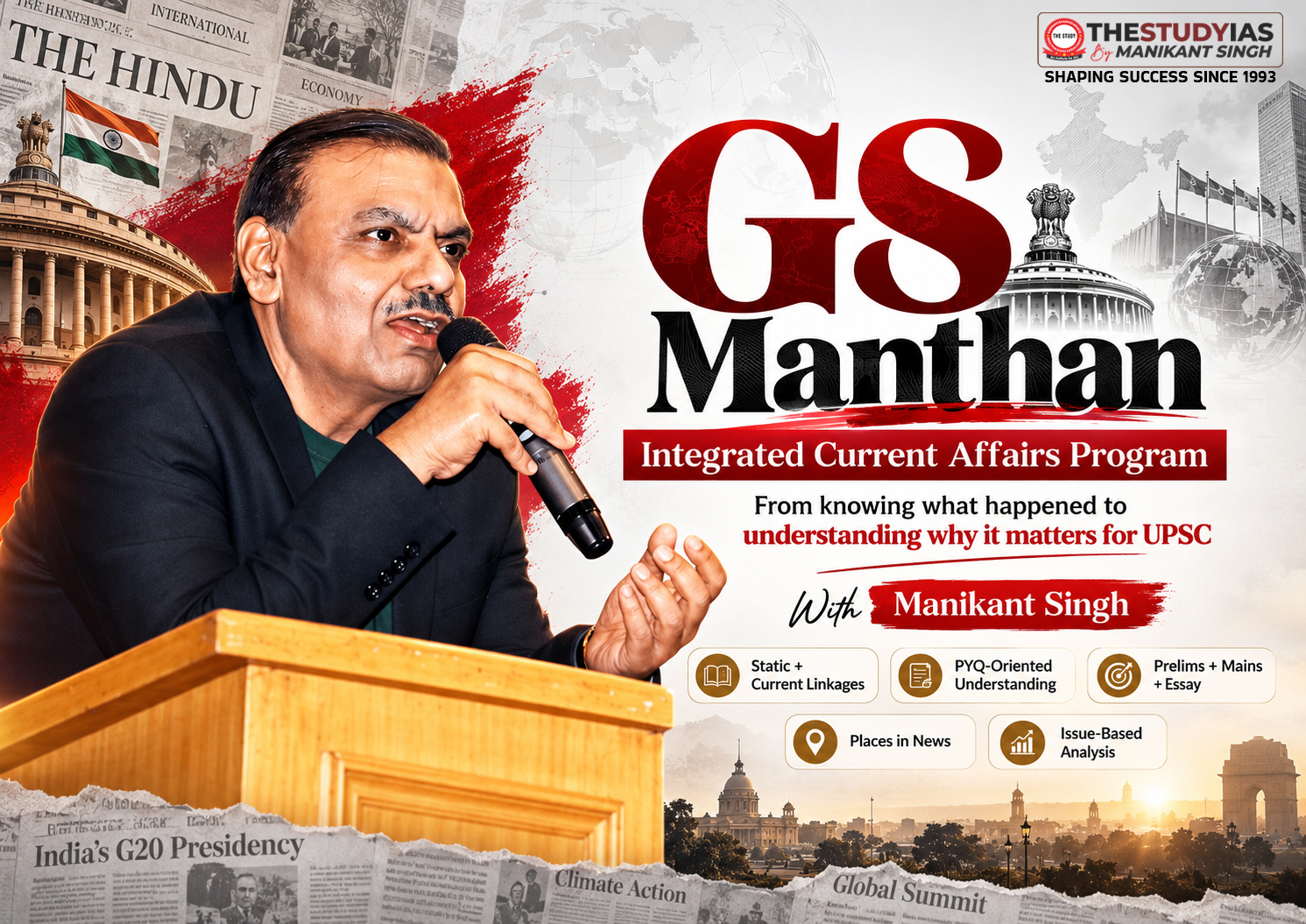
GS Manthan - Current Affairs by Manikant Sir
GS Manthan - Current Affairs by Manikant Sir
GS Manthan: Current Affairs the Way UPSC Actually Uses It
You may read the newspaper every day, follow daily Current Affairs, save monthly Current Affairs PDFs and still struggle when a Mains question appears from the very issue you studied. The problem is usually not lack of information. The problem is that information was never converted into a UPSC-ready framework.
GS Manthan is a 1-year online UPSC Current Affairs course by Manikant Singh built to solve that gap. Important national and international developments are connected with Static GS, the UPSC syllabus, PYQs, Prelims, Mains answer writing and Essay so that Current Affairs becomes usable knowledge rather than a separate burden.
Course Fee: ₹2,500 for 1 Year | Mode: Online | Medium: Hindi & English
Reading Current Affairs Is Not Enough
UPSC rarely asks, “What happened in the news?” It asks through concepts, causes, consequences, institutions, constitutional provisions, economic implications, geographical context, international relations, social impact, ethical dimensions and policy choices.
GS Manthan therefore does not stop at news explanation. It trains students to ask: What is the static concept behind this issue? Where does it fit in the syllabus? Has UPSC asked a related PYQ? What dimensions can become a Mains answer? What facts, locations or institutions can become a Prelims question?
Static GS + Current Affairs + PYQ + Application
Each important issue is studied through an integrated chain: Current Development → Background → Static GS → Syllabus Linkage → PYQ Pattern → Prelims Relevance → Mains & Essay Application.
This approach strengthens both Current Affairs and General Studies. Polity Current Affairs becomes easier when connected with constitutional concepts; Economy Current Affairs becomes clearer through basic economic principles; International Relations Current Affairs gains meaning through geography, history and strategic interests; Environment, Science & Technology, Society, Internal Security and Governance are understood through the same connected method.
How GS Travelled This Week
A signature learning approach in GS Manthan is “How GS Travelled This Week”. One contemporary issue may travel across Polity, Economy, Geography, History, International Relations, Environment, Society, Ethics and Essay.
Students learn to trace these interlinkages instead of storing the same issue in separate subject silos. This develops the multidimensional thinking required for UPSC Mains while simultaneously strengthening conceptual elimination for Prelims.
UPSC Current Affairs for Prelims
For Prelims Current Affairs, the focus is not indiscriminate fact collection. Important issues are converted into concepts, institutions, reports, schemes, locations, statements and elimination cues. Places in News adds map-based and geographical context wherever relevant.
This makes the programme useful for aspirants looking for UPSC Current Affairs for Prelims, current-affairs-linked MCQ practice, PYQ-based understanding and revision-ready factual context without drowning in low-value news.
UPSC Current Affairs for Mains Answer Writing
Mains requires more than remembering a current event. Students need background, stakeholders, causes, consequences, challenges, constitutional or institutional dimensions, data/examples, counter-arguments and a balanced way forward.
GS Manthan converts important issues into these answer-building dimensions. The aim is to help students use Current Affairs in GS Paper 1, GS Paper 2, GS Paper 3, GS Paper 4 and Essay wherever relevant, rather than adding random examples at the last moment.
Current Affairs for Essay and Ethics
Contemporary events often provide the strongest examples for Essay and Ethics, but only when they are understood beyond headlines. GS Manthan identifies larger themes, competing values, governance dilemmas, social changes, technological questions and policy debates that can enrich analytical writing.
Weekly Current Affairs Analysis, Not a News Dump
Many aspirants search for daily Current Affairs, monthly Current Affairs, newspaper analysis, Current Affairs notes and Current Affairs magazines because they fear missing information. GS Manthan follows a different principle: selection before accumulation.
The programme filters examination-relevant developments and organises them through issue-wise analysis, static linkages and revision. The objective is not to discuss every headline; it is to ensure that the issues you study can actually be recalled, connected and applied in the examination.
Current Affairs Notes, Handouts, Practice and Revision
Structured handouts and revision-oriented material support the learning cycle. Current Affairs practice and tests help students check whether they can recall facts, understand concepts, identify interlinkages and apply an issue in Prelims or Mains format.
The programme is therefore designed not only as a Current Affairs class, but as a Current Affairs preparation system—learn, connect, practise, revise and apply.
Subjects and Current Affairs Areas Covered
Depending on the relevance of the week’s issues, GS Manthan can connect Current Affairs with Indian Polity & Constitution, Governance, Economy, International Relations, Geography, Environment & Ecology, Science & Technology, Society, Social Justice, Internal Security, Disaster Management, History & Culture, Ethics and Essay.
The emphasis is always on UPSC syllabus relevance rather than artificial subject boundaries.
Who Should Join GS Manthan?
- Beginners who do not know how to start Current Affairs preparation for UPSC
- Aspirants overwhelmed by newspapers, YouTube updates, websites, daily Current Affairs and monthly compilations
- Prelims aspirants who need Current Affairs with concepts, PYQs, elimination and Places in News
- Mains aspirants who want issue analysis, examples, arguments and better answer enrichment
- Repeat aspirants who know facts but struggle to connect Current Affairs with Static GS
- Students looking for a structured UPSC Current Affairs online course with Manikant Singh
GS Manthan in One Line
Know the issue. Connect it with GS. Understand the UPSC demand. Use it in the examination.
1-Year Online Course | Fee: ₹2,500
Course Curriculum & Modules
Weekly UPSC Current Affairs Analysis
Selection and analysis of important national and international developments for examination relevance.
How GS Travelled This Week
Tracing one issue across multiple GS subjects and papers to build interlinkages.
Static + Current Integration
Connecting contemporary developments with core GS concepts so Current Affairs strengthens static preparation.
UPSC Syllabus Mapping
Locating each major issue within relevant Prelims and Mains syllabus themes.
PYQ-Oriented Understanding
Using previous-year-question patterns to understand recurring UPSC themes without making speculative question predictions.
Prelims Current Affairs Application
Concepts, factual context, institutions, reports, schemes, places and elimination-oriented practice.
Mains Current Affairs Application
Issue dimensions, arguments, examples, challenges and balanced way-forward frameworks for answer writing.
Essay & Ethics Enrichment
Contemporary examples, themes, dilemmas and arguments that can strengthen analytical writing.
Current Affairs Notes & Revision Material
Structured handouts and revision-oriented material for consolidation.
Practice & Tests
Current-affairs-linked practice to test recall, conceptual understanding, interlinkages and application.
Places in News
Map-based and geographical context for important places appearing in current developments.
Teaching Pedagogy & Approach
Interlinkage-First Current Affairs Pedagogy
GS Manthan follows an interlinkage-first method rather than a headline-first method. The learning sequence is: Select the issue → understand the background → identify the static concept → map it to the syllabus → connect relevant PYQs → examine Prelims possibilities → build Mains/Essay dimensions → practise → revise.
The goal is to create a repeatable Current Affairs mindset that students can use independently throughout their UPSC preparation.
Key Highlights
- 1-Year Online UPSC Current Affairs Course
- Current Affairs with Manikant Singh (Manikant Sir)
- Static GS + Current Affairs Integration
- How GS Travelled This Week
- UPSC Syllabus Mapping & PYQ Linkages
- Prelims Current Affairs + Mains Current Affairs + Essay
- Issue-Wise Current Affairs Analysis
- Current Affairs Notes / Handouts & Revision Material
- Current Affairs Practice & Tests
- Places in News & Map-Based Context
Frequently Asked Questions (FAQs)
What is GS Manthan?
GS Manthan is a 1-year online UPSC Current Affairs course by Manikant Singh that integrates contemporary issues with Static GS, the UPSC syllabus, PYQs, Prelims, Mains answer writing, Essay and Places in News.
Who teaches GS Manthan?
GS Manthan is taught by Manikant Singh, popularly known as Manikant Sir.
Is GS Manthan useful for both UPSC Prelims and Mains Current Affairs?
Yes. Prelims preparation focuses on concepts, factual context, statements, institutions, places and elimination, while Mains preparation focuses on issue dimensions, arguments, examples and answer-building.
Is GS Manthan a daily Current Affairs course?
GS Manthan is not designed as a daily headline-reading service. It filters examination-relevant developments and teaches them through a structured weekly and issue-based Current Affairs learning cycle.
Does GS Manthan cover monthly Current Affairs?
The programme continuously covers important contemporary issues through its ongoing learning cycle. It should not be advertised as a separate monthly magazine or monthly compilation unless that deliverable is formally confirmed.
Does the course include UPSC newspaper analysis?
The programme analyses important developments that matter for UPSC, but its objective is broader than newspaper summary. It adds static background, syllabus mapping, PYQs and examination application.
Are Current Affairs notes provided?
The course structure includes handouts and revision-oriented Current Affairs material. Do not promise physical material unless separately confirmed.
Are PYQs used in the Current Affairs course?
Yes. Relevant UPSC previous-year-question patterns are used to understand recurring themes and the kind of dimensions UPSC values.
Does GS Manthan help with Mains answer writing?
Yes. Important issues are broken into answer-ready dimensions such as context, causes, consequences, stakeholders, challenges, examples and way forward.
Does GS Manthan cover Places in News?
Yes. Important locations appearing in Current Affairs are placed in map-based and geographical context where relevant.
Is GS Manthan suitable for beginners?
Yes. It is useful for beginners who need a Current Affairs preparation method as well as repeat aspirants who already follow news but struggle with interlinkages and examination application.
What is the course duration and fee?
The current course duration is 1 year and the approved fee is ₹2,500 for the online programme.
Is GST included in ₹2,500?
Yes.