Vande Mataram at Red Fort on Independence Day 2026
11 Aug 2026
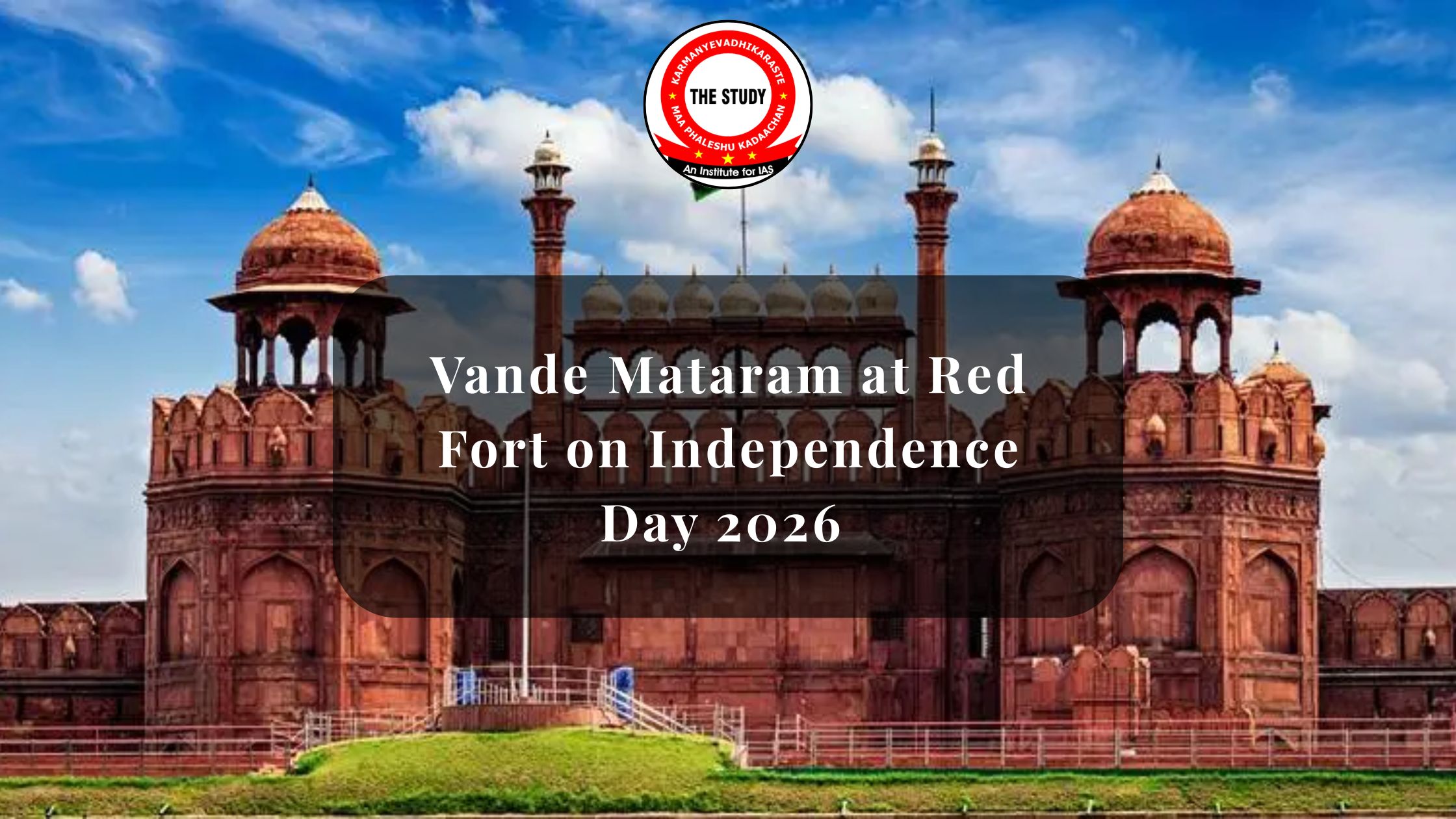
Vande Mataram at Red Fort on Independence Day 2026 | The Study IAS
Vande Mataram will be sung from the ramparts of the Red Fort for the first time during India's Independence Day ceremony on August 15, 2026, according to an announcement by the Ministry of Defence. The development is being described as a historic addition to the country's traditional Independence Day programme and comes during India's 80th Independence Day celebrations.
The announcement has drawn attention because the Red Fort ceremony is one of India's most important annual national events. The Prime Minister traditionally unfurls the National Flag from the historic monument and addresses the nation. This year, Vande Mataram will be included in the ceremony before the National Anthem, giving the national song a prominent place in the official proceedings.
The decision also comes in a year when the government has placed particular emphasis on the historical and cultural importance of Vande Mataram, with 2026 marking 150 years since the song's composition. The song had already been a major focus of the 2026 Republic Day celebrations.
Full Vande Mataram at Red Fort on Independence Day 2026
What Has Been Announced?
The Ministry of Defence has announced that Vande Mataram will be sung from the ramparts of the Red Fort during the Independence Day ceremony on August 15, 2026. This will be the first time the national song is formally sung from the Red Fort ramparts as part of the Independence Day ceremony, according to the announcement.
The announcement is significant because the Red Fort has served as the symbolic center of India's Independence Day celebrations for decades. Every year, the Prime Minister's flag unfurling and address from the monument connect the present-day Republic with the historical struggle that culminated in independence in 1947. Adding Vande Mataram to this ceremony gives the song a particularly prominent setting.
Why It Is a Historic First
Vande Mataram has been closely associated with India's freedom struggle for well over a century, but its inclusion in this specific form at the Red Fort Independence Day ceremony represents a new development. According to Defence Secretary Rajesh Kumar Singh, the song will be sung before the National Anthem, with attendees expected to stand during its rendition.
The announcement therefore changes the traditional sequence of the ceremony while preserving the National Anthem's distinct constitutional and ceremonial status. It also places one of India's most historically significant patriotic songs directly within the country's most visible Independence Day event.
When Will Vande Mataram Be Sung?
Independence Day 2026 Date
India will celebrate its 80th Independence Day on Saturday, August 15, 2026. The principal national ceremony will be held at the Red Fort in New Delhi, where Prime Minister Narendra Modi is scheduled to lead the traditional Independence Day proceedings.
The addition of Vande Mataram is expected to be one of the notable features of this year's programme. Reports based on the Defence Ministry's announcement state that the song will be sung before the National Anthem.
Position in the Ceremony
The decision to place Vande Mataram before the National Anthem is particularly noteworthy. It means the national song will not simply appear as a cultural performance somewhere in the wider programme; instead, it will form part of the formal ceremonial sequence.
More than 27,000 people, including dignitaries, visitors, and students, are expected to attend the Red Fort event, and they will stand during the rendition, according to the Defence Secretary's briefing.
What Is the Significance of Vande Mataram?
Origin and Author
Vande Mataram was written by Bankim Chandra Chattopadhyay, one of the most influential Bengali writers of the nineteenth century. The song appeared in his celebrated novel Anandamath, which was published in the late nineteenth century.
Over time, Vande Mataram moved beyond literature and became deeply connected with India's nationalist movement. Its invocation of the motherland resonated strongly with people involved in the struggle against colonial rule.
The song's historical journey is therefore much larger than the few minutes it takes to sing. It became a cultural expression of patriotism at a time when Indian nationalism was developing into a powerful political force.
Role in India's Freedom Movement
During the freedom struggle, Vande Mataram became one of the most recognizable patriotic expressions associated with Indian nationalism. It was sung at political gatherings and nationalist events and became closely linked with resistance to British rule.
Its importance grew particularly during the Swadeshi movement following the 1905 partition of Bengal. Nationalist leaders and activists used songs, literature, newspapers, and public meetings to build political awareness and encourage people to challenge colonial policies.
In this sense, Vande Mataram functioned almost like a musical banner. It could be carried in words and voices wherever political activity was taking place.
National Song Status
India has both a National Anthem, Jana Gana Mana, and a National Song, Vande Mataram. The two have different historical backgrounds and official roles.
Vande Mataram was accorded the status of the National Song by the Constituent Assembly in 1950, while Jana Gana Mana is the National Anthem. Both occupy an important place in India's national life.
This distinction is essential because referring to Vande Mataram as India's National Anthem would be incorrect. The National Anthem remains Jana Gana Mana.
Why Is the Full Version Being Featured in 2026?
150 Years of Vande Mataram
One major reason Vande Mataram has received special attention in 2026 is the commemoration of 150 years of the national song.
The Government of India had already made Vande Mataram the central theme of the Republic Day Parade 2026. The Ministry of Defence announced a programme featuring the song's history, artwork based on its verses, nationwide band performances, and tableaux connected with the themes of Vande Mataram and self-reliant India.
The Independence Day programme therefore continues a year-long emphasis on the song's historical and cultural legacy.
Connection With National Celebrations
The choice of Vande Mataram fits naturally with an Independence Day ceremony because the song was deeply connected with the Indian nationalist movement.
The Red Fort itself carries enormous historical symbolism. The Mughal monument became one of the most recognizable sites of independent India's national celebrations after 1947. Bringing Vande Mataram into the ceremony creates a symbolic connection between the freedom movement, independence, and contemporary national identity.
Cultural Significance
Vande Mataram has survived across generations because it became more than a literary composition. It became part of India's political and cultural memory.
For many Indians, hearing it during an Independence Day ceremony may evoke images of the freedom movement, nationalist gatherings, and the sacrifices associated with the struggle against colonial rule.
At the same time, India's national institutions distinguish between cultural significance and the formal status of national symbols. That distinction is important when discussing the song accurately.
Independence Day 2026 Red Fort Ceremony
Prime Minister's Address
The traditional centerpiece of Independence Day at the Red Fort is the Prime Minister's address to the nation. The Prime Minister unfurls the National Flag and speaks about India's achievements, challenges, priorities, and aspirations.
Previous Independence Day addresses have covered subjects ranging from economic development and infrastructure to education, national security, technology, social welfare, and India's long-term development goals. The speech is therefore watched closely not only for patriotic messaging but also for policy announcements.
National Anthem
Although Vande Mataram will receive a new place in the ceremony, Jana Gana Mana remains India's National Anthem. The announcement does not replace the National Anthem with Vande Mataram.
Instead, the reported programme places Vande Mataram before the National Anthem, giving both national compositions a distinct place in the ceremony.
This distinction is particularly important for students because questions about India's National Anthem and National Song frequently appear in general knowledge, history, and competitive examinations.
Yuva Shakti Theme
Another prominent feature of the Independence Day 2026 celebrations will be the emphasis on "Yuva Shakti," or youth power. The government plans to highlight the achievements and contributions of young Indians in different fields.
The youth-focused approach gives this year's celebration a forward-looking dimension. Independence Day is naturally rooted in history, but a national celebration also looks toward the future. Young Indians represent the generation that will shape India's institutions, economy, technology, culture, and global role in the coming decades.
Expected Participation
The Red Fort event is expected to attract thousands of invited guests, including dignitaries, students, and other participants. Reports indicate that more than 27,000 people are expected at the ceremony.
The scale of the event reflects the importance of the Red Fort ceremony as a national occasion. What happens on its ramparts is watched by millions of people across India and around the world.
Vande Mataram vs Jana Gana Mana
National Song
Vande Mataram is India's National Song. Written by Bankim Chandra Chattopadhyay, it became an important expression of Indian nationalism during the freedom movement.
Its historical importance is closely connected with India's anti-colonial struggle, making it particularly appropriate for discussions surrounding Independence Day.
National Anthem
Jana Gana Mana is India's National Anthem. Written by Rabindranath Tagore, it was adopted as the National Anthem by the Constituent Assembly on January 24, 1950.
The Anthem has its own ceremonial rules and occupies a distinct constitutional and national position.
Key Differences: Vande Mataram vs Jana Gana Mana
- Vande Mataram
- Status: National Song
- Author: Bankim Chandra Chattopadhyay
- Historical Connection: Indian nationalist movement
- Literary Origin:Anandamath
- 2026 Red Fort Development: To be sung before the National Anthem
- Jana Gana Mana
- Status: National Anthem
- Author: Rabindranath Tagore
- Historical Connection: National anthem of independent India
- Literary Origin: Originally composed as a Bengali song
- 2026 Red Fort Development: Remains the National Anthem
The distinction does not mean that one is more important than the other. Both are deeply embedded in India's national history, but their official roles are different.
Historical Journey of Vande Mataram
Bankim Chandra Chattopadhyay
Bankim Chandra Chattopadhyay was a major figure in Indian literature and is remembered for his contribution to the development of modern Indian nationalism through literature.
His creation of Vande Mataram gave the nationalist movement a powerful cultural expression. The phrase itself translates broadly as an invocation or salutation to the motherland.
Anandamath
Vande Mataram appeared in Anandamath, a novel that became closely associated with nationalist thought.
The song's historical context and imagery have also generated discussion over the decades, particularly because some of its later verses contain religious imagery. This is one reason why discussions about the song should distinguish between its historical nationalist role, its literary context, and the limited portion used in official national observances.
Freedom Movement
The song's importance expanded dramatically during the nationalist movement. It became a rallying cry at public gatherings and political demonstrations.
Its history illustrates how culture can influence politics. A poem or song may begin on a page, but when thousands of people sing it together, it can become a symbol of collective identity.
Adoption as National Song
Following independence, India retained Vande Mataram's special national significance while adopting Jana Gana Mana as the National Anthem.
The result is a national framework in which both songs have enduring importance, but their official designations remain distinct.
Why Independence Day 2026 Is Special
India's 80th Independence Day
August 15, 2026, marks India's 80th Independence Day. Eight decades after 1947, the country is celebrating a milestone that naturally encourages reflection on the journey from colonial rule to the world's largest democracy.
The ceremony's focus on Vande Mataram adds another historical layer because the song itself predates independence and was associated with the nationalist movement that helped shape the political consciousness of colonial India.
Youth Power
The focus on Yuva Shakti provides a bridge between history and the future. The freedom struggle belongs to the country's historical memory, but the responsibility of building the next phase of India belongs to today's citizens, especially its young population.
This is why Independence Day celebrations often combine remembrance with forward-looking messages. A national anniversary is not simply a look backward; it is also a moment to ask what comes next.
National Identity
National symbols such as the Tricolour, National Anthem, and National Song provide shared points of reference in a country of enormous linguistic, cultural, religious, and regional diversity.
Their significance lies partly in their ability to create a common national vocabulary. At the same time, India's constitutional framework recognizes diversity and pluralism as important features of the country.
Conclusion
The decision to have Vande Mataram sung from the ramparts of the Red Fort for the first time during an Independence Day ceremony makes Independence Day 2026 historically notable. The announcement by the Ministry of Defence places the National Song directly within the country's most prominent Independence Day ceremony and comes as India marks the 150th anniversary of Vande Mataram.
The song's inclusion before the National Anthem does not change the distinction between the two. Vande Mataram is India's National Song, while Jana Gana Mana remains the National Anthem. Instead, the 2026 ceremony gives both compositions their own place within the national programme.
With Yuva Shakti also expected to be a major focus, the ceremony is designed to connect India's freedom struggle and national heritage with the country's younger generation. For millions watching from across India, the moment Vande Mataram rings out from the Red Fort on August 15 could become one of the defining images of the 80th Independence Day.
FAQs About Vande Mataram at Red Fort
1. Will Vande Mataram be sung at the Red Fort on Independence Day 2026?
Yes. The Ministry of Defence has announced that Vande Mataram will be sung from the ramparts of the Red Fort for the first time during the Independence Day ceremony on August 15, 2026.
2. Will Vande Mataram replace Jana Gana Mana?
No. Vande Mataram is India's National Song, while Jana Gana Mana is the National Anthem. The 2026 announcement states that Vande Mataram will be sung before the National Anthem, rather than replacing it.
3. Who wrote Vande Mataram?
Bankim Chandra Chattopadhyay wrote Vande Mataram. It appeared in his novel Anandamath and later became closely associated with India's freedom movement.
4. Why is Vande Mataram particularly important in 2026?
The year 2026 marks 150 years of Vande Mataram, and the Government of India has highlighted the song in major national celebrations throughout the year, including the Republic Day Parade.
5. What is the main theme of Independence Day 2026?
The 2026 Independence Day celebrations will prominently showcase "Yuva Shakti," or youth power, highlighting the achievements and contributions of India's young people.
Subscribe to our Youtube Channel for more Valuable Content – TheStudyias
Download the App to Subscribe to our Courses – Thestudyias
The Source’s Authority and Ownership of the Article is Claimed By THE STUDY IAS BY MANIKANT SINGH