Uneven Distribution of Tigers in India
4 Jun 2026
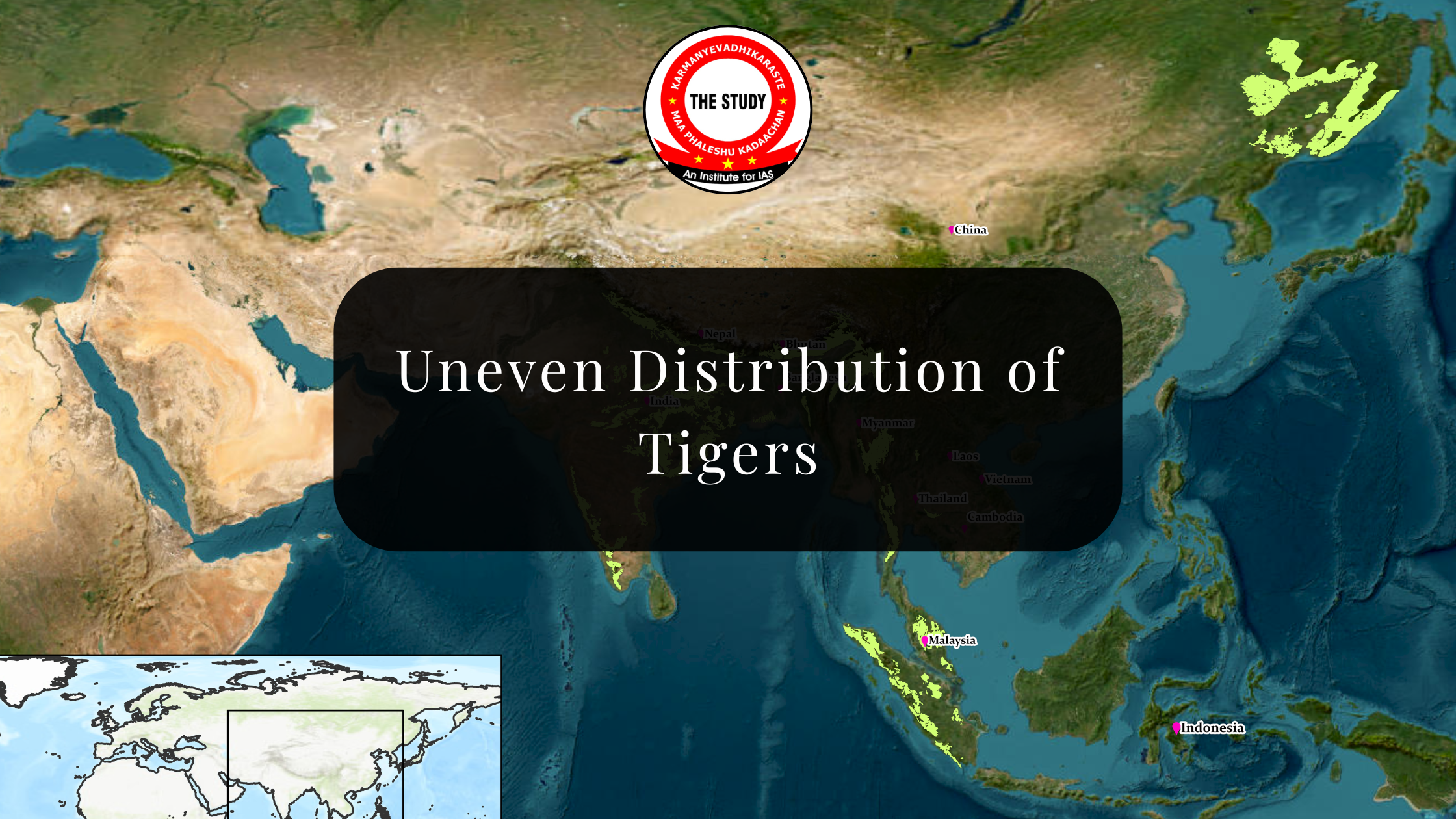
Uneven Distribution of Tigers in India: Why Some Reserves Thrive While Others Remain Empty
India’s tiger conservation story is globally significant, but the distribution of tigers across the country is deeply uneven. While India now has 58 notified tiger reserves, after Madhav National Park in Madhya Pradesh was declared the country’s 58th tiger reserve, the latest detailed distribution data from the 2022 tiger assessment shows that tiger populations remain concentrated in a small number of high-performing reserves.
Down To Earth’s analysis of NTCA’s Status of Tigers, Co-Predators and Prey in India, 2022 found that nearly 40% of tigers were concentrated in just 11% of reserves. Only six reserves had more than 100 tigers, while 22 reserves had fewer than 10 tigers or none at all. This shows that India’s tiger recovery is strong, but not evenly spread.
What Does Uneven Distribution of Tigers Mean?
Uneven distribution of tigers means that tiger numbers are not spread equally across all tiger reserves. Some reserves hold very high tiger populations, while others have only a few tigers or no tigers at all.
This does not mean every reserve should have the same number of tigers. Tiger density depends on habitat quality, prey availability, forest connectivity, protection levels, carrying capacity and ecological conditions.
The concern is that several reserves have not been able to sustain viable tiger populations despite being notified as tiger reserves.
Current Status of Tiger Distribution in India
The 2022 NTCA report data, as analysed by Down To Earth, showed that 1,977 tigers were documented within 53 reserves. Six reserves — Kaziranga, Bandipur, Nagarhole, Bandhavgarh, Mudumalai and Corbett — together accounted for 795 tigers.
Corbett alone hosted the highest estimated number, followed by Nagarhole, Bandipur, Kaziranga, Bandhavgarh and Mudumalai. At the other end, DTE reported that Buxa, Dampa and Palamau recorded no tigers, while several other reserves had five or fewer.
Why Are Tigers in India Unevenly Distributed?
Tigers in India are unevenly distributed because they survive only where habitat, prey, water, security and connectivity come together. A tiger reserve may exist legally, but if the ecosystem is fragmented, disturbed or poorly managed, it cannot sustain a stable tiger population.
Habitat Quality and Prey Base
Tigers need large, contiguous forests with dense vegetation, water sources and abundant prey. Their main prey includes deer species, wild boar, nilgai and other herbivores.
Reserves such as Corbett, Bandipur, Nagarhole, Bandhavgarh, Dudhwa and Mudumalai support higher tiger numbers because they have healthier habitats, better prey availability and stronger protection systems.
Why Prey Base Matters
Tigers are apex predators. If prey density is low, tiger density will also remain low. Even a large forest may not support many tigers if it lacks herbivores.
This is why prey augmentation and habitat restoration are essential in underperforming reserves.
Habitat Fragmentation
Habitat fragmentation is one of the biggest reasons behind uneven tiger distribution. Rapid urbanisation, agriculture, highways, railway lines, mining and other linear infrastructure have broken many once-continuous forest landscapes.
The NTCA’s 2022 summary report notes that many tiger reserves and protected areas are now like “small islands” in a wider landscape of unsustainable land use. It also states that several corridors outside protected areas continue to deteriorate due to human use and development projects.
Why Fragmentation Hurts Tigers
Tigers are solitary and territorial animals. Adult males and females need large territories. Young tigers also need safe dispersal routes to move out and establish new territories.
When corridors are blocked, tiger movement becomes restricted. This leads to overcrowding in strong reserves and weak recovery in low-density reserves.
Management and Staff Shortages
Protection quality varies across reserves. Some reserves have strong patrolling systems, trained frontline staff, camera trap monitoring, anti-poaching networks and community support. Others face manpower gaps and weak enforcement.
Down To Earth reported that management evaluations flagged threats such as poaching, invasive species, mining, staff shortages and habitat fragmentation in several tiger reserves.
Why Frontline Staff Matter
Tiger conservation is execution-heavy. Without trained guards, regular patrolling and quick response systems, reserves become vulnerable to poaching, illegal grazing, encroachment and habitat degradation.
Human Disturbance and Mining
Human disturbance directly affects tiger habitats. Mining, roads, settlements, tourism pressure, cattle grazing and illegal resource extraction can degrade forests and disturb tiger movement.
The NTCA 2022 report highlights that the Central Indian landscape has some of India’s best tiger habitats, but also faces major conservation challenges due to a high concentration of mining activity.
Impact on Eastern and Central India
States such as Jharkhand, Chhattisgarh and Odisha have seen weaker tiger recovery in several landscapes because of mining pressure, fragmented forests, insurgency-linked governance gaps in some areas, and poor prey recovery.
Down To Earth also highlighted Palamau in Jharkhand among reserves that recorded no tigers in the 2022 reserve-level analysis.
Carrying Capacity Limits in Successful Reserves
Some tiger reserves have the opposite problem: they are doing so well that they are nearing ecological saturation.
Every protected area has a carrying capacity. This means it can support only a certain number of tigers based on prey, territory size, water and habitat quality.
What Happens When Carrying Capacity Is Reached?
Dominant tigers occupy the best territories. Sub-adult and weaker tigers are then pushed into buffer zones, corridors or human-dominated landscapes.
This increases the risk of:
- Human-tiger conflict
- Livestock predation
- Tiger deaths in territorial fights
- Road and rail accidents
- Dispersal into unsafe habitats
This is why strong reserves must be connected to other habitats through functional corridors.
Historical Extinctions and Reintroductions
Some tiger reserves lost their tiger populations due to poaching and habitat degradation. Sariska is a well-known example where tigers were locally wiped out in the early 2000s and later reintroduced.
The NTCA 2022 report notes that successful tiger reintroduction has taken place in Panna and Sariska, while some other areas such as Satkosia, Sahyadri and Kawal have faced local extinction or severe depletion.
Why Reintroduction Is Not Enough
Reintroduction can work only when the causes of local extinction are fixed. If poaching, prey shortage, habitat fragmentation or human disturbance remain unresolved, released tigers may not survive or breed successfully.
Why Some Tiger Reserves Have More Tigers
Some reserves have high tiger populations because they combine ecological strength with strong governance.
Common Features of Successful Reserves
High-performing reserves usually have:
- Large forested areas
- Strong prey base
- Reliable water sources
- Grasslands and mixed habitats
- Low poaching pressure
- Better frontline staffing
- Strong monitoring systems
- Functional buffer zones
- Better connectivity with nearby forests
This is why reserves such as Corbett, Bandipur, Nagarhole, Bandhavgarh, Kaziranga and Mudumalai have emerged as tiger strongholds.
Why Some Reserves Have Few or No Tigers
Low-density or zero-tiger reserves usually suffer from one or more structural problems.
Common Problems in Weak Reserves
- Poor prey base
- Habitat fragmentation
- Mining and infrastructure pressure
- Weak corridors
- Poaching history
- Invasive species
- Staff shortages
- Human disturbance
- Poor monitoring
- Lack of ecological recovery after tiger loss
Such reserves need targeted restoration, not just legal protection.
Why Tiger Corridors Are Critical
Tiger reserves cannot work as isolated islands. Tigers must move between reserves to maintain genetic diversity, avoid inbreeding and recolonise empty habitats.
The NTCA report states that habitat corridors have been identified and integrated into conservation decision-making, but many corridors remain outside protected areas and continue to deteriorate.
Corridor Protection Should Be a Priority
India’s next phase of tiger conservation must prioritise:
- Protecting forest corridors
- Regulating highways and railways
- Wildlife crossings
- Habitat restoration
- Community-led conservation
- Landscape-level planning
Without corridors, tiger recovery will remain concentrated in a few reserves.
Way Forward
India must shift from reserve-count expansion to reserve-quality improvement.
Restore Low-Density Reserves
Tiger reserves with few or no tigers should receive targeted habitat restoration, prey recovery, anti-poaching strengthening and scientific monitoring.
Protect Corridors
Corridors must be legally protected and integrated into infrastructure planning. Wildlife passages, overpasses and underpasses should be mandatory in sensitive landscapes.
Strengthen Frontline Capacity
Tiger reserves need adequate staff, better training, technology-backed patrolling, equipment and incentives for frontline workers.
Regulate Mining and Linear Infrastructure
Mining, highways, railways and transmission lines in tiger landscapes must go through strict ecological scrutiny.
Manage Carrying Capacity
High-density reserves need scientific population management. Dispersing tigers must have safe connected habitats instead of being pushed into conflict zones.
Improve Community Participation
Local communities must benefit from conservation through livelihood support, eco-development, compensation systems and participation in monitoring.
Common Mistakes to Avoid
Treating More Tiger Reserves as Equal to Better Conservation
Increasing the number of tiger reserves is useful, but it does not automatically ensure tiger recovery. Habitat quality and management capacity matter more.
Ignoring Low-Density Reserves
India’s tiger success story cannot rely only on a handful of strong reserves. Weak reserves need urgent recovery plans.
Viewing Tigers in Isolation
Tigers depend on prey, forests, water, corridors and local communities. Conservation must address the entire ecosystem.
Ignoring Carrying Capacity
High tiger numbers in a few reserves can create conflict if corridors and adjoining habitats are not secured.
Expert Insights
India’s tiger conservation model has delivered strong national recovery, but the next challenge is distribution quality. The current pattern shows a concentration of tigers in a few secure landscapes and weak recovery in fragmented reserves.
The future strategy must be landscape-based, not reserve-only. India needs to restore weak reserves, secure corridors, regulate disruptive development and strengthen frontline protection.
The real benchmark is not just how many tigers India has, but how many viable, connected and genetically healthy tiger populations it can sustain.
Key Takeaways
- Tigers in India are unevenly distributed because they need dense habitat, water, prey, secure corridors and low disturbance.
- A few reserves such as Corbett, Bandipur, Nagarhole, Bandhavgarh, Kaziranga and Mudumalai hold a large share of India’s reserve-level tiger population.
- Many reserves remain weak because of fragmented habitats, poor prey base, poaching risk, mining, staff shortages and human disturbance.
- The 2022 NTCA-linked data analysed by Down To Earth covered 53 reserves; India currently has 58 notified tiger reserves after new additions.
- Habitat connectivity is as important as reserve-level protection because tigers need large territories and safe dispersal routes.
- Carrying capacity in successful reserves pushes some tigers into buffer areas and human-dominated landscapes.
- Future tiger conservation must focus on restoring low-density reserves, protecting corridors and improving frontline management.
Conclusion
India’s tiger conservation success is real, but it is uneven. A few reserves hold a large share of the tiger population, while many reserves remain underpopulated or empty.
The reason is clear: tiger recovery depends on habitat quality, prey base, corridor connectivity, frontline protection and low disturbance. Legal notification alone cannot create tiger populations.
India’s next conservation priority must be to move from more reserves to better-connected, better-managed and ecologically viable tiger landscapes. That is the real pathway to long-term tiger security.
FAQs
Why are tigers unevenly distributed in India?
Tigers are unevenly distributed because they need dense forests, water, prey, protection and connected habitats. Reserves with strong ecosystems support more tigers, while fragmented or disturbed reserves often have few or no tigers.
Which tiger reserves have the highest tiger populations?
According to the 2022 reserve-level analysis cited by Down To Earth, Corbett, Nagarhole, Bandipur, Kaziranga, Bandhavgarh and Mudumalai were among the reserves with more than 100 tigers.
Why do some tiger reserves have no tigers?
Some reserves have no tigers because of past poaching, poor prey base, habitat degradation, fragmentation, staff shortages, mining pressure and weak connectivity with other tiger habitats.
What is the role of tiger corridors?
Tiger corridors allow tigers to move between reserves. They help maintain genetic diversity, reduce overcrowding in high-density reserves and allow recolonisation of weak or empty habitats.
How does habitat fragmentation affect tigers?
Habitat fragmentation breaks continuous forests into isolated patches. This restricts tiger movement, reduces breeding opportunities, increases conflict and weakens long-term population viability.
What is carrying capacity in tiger reserves?
Carrying capacity is the maximum number of tigers a habitat can support based on prey, water, territory size and ecological conditions. Once this limit is reached, younger tigers are pushed into buffer zones or human-dominated areas.
Why is prey base important for tiger conservation?
Tigers depend on herbivores such as deer, wild boar and nilgai. If prey numbers are low, tiger populations cannot grow even if forest cover exists.
How can India fix uneven tiger distribution?
India can fix uneven tiger distribution by restoring weak reserves, improving prey base, protecting corridors, regulating mining and infrastructure, increasing frontline staff and using landscape-level conservation planning.
Related posts :
- Majoritarianism vs Constitutionalism
- India-Bangladesh Ties
- Nordic Countries and India
- Tackling Ocean Plastic Pollution
- India-Bhutan Ties
- India-UAE Ties
- India-Netherlands Ties
- Captagon: The “Jihadi Drug”
- Bioenergy Systems
- Transforming the Brahmaputra
- India–Africa Forum Summit
- India–US Defence Ties
Subscribe to our YouTube Channel for more Valuable Content – TheStudyias
Download the App to Subscribe to our Courses –Thestudyias
The Source’s Authority and Ownership of the Article is Claimed By THE STUDY IAS BY MANIKANT SINGH
Comments (0)
Leave a Comment