Understanding AM, FM and Signal Modulation
11 Aug 2026
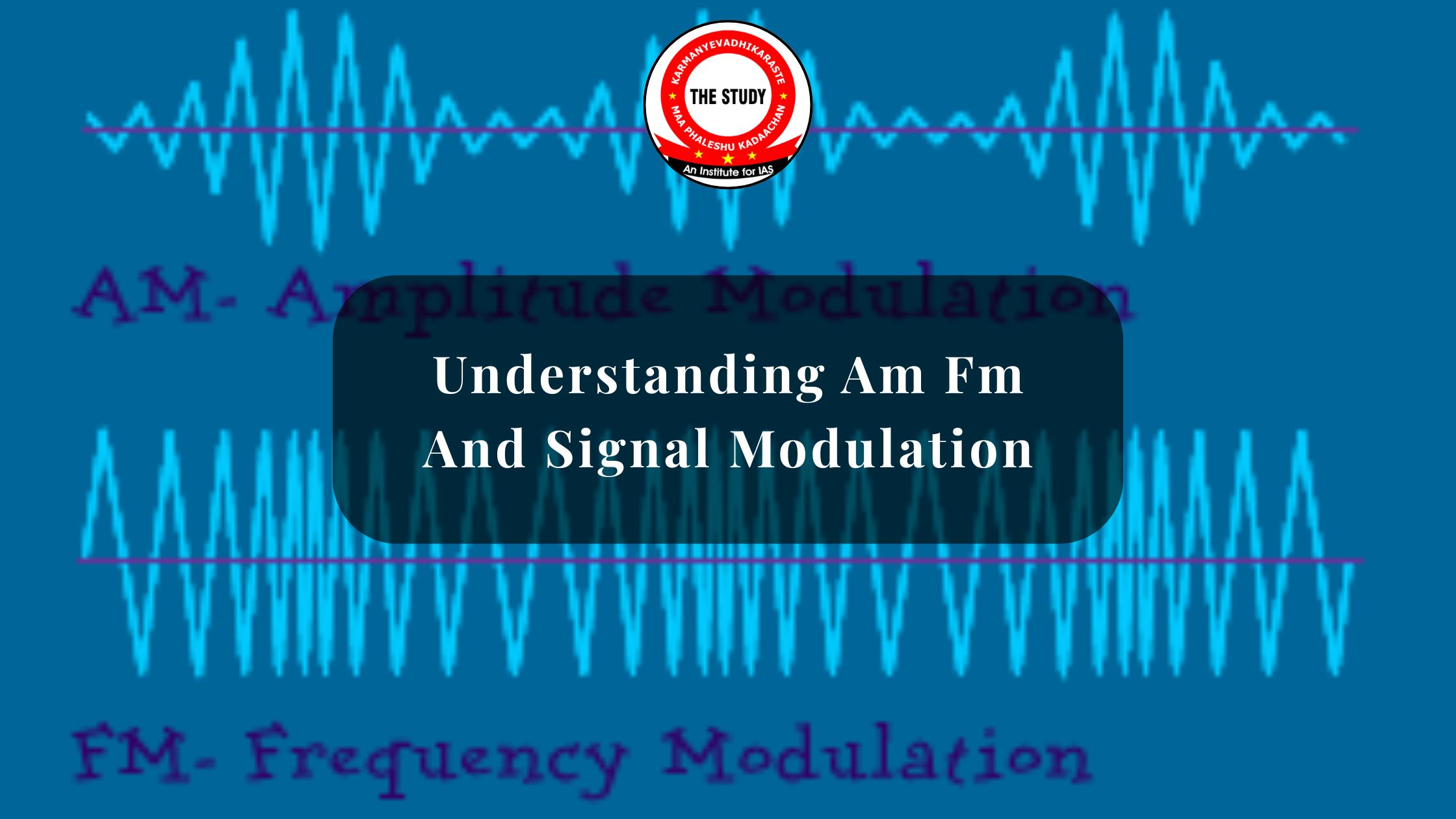
Understanding AM, FM and Signal Modulation: Concepts, Differences & Applications
Introduction
Modern communication systems allow information to travel across cities, countries and continents within seconds. Whether it is a radio broadcast, television transmission, satellite communication or wireless technology, the basic objective remains the same: transmit information accurately from one point to another.
This makes signal modulation an important concept in Science and Technology for UPSC, UPPSC and other competitive examinations. Modulation explains how information such as voice, music or data can be converted into a form suitable for transmission through a communication channel.
Two important analogue modulation techniques are Amplitude Modulation (AM) and Frequency Modulation (FM). Although both use a carrier wave to transmit information, they differ in the characteristics of the carrier that are varied.
In AM, the amplitude of the carrier varies according to the information signal, whereas in FM, the frequency of the carrier varies according to the information signal.
For competitive examinations, the objective is not to study communication engineering in excessive mathematical detail. Aspirants should instead understand the basic mechanism, differences, applications, bandwidth, noise resistance, modulation index and practical significance of AM and FM.
What Are AM, FM and Signal Modulation?
What Is Signal Modulation and Why Is It Needed?
A communication system generally consists of an information signal, transmitter, communication channel and receiver.
The original information signal may be a low-frequency audio signal. Directly transmitting such a signal over long distances is often impractical. Therefore, the information is used to modify a high-frequency carrier wave.
This process is called modulation.
The basic communication sequence can be represented as:
Information Signal → Modulation → Transmission → Reception → Demodulation → Original Information
Modulation serves several important purposes:
- Makes wireless transmission practical.
- Allows signals to be transmitted over long distances.
- Facilitates efficient use of the electromagnetic spectrum.
- Allows different signals to use different frequency channels.
- Makes the design of transmitting and receiving systems more practical.
- Enables multiple communication channels to operate within the available spectrum.
At the receiving end, demodulation is used to recover the original information from the modulated signal.
How Does a Carrier Wave Carry Information?
A carrier wave is generally a high-frequency electromagnetic or electrical signal used to carry information.
A wave can be described using characteristics such as:
- Amplitude
- Frequency
- Phase
The information signal can modify one of these characteristics.
This gives rise to different forms of modulation:
Modulation
Carrier property that changes
AM - Amplitude
FM - Frequency
PM - Phase
What Is Amplitude Modulation (AM) and How Does It Work?
In Amplitude Modulation, the amplitude of the carrier wave varies according to the instantaneous amplitude of the message signal.
The carrier frequency remains essentially constant.
Therefore:
AM changes the amplitude of the carrier according to the information signal.
AM has historically been used in forms of radio broadcasting and communication because its transmission and reception mechanisms can be relatively simple.
However, AM is comparatively vulnerable to noise because many electrical disturbances produce unwanted amplitude variations.
What Is Frequency Modulation (FM) and How Does It Work?
In Frequency Modulation, the frequency of the carrier wave changes according to the amplitude of the information signal.
The amplitude of the carrier remains essentially constant.
Therefore:
FM changes the frequency of the carrier according to the information signal.
When the instantaneous amplitude of the message signal increases, the carrier frequency deviates from its central value. The extent of this change is known as frequency deviation.
FM is widely associated with high-quality audio broadcasting because of its relatively strong resistance to many forms of amplitude noise.
However, FM generally requires greater bandwidth than conventional AM.
This creates an important trade-off:
FM → Better noise immunity and audio quality, but greater bandwidth requirement.
What Is the Difference Between AM and FM?
AM and FM perform the same broad function—carrying information through a carrier—but modify different properties of the carrier.
A common examination trap is the statement "FM has no noise." This is incorrect.
FM is generally more resistant to amplitude-related noise, but no communication system is completely free from interference.
Why Does FM Provide Better Noise Resistance Than AM?
The difference can be understood from the way information is encoded.
In AM, information is carried through variations in amplitude. If external electrical interference changes the amplitude of the signal, the information can become distorted.
In FM, information is carried through variations in frequency. Many common noise sources primarily affect amplitude. FM receivers can therefore reduce the impact of such amplitude variations through appropriate signal processing.
This is why FM is generally preferred where higher audio quality and better resistance to amplitude noise are important.
However, this advantage comes at the cost of increased spectrum requirements.
Thus, aspirants should avoid writing:
"FM is always superior to AM."
A better statement is:
FM generally provides better noise immunity and audio fidelity, while AM offers advantages such as simpler systems and comparatively lower bandwidth requirements.
Where Are AM and FM Used in Real-World Communication?
AM and FM have played important roles in the development of radio communication.
AM has been used in:
- Medium-wave radio broadcasting
- Long-wave and short-wave broadcasting
- Certain forms of aviation communication
- Other communication systems where its characteristics are useful
FM has been widely used in:
- FM radio broadcasting
- High-quality audio transmission
- Two-way radio communication
- Various wireless communication applications
The distinction between their applications should not be treated as absolute because modern communication technology uses many advanced modulation and digital
techniques.
The larger lesson for UPSC is that communication technology continuously evolves from analogue systems towards sophisticated digital communication, satellite systems, mobile networks and broadband technologies.
Why Are AM, FM and Signal Modulation Important for UPPSC and Other Competitive Exams?
AM, FM and modulation can appear in questions related to Science and Technology, telecommunications, electromagnetic spectrum and communication systems.
For UPPSC aspirants, the topic is particularly useful because objective questions can test:
- Basic definitions.
- AM–FM differences.
- Noise immunity.
- Bandwidth.
- Carrier waves.
- Sidebands.
- Modulation index.
- Demodulation.
- Applications of communication technology.
Questions may also be framed as multiple statements where only one statement is correct.
For example:
Consider the following statements:
- In AM, carrier amplitude varies according to the message signal.
- In FM, carrier frequency varies according to the message signal.
- FM is completely immune to noise.
The correct answer would reject Statement 3 because FM is not completely noise-free.
This illustrates why conceptual clarity is more useful than memorising isolated facts.
What Are the Most Important Facts to Remember for UPPSC Prelims?
Before the examination, revise these points:
- Modulation means varying a carrier characteristic according to an information signal.
- AM changes amplitude.
- FM changes frequency.
- PM changes phase.
- AM is comparatively more affected by amplitude noise.
- FM generally has better resistance to amplitude noise.
- FM generally requires greater bandwidth than conventional AM.
- AM produces upper and lower sidebands.
- Demodulation recovers the original information signal.
- A carrier wave is used to transmit information.
- The message signal contains the information being transmitted.
- Excessive AM modulation can cause over-modulation and distortion.
- AM and FM are forms of analogue modulation.
These points are sufficient to handle most basic Prelims-level questions on the subject.
What Previous Year Exam-Oriented Concepts Should Aspirants Revise?
Rather than memorising an entire communication-engineering textbook, aspirants should revise concepts that can be converted into statement-based questions.
Focus on:
- The difference between carrier signal and message signal.
- The parameters changed in AM, FM and PM.
- Relationship between bandwidth and message frequency.
- Meaning of modulation index.
- Concept of frequency deviation in FM.
- Meaning and importance of sidebands.
- Difference between modulation and demodulation.
- Relationship between noise and signal quality.
- Applications of AM and FM.
- Difference between analogue and digital modulation.
Aspirants should also practise elimination. Words such as "completely," "always," "never," and "only" often make otherwise plausible statements incorrect.
FAQs
What is signal modulation?
Signal modulation is the process of varying a characteristic of a high-frequency carrier wave according to an information or message signal to facilitate transmission.
What is the main difference between AM and FM?
In AM, the amplitude of the carrier varies according to the message signal. In FM, the frequency of the carrier varies according to the message signal.
Why is FM generally less affected by noise?
FM represents information through frequency variations and is therefore less affected by many forms of amplitude noise than AM.
Which has greater bandwidth, AM or FM?
Generally, FM requires greater bandwidth than conventional AM.
What are sidebands?
Sidebands are frequency components generated around the carrier frequency during modulation. In conventional AM with a single-tone message, they occur at fc + fm and fc − fm.
What is a modulation index?
Modulation index indicates the extent to which a carrier is modulated. For conventional AM, it is the ratio of message amplitude to carrier amplitude.
What is demodulation?
Demodulation is the process of extracting the original information signal from the modulated carrier at the receiving end.
Is FM completely immune to noise?
No. FM has better immunity to many forms of amplitude noise, but it is not completely immune to all types of interference.
Subscribe to our Youtube Channel for more Valuable Content – TheStudyias
Download the App to Subscribe to our Courses – Thestudyias
The Source’s Authority and Ownership of the Article is Claimed By THE STUDY IAS BY MANIKANT SINGH