The Study IAS: 35 Years of Legacy in Civil Services Mentorship (1991–2026)
19 Nov 2026
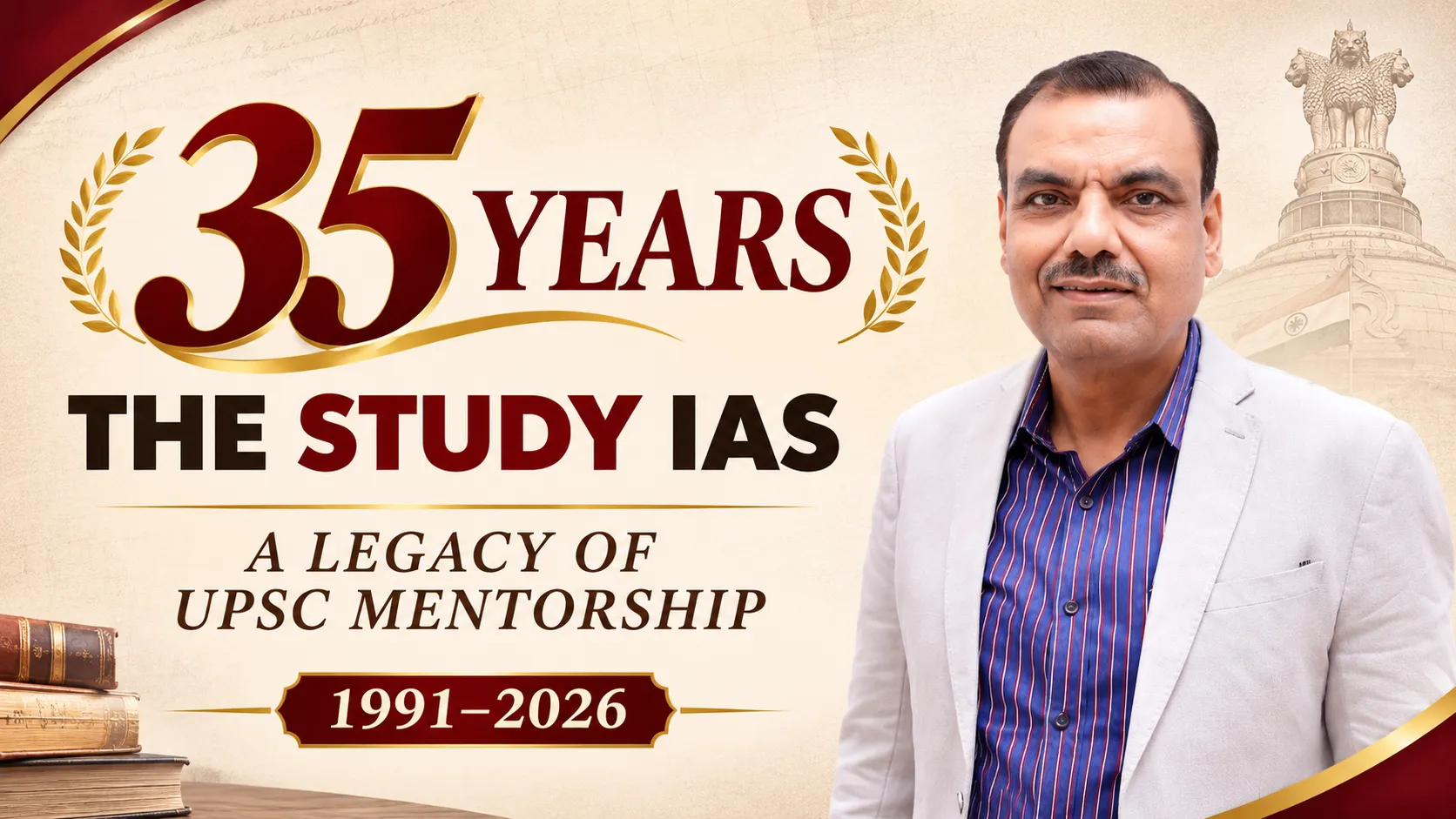
35 Years of Legacy
in Civil Services Mentorship
For 35 years, The Study IAS has taught UPSC aspirants one idea above all others: information becomes useful only when you understand it.
What began in 1991–92 as a small group of students under Manikant Singh Sir has grown into a teaching approach that connects Prelims and Mains, links one subject to another, and treats every previous-year question as a lesson in how UPSC thinks.
How It Began
The Study IAS began with a question, not a plan.
Manikant Sir had himself appeared for the Civil Services Examination (Mains) several times. Those attempts gave him something no textbook could: a first-hand understanding of what aspirants struggle with, and of the gap between what the examination demands and how most candidates prepare for it.
Teaching was not his original career plan. Around 1991–92, circumstances drew him into the classroom, first with a small group of students. There was no large infrastructure and no institutional machinery, only a teacher, a handful of aspirants, and a determination to explain difficult things clearly.
The world of that time was very different from today's. There were no online classes, no YouTube lectures, no digital libraries and no endless stream of PDFs. Aspirants depended on books, newspapers, libraries, classroom teaching and their own handwritten notes.
Preparation culture leaned heavily on memorisation, and the assumption was that the candidate who remembered the most would do the best.
Manikant Sir's classroom experience made him doubt that assumption. UPSC asks candidates to understand issues, analyse questions and express a view within limited time and words. That doubt became the starting point of everything The Study IAS stands for.
Growth Through Word of Mouth
Our growth came largely from student trust and word of mouth.
As students felt the difference in how they were learning, they told others. New batches followed, classrooms grew larger, and the institution expanded step by step.
The foundation remained the same: quality teaching, strong academic content and a clear focus on what UPSC actually demands.
What UPSC Actually Tests
Our approach begins with a simple observation: the Civil Services Examination is not a test of how many facts a candidate can recall.
UPSC can ask about a familiar topic in an unfamiliar way. A student who has memorised a standard answer may be stuck the moment the question changes its angle.
A student who understands the subject can carry the same knowledge into a new context and still write a relevant, confident answer.
That is why The Study IAS builds conceptual clarity first and adds factual detail on top of it. The knowledge a student develops should work across Prelims, Mains, Essay, Ethics and the Personality Test, not just in one paper.
One Syllabus, One Understanding
Prelims and Mains should not be treated as two unrelated examinations.
One of the defining features of Manikant Sir's teaching journey is his insistence on moving beyond rote learning.
This mattered especially in an era when Prelims also carried an optional subject and factual preparation dominated the culture of the time. Manikant Sir took a different position.
A candidate with strong, Mains-oriented understanding can often solve Prelims questions more reliably, because conceptual clarity helps in eliminating options, spotting relationships and making sense of unfamiliar information.
Build the Conceptual Base First
The integrated approach does not ignore what Prelims specifically needs. Facts, MCQ practice and revision remain essential. The difference is the order: first build a strong conceptual base, then add the factual layer and the practice that Prelims demands.
This avoids a common trap, which is preparing two separate sets of knowledge for the same subject.
Take the Indian Constitution. A student can study its historical background, institutional structure, key provisions and contemporary relevance as one connected body of knowledge. That same understanding then supports an objective question in Prelims and an analytical question in Mains.
The principle holds across History, Geography, Economy, Polity, Environment and International Relations.
The Teaching Philosophy
The aim is not to make students remember more. It is to help them understand better, connect ideas and use knowledge intelligently.
Understanding Over Memorisation
UPSC has a very large syllabus. Trying to memorise every fact from every source quickly becomes impractical, and it does not even match what the examination rewards.
Students need to know what is important, why it matters and how topics connect. This is why The Study IAS values qualitative preparation over a larger quantity of material.
The aim is to build a student who can understand a topic, form a view, and use the right facts to support it.
Read, Feel and Think
Our learning philosophy can be summed up in three words: Read, Feel and Think.
- Read to gain the basic knowledge.
- Feel the relevance of what you have read, meaning how it touches people, society, institutions and the country.
- Think about the wider implications of the issue.
Consider an economic policy. Remembering its features is only the first step. A thoughtful candidate also asks why it was introduced, whom it affects, what challenges it may face and how it connects to larger economic and social questions.
Interlinking Subjects
The boundaries between UPSC subjects are academic divisions. Real-world issues are interconnected.
History explains the background of contemporary international relations. Geography helps explain agriculture, climate and migration. Economy connects with government policy and social issues. Polity is best understood through constitutional history and political developments.
Students who learn this way develop a wider administrative perspective. Instead of seeing the syllabus as a set of isolated sections, they see how one area influences another.
History and History Optional
History holds a special place in our teaching.
Manikant Sir treats History as far more than a list of dates, events and personalities. Developments are studied through causes, consequences, continuity, change, and the relationship between institutions and society.
This approach matters most in History Optional, where marks are earned through analytical answers, not by reproducing facts.
It also pays off beyond the optional paper. The historical background of international conflicts, political institutions, social structures and economic systems helps students understand contemporary issues in depth.
Meet Manikant Singh Sir
Manikant Singh Sir is the founding teacher of The Study IAS and, in the eyes of his students, the best teacher for History Optional.
Meet Manikant Singh Sir →An Aspirant Before He Was a Teacher
His understanding of UPSC comes from having been on the other side of the desk. Manikant Sir appeared for the Civil Services Examination several times himself, and those attempts showed him what aspirants actually struggle with.
Around 1991–92 he began teaching a small group of students. More than three decades on, he is still in the classroom, still looking for a clearer way to explain a difficult idea.
Why History Optional Aspirants Look to Him
History Optional rewards analysis, not recall. Manikant Sir teaches History through causes, consequences, continuity and change, and through the relationship between institutions and society.
Students learn to see Ancient, Medieval, Modern and World History as one connected story instead of four lists of facts.
What Students Carry Into Their Preparation
- A limited set of consolidated classroom notes.
- Repeated revision until concepts and analytical structure feel natural.
- Question practice and answer writing early in the preparation journey.
Students who have followed this method, such as Mamta, whose History Optional score rose from 182 to 276 marks, describe the same turning point: understanding the material and presenting it analytically mattered more than reading more books.
The Teacher's Craft
What students notice first is how he simplifies. A complex concept is broken down until it is clear, and then connected to the rest of the syllabus, because Manikant Sir believes that real issues do not respect the boundaries between subjects.
He also keeps a constant eye on the examination. Previous Year Questions are a regular part of his teaching, so that students learn not only what to study but how UPSC frames its questions and what each question really demands.
Previous Year Questions: Learning the Language of UPSC
Understanding a question is a skill in itself.
A question may name a familiar topic but ask you to examine it from a specific angle. It may require comparison, evaluation, criticism, causes, consequences, or an assessment of continuity and change.
Candidates often lose marks not because they do not know the topic, but because they answer the topic and miss the demand.
For this reason, Previous Year Questions are central to how we teach. By analysing PYQs, students learn to:
- Identify recurring themes and the depth UPSC expects.
- Separate the topic of a question from its actual demand.
- Move away from memorised model answers towards flexible, question-specific writing.
Revision and Answer Writing
Preparation does not become stronger simply because more material has been completed. It becomes stronger when knowledge is retained and applied.
Revision as a Continuing Process
Finishing a topic once does not mean it has been retained. At The Study IAS, revision is treated as a continuing process, not a final stage before the exam.
Students revisit topics at short and progressively longer intervals. A topic studied today may be reviewed the next day, then after a week, then a month, and again in the larger revision cycles.
The purpose is to make knowledge durable and reduce the urge to keep searching for new material.
Writing Early, Writing Regularly
Answer writing is learned by doing. We encourage students to start early instead of waiting to finish the syllabus.
The first goal is to overcome hesitation, even with a single answer a day. The next is to learn how to structure an answer, choose relevant information and address the exact demand of the question.
Over time, students learn to combine facts with analysis rather than filling the page with information that does not answer what was asked.
Lessons from Our Students
The experiences of our students are the best proof of what focused, understanding-led preparation looks like.
Fewer Sources, Revised Many Times
The most consistent lesson is the value of limiting resources. Instead of adding new books and material every few weeks, successful students choose reliable sources, understand them thoroughly and revise them repeatedly.
This reduces confusion and leaves more time for practice and revision.
A Story from History Optional
Mamta scored 276 marks in History Optional after changing her approach to answer writing and analysis. Her earlier attempt had resulted in 182 marks.
The difference was not a longer reading list. Her preparation was built around a limited set of notes covering Ancient, Medieval, Modern and World History, combined with question and test practice.
What changed was how she understood and presented the material. Her journey shows the value of structured notes, repeated revision, extensive question practice and analytical answer writing.
Taming Current Affairs
Today's aspirant has access to an enormous amount of news. The challenge is not finding it but filtering it.
We encourage students to connect relevant developments to the static syllabus instead of treating every headline as a separate topic. Focus on events with a clear link to History, Geography, Polity, Economy, Environment, Science and Technology or International Relations.
From Classrooms to Online Learning
Then and Now
In the early 1990s, information was scarce. Students spent significant time just searching for material.
Today an aspirant can reach lectures, PDFs, digital books, test series and discussion platforms from a phone. The problem has reversed: earlier, students struggled to find information; now they struggle to decide which information deserves their attention.
Learning Without Relocating
Online learning has allowed students across India to access Manikant Sir's guidance without moving to Delhi or any other coaching hub.
What matters is the quality of guidance, consistency, the right resources and the discipline to follow a process.
Technology in Its Place
We use technology selectively: for learning, revision, practice and resolving doubts. It should support preparation and not become another source of distraction and information overload.
Technology makes education more accessible, but it cannot replace the student's own effort. Students still have to read carefully, understand concepts, revise regularly, practise questions and think for themselves.
35 Years, Three Generations of Aspirants
The Study IAS has been part of the preparation journey of very different generations. Each generation has faced its own difficulties, but what they needed was the same: clarity, discipline, understanding and analytical thinking.
Learning With Limited Resources
Students prepared with limited resources, relying on books, newspapers and classroom notes.
A Growing Coaching Ecosystem
The coaching ecosystem grew and the examination pattern kept changing, requiring aspirants to adapt while maintaining strong fundamentals.
An Age of Too Much Choice
Aspirants now have a vast digital learning environment. The challenge is no longer simply access to information, but knowing what deserves attention.
What stands out across these decades is the continuity of Manikant Sir's commitment to teaching. A difficult topic can always be explained more clearly, a complex concept can be simplified further, and a better way of presenting an idea can always be found.
That constant refinement is the craft of teaching, and it has never stopped.
What the Next Decade Asks of Us
AI, online education and social media have changed how students reach information, and the volume of content will only grow.
In that world, the ability to filter, to identify reliable sources and to stay focused matters more than ever.
The challenge ahead is therefore not simply access. It is judgement, understanding and application.
Four Principles That Have Not Changed in 35 Years
Understanding over memorisation.
Focused resources over endless material.
Interlinked learning over isolated facts.
Thoughtful preparation over mechanical study.
Frequently Asked Questions
Begin Your Preparation With Understanding
The legacy of The Study IAS has been built over 35 years, but it does not belong only to the past. It continues with every new batch that walks into a classroom, wrestles with a difficult topic, attempts a question, revises a concept and slowly learns to look at an issue from more than one angle.
If you are starting your UPSC journey, or rethinking it, come and experience the approach yourself.
Comments (0)
Leave a Comment