Sustainable Urbanisation
12 May 2026
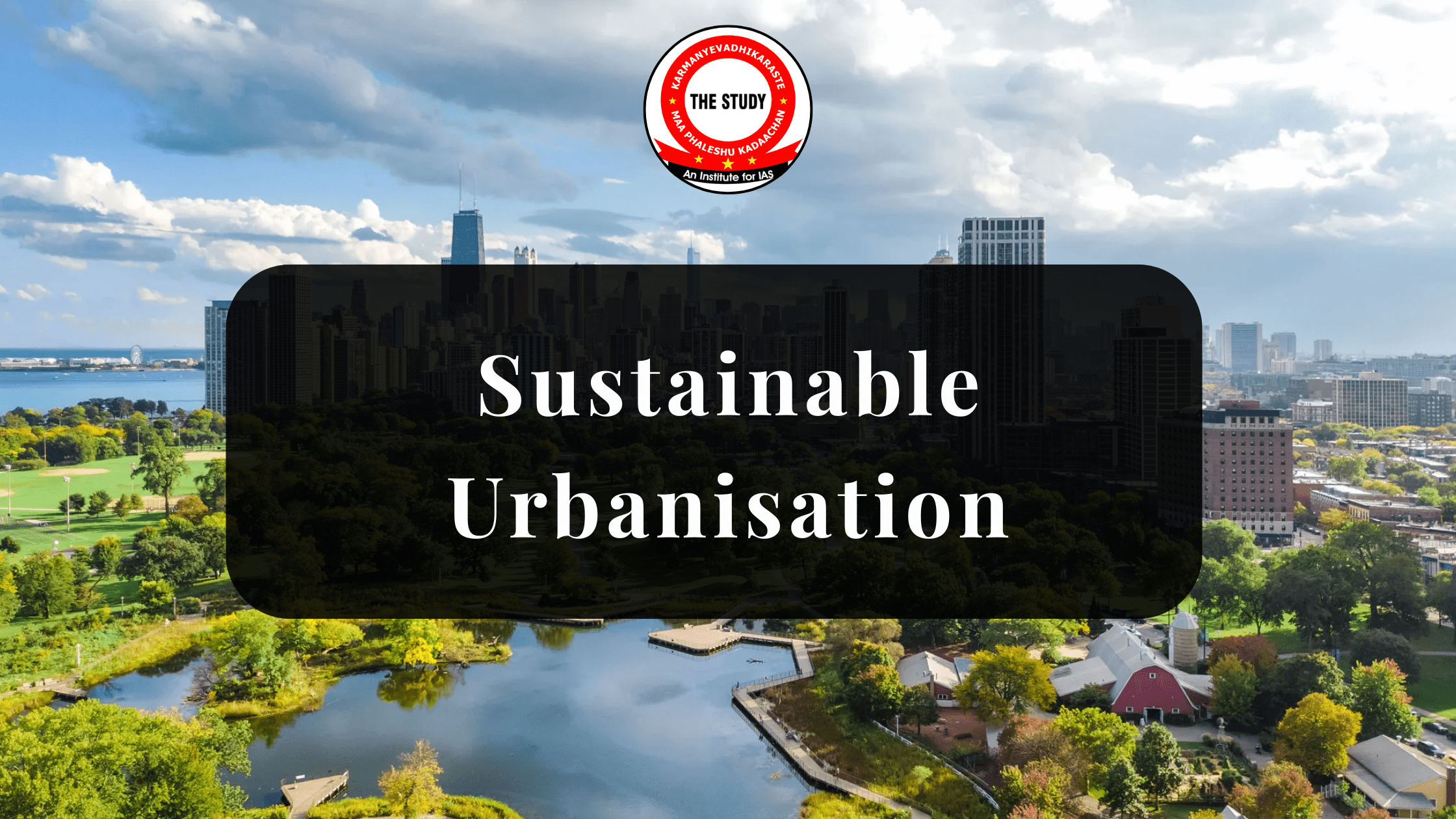
Sustainable Urbanisation: Meaning, Importance, Challenges and UPSC Relevance
Sustainable urbanisation refers to planned urban growth that balances economic development, environmental sustainability, and social equity. It focuses on affordable housing, climate resilience, green infrastructure, efficient resource use, and inclusive urban planning.
Why in the News?
Recently, UN-Habitat launched the “Catalogue of Solutions 2026–2029” to address growing global concerns related to housing shortages, urban inequality, climate risks, and lack of basic urban services.
The initiative highlights the urgent need for sustainable urbanisation as cities worldwide continue to expand rapidly.
What is Sustainable Urbanisation?
Sustainable urbanisation refers to the development of cities in a manner that balances:
- Economic growth
- Environmental sustainability
- Social inclusiveness
It aims to create cities that are:
- Livable
- Climate-resilient
- Resource-efficient
- Economically productive
- Socially inclusive
Sustainable urbanisation ensures that present urban needs are met without compromising the ability of future generations to meet their own needs.
Key Features of Sustainable Urbanisation
Affordable Housing
Ensures access to safe and affordable housing for all sections of society.
Green Infrastructure
Promotes parks, urban forests, green roofs, and sustainable drainage systems.
Sustainable Mobility
Encourages public transport, cycling, and pedestrian-friendly urban planning.
Efficient Resource Use
Focuses on water conservation, renewable energy, and waste recycling.
Climate Resilience
Builds infrastructure capable of handling floods, heatwaves, and extreme weather.
Inclusive Governance
Ensures participation of citizens and local communities in urban planning.
Why Sustainable Urbanisation is Essential
Planned Development
Unplanned urban expansion often causes:
- Urban sprawl
- Traffic congestion
- Flooding
- Heat islands
- Pressure on infrastructure
According to NITI Aayog expert Debashish Dhar in The Blind Spot, poor planning is one of the biggest reasons behind urban crises in India.
Planned sustainable development helps cities grow systematically.
Prevents Environmental Degradation
Sustainable urbanisation reduces:
- Carbon emissions
- Air pollution
- Land degradation
- Biodiversity loss
It promotes:
- Renewable energy
- Green spaces
- Energy-efficient buildings
- Sustainable transport systems
This becomes critical as cities are major contributors to greenhouse gas emissions globally.
Cities as Economic Engines
Indian cities occupy only around 3% of the country’s landmass but contribute nearly 70% of economic output, according to the Economic Survey 2025-26.
Sustainable cities:
- Improve productivity
- Reduce logistical costs
- Promote innovation
- Attract investments
They also support the transition towards a circular economy.
Ensures Resource Security
Rapid urban growth increases pressure on:
- Water
- Electricity
- Land
- Waste management systems
Sustainable urbanisation encourages:
- Water recycling
- Rainwater harvesting
- Renewable energy
- Waste-to-energy systems
This ensures long-term resource availability.
Promotes Social Equity
Unplanned urbanisation often leads to:
- Slum formation
- Income segregation
- Unequal access to services
Sustainable urban planning promotes:
- Affordable housing
- Public transport
- Access to healthcare and education
- Inclusive urban spaces
This supports balanced and equitable growth.
Mitigates Climate Risks
Cities are highly vulnerable to:
- Floods
- Heatwaves
- Water scarcity
- Extreme rainfall
Sustainable urbanisation promotes:
- Climate-resilient infrastructure
- Heat-reducing urban design
- Flood management systems
- Disaster preparedness
This is essential in the era of climate change.
Sustainable Urbanisation in India
India is urbanising rapidly.
According to estimates:
- By 2030, around 40% of India’s population may live in urban areas.
- Urban areas will significantly drive economic growth.
However, Indian cities face challenges such as:
- Traffic congestion
- Air pollution
- Waste accumulation
- Informal settlements
- Water scarcity
Therefore, sustainable urbanisation has become a national development priority.
Challenges to Sustainable Urbanisation
Unplanned Urban Growth
Rapid migration and weak urban planning create pressure on city infrastructure.
Poor Urban Governance
Urban local bodies often face:
- Financial constraints
- Limited autonomy
- Administrative inefficiency
Housing Shortages
Affordable housing remains inaccessible for many low-income groups.
Climate Vulnerability
Many Indian cities are vulnerable to floods and heatwaves.
Resource Stress
Cities consume large amounts of water and energy, often unsustainably.
Transport Problems
Car-centric development increases congestion and pollution.
Government Initiatives Related to Urbanisation
Smart Cities Mission
Focuses on technology-driven and sustainable urban development.
AMRUT Mission
Improves urban infrastructure, water supply, and sewerage systems.
PMAY-Urban
Promotes affordable housing for urban poor.
Swachh Bharat Mission (Urban)
Enhances sanitation and waste management.
Transit-Oriented Development (TOD)
Encourages compact urban growth around public transport networks.
Global Efforts and International Frameworks
Sustainable Development Goal 11
United Nations Sustainable Development Goal 11 aims to make cities:
- Inclusive
- Safe
- Resilient
- Sustainable
New Urban Agenda
Adopted during Habitat III Conference to promote sustainable urban development globally.
Paris Climate Agreement
Encourages low-carbon urban transitions.
Way Forward
Strengthen Urban Planning
Cities need integrated master plans and scientific land-use planning.
Invest in Public Transport
Mass transit systems can reduce congestion and pollution.
Promote Circular Economy
Waste recycling and efficient resource use must become central to urban policy.
Empower Urban Local Bodies
Financial and administrative decentralization is essential.
Climate-Proof Infrastructure
Urban infrastructure should incorporate climate adaptation measures.
Encourage Citizen Participation
Urban governance must become more participatory and transparent.
Conclusion
Sustainable urbanisation is no longer optional; it is essential for economic stability, environmental protection, and social justice.
As India continues to urbanise rapidly, the quality of urban growth will determine the country’s long-term development trajectory.
Well-planned, resilient, and inclusive cities can become engines of sustainable growth while ensuring a better quality of life for future generations.
Key Takeaways
- Sustainable urbanisation balances economy, environment, and equity.
- UN-Habitat launched the Catalogue of Solutions 2026–2029.
- Indian cities contribute nearly 70% of economic output.
- Sustainable cities reduce pollution and climate risks.
- SDG 11 focuses on sustainable and inclusive cities.
- Urban planning, public transport, and climate resilience are crucial.
- Sustainable urbanisation is highly important for UPSC GS Papers 1, 2, and 3.
FAQs : Sustainable Urbanisation
1. What is sustainable urbanisation?
Sustainable urbanisation is the process of developing cities while balancing economic growth, environmental protection, and social equity.
2. Why is sustainable urbanisation important?
It helps reduce pollution, improves infrastructure, ensures affordable housing, and makes cities resilient to climate change.
3. What are the major challenges of urbanisation in India?
Key challenges include urban flooding, slums, pollution, traffic congestion, and inadequate infrastructure.
4. What is the role of UN-Habitat?
UN-Habitat works on promoting sustainable and inclusive urban development globally.
5. What is SDG 11?
SDG 11 aims to make cities inclusive, safe, resilient, and sustainable.
6. How does sustainable urbanisation reduce climate risks?
It promotes climate-resilient infrastructure, flood management systems, and green urban planning.
7. Which government schemes support sustainable urbanisation in India?
Major schemes include Smart Cities Mission, AMRUT, PMAY-Urban, and Swachh Bharat Mission.
8. How are cities important for India’s economy?
Indian cities contribute nearly 70% of the country’s economic output despite occupying only about 3% of land area.
Related Topics :
• Index of Service Production (ISP)
• CDSCO: Role, Challenges, and Digital Drugs Regulatory System (DDRS)
• Rights of Persons with Disabilities (RPwD) Act, 2016
• Supreme Court Judge’s Strength
• Chief Minister Resignation Rules Under the Indian Constitution
• Indian Navy Maritime Security Strategy 2026 Explained
Subscribe to our YouTube Channel for more Valuable Content – TheStudyias
Download the App to Subscribe to our Courses – Thestudyias
The Source’s Authority and Ownership of the Article is Claimed By THE STUDY IAS BY MANIKANT SINGH
Comments (0)
Leave a Comment