Supplies of Muriate of Potash (MOP)
4 Jun 2026
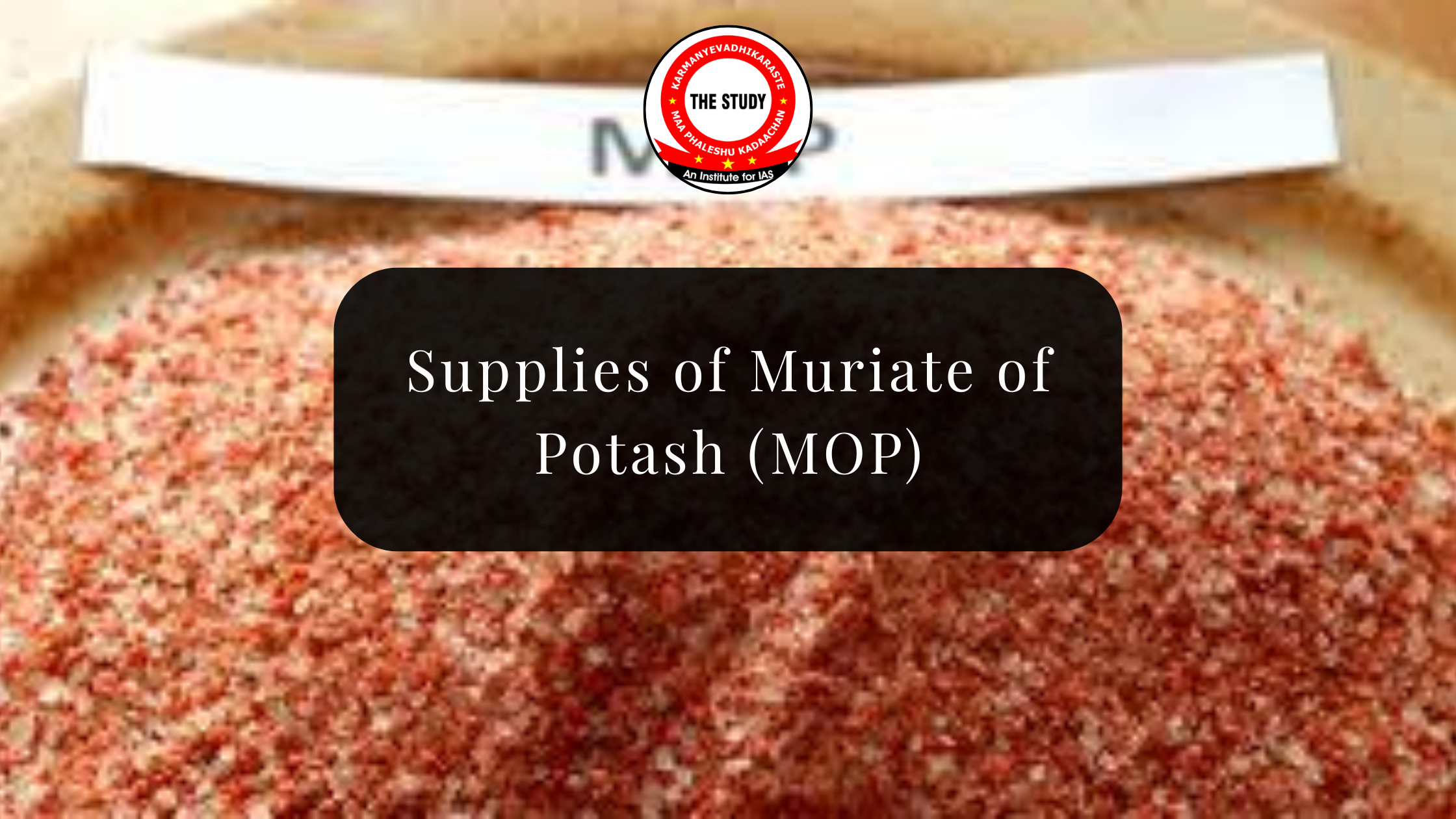
Supplies of Muriate of Potash (MOP): Why India Is Securing Potash Amid Global Supply Chain Disruptions
India is moving to secure long-term supplies of Muriate of Potash (MOP) as global fertiliser supply chains face pressure from geopolitical instability, the West Asia crisis, volatile prices, currency fluctuations, and over-dependence on limited suppliers. MOP is a key potassium-based fertiliser, and India is almost entirely dependent on imports for it. Recent reports show that India is accelerating its long-pending investment in Canada’s Karnalyte Resources Wynyard Potash Project to secure stable access to potash supplies.
This is not just a fertiliser issue. It is linked to India’s food security, subsidy burden, agricultural productivity, import strategy, and supply-chain resilience.
What is Muriate of Potash?
Muriate of Potash, commonly known as MOP, is a potassium-rich fertiliser used to provide potassium to crops. Potassium is one of the three primary plant nutrients, along with nitrogen and phosphorus.
MOP helps crops improve root growth, water regulation, disease resistance, grain quality, fruit quality, and overall productivity. It is especially important for balanced fertiliser use because excessive dependence on nitrogen-based fertilisers can damage soil health over time.
Why Are Supplies of MOP Important for India?
India’s agriculture depends heavily on fertilisers to maintain crop productivity. Since India does not produce enough potash domestically, MOP imports become critical for ensuring uninterrupted fertiliser availability.
India’s direct MOP consumption stood at about 2.2 million tonnes in 2024–25, while imports reached 3.54 million tonnes, with part of the imported material being used in complex fertilisers such as NP and NPK.
This makes MOP a strategic agricultural input, not just a commercial commodity.
Major Causes of MOP Supply Chain Concerns
Geopolitical Instability
The biggest concern is geopolitical instability. The West Asia crisis has increased uncertainty in global fertiliser trade, shipping, insurance, energy prices, and import planning.
India imports fertilisers such as urea, DAP, and MOP, along with LNG used for fertiliser production. Reuters reported that India has been seeking additional fertiliser supplies from countries such as Russia, Belarus, and Morocco because Middle East tensions and export restrictions from China could tighten supplies before the summer planting season.
West Asia Crisis
The West Asia crisis can affect fertiliser supplies by increasing shipping risks, freight costs, insurance premiums, and energy prices. This is especially serious because fertiliser demand rises before the kharif season.
Maritime Trade Disruption
The Strait of Hormuz is a major global chokepoint, especially for energy shipments. However, for MOP specifically, the claim should be framed carefully. India’s MOP supplies from Canada and Russia do not primarily depend on the Strait of Hormuz. The safer point is that the West Asia crisis raises broader maritime, energy, and logistics risks that indirectly affect fertiliser procurement.
Dependence on Limited Suppliers
India’s potash import basket is highly concentrated. Recent reporting shows that four countries account for more than 90% of India’s potash imports:
Where Does Belarus Fit In?
Belarus is one of the world’s major potash producers and has historically been important in global potash trade. India is also in talks to increase fertiliser purchases from Belarus and other countries.
However, for the current India import-share structure, recent reporting highlights Russia, Canada, Israel, and Jordan as the four countries accounting for over 90% of India’s potash imports. Belarus should be mentioned as a strategic global supplier, not inserted into the current four-country share table unless fresh official import data supports it.
READ MORE : How to Score 300+ in History Optional • World History Strategy for UPSC History Optional (Paper 1) • Modern History Strategy for UPSC Optional (Paper 2) • Medieval History Strategy for UPSC Optional • Plant-Based Meat • BHAVYA Scheme • Cooperative AI • Landslides • E20 Fuel • Deforestation • Drop Shipping • Memory Chip • US-Iran Deal • Urban Water Stress in India • Dancing Girl of Mohenjo-daro • Forest Rights Appellate Tribunal (FORAT) • RBI and Fiscal Policy
Market and Financial Pressures
Volatile Global MOP Prices
MOP prices are highly sensitive to geopolitical shocks, supply restrictions, sanctions, freight rates, and global demand. According to World Bank-linked data cited in recent reporting, benchmark MOP spot prices rose from about $352 per tonne in April 2025 to about $401 per tonne in April 2026.
This affects India directly because higher global fertiliser prices increase procurement costs and raise the fertiliser subsidy burden.
Currency and Logistics Pressures
Exchange-rate volatility further increases import costs. If the rupee weakens against the dollar, India has to spend more on the same quantity of imported fertiliser.
Rising freight rates, port delays, shipping insurance, and route uncertainty also add to procurement risk.
Rising Fertiliser Subsidy Burden
India protects farmers from sharp fertiliser price increases through subsidies. This keeps fertilisers affordable, but it puts pressure on public finances.
India’s fertiliser subsidy bill crossed ₹2.17 trillion in FY26, while the FY27 budget allocation stands at ₹1.71 trillion. Officials expect the allocation may rise if the West Asia crisis continues to disrupt fertiliser supplies and global prices.
Major Exporters of Potash to India
India’s key MOP suppliers include:
Russia
Russia is currently India’s largest potash supplier, accounting for around 51% of imports. This creates strategic risk because Russia is exposed to sanctions, shipping restrictions, payment complications, and geopolitical volatility.
Canada
Canada accounts for about one-fourth of India’s potash imports and is one of the most important stable suppliers. India’s renewed push in the Canadian Wynyard project reflects this strategic importance.
Israel
Israel is a recurring potash supplier to India. However, the Israel-Iran conflict and broader West Asian volatility increase uncertainty around supplies and shipping confidence.
Jordan
Jordan is another important supplier. India has previously turned to Jordan during supply disruptions, making it part of India’s diversification strategy.
Belarus
Belarus is a major global potash producer and remains relevant for India’s long-term diversification. However, sanctions and route complications can affect its export reliability.
Why Is India Scaling Up Potash Investment in Canada?
India is accelerating its investment focus on Canada’s Wynyard Potash Project because it offers a more stable long-term source of MOP outside the immediate West Asia conflict zone.
Karnalyte Resources says the Wynyard project has planned Phase 1 production of 675,000 tonnes per year, followed by two additional phases of 750,000 tonnes each, taking total planned capacity to 2.175 million tonnes per year. The company has also stated that environmental permits remain valid and that the offtake agreement with GSFC remains in effect.
GSFC holds a 47.73% stake in Karnalyte, giving India a strategic position in the project.
Why Does India Need to Diversify Potash Exporters?
India needs to diversify potash exporters because fertiliser security is directly connected to food security.
Mitigate Geopolitical Risks
Conflicts, sanctions, diplomatic tensions, port disruptions, and shipping restrictions can interrupt supplies from major exporting countries. Diversification reduces India’s exposure to any single region or supplier.
Reduce Subsidy Pressure
When international prices rise sharply, India’s subsidy burden increases. Diversified sourcing and long-term contracts can help reduce exposure to sudden price spikes.
Secure Long-Term Access
Overseas assets such as GSFC’s stake in the Wynyard project can provide predictable access to potash. This is important because India cannot depend only on spot purchases during global crises.
Strengthen Supply Chain Resilience
Multiple sourcing options reduce the risk of shortages caused by war, port closures, sanctions, or logistical bottlenecks.
Ensure Food Security
Potash is essential for crop productivity. Stable MOP supplies help ensure that farmers receive fertilisers on time during kharif and rabi seasons.
Improve Bargaining Power
When India depends on a few suppliers, exporters gain pricing power. Diversification gives India stronger leverage during price negotiations and long-term contract discussions.
Way Forward for India
India needs a strategic fertiliser security framework.
Secure Overseas Mineral Assets
India should continue investing in overseas potash assets in politically stable regions.
Diversify Import Sources
India should expand sourcing beyond a narrow group of suppliers and maintain active engagement with Canada, Russia, Jordan, Israel, Belarus, Morocco, and other potential partners.
Build Strategic Fertiliser Reserves
Like energy reserves, India should consider strategic reserves for critical fertilisers and raw materials.
Promote Balanced Fertiliser Use
India must reduce excessive dependence on urea and encourage balanced use of nitrogen, phosphorus, and potassium.
Improve Domestic Alternatives
While domestic potash production is limited, India can strengthen nutrient-use efficiency, organic fertilisers, bio-fertilisers, and soil health management.
Use Long-Term Contracts
Long-term supply contracts can reduce exposure to spot price volatility.
Common Mistakes to Avoid
Overstating the Strait of Hormuz Link
Do not write that all MOP supplies depend on the Strait of Hormuz. Canada and Russia-linked routes do not primarily depend on it. The accurate point is that West Asia instability increases broader shipping, energy, and logistics risks.
Mixing Global Producers with Current Indian Import Shares
Belarus is a major global potash producer, but recent India import-share data places Russia, Canada, Israel, and Jordan as the four countries accounting for over 90% of India’s potash imports.
Treating Price Rise as Only a Fertiliser Issue
MOP price volatility affects the subsidy bill, farmer costs, crop planning, food prices, and fiscal management.
Ignoring the Food Security Link
Potash supply is not merely a trade concern. It is a food security concern.
Key Takeaways
- India is heavily dependent on imported MOP because domestic potash production is negligible.
- MOP is essential for crop yield, plant strength, disease resistance, and soil nutrient balance.
- Four countries account for over 90% of India’s potash imports: Russia, Canada, Israel, and Jordan.
- Russia alone accounts for 51% of India’s potash imports, while Canada accounts for 25%.
- Benchmark MOP prices rose from about $352 per tonne in April 2025 to about $401 per tonne in April 2026.
- India’s fertiliser subsidy bill crossed ₹2.17 trillion in FY26, while the FY27 budget allocation stands at ₹1.71 trillion.
- India’s investment push in Canada is aimed at long-term potash security through overseas resource access.
Conclusion
India’s push to secure supplies of Muriate of Potash reflects a larger strategic reality: fertiliser security is now part of national economic security. With India dependent on imports for potash, disruptions in global supply chains can directly affect farmers, crop output, food prices, and the subsidy bill.
The Canada investment push through the Wynyard Potash Project is a practical step toward long-term supply resilience. But India needs a broader strategy: diversified suppliers, overseas assets, long-term contracts, strategic reserves, balanced fertiliser use, and better nutrient management.
For India, MOP is not just a fertiliser input. It is a strategic link between global geopolitics and domestic food security.
FAQs on Muriate of Potash
What is Muriate of Potash?
Muriate of Potash, or MOP, is a potassium-based fertiliser used to improve crop growth, root strength, disease resistance, water regulation, and yield quality.
Why is India dependent on MOP imports?
India is dependent on MOP imports because domestic potash production is negligible. As a result, India relies on foreign suppliers to meet its potassium fertiliser requirements.
Which countries supply potash to India?
Recent reporting shows that Russia, Canada, Israel, and Jordan account for over 90% of India’s potash imports. Russia contributes 51%, Canada 25%, Israel 8%, and Jordan 8%.
Why is India investing in Canada’s potash sector?
India is investing in Canada’s potash sector to secure stable long-term MOP supplies. GSFC holds a strategic stake in Karnalyte Resources’ Wynyard Potash Project in Saskatchewan.
Why is the West Asia crisis a concern for fertiliser supplies?
The West Asia crisis can increase shipping risk, insurance costs, energy prices, freight costs, and uncertainty in fertiliser procurement. This can raise India’s import bill and subsidy burden.
How does MOP supply affect food security?
MOP supports crop yield, quality, and disease resistance. If MOP supplies are disrupted, fertiliser availability can suffer, affecting agricultural productivity and food security.
Why should India diversify potash imports?
India should diversify potash imports to reduce geopolitical risk, avoid supplier concentration, improve bargaining power, control subsidy pressure, and ensure uninterrupted fertiliser availability.
READ MORE : How to Score 300+ in History Optional • World History Strategy for UPSC History Optional (Paper 1) • Modern History Strategy for UPSC Optional (Paper 2) • Medieval History Strategy for UPSC Optional • Plant-Based Meat • BHAVYA Scheme • Cooperative AI • Landslides • E20 Fuel • Deforestation • Drop Shipping • Memory Chip • US-Iran Deal • Urban Water Stress in India • Dancing Girl of Mohenjo-daro • Forest Rights Appellate Tribunal (FORAT) • RBI and Fiscal Policy
Related posts :
- Majoritarianism vs Constitutionalism
- India-Bangladesh Ties
- Nordic Countries and India
- Tackling Ocean Plastic Pollution
- India-Bhutan Ties
- India-UAE Ties
- India-Netherlands Ties
- Captagon: The “Jihadi Drug”
- Bioenergy Systems
- Transforming the Brahmaputra
- India–Africa Forum Summit
- India–US Defence Ties
Subscribe to our YouTube Channel for more Valuable Content – TheStudyias
Download the App to Subscribe to our Courses –Thestudyias
The Source’s Authority and Ownership of the Article is Claimed By THE STUDY IAS BY MANIKANT SINGH
Comments (0)
Leave a Comment