Substantive Equality
28 Aug 2026
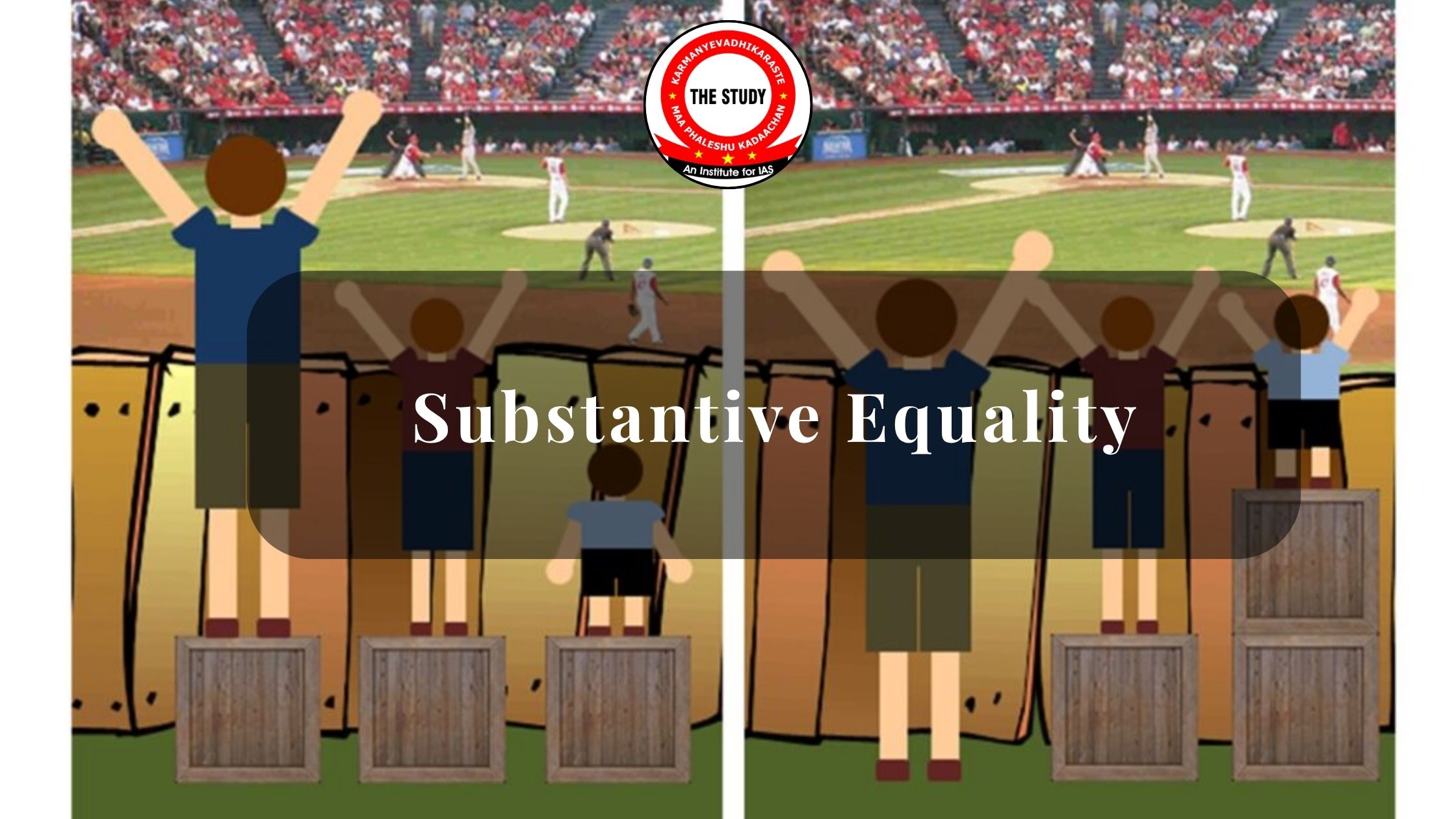
Substantive Equality
Introduction
Equality is one of the foundational promises of the Indian Constitution. Yet, a simple question creates a deeper constitutional debate: Can people who begin from unequal social, economic and historical positions be made equal merely by treating everyone identically?
The idea of substantive equality answers this question in the negative.
Formal equality says that similarly placed persons should receive similar treatment. Substantive equality goes further: it asks whether the law, policy or institution actually produces equal opportunity and meaningful outcomes, especially for groups disadvantaged by caste, gender, disability, poverty or historical exclusion.
This distinction is crucial for UPSC because Indian constitutionalism does not treat equality as mere uniformity. Articles 14, 15 and 16 together demonstrate the movement from formal equality towards equality in substance.
For a new aspirant, the easiest way to understand the concept is:
Formal equality asks: “Are we treating everyone the same?”
Substantive equality asks: “Does this treatment actually give everyone a fair chance?”
How Does Substantive Equality Work in the Indian Constitutional Framework?
What Is the Difference Between Formal and Substantive Equality?
Formal equality requires equal treatment before the law. If two persons are similarly situated, the State should not discriminate arbitrarily between them.
Substantive equality recognises that identical treatment can sometimes reproduce existing inequality.
Consider two students preparing for a competitive examination. One has access to quality schooling, digital resources and private coaching, while another has faced poverty, social exclusion and poor educational infrastructure.
Giving both students exactly the same opportunity may appear neutral. But substantive equality asks whether the disadvantaged student has a realistic opportunity to compete.
Therefore:
Formal equality = equality of treatment.
Substantive equality = equality of opportunity and effective participation.
India's constitutional framework accommodates both.
How Does Article 14 Support Substantive Equality?
Article 14 guarantees equality before law and equal protection of laws.
It does not mean that every law must treat every person identically.
The Supreme Court has recognised that reasonable classification is permissible when there is an intelligible differentia and a rational connection between the classification and the objective of the law.
This becomes important for substantive equality.
For example, a welfare measure targeting economically vulnerable groups may differentiate between citizens, but the objective is not arbitrary discrimination—it is to address a specific disadvantage.
Thus, different treatment can sometimes be necessary to achieve genuine equality.
Why Are Articles 15 and 16 Central to Substantive Equality?
Article 15 prohibits discrimination on specified grounds while permitting certain forms of affirmative action.
Article 15(3) enables special provisions for women and children.
Article 15(4) permits special provisions for the advancement of socially and educationally backward classes, Scheduled Castes and Scheduled Tribes.
Article 15(5) enables special provisions concerning admission to educational institutions for socially and educationally backward classes, SCs and STs, subject to constitutional limitations.
Article 16 guarantees equality of opportunity in public employment, while clauses such as 16(4), 16(4A) and 16(4B) provide constitutional space for reservation-related measures.
These provisions illustrate an important constitutional principle:
Equality may require positive intervention when historical disadvantage prevents genuine equality of opportunity.
Is Reservation an Example of Substantive Equality?
Yes, reservation is one of India's most important examples of the substantive-equality approach.
The constitutional argument is not simply that some citizens should receive preferential treatment.
It is that historical exclusion can create structural barriers that formal equality alone cannot remove.
Reservation seeks to improve representation and access for historically disadvantaged communities in specified contexts.
However, a high-quality UPSC answer should avoid presenting reservation as the only instrument of substantive equality.
Other tools include:
- Scholarships and educational support
- Accessible public infrastructure
- Gender-responsive policies
- Disability accommodations
- Social-security programmes
- Anti-discrimination mechanisms
- Targeted welfare interventions
Therefore, substantive equality is a constitutional philosophy, while reservation is one of its important policy instruments.
How Does the Supreme Court Interpret Substantive Equality?
The Supreme Court's equality jurisprudence has gradually moved beyond a narrow understanding of Article 14.
The landmark E.P. Royappa v. State of Tamil Nadu (1974) judgment shifted the focus towards arbitrariness, establishing that equality and arbitrariness are fundamentally incompatible.
In Maneka Gandhi v. Union of India (1978), the Court strengthened the relationship between Articles 14, 19 and 21, giving equality a broader constitutional significance.
In NALSA v. Union of India (2014), the Court recognised the rights of transgender persons and emphasised constitutional equality and dignity.
In Janhit Abhiyan v. Union of India (2022), the Supreme Court upheld the constitutional validity of the 103rd Constitutional Amendment, which introduced reservation for Economically Weaker Sections, subject to the Court's reasoning.
Together, these developments show that equality increasingly concerns dignity, non-arbitrariness, inclusion and meaningful opportunity, rather than mechanical uniformity.
What Are the Major Challenges in Achieving Substantive Equality in India?
The biggest challenge is that inequality is multidimensional.
A person's disadvantage may arise from the interaction of:
caste + gender + poverty + geography + disability + education.
This is sometimes described through the concept of intersectionality.
For example, a poor woman from a historically disadvantaged community in a remote region may face multiple barriers simultaneously.
There are also practical concerns:
- Benefits may not reach the intended population.
- Identification of beneficiaries can be difficult.
- Administrative capacity varies across regions.
- Policies can become excessively dependent on quotas.
- Discrimination may persist even after formal access improves.
- Unequal access to quality education and healthcare continues to affect opportunity.
Therefore, substantive equality requires institutional reform, not merely legal declarations.
Why Is Substantive Equality Important for UPPSC and Other Competitive Exams?
For UPSC, the concept is relevant to GS-II, Essay and Ethics. It can be used in questions involving:
- Equality and social justice
- Reservation
- Women and gender justice
- Disability rights
- Minority and vulnerable-group welfare
- Affirmative action
- Constitutional morality
- Inclusive development
For UPPSC and other State examinations, connect substantive equality with Uttar Pradesh's social-development challenges, welfare delivery, education, employment, women's empowerment and representation.
A strong Mains answer should follow this structure:
Definition → Formal vs substantive equality → Constitutional provisions → Supreme Court jurisprudence → Examples → Challenges → Way forward.
What Are the Quick Facts for UPPSC Prelims, Previous Year Exam-Oriented Points and FAQ?
Quick Facts for UPPSC Prelims
- Article 14: Equality before law and equal protection of laws.
- Article 15: Prohibition of discrimination on specified grounds.
- Article 15(3): Special provisions for women and children.
- Article 15(4): Advancement of socially and educationally backward classes, SCs and STs.
- Article 16: Equality of opportunity in public employment.
- Article 16(4): Reservation for backward classes inadequately represented in State services.
- Article 17: Abolition of untouchability.
- Article 46: Promotion of educational and economic interests of weaker sections, particularly SCs and STs.
- 103rd Constitutional Amendment: Introduced EWS reservation provisions.
- E.P. Royappa case: Important development in Article 14 jurisprudence.
Previous Year Exam-Oriented Points
Prepare substantive equality through these recurring themes:
- Equality versus equity.
- Article 14 and reasonable classification.
- Affirmative action.
- Reservation and social justice.
- Intersectionality.
- Gender equality.
- Disability rights and reasonable accommodation.
- Equality, dignity and constitutional morality.
- EWS reservation.
- Balancing equality with merit and efficiency.
FAQ
Is substantive equality the same as equality of outcome?
No. It primarily seeks to remove structural barriers and ensure meaningful equality of opportunity. It does not necessarily require identical outcomes.
Does treating everyone differently violate Article 14?
Not necessarily. Constitutionally valid classification may be permissible when it is based on relevant distinctions and has a rational relationship with the objective.
Why is substantive equality necessary?
Because historically disadvantaged groups may remain disadvantaged even when formally equal laws apply to everyone.
Is reservation the only form of substantive equality?
No. Education, healthcare, accessibility, social security, anti-discrimination laws and targeted welfare can also promote substantive equality.
Subscribe to our Youtube Channel for more Valuable Content – TheStudyias
Download the App to Subscribe to our Courses – Thestudyias
The Source’s Authority and Ownership of the Article is Claimed By THE STUDY IAS BY MANIKANT SINGH
Comments (0)
Leave a Comment