Special Frontier Force SFF
21 Aug 2026
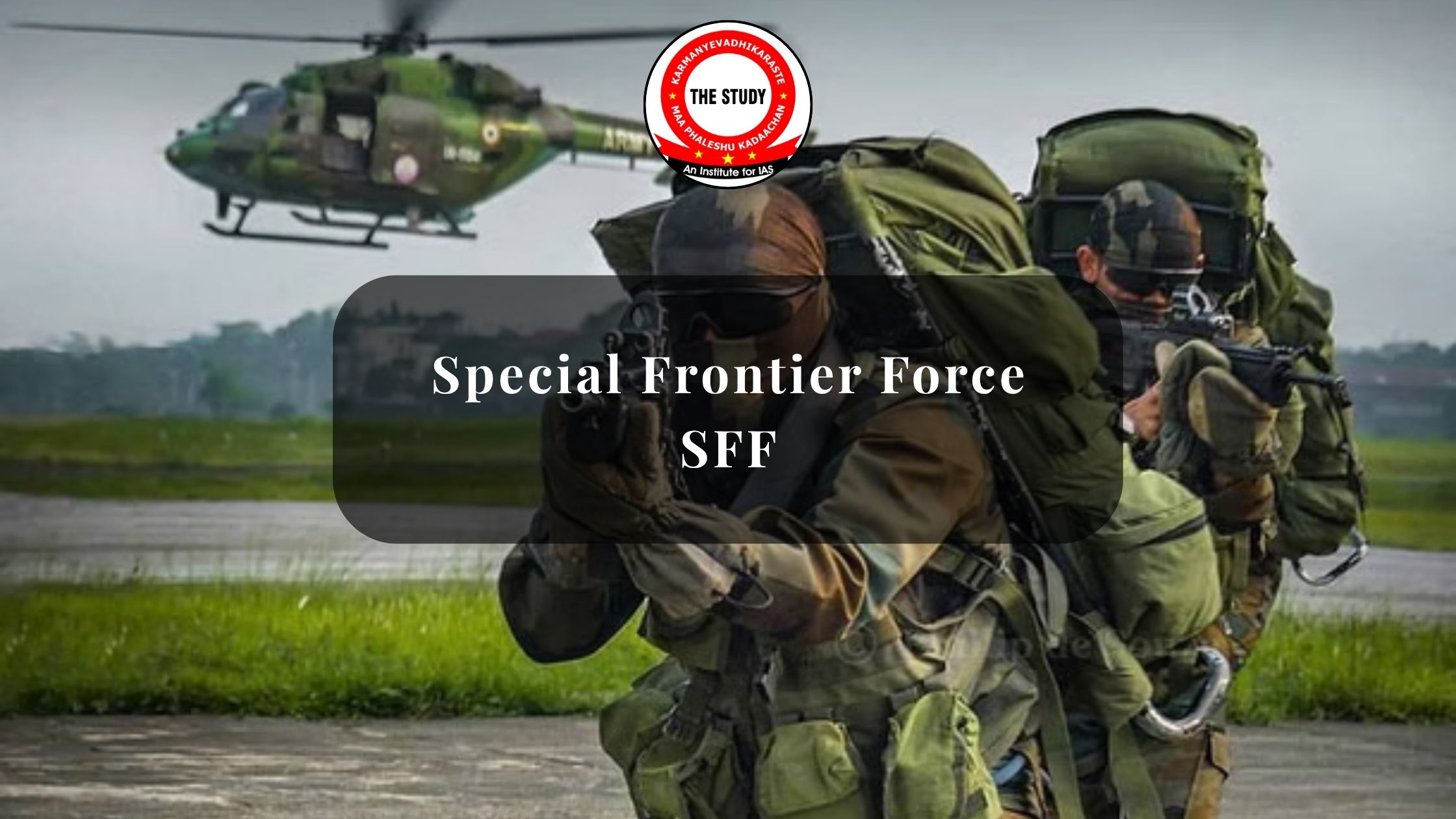
Special Frontier Force (SFF): History, Role, Structure & Importance
Introduction
The Special Frontier Force (SFF) is one of India's most distinctive and relatively secretive security formations. Raised in the aftermath of the 1962 India-China War, it was initially designed to undertake specialised operations in the difficult Himalayan terrain and, if required, operate behind enemy lines. It was initially composed largely of Tibetan refugees, with recruitment later expanding to include Gorkhas. Its units are popularly known as Vikas Battalions, while the force was initially referred to as Establishment 22.
The SFF is important for competitive examinations because it connects several themes: India-China relations, border management, intelligence organisations, special forces, Tibetan refugees, national security, high-altitude warfare and India's strategic response to the 1962 war.
However, aspirants should be careful with information about the SFF. Much of its organisational structure, strength and operational activity is not publicly disclosed. Therefore, preparation should rely on verified information rather than speculative claims about classified operations.
Special Frontier Force: Formation, Organisation, Operations & Strategic Significance
What is the Special Frontier Force and why was it created?
The Special Frontier Force was established on 14 November 1962, shortly after the Sino-Indian War. The immediate strategic objective was to create a force capable of operating in mountainous areas and conducting unconventional missions against a potential Chinese adversary.
The force initially recruited large numbers of Tibetan refugees, particularly people from the Khampa community, who possessed familiarity with the Himalayan environment. Later, Gorkhas also became part of the force.
The formation of the SFF reflected India's post-1962 effort to strengthen its capabilities in mountain warfare, intelligence and unconventional operations.
Why was the SFF initially called Establishment 22?
The SFF was initially known as Establishment 22. The name is generally linked to Major General Sujan Singh Uban, the officer who played a central role in raising the force and who had previously commanded the 22 Mountain Regiment.
Sujan Singh Uban became the first important Indian military figure associated with the organisation. The early force was developed with an emphasis on guerrilla warfare, mountain operations and specialised training.
The historical background also involved cooperation between Indian intelligence and the United States during the Cold War. The precise extent and institutional nature of this cooperation has been discussed differently in secondary sources, so aspirants should avoid presenting disputed details as officially established facts.
What is the connection between the SFF and Tibetan resistance?
The origins of the SFF are closely connected with the history of the Tibetan resistance movement.
The Chushi Gangdruk, a Tibetan resistance organisation, had emerged following China's occupation of Tibet. After the Dalai Lama and large numbers of Tibetans came to India in 1959, a pool of experienced and motivated Tibetan fighters became available for possible military and intelligence-related roles.
India's post-1962 security requirements and the existing Tibetan resistance network therefore came together in the creation of the SFF.
This background is important for understanding the intersection of:
Tibet issue + India-China relations + Cold War geopolitics + Indian national security.
How is the SFF different from the Indian Army?
One of the most important examination points is that the SFF should not simply be described as a regular Indian Army regiment.
Public sources describe it as a specialised force under the Cabinet Secretariat, with an Indian Army officer serving as its Inspector General. Its operational relationship with the Army has varied according to circumstances. The units are commonly known as Vikas Battalions.
The distinction matters because India maintains several specialised security organisations with different administrative and operational arrangements.
For Prelims, remember:
SFF → Cabinet Secretariat framework → specialised force → Vikas Battalions
rather than assuming that it is simply another infantry regiment of the Indian Army.
What are the major roles and capabilities of the SFF?
The original purpose of the SFF centred on covert and unconventional operations, particularly in mountainous terrain.
Its publicly reported capabilities and roles have included:
- High-altitude operations
- Mountain warfare
- Reconnaissance and surveillance
- Specialised border missions
- Covert operations
- Support to broader military objectives
The force received specialised training in areas such as rock climbing, guerrilla warfare and airborne operations. Historical accounts also describe extensive training for operations in difficult mountainous environments.
Because many details remain classified, aspirants should avoid quoting unverified figures about the SFF's present strength, weapons or exact deployment pattern.
What was the role of SFF in the 1971 Bangladesh Liberation War?
The SFF was also deployed during the 1971 India-Pakistan War.
It operated in the Chittagong Hill Tracts of what was then East Pakistan, where its mountain-warfare capabilities were particularly relevant. This deployment demonstrated that the SFF's usefulness extended beyond its original China-focused role.
The 1971 experience is significant because it demonstrates how specialised forces can be employed according to terrain and strategic requirements.
For a Mains answer, this can be used as an example of India's development of specialised military capabilities after the 1962 experience.
Why did the SFF become significant during the 2020 India-China tensions?
The SFF attracted renewed attention during the 2020 India-China border crisis in eastern Ladakh.
Public reporting stated that SFF personnel were involved in operations in the high-altitude region, including actions around strategic heights on the southern bank of Pangong Tso. The force's familiarity with mountainous terrain made it particularly relevant to the operational environment.
The episode highlighted an important transformation in India's border strategy: modern Himalayan security requires not only conventional troops and infrastructure but also specialised capabilities suited to high-altitude terrain.
What is the Importance of SFF for UPPSC and Other Competitive Exams?
For UPPSC, UPSC, CDS, CAPF and other competitive examinations, SFF can be linked with Internal Security, India-China relations, Defence Technology, Border Management and National Security.
Aspirants should connect the topic with:
- 1962 India-China War
- Tibetan refugee issue
- Line of Actual Control (LAC)
- High-altitude warfare
- Specialised forces
- Intelligence and covert operations
- India's Himalayan security
- Strategic autonomy
For Mains, instead of merely describing the SFF, a stronger argument is:
India's post-1962 security evolution demonstrates the shift from conventional defence alone towards a combination of specialised forces, intelligence, infrastructure and terrain-specific capabilities.
What are the Previous Year Exam-Oriented Points?
There is no basis to claim that SFF is a repeatedly asked PYQ topic unless a specific UPSC/UPPSC question is verified. It is better treated as a current-affairs-linked security topic.
For examination purposes, remember:
- SFF was raised after the 1962 India-China War.
- It was initially known as Establishment 22.
- Major General Sujan Singh Uban was closely associated with its formation.
- It initially recruited mainly Tibetan refugees.
- Its units are popularly called Vikas Battalions.
- It is not simply a regular Indian Army regiment.
- It participated in the 1971 India-Pakistan War.
- It gained renewed public attention during the 2020 India-China border tensions.
What is the Final Verdict on the Special Frontier Force?
The Special Frontier Force represents an important chapter in India's evolution of specialised national-security capabilities.
Its story begins with the strategic shock of 1962, develops through India's engagement with the Tibetan resistance and Cold War geopolitics, and continues into contemporary Himalayan security challenges.
For an aspirant, the key lesson is not to memorise every claim about this secretive organisation. Instead, understand the larger strategic chain:
1962 War → specialised mountain capability → Tibetan recruitment → unconventional warfare → evolving national-security role → contemporary Himalayan preparedness.
That framework is sufficient to convert a current-affairs topic into a strong UPPSC/UPSC GS-III answer.
FAQs
1. What is the Special Frontier Force?
The SFF is a specialised Indian force established after the 1962 India-China War for unconventional and high-altitude operations.
2. When was the SFF established?
It was established on 14 November 1962.
3. What was the original name of SFF?
It was initially known as Establishment 22.
4. Why is it called the Vikas Battalion?
The units of the SFF are commonly referred to as Vikas Battalions.
5. Who was Major General Sujan Singh Uban?
He was a senior Indian military officer closely associated with the establishment and early leadership of the SFF.
6. Why is SFF important for UPPSC?
It links India-China relations, border security, Tibet, special forces, intelligence and Himalayan defence, making it relevant to both Prelims and GS-III Mains.
7. Did the SFF participate in the 1971 war?
Yes. It was deployed in the Chittagong Hill Tracts during the 1971 India-Pakistan War.
Subscribe to our Youtube Channel for more Valuable Content – TheStudyias
Download the App to Subscribe to our Courses – Thestudyias
The Source’s Authority and Ownership of the Article is Claimed By THE STUDY IAS BY MANIKANT SINGH
Comments (0)
Leave a Comment