Revolt of 1857: Causes, Nature, Centres and Consequences
10 Oct 2026
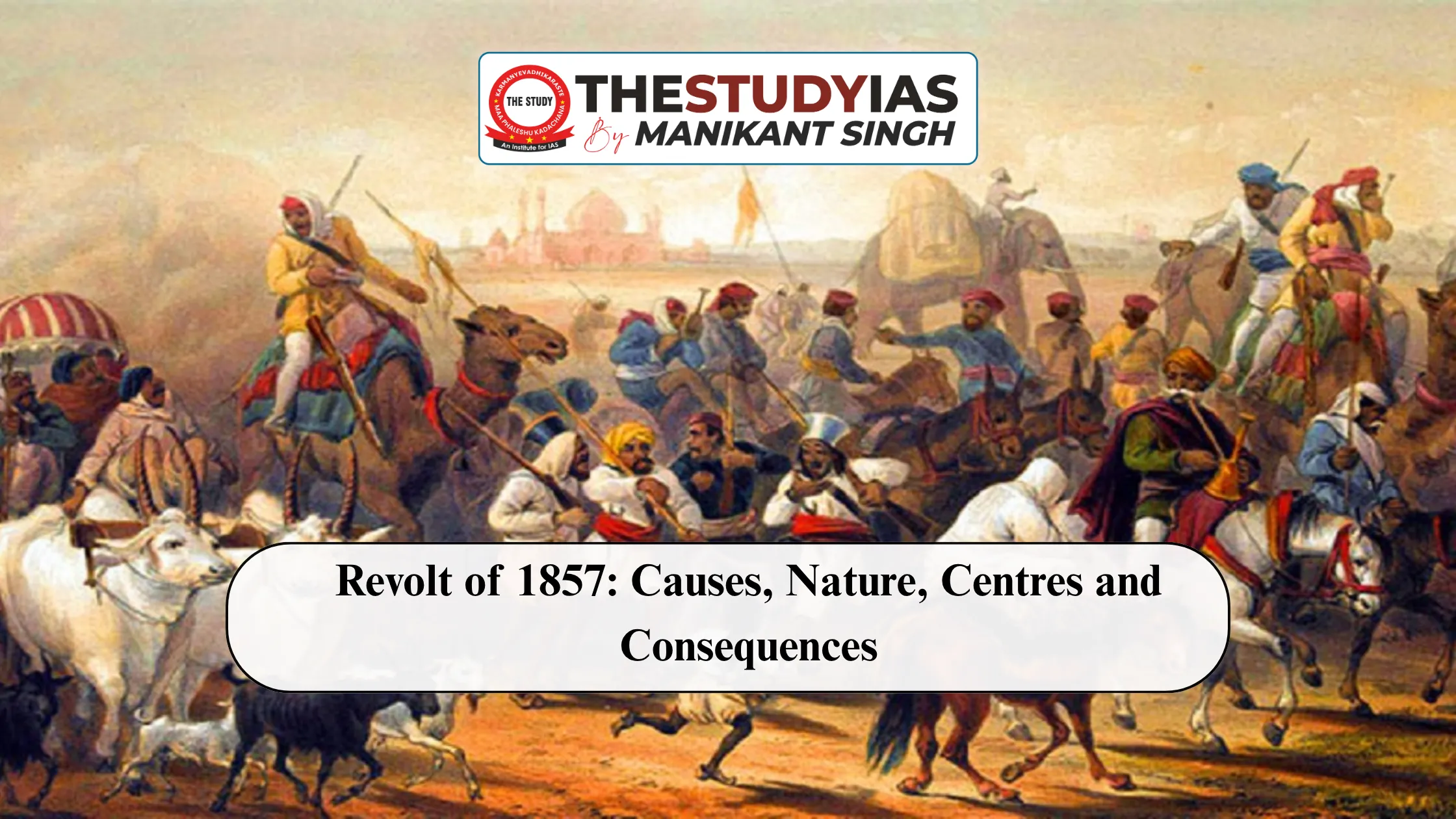
Revolt of 1857: Causes, Nature, Centres and Consequences
The Revolt of 1857 was one of the most significant challenges to British rule in nineteenth-century India. What began as a military uprising among sections of the East India Company's army at Meerut on 10 May 1857 soon spread across large parts of northern and central India.The revolt brought together different sections of society, including sepoys, peasants, zamindars, rulers and other groups, although their reasons for participation were not always identical.
The uprising was eventually suppressed, but it had major consequences for the structure of British rule in India. The East India Company's rule came to an end, and the British Crown assumed direct control over India.
For UPSC, the Revolt of 1857 should not be studied merely as a sequence of events. Its causes, nature, centres, leadership, reasons for failure and consequences are equally important.
What Was the Revolt of 1857?
The Revolt of 1857 was a widespread uprising against British authority that began among Indian soldiers of the East India Company's Bengal Army and subsequently involved sections of the civilian population.The revolt spread rapidly from Meerut to Delhi and then to several regions of North and Central India. IGNOU's historical material notes that the uprising soon extended beyond the sepoy ranks and involved peasants and other civilian groups across a wide area.
The revolt is described differently by historians. Some emphasise its character as a sepoy mutiny, while others highlight the participation of peasants, rulers and civilians and interpret it as a broader anti-colonial uprising.Therefore, understanding its nature is an important part of studying the revolt.
Causes of the Revolt of 1857
The Revolt of 1857 did not have a single cause.Political annexations, economic exploitation, social and religious concerns, military grievances and administrative changes created a wider atmosphere of dissatisfaction.The immediate military trigger provided the spark, but the underlying discontent had developed over a longer period.
Political Causes
British expansion had affected the position of Indian rulers and traditional political elites. The Doctrine of Lapse, associated with Lord Dalhousie, was used to annex several states where the British refused to recognise adopted heirs under their succession policy.States such as Satara, Jhansi and Nagpur were annexed under this policy.
The annexation of Awadh in 1856 was particularly significant. The British justified the annexation on grounds of alleged maladministration, but it generated resentment among the ruling elite, soldiers and sections of the population.
The displacement of rulers and court establishments also affected groups that had depended upon these political structures.
Economic Causes
Colonial economic policies affected peasants, artisans, zamindars and other sections of Indian society.Land revenue systems placed considerable pressure on cultivators. The colonial state sought to maximise revenue collection, while changes in land relations affected the position of traditional landholders.IGNOU's material identifies exploitation of the peasantry and the operation of different land revenue settlements as important background factors behind the revolt.
Indian handicrafts also faced increasing competition from machine-made British goods. The decline of traditional industries affected artisans and other groups dependent on indigenous production.Economic grievances therefore contributed to the broader dissatisfaction against colonial rule.
Military Causes
Indian sepoys formed an important part of the East India Company's military system, particularly in the Bengal Army.Despite their large numerical strength, Indian soldiers experienced several forms of discrimination in matters such as pay, promotion and service conditions.There was also resentment over the possibility of serving overseas. The General Service Enlistment Act of 1856 required new recruits to accept the possibility of overseas service, which created concern among sections of Hindu soldiers because of prevailing religious beliefs regarding crossing the sea.
The military grievances became especially significant because the sepoys were already organised, armed and capable of spreading the rebellion rapidly.
Social and Religious Causes
British interventions in Indian society generated suspicion among some sections of the population.Social reform measures such as the abolition of sati and the legalisation of widow remarriage had humanitarian objectives, but sections of conservative society feared that the colonial government was interfering with established religious and social practices.
Christian missionary activity and the growing presence of Western education also created concerns among sections of Indian society. It is important, however, not to assume that all Indians opposed social reform or that religious fears were uniform across the country. These concerns contributed to the atmosphere of suspicion rather than acting as a single cause.
Immediate Cause: The Enfield Rifle Cartridges
The immediate trigger was the controversy surrounding the Enfield rifle cartridges.It was widely believed among Indian soldiers that the cartridges were greased with cow and pig fat. Since the cartridges had to be bitten open before use, the issue created serious religious concerns among both Hindu and Muslim soldiers.The controversy intensified existing military grievances.
The incident involving Mangal Pandey at Barrackpore on 29 March 1857 preceded the outbreak at Meerut. On 10 May 1857, sepoys at Meerut rebelled, killed several European officers and moved towards Delhi.
Thus, the cartridge issue was the immediate trigger rather than the sole cause of the revolt.
Major Causes at a Glance
The Revolt of 1857 should therefore be understood as the result of multiple interconnected grievances rather than one isolated incident.
Beginning and Spread of the Revolt
The revolt began at Meerut on 10 May 1857.The rebels marched to Delhi, where they declared the ageing Mughal emperor Bahadur Shah Zafar as their symbolic leader.
Delhi became an important political centre of the rebellion.From Delhi, the revolt spread to several regions of North and Central India. Important centres included Kanpur, Lucknow, Jhansi, Bareilly and parts of Bihar.
The spread of the revolt was rapid during May and June 1857, although its intensity and form varied across regions.
Major Centres and Leaders of the Revolt of 1857
The revolt had several important regional centres. Leadership also varied according to local political and social conditions.
The regional leadership shows that the revolt did not operate under a single central command.
Different leaders pursued their own local objectives while sharing opposition to British authority.
Nature of the Revolt of 1857
The nature of the Revolt of 1857 has been debated among historians.One interpretation emphasises the revolt's origin among the sepoys of the East India Company's army and therefore describes it primarily as a sepoy mutiny.Another interpretation highlights the participation of peasants, zamindars, dispossessed rulers and civilians in several regions and therefore views it as a broader popular or anti-colonial uprising.
The revolt was not uniform throughout India. Large parts of southern and western India remained outside the main zone of rebellion, and several Indian rulers and groups did not support the uprising.Therefore, the most useful approach is to recognise its military origin, significant civilian participation and strong regional variation.
Was the Revolt a Sepoy Mutiny?
The revolt clearly began as a military uprising.Indian soldiers played a central role in its initial spread, particularly in the Bengal Army.However, describing the entire revolt only as a sepoy mutiny does not fully capture the participation of peasants, zamindars, rulers and civilians in different regions.The evidence therefore supports a more nuanced understanding of the revolt.
Was It the First War of Independence?
The Revolt of 1857 has also been described as the First War of Independence, particularly in nationalist interpretations.This interpretation highlights the common opposition to British rule and the participation of different sections of society.However, the revolt lacked a unified national programme, central organisation and participation across the whole subcontinent.
Why Did the Revolt of 1857 Fail?
Despite its widespread nature, the revolt was ultimately suppressed by the British.One important reason was the absence of a unified leadership and central command.Different leaders operated in different regions and often pursued local objectives.The rebels also lacked a common political programme for governing India after the British were removed.The revolt did not receive uniform support from all Indian rulers, communities and regions. Some princely states and groups supported or cooperated with the British.
The British also possessed important military and organisational advantages, including better access to resources, communications and reinforcements.Therefore, the failure of the revolt resulted from a combination of limited geographical spread, organisational weaknesses, lack of unified leadership and British military superiority.
Consequences of the Revolt of 1857
The revolt had major political and administrative consequences.The most important change was the end of the rule of the East India Company.The Government of India Act 1858 transferred the administration of India from the Company to the British Crown.
The Governor-General also became the Viceroy, representing the British Crown in India.
End of East India Company Rule
The revolt convinced the British government that the existing system of Company rule required major restructuring.The Government of India Act 1858 ended the Company's administrative role.India came under the direct authority of the British Crown.This marked a fundamental transformation in the structure of colonial governance.
Change in British Policy Towards Indian Princes
After 1857, British policy towards Indian princely states became more cautious.The British abandoned the aggressive annexationist approach associated with the earlier period and sought greater cooperation from Indian princes.The right of adoption was recognised, reducing the threat of annexation under the Doctrine of Lapse.Princely states increasingly became important allies of the colonial government.
Changes in the Army
The British reorganised the Indian army after the revolt.The proportion of European soldiers was increased in relation to Indian soldiers.Recruitment patterns were also altered, with greater reliance on communities and regions that the British classified as “martial races.”
The army was reorganised to reduce the possibility of another large-scale coordinated uprising.
Divide and Rule
The revolt influenced the development of British policies towards Indian society.The colonial administration became more cautious about social and religious intervention. At the same time, the British increasingly emphasised differences between communities and social groups.This later became an important element in colonial political strategy.
Changes in Land and Agrarian Policy
The revolt also influenced colonial thinking about rural elites and landed interests.In several areas, the British attempted to strengthen relationships with influential landlords and traditional elites. The aim was to create social groups whose interests were tied more closely to the stability of colonial rule.
Impact of the Revolt on Indian Nationalism
The Revolt of 1857 failed to overthrow British rule, but it became an important part of India's anti-colonial historical memory.
The courage and resistance of figures such as Rani Lakshmibai, Bahadur Shah Zafar, Nana Sahib, Kunwar Singh and Begum Hazrat Mahal became powerful symbols in later nationalist narratives.
The revolt also demonstrated that British rule could face large-scale resistance involving different social groups.
However, the modern nationalist movement that emerged later had a different organisational structure, political vocabulary and programme.Therefore, 1857 should be understood as an important precedent and historical memory, rather than simply as an identical form of the later national movement.
Revolt of 1857: Causes, Nature and Consequences at a Glance
Why Is the Revolt of 1857 Important for UPSC
The Revolt of 1857 is a core topic in Modern Indian History and is relevant to the GS Paper 1 syllabus.It connects political expansion, colonial economic policies, military organisation, social change and the evolution of anti-colonial resistance.UPSC questions can approach the topic from different angles. Instead of asking only about causes, a question can focus on the nature of the revolt, its regional spread, its limitations or its consequences.
The official UPSC archive provides previous Civil Services Mains question papers, including GS Paper I, which can be used to identify the examination's approach to Modern Indian History
Answer Writing Approach
A Mains answer on the Revolt of 1857 should have a clear introduction, organised body and balanced conclusion.If the question asks about causes, divide them into political, economic, military, social-religious and immediate causes.
If the question asks about nature, discuss the military origin, civilian participation, regional variation and the debate over its character.If the question asks about consequences, focus on the transfer of power to the Crown, changes in army organisation, policy towards princely states and changes in colonial governance.
Frequently Asked Questions
What was the immediate cause of the Revolt of 1857?
The immediate trigger was the controversy over the Enfield rifle cartridges, which were believed to be greased with cow and pig fat.
Where did the Revolt of 1857 begin?
The revolt began at Meerut on 10 May 1857. The rebels subsequently marched to Delhi and declared Bahadur Shah Zafar as their symbolic leader.
Who were the major leaders of the Revolt of 1857?
Important leaders included Bahadur Shah Zafar in Delhi, Nana Sahib in Kanpur, Rani Lakshmibai in Jhansi, Begum Hazrat Mahal in Lucknow, Kunwar Singh in Bihar and Khan Bahadur Khan in Bareilly.
Why did the Revolt of 1857 fail?
Major factors included lack of unified leadership and organisation, limited geographical spread, absence of a common political programme, uneven support and the military superiority of the British.
Conclusion
The Revolt of 1857 was the result of multiple political, economic, military and social grievances that had accumulated under colonial rule.
Although the immediate spark came from the cartridge controversy, the rebellion quickly developed into a wider uprising involving soldiers and, in several regions, peasants, rulers and civilians.Its failure exposed the organisational and regional limitations of the resistance, but its consequences were far-reaching.
The end of East India Company rule and the beginning of direct Crown rule marked a major turning point in India's colonial history.
Subscribe to our Youtube Channel for more Valuable Content –TheStudyias
Download the App to Subscribe to our Courses –Thestudyias
The Source’s Authority and Ownership of the Article is Claimed ByTHE STUDY IAS BY MANIKANT SINGH
Comments (0)
Leave a Comment