Pradhan Mantri Jan Arogya Yojana
11 Aug 2026
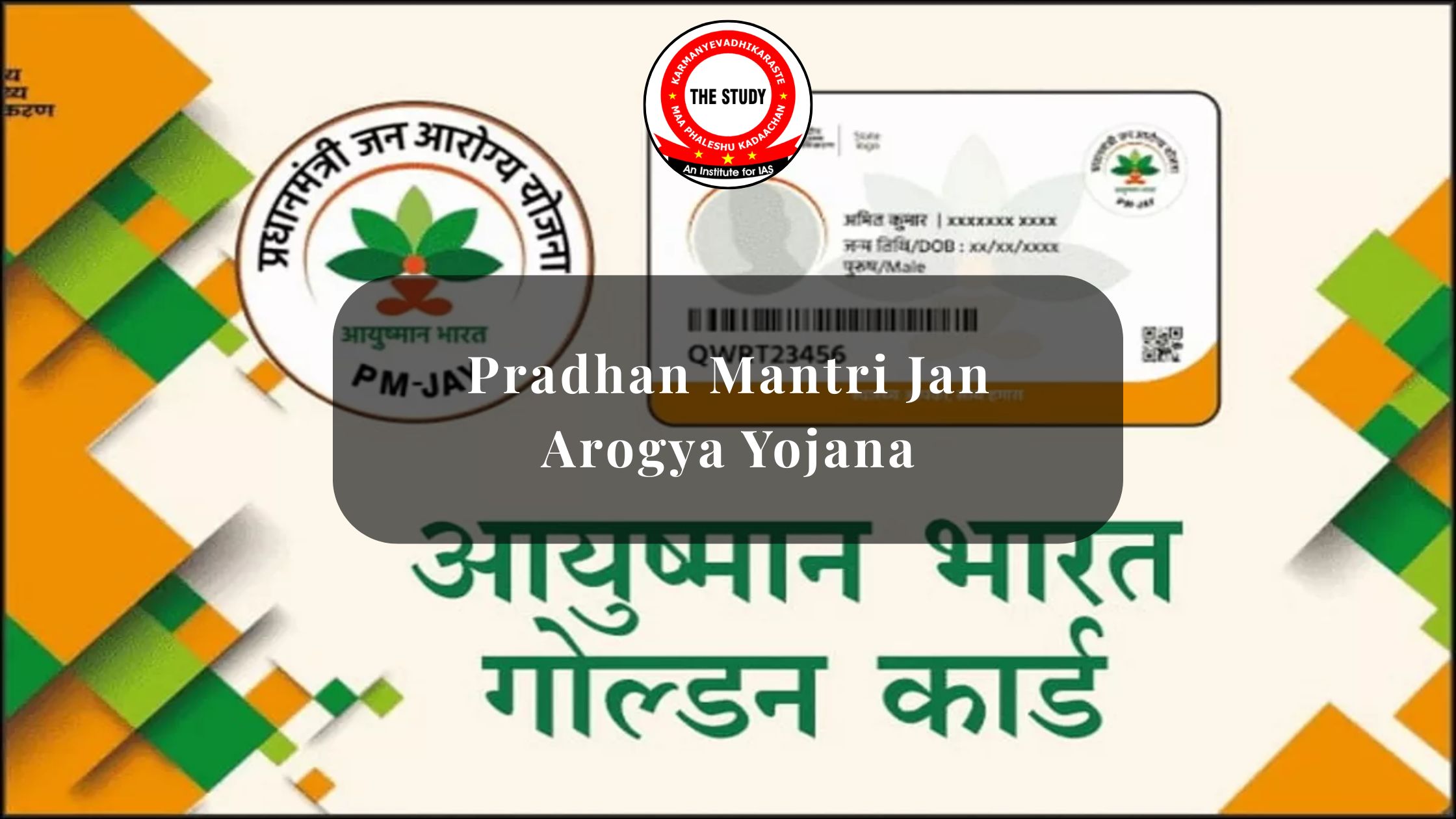
Pradhan Mantri Jan Arogya Yojana (PM-JAY)
Introduction
The Pradhan Mantri Jan Arogya Yojana (PM-JAY) is the hospitalisation component of Ayushman Bharat, launched on 23 September 2018. It was introduced to provide financial protection against major healthcare expenses and reduce the burden of catastrophic out-of-pocket expenditure on economically vulnerable households.
PM-JAY provides health cover of up to ₹5 lakh per family per year for secondary and tertiary hospitalisation to eligible beneficiaries. Treatment is provided on a cashless basis through empanelled public and private hospitals, with portability across India.
The scheme has also undergone a major expansion. Since October 2024, all citizens aged 70 years and above are eligible, irrespective of their socio-economic status. The expansion is estimated to benefit around 6 crore senior citizens belonging to 4.5 crore families.
For UPPSC aspirants, PM-JAY is important not merely as a government scheme but as a case study in healthcare reform, social justice, poverty reduction, financial protection, cooperative federalism and Universal Health Coverage.
Evolution, Structure and Coverage of PM-JAY
PM-JAY was launched as the second pillar of Ayushman Bharat, alongside the Health and Wellness Centre component, now associated with Ayushman Arogya Mandirs. Its focus is primarily on protecting households from large hospitalisation expenses.
The scheme covers approximately 12 crore families under its core beneficiary framework, corresponding to around 40% of India's population. States and Union Territories can also expand the beneficiary base using their own resources.
The National Health Authority (NHA) is responsible for implementing PM-JAY at the national level, while State Health Agencies and equivalent state-level institutions manage implementation within States and UTs.
Its major features include:
- Health assurance of ₹5 lakh per family per year.
- Coverage of secondary and tertiary hospitalisation.
- Cashless treatment at empanelled hospitals.
- Public as well as private hospital participation.
- National portability of benefits.
- Defined Health Benefit Packages.
- Digital beneficiary verification.
- Grievance-redressal mechanisms.
By 28 February 2026, 36,229 hospitals had been empanelled under the scheme—19,483 public and 16,746 private. More than 11.69 crore hospital admissions, involving approximately ₹1.73 lakh crore, had been authorised.
How Does PM-JAY Provide Financial Protection?
What does the ₹5 lakh coverage actually mean?
The ₹5 lakh amount is a family-level annual health assurance limit, rather than ₹5 lakh paid individually to every family member.
The benefit is primarily intended for covered hospitalisation and treatment packages. This distinction is important for Prelims because questions may test whether the amount is per individual or per family.
For senior citizens aged 70 years and above, the government has created a specific framework under Ayushman Bharat Vay Vandana. Senior citizens belonging to already covered families can receive an additional top-up of up to ₹5 lakh for themselves, without sharing that additional amount with younger family members.
Why is portability important for migrant workers?
One of PM-JAY's important design features is national portability. A beneficiary does not necessarily have to return to the home State to access covered treatment.
This is particularly important for migrant workers, informal-sector workers and families whose members move between States for employment.
As of July 2026, PM-JAY had facilitated around 29.05 lakh inter-State admissions, valued at approximately ₹8,383.97 crore.
What changed with coverage for senior citizens?
The expansion to people aged 70 years and above, irrespective of income, represents a significant shift from a predominantly socio-economic targeting approach towards age-based universal eligibility for this group.
The government estimates that approximately 6 crore senior citizens from 4.5 crore families will benefit.
However, senior citizens already covered by certain government health schemes may have to choose between the existing scheme and PM-JAY benefits, according to applicable rules.
What are PM-JAY's major achievements?
The scale of the programme is significant. As of 5 June 2026, government data reported:
- 44.14 crore Ayushman Cards
- 12.03 crore hospitalisations
- Around ₹1.80 lakh crore worth of treatment
- 36,218 empanelled hospitals
The same data reported 1.20 crore senior citizens enrolled under Ayushman Bharat Vay Vandana.
These figures demonstrate the scale of India's publicly funded health-assurance architecture, although enrollment or card creation should not automatically be interpreted as equivalent to actual utilisation of healthcare services.
Why is PM-JAY important for UPPSC and other competitive exams?
PM-JAY has strong relevance for UPPSC, UPSC and other State PCS examinations.
For Prelims, remember its launch year, coverage amount, beneficiary categories, portability, implementing institutions and senior-citizen expansion.
For Mains, the scheme can be used under:
- GS-II: Government policies and interventions, health and social justice.
- GS-III: Human capital and inclusive development.
- Essay: Healthcare, poverty and welfare-state issues.
- Ethics: Equity, accessibility and dignity in public service.
A strong Mains answer should go beyond describing the scheme. For example, the candidate can argue that PM-JAY addresses the financial-access dimension of Universal Health Coverage, while stronger primary healthcare and infrastructure are necessary to address the availability and quality dimensions.
What are the Previous Year Exam-Oriented Points?
For objective examination preparation, aspirants should remember these distinctions:
- PM-JAY is the second pillar of Ayushman Bharat.
- It was launched in 2018.
- It provides up to ₹5 lakh per family per year.
- Its core focus is secondary and tertiary hospitalisation.
- Treatment is available through empanelled public and private hospitals.
- Benefits have national portability.
- From 2024, people aged 70 years and above are eligible irrespective of socio-economic status.
- PM-JAY should not be confused with the Ayushman Bharat Digital Mission (ABDM), which focuses on the digital health ecosystem.
- States can expand beneficiary coverage through their own resources.
FAQs
What is Pradhan Mantri Jan Arogya Yojana?
PM-JAY is the health-assurance component of Ayushman Bharat that provides financial protection for covered secondary and tertiary hospitalisation.
When was PM-JAY launched?
It was launched on 23 September 2018.
How much coverage does PM-JAY provide?
It provides health assurance of up to ₹5 lakh per family per year.
Are all citizens above 70 eligible?
Yes. Citizens aged 70 years and above are eligible irrespective of income or socio-economic status, subject to the scheme's applicable rules.
Can PM-JAY benefits be used outside the home State?
Yes. The scheme provides national portability through its empanelled hospital network.
Why is PM-JAY important for UPPSC?
It combines current affairs with static topics such as healthcare, social justice, welfare schemes, poverty, governance, financial protection and Universal Health Coverage, making it relevant for both Prelims and Mains.
Subscribe to our Youtube Channel for more Valuable Content – TheStudyias
Download the App to Subscribe to our Courses – Thestudyias
The Source’s Authority and Ownership of the Article is Claimed By THE STUDY IAS BY MANIKANT SINGH
Comments (0)
Leave a Comment