Post-Independence India: Major Historical Events
6 Feb 2026
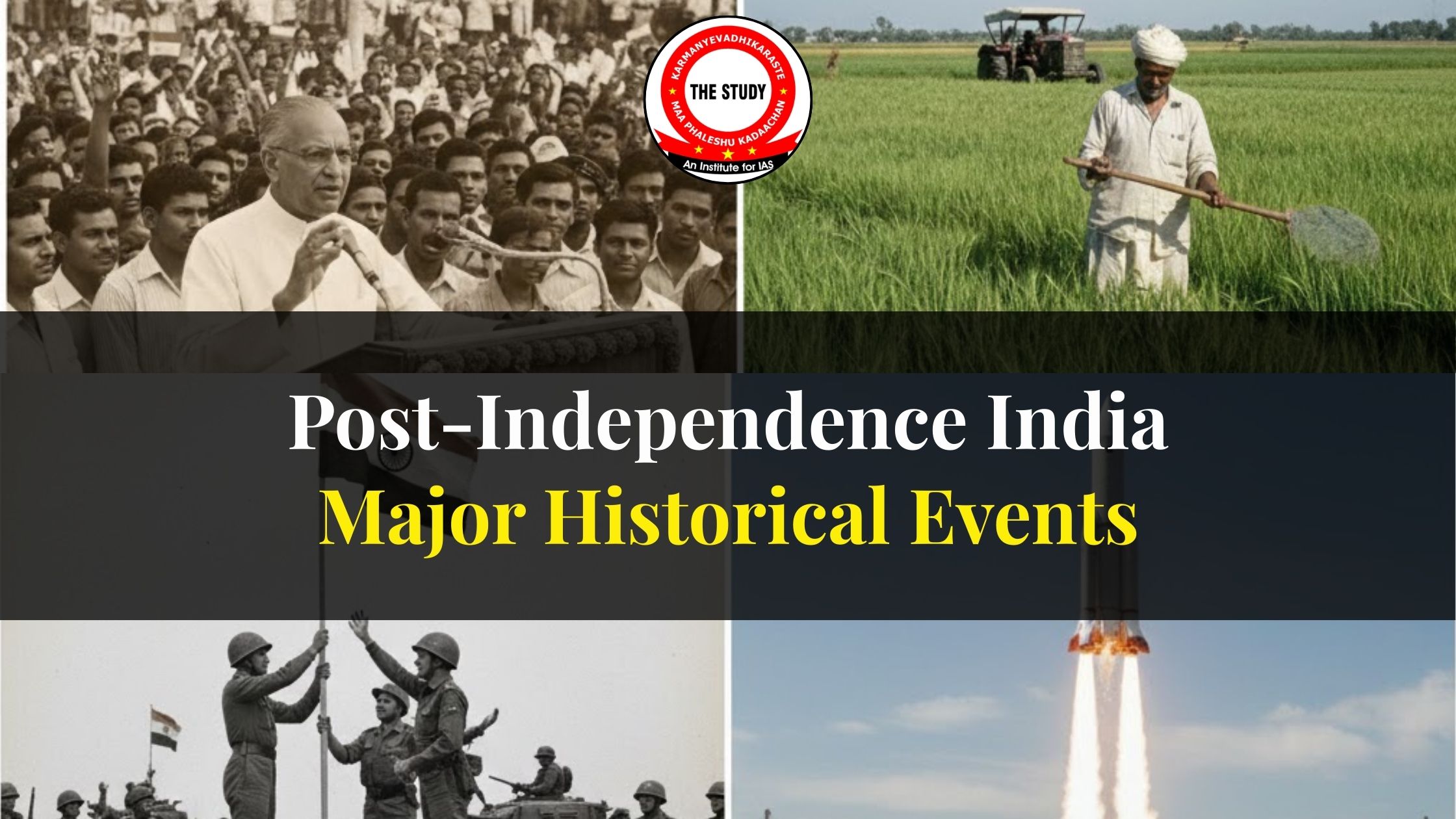
Post-Independence India: Major Historical Events
India’s independence on 15 August 1947 marked the culmination of a long struggle against colonial rule. However, independence did not immediately translate into stability. Instead, it ushered in a period of intense nation-building as India confronted the challenges of partition violence, administrative consolidation, integration of diverse princely states, the framing of a democratic constitution, socio-economic reconstruction, and evolving foreign relations in a bipolar world. This article traces these developments in chronological order, emphasising their causes, processes, and enduring impacts.
1. Independence and the Legacy of Partition (August 1947)
The withdrawal of British colonial rule resulted in the emergence of two sovereign dominions: India and Pakistan. The partition was accompanied by perhaps the most traumatic episode in the subcontinent’s history.
1.1 Causes of Partition
The demand for a separate Muslim homeland, led by the All-India Muslim League under Muhammad Ali Jinnah, stemmed from political distrust between the League and the Indian National Congress, fears over majoritarian domination, and British policies that hardened communal identities. The failure of negotiations in the final years of British rule culminated in the Indian Independence Act of 1947, which provided for partition as a solution to the “Muslim question” in undivided India.
1.2 Immediate Aftermath
Partition unleashed unprecedented communal violence across Punjab, Bengal, Delhi, Bihar, and Sindh. Estimates suggest that hundreds of thousands to over a million people died, millions of families were uprooted, and large-scale atrocities occurred. The sudden dissolution of administrative structures and the migration of millions tested the fragile capacity of the new state to maintain law and order.
The violence highlighted the importance of a secular democratic ethos in the newly independent state and strengthened the resolve of leaders like Jawaharlal Nehru, India’s first Prime Minister, to uphold constitutionalism and pluralism.
2. Political Consolidation and Integration of Princely States (1947–1950)
At independence, British India was not a single political unit; in addition to British provinces, it included 565 princely states with varying degrees of autonomy under British paramountcy.
2.1 Challenges of Integration
The princely states were legally free to accede to either India or Pakistan or remain independent. Their diverse aspirations posed a real risk of political fragmentation similar to the Balkanization seen in other parts of the world.
2.2 Strategies of Integration
Under the leadership of Sardar Vallabhbhai Patel, India adopted a strategy of diplomacy backed by firm resolve. Patel, along with his Secretary V.P. Menon, used Instruments of Accession to persuade rulers to join the Indian Union. Promises of privy purses (guaranteed income to the former rulers) and respect for their dignity helped smooth transitions in many cases.
Key integrations included:
- Junagadh (1947–48): The Nawab of Junagadh acceded to Pakistan despite a predominantly Hindu population. A popular revolt and economic blockade forced the Nawab to flee, and Junagadh was integrated into India after a plebiscite.
- Hyderabad (1948): The Nizam of Hyderabad resisted accession and assembled a private militia (Razakars). The Indian government launched Operation Polo, a police action that led to Hyderabad’s integration.
- Kashmir (1947): The Maharaja of Kashmir signed the Instrument of Accession after an invasion by tribal forces from Pakistan, leading to the first India-Pakistan conflict over the region.
This process resulted in the political unification of India, laying the foundation for a stable democratic polity.
3. Framing and Adoption of the Constitution (1947–1950)
Having won political independence, India next focused on institutionalising democratic governance.
3.1 Constituent Assembly and Drafting
The Constituent Assembly, constituted in 1946, was tasked with drafting a constitution. It represented diverse political, religious, and regional interests. Under the chairmanship of Dr. B.R. Ambedkar, the Assembly debated for over two years, addressing issues of federalism, fundamental rights, social justice, citizenship, and the balance of powers.
3.2 Adoption of the Constitution
On 26 January 1950, the Constitution of India came into effect, and India became a sovereign, democratic republic. It established:
- A Parliamentary system with universal adult franchise
- Fundamental Rights and Directive Principles of State Policy
- A federal structure balancing unity with regional diversity
The choice of 26 January also underscored the continuity with earlier national aspirations, as it commemorated the 1930 Purna Swaraj Declaration.
4. First General Elections and Democratic Consolidation (1951–52)
India’s first general elections were held between October 1951 and February 1952. They were historic not only for the scale of over 173 million voters who participated but also for marking the first time in the post-colonial world that a deeply stratified and largely illiterate society embraced universal adult franchise.
The Indian National Congress won a decisive mandate, legitimising democratic governance and setting a precedent for peaceful transfers of power through elections—a defining feature of Indian polity.
5. Nehruvian Vision: Planning, Industrialization, and Foreign Policy (1950s–1960s)
5.1 Economic Planning and Mixed Economy
Emerging from colonial exploitation, India inherited a weak industrial base, high poverty, low literacy, and acute food insecurity. To address these structural challenges, the Government adopted economic planning, establishing the Planning Commission in 1950 and launching the Five-Year Plans.
India adopted a mixed economy model combining public and private sectors. Socialistic principles were embedded through state intervention, especially in heavy industries, infrastructure, and core sectors. This approach sought balanced growth, self-reliance, and reduction of inequalities.
5.2 Land Reforms and Agrarian Transformation
Agrarian reform was central to eliminating feudal structures and promoting equity. Key aspects included abolition of intermediaries, tenancy reforms, and a ceiling on landholdings to redistribute surplus land to the landless.
These reforms aimed to increase agricultural productivity, reduce rural poverty, and empower small farmers, although implementation varied across states due to socio-political constraints.
5.3 Nehruvian Foreign Policy
In an increasingly polarised world after World War II, India under Jawaharlal Nehru pursued a policy of non-alignment, refusing to formally align with either the capitalist West (led by the United States) or the communist East (led by the Soviet Union).
Key principles included:
- Respect for sovereignty and territorial integrity
- Non-alignment and neutrality in Cold War conflicts
- Anti-colonial solidarity and support for national liberation movements
Nehru co-founded the Non-Aligned Movement (NAM), which sought to assert the interests of newly independent nations.
Nehruvian foreign policy emphasised peaceful coexistence, mediation in international disputes, and disarmament—values consistent with India’s democratic and pluralistic ethos.
6. Reorganisation of States (1953–1956)
India’s linguistic and cultural diversity soon generated demands for administrative reorganisation.
6.1 Rise of Linguistic Demands
The first major demand came from Telugu speakers in the Andhra region. The Potti Sriramulu fast unto death in 1952, demanding a separate state for Telugu speakers, resulted in his death and intensive protests. This pressured the government to create Andhra State in 1953—the first linguistic state in India.
6.2 States Reorganisation Commission
To address such demands comprehensively, the government appointed the States Reorganisation Commission (SRC) in 1953. After extensive consultations, the SRC recommended reorganising states largely on linguistic lines while balancing administrative viability and national unity.
6.3 States Reorganisation Act, 1956
On 1 November 1956, the States Reorganisation Act came into effect, redrawing state boundaries along linguistic lines and abolishing the earlier classification of states. This led to the creation of 14 states and 6 union territories and redefined Centre-State relations.
Subsequent reorganisations created new states such as Maharashtra and Gujarat (1960), Punjab, Haryana, Himachal Pradesh (1966), Northeastern states (1970s–80s) and, later, Chhattisgarh, Uttarakhand, and Jharkhand (2000).
This linguistic reorganisation strengthened administrative efficiency and cultural identity while maintaining national integration.
7. Wars and Regional Security Challenges (1947–1971)
India’s formative decades were marked by several conflicts that shaped its security and diplomatic posture.
7.1 First Indo-Pakistan War (1947–48)
Immediately after independence, India and Pakistan clashed over Kashmir. The accession of the princely state to India and the entry of Pakistani tribal fighters escalated the conflict. A UN-brokered ceasefire in 1949 left India in control of the Valley and Jammu while Pakistan controlled Azad Kashmir and Northern Areas.
7.2 Sino-Indian War (1962)
Border disputes with China culminated in the Sino-Indian War in 1962, resulting in a decisive Chinese victory and occupation of contested territory in Ladakh and Arunachal Pradesh. The conflict highlighted the need for better frontier infrastructure and informed India’s future defence policies.
7.3 Indo-Pakistan War of 1965
The 1965 war erupted over the Rann of Kutch and Kashmir. After weeks of fighting, the Tashkent Agreement (January 1966) restored the status quo ante. It underscored the limitations of military solutions and the importance of diplomacy.
7.4 War and Liberation of Bangladesh (1971)
Political strife and humanitarian crises in East Pakistan (now Bangladesh) led to war. India’s intervention in support of Bangladeshi liberation forces resulted in a decisive Indian victory and the creation of Bangladesh. The Simla Agreement (1972) reaffirmed the commitment to bilateral negotiations and respect for the Line of Control in Kashmir.
These conflicts shaped India’s defence posture, its alignment with global powers, and its commitment to peaceful conflict resolution—core tenets of both national security and foreign policy.
8. Leadership Transitions: From Nehru to Shastri to Indira Gandhi
India’s early decades saw transitions that had both political and symbolic significance.
8.1 Jawaharlal Nehru (1947–1964)
Nehru’s long leadership established the democratic framework, modern institutions, planning system, and foreign policy foundations. He balanced socio-economic goals with political stability, though his policies, particularly in foreign affairs, later drew criticism for strategic miscalculations (e.g., Sino-Indian border).
8.2 Lal Bahadur Shastri (1964–1966)
After Nehru’s death, Lal Bahadur Shastri became Prime Minister. He is remembered for his integrity, commitment to simplicity, and focus on national morale. Under Shastri:
- India faced the 1965 war with Pakistan, and Shastri’s leadership helped maintain national resilience.
- The slogan “Jai Jawan, Jai Kisan” emphasised the twin priorities of defence and agricultural productivity—particularly crucial amid food shortages.
Shastri’s tenure, though brief, reinforced the principles of self-reliance and patriotic unity.
9. Socio-Economic Reforms and Challenges (1960s–1980s)
9.1 Green Revolution
Food security remained a persistent challenge. The Green Revolution (late 1960s and early 1970s) introduced high-yielding variety seeds, modern irrigation, and fertilisers in states like Punjab and Haryana. This transformed India from a food-deficit country to a self-sufficient agricultural producer.
9.2 Continued Planning and Industrial Policy
Subsequent Five-Year Plans emphasised diversification of industry, expansion of infrastructure, and rural development. Policies oscillated with changing governments, but the underlying goal remained equitable growth.
10. Later Developments: Federalism, New States, and Continued Transformation (1990s onwards)
Though outside the immediate post-independence decades, later events flowed from earlier foundations.
10.1 Economic Liberalisation (1991)
In response to a balance-of-payments crisis, India introduced liberalisation, privatisation, and globalisation (LPG) reforms in 1991. This shifted India toward a more open economy, stimulating growth in services, technology, and global trade.
10.2 New State Formations
The demand for smaller administrative units based on identity and development continued. Movements like the Uttarakhand movement eventually led to the creation of Uttarakhand in 2000. Subsequent formations like Telangana (2014) reflected continuing federal evolution.
11. Economic Liberalisation and Structural Transformation (1991–2004)
By the late 1980s, India’s state-led economic model faced serious constraints. Low growth, rising fiscal deficits, inefficient public sector enterprises, and mounting external debt culminated in a balance of payments crisis in 1991.
11.1 New Economic Policy, 1991
Under Prime Minister P.V. Narasimha Rao and Finance Minister Dr. Manmohan Singh, India initiated the New Economic Policy (NEP) based on three pillars:
- Liberalisation: Reduction of industrial licensing, deregulation of markets
- Privatisation: Disinvestment in public sector enterprises
- Globalisation: Opening up to foreign trade and investment
These reforms marked a decisive shift from a closed, planned economy to a market-oriented framework. The role of the state changed from direct controller to facilitator of economic activity.
11.2 Impact of Reforms
- Rapid growth of the services sector, especially IT and telecommunications
- Increased foreign direct investment (FDI)
- Expansion of the middle class
- Integration of India into the global economy
However, reforms also raised concerns about regional inequality, informal employment, and agrarian distress, highlighting the need for inclusive growth.
12. Coalition Politics and Democratic Maturity (1989–2014)
The period from the late 1980s to the early 2010s witnessed the rise of coalition governments, reflecting India’s social diversity and the strengthening of federalism.
12.1 End of One-Party Dominance
The decline of Congress's dominance led to coalition governments at the Centre, including:
- National Front governments (1989–1991)
- United Front governments (1996–1998)
- National Democratic Alliance (NDA) under Atal Bihari Vajpayee (1998–2004)
This era demonstrated that coalition governance could provide stability, contrary to earlier apprehensions.
12.2 Vajpayee Era (1998–2004)
The Vajpayee government is remembered for:
- Pokhran-II nuclear tests (1998), asserting India’s nuclear status
- Emphasis on infrastructure development (Golden Quadrilateral highway project)
- Improved relations with the United States
- Initiatives towards peace with Pakistan (Lahore Declaration)
13. Rights-Based Welfare and Inclusive Growth (2004–2014)
The United Progressive Alliance (UPA) governments, led by Dr. Manmohan Singh, focused on combining economic growth with social justice.
13.1 Major Welfare Legislations
Several landmark legislations were enacted:
- Right to Information Act (2005) – enhanced transparency and accountability
- Mahatma Gandhi National Rural Employment Guarantee Act (MGNREGA), 2005 – guaranteed 100 days of employment to rural households
- Right to Education Act (2009) – made elementary education a fundamental right
- National Food Security Act (2013) – ensured subsidised food grains
These measures strengthened the social sector and democratic participation, aligning with constitutional values of equity and justice.
13.2 Challenges
Despite high growth rates (2004–2008), the period faced challenges such as:
- Corruption scandals
- Global financial crisis of 2008
- Policy paralysis in later years
These factors shaped public discourse and electoral outcomes in the following decade.
14. Political Centralisation and Governance Reforms (2014–2024)
The 2014 General Elections marked a significant shift in Indian politics with the rise of a single-party majority government under Prime Minister Narendra Modi.
14.1 Governance and Economic Reforms
Key initiatives included:
- Goods and Services Tax (GST), 2017 – created a unified national market
- Insolvency and Bankruptcy Code (2016) – strengthened financial discipline
- Digital India – expansion of digital infrastructure and e-governance
- Jan Dhan–Aadhaar–Mobile (JAM) trinity – improved delivery of welfare schemes
14.2 Social and Political Developments
- Abrogation of Article 370 (2019) and reorganisation of Jammu and Kashmir
- Passage of the Citizenship Amendment Act (2019), leading to widespread debate and protests
- Emphasis on cultural nationalism and national identity
14.3 COVID-19 Pandemic (2020–2022)
The global pandemic posed unprecedented challenges:
- Nationwide lockdown in 2020
- Economic slowdown and migrant crisis
- Large-scale vaccination drive
India’s response highlighted both the strengths and limitations of state capacity in crisis management.
15. India in the Global Order and Contemporary Developments (2022–2025)
15.1 Foreign Policy and Strategic Role
By the early 2020s, India emerged as a key global player:
- Active participation in Quad (India, USA, Japan, Australia)
- Leadership in G20, hosting the G20 Summit in 2023
- Strategic autonomy amid Russia-Ukraine conflict
- Strengthening ties with Africa, West Asia, and Southeast Asia
India projected itself as the voice of the Global South, continuing the legacy of non-alignment in a modern form.
15.2 Economic and Technological Advances
- Expansion of startup ecosystem and digital payments
- Focus on manufacturing through “Make in India” and “Atmanirbhar Bharat”
- Investments in renewable energy and climate commitments
Conclusion: Continuity and Change in Post-Independence India
From the trauma of Partition to the aspirations of a global power in the 21st century, India’s post-independence journey has been marked by continuity and change. The foundations laid in the early years—democracy, secularism, federalism, and social justice—continue to guide national development, even as new challenges emerge.
India’s experience demonstrates that nation-building is not a one-time event but an ongoing historical process, shaped by institutions, leadership, popular movements, and global forces. As India moves beyond 2025, its ability to balance growth with equity, unity with diversity, and tradition with modernity will determine the future course of its democratic experiment.
Key Takeaways
- Independence initiated nation-building, not immediate stability
- Partition shaped India’s secular and constitutional commitment
- Integration of princely states prevented political fragmentation
- Constitution institutionalised democracy and social justice
- Planning and mixed economy addressed colonial underdevelopment
- Linguistic reorganisation strengthened federalism
- Wars influenced defence, diplomacy, and realism
- Green Revolution ensured food security
- Liberalisation marked a shift to market-oriented growth
- Welfare laws deepened democratic participation
- Contemporary India balances growth, identity, and global role
Summary: Post-Independence India
India’s post-independence journey is a story of continuity and adaptation. From the trauma of Partition to the framing of a transformative Constitution, the early leadership focused on political unity, democratic legitimacy, and socio-economic reconstruction. The Nehruvian era laid the foundations of planning, industrialisation, and non-aligned foreign policy, while linguistic reorganisation accommodated diversity within a unified framework.
Subsequent decades witnessed wars, agrarian transformation through the Green Revolution, leadership transitions, and evolving federal dynamics. The 1991 economic reforms marked a decisive break from state-led development, integrating India into the global economy. Coalition politics, rights-based welfare, and governance reforms further reflected democratic deepening.
FAQs
1. Why is Partition considered a defining moment in post-independence India?
Partition caused massive violence and displacement, shaping India’s commitment to secularism, constitutionalism, and national unity.
2. How did India integrate the princely states after 1947?
Through Instruments of Accession, diplomatic persuasion, incentives like privy purses, and limited military action where necessary.
3. What was the core idea behind the Nehruvian economic model?
It adopted a mixed economy with state-led planning to achieve self-reliance, industrialisation, and social justice.
4. Why was the States Reorganisation Act, 1956 significant?
It reorganised states largely on linguistic lines, strengthening federalism while preserving national integration.
5. What triggered economic liberalisation in 1991?
A balance of payments crisis exposed the limits of the planned economy, leading to liberalisation, privatisation, and globalisation reforms.
Subscribe to our Youtube Channel for more Valuable Content – TheStudyias
Download the App to Subscribe to our Courses – Thestudyias
The Source’s Authority and Ownership of the Article is Claimed By THE STUDY IAS BY MANIKANT SINGH
Comments (0)
Leave a Comment