Post-Independence India for UPSC: Important Themes, Events & Sources
19 Sept 2026
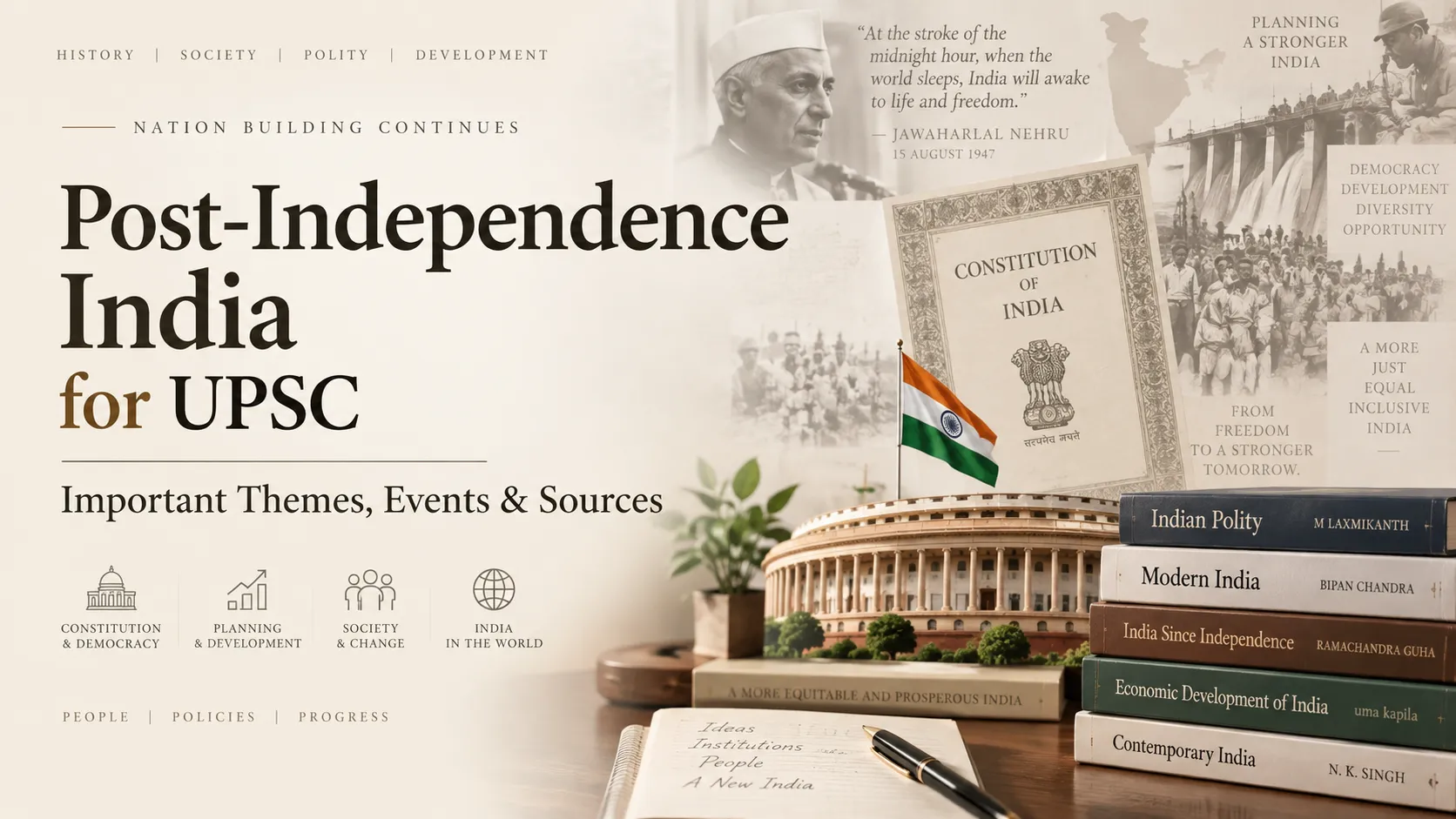
Post-Independence India for UPSC: Important Themes, Events & Sources
Post-Independence India for UPSC covers the political, economic, social and administrative transformation of India after 1947. For UPSC preparation, the subject is best understood through major themes such as integration of princely states, linguistic reorganisation, consolidation of democracy, economic planning, agrarian change, social movements and India's evolving foreign policy.
The objective is not to memorise every event after Independence. Preparation should focus on developments that explain how the Indian state was consolidated, how democratic institutions evolved, how the economy changed and how social and regional challenges were addressed.
A theme-based approach makes post-1947 India notes shorter, easier to revise and more useful for analytical answers.
Why Post-Independence India Is Important for UPSC
Post-Independence India is explicitly relevant to GS Paper I, where the syllabus includes consolidation and reorganisation within the country after Independence. Several developments also overlap with Indian polity, economy, society and international relations.
For History Optional, post-1947 developments should be prepared according to the applicable syllabus boundaries and question trends rather than treated as an unlimited extension of Modern Indian History.
The central focus should remain on processes and their consequences.
Integration of Princely States
At Independence, political integration was one of India's most immediate challenges. British paramountcy over princely states ended, creating the need to integrate hundreds of princely territories into the Indian Union.
Sardar Vallabhbhai Patel and V. P. Menon played central roles in this process. Most princely states joined India through negotiation and the Instrument of Accession, while cases such as Junagadh, Hyderabad and Jammu and Kashmir involved more complicated political circumstances.
The integration process is important because it established the territorial foundations of the Indian Union and strengthened political consolidation.
For UPSC, the topic should be studied as part of the larger challenge of nation-building and territorial consolidation, not simply as a collection of accession events.
Linguistic Reorganisation of States
The reorganisation of states became another major challenge after Independence. Demands for states based on linguistic identity had roots in the national movement, but the leadership initially approached the issue cautiously because of concerns over national unity.
The creation of Andhra State in 1953 accelerated demands for wider linguistic reorganisation. The States Reorganisation Commission was subsequently established, and the States Reorganisation Act, 1956 significantly reorganised India's internal boundaries.
Linguistic reorganisation ultimately demonstrated that regional identities could be accommodated within the constitutional structure rather than necessarily becoming threats to national unity.
Why Linguistic Reorganisation Matters
The topic connects several important themes: federalism, regional identity, democratic accommodation and national integration.
A strong answer should therefore examine both the initial concerns and the longer-term political impact of linguistic states.
Consolidation of Indian Democracy
India's democratic development after 1947 was significant because universal adult franchise was introduced in a country marked by widespread poverty, limited literacy and enormous social diversity.
The first general elections of 1951–52 established electoral democracy on a massive scale. Parliamentary institutions, political parties and regular elections gradually became central features of the political system.
Democratic consolidation should not be treated as a smooth or uninterrupted process. India experienced political conflicts, regional challenges, institutional tensions and periods of centralisation.
The broader theme is the adaptability and evolution of Indian democracy.
The Nehruvian Economic Model and Planning
Economic development was a central concern of the newly independent state. Colonial rule had left India with widespread poverty, limited industrial capacity and major developmental challenges.
The post-Independence strategy emphasised planned economic development and a mixed economy. The Planning Commission was established in 1950, followed by the Five-Year Plans.
The Second Five-Year Plan placed greater emphasis on heavy industry and public-sector development. The state assumed an important role in infrastructure, industrialisation and long-term economic planning.
Main Features of the Early Development Strategy
For UPSC answers, the model should be evaluated through both achievements and limitations rather than described only through plan targets.
Land Reforms and Agrarian Change
Agrarian reform was necessary because rural India inherited significant inequalities in land ownership and tenancy arrangements.
Post-Independence land reforms broadly included the abolition of intermediaries, tenancy reforms, land-ceiling measures and attempts at consolidation of holdings.
Implementation varied significantly across states. While intermediary structures were weakened in many areas, redistribution and tenancy reforms produced uneven outcomes.
This topic should therefore be understood through the gap between legislative intention and actual implementation.
Green Revolution and Agricultural Transformation
Food security became a major concern, particularly during the 1960s. The Green Revolution introduced high-yielding varieties, irrigation, fertilisers, improved inputs and institutional support to increase agricultural production.
It contributed significantly to food-grain production and reduced dependence on external food supplies. However, its impact was regionally and socially uneven.
The Green Revolution is therefore best studied as both an agricultural achievement and a source of new regional and socio-economic disparities.
Social Change After Independence
Political Independence did not automatically remove deeply rooted social inequalities. The Constitution created a framework based on equality, fundamental rights and affirmative action, while social and political movements continued to challenge existing hierarchies.
Post-Independence social change includes the politics of caste, movements among historically disadvantaged communities, women's movements, tribal issues and changing patterns of political participation.
These developments are important because democracy gradually expanded political participation beyond traditional elites.
The growth of social justice politics also changed electoral mobilisation and the relationship between state institutions and marginalised groups.
Regionalism and Challenges to National Integration
Regional aspirations emerged in different forms after Independence. Some were linked to language and statehood, while others developed around ethnicity, autonomy, economic grievances or political representation.
India's response combined constitutional accommodation, creation of new states, negotiations, electoral politics and, in some situations, security measures.
This theme is particularly important for understanding the flexibility of Indian federalism.
Regionalism should not automatically be equated with separatism. Many regional movements sought greater recognition or autonomy within the Indian Union rather than separation from it.
India's Foreign Policy After Independence
India's foreign policy developed in the context of the Cold War, decolonisation and the emergence of newly independent states across Asia and Africa.
Non-alignment became one of its most important principles. It sought to preserve strategic autonomy rather than formally joining the major Cold War military blocs.
Other important areas include relations with neighbouring countries, support for anti-colonial movements, India-China relations, India-Pakistan conflicts and India's role in the Non-Aligned Movement.
Foreign policy should be connected with India's domestic priorities, security concerns and the wider international environment.
The Emergency of 1975–77
The Emergency represents a critical phase in the history of post-Independence Indian democracy.
Declared in 1975, the period witnessed restrictions on civil liberties, censorship, arrests of political opponents and greater concentration of political authority.
Its significance extends beyond the events of 1975–77. The electoral defeat of the ruling government in 1977 and restoration of democratic competition demonstrated both the vulnerability and resilience of India's democratic institutions.
For UPSC, the Emergency is therefore best studied through the themes of democratic institutions, executive power, civil liberties and political accountability.
Economic Reforms of 1991
The economic reforms initiated in 1991 marked an important change in India's development strategy. A severe balance-of-payments crisis provided the immediate context for reforms involving liberalisation, deregulation and greater integration with the global economy.
The reforms reduced several restrictions associated with the earlier regulatory framework and expanded the role of private enterprise and international economic engagement.
The transition should not be understood as the complete abandonment of the state. Instead, it represented a significant change in the relationship between the state, market and private sector.
Important Post-Independence India Themes for UPSC
The syllabus becomes easier to revise when major events are organised under larger themes.
This structure provides a clearer framework for both revision and answer writing.
How to Make Post-1947 India Notes
Post-1947 India notes should be organised thematically rather than year by year. Each major topic can be condensed under five components: background, development, challenges, impact and significance.
For example, linguistic reorganisation can be summarised through the background of linguistic demands, initial hesitation, creation of Andhra, States Reorganisation Commission, the 1956 reorganisation and its impact on Indian federalism.
A similar framework can be applied to land reforms, the Green Revolution, Emergency, regional movements and economic reforms.
This format keeps notes concise and allows faster revision before Mains.
Sources for Post-Independence India UPSC Preparation
Source selection should remain limited and syllabus-oriented.
For standard reading, India Since Independence by Bipan Chandra and others is commonly used for deeper coverage of major post-Independence developments. It should be read selectively according to syllabus requirements rather than necessarily cover-to-cover.
For GS preparation, concise notes combined with PYQs are generally more revision-friendly than extensive source accumulation.
Using PYQs for Post-Independence India
PYQs help identify the level of analysis expected in Mains. Questions may focus on integration, linguistic reorganisation, political developments or broader processes of consolidation after Independence.
PYQ analysis should classify topics according to frequency, dimensions asked and connection with the syllabus. Topics with strong syllabus relevance should receive deeper conceptual preparation even when direct questions have not appeared frequently.
The focus should remain on explaining historical processes rather than simply reproducing facts.
Common Mistakes in Post-Independence India Preparation
The central requirement is to understand change over time. Events become relevant when they explain the evolution of India's political institutions, economy, society, federal structure or national integration.
Conclusion
Preparing Post-Independence India for UPSC becomes manageable when the period is divided into major themes rather than studied as an uninterrupted chronology after 1947.
Political integration established the territorial foundations of the Union, linguistic reorganisation accommodated regional identities, democratic institutions evolved through periods of stability and crisis, economic policy moved from planning toward liberalisation, and social and regional movements expanded political participation.
Preparation should therefore focus on themes, causes, challenges, outcomes and long-term significance. Limited sources, concise post-1947 India notes and PYQ-based revision provide a more effective strategy than attempting to memorise every political event after Independence.
FAQs
What are the most important themes of Post-Independence India for UPSC?
Political integration, linguistic reorganisation, consolidation of democracy, economic planning, land reforms, Green Revolution, social movements, regionalism, foreign policy, Emergency and economic reforms are major themes.
How should Post-Independence India be prepared for UPSC Mains?
Preparation should be theme-based. Each major development should be studied through its background, challenges, outcome and historical significance, followed by PYQ-based revision.
Is Post-Independence India important for GS Paper I?
Yes. GS Paper I explicitly includes post-Independence consolidation and reorganisation within India.
What are the best sources for Post-Independence India?
NCERT material can provide the foundation, while a standard text such as India Since Independence can provide deeper thematic coverage. UPSC syllabus, PYQs and concise revision notes should determine the final depth of preparation.
How should post-1947 India notes be made?
Notes should be organised by themes rather than by individual years. Use a consistent structure covering background, development, challenges, impact and significance.
Is the Green Revolution important for Post-Independence India?
Yes. It is important for understanding agricultural transformation, food security, technological change and emerging regional and socio-economic disparities.
Why is linguistic reorganisation important for UPSC?
Linguistic reorganisation demonstrates how India accommodated regional and linguistic identities within a federal democratic structure while maintaining national unity.
How should the Emergency be studied for UPSC?
The Emergency should be studied through its political context, restrictions on democratic freedoms, institutional consequences, the 1977 election and its wider significance for Indian democracy.