Periyar's Self Respect Movement A Legacy Of Social Transformation
18 Aug 2026
Introduction
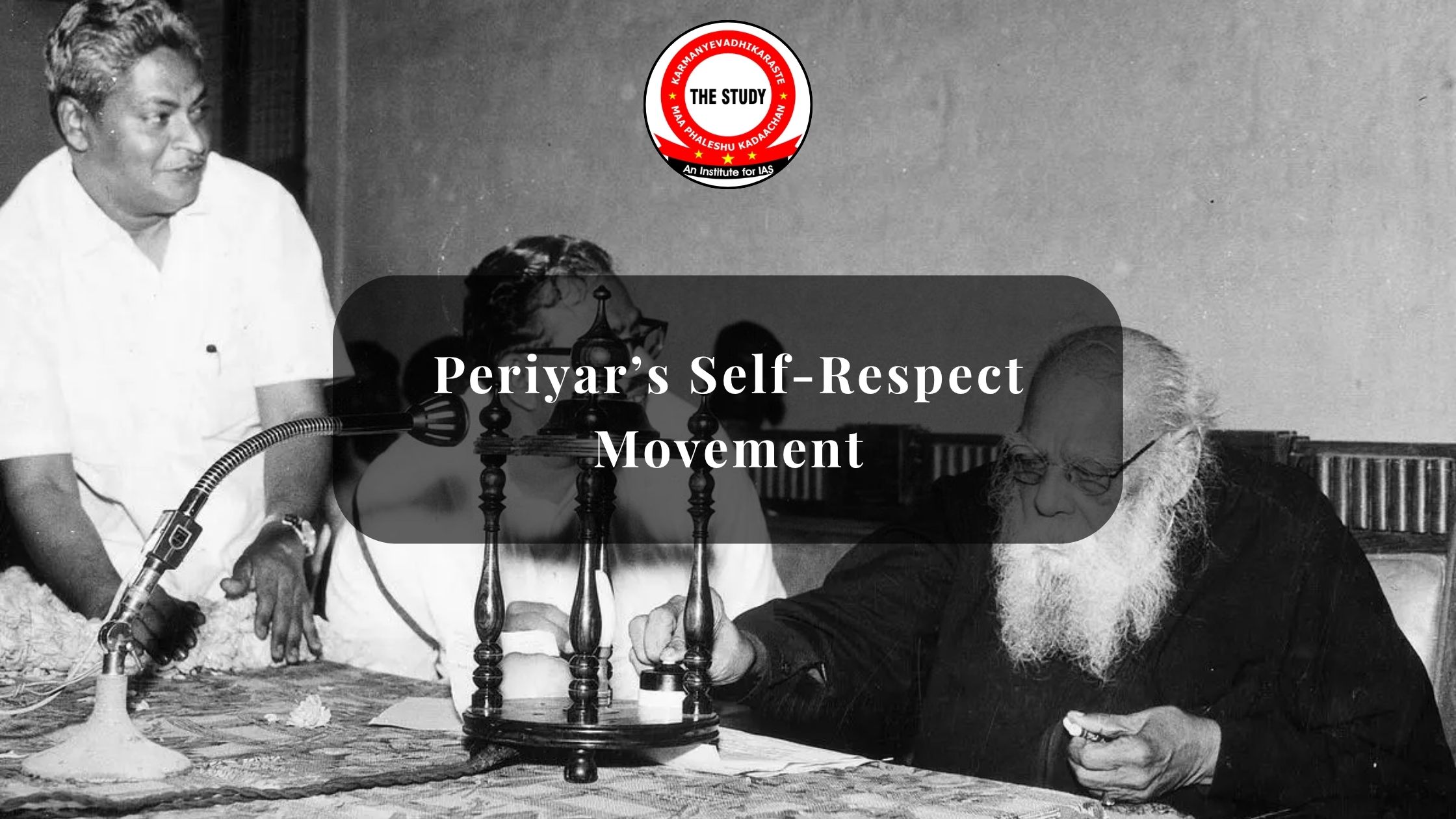
The Self-Respect Movement (Suya Mariyadhai Iyakkam) was one of the most influential social reform movements of twentieth-century South India. Led by E.V. Ramasamy, popularly known as Periyar, the movement emerged in 1925 in the Madras Presidency and sought to challenge caste hierarchy, social inequality, religious orthodoxy and patriarchal practices.
Unlike a movement focused primarily on political independence, the Self-Respect Movement argued that political freedom had little meaning without social dignity and equality. Its central idea was that every individual should possess the right to live with self-respect, question inherited social hierarchies and exercise freedom of thought.
The movement became an important force in the evolution of the Dravidian social and political movement in Tamil Nadu. Its influence extended to questions of caste, women's rights, marriage, education, rationalism, representation and social justice. Contemporary Tamil Nadu government documents continue to identify self-respect and social justice as important elements of the state's reform legacy.
For UPPSC aspirants, the topic is particularly relevant because it illustrates how regional social reform movements contributed to broader processes of social transformation in modern India.
Historical Background and Evolution of the Self-Respect Movement
E.V. Ramasamy's political journey before 1925 shaped the intellectual background of the movement. He had been associated with the Indian National Congress and participated in the Non-Cooperation Movement. His involvement in the Vaikom Satyagraha of 1924–25, which challenged caste-based restrictions on access to roads around the Vaikom temple in Travancore, further strengthened his opposition to caste discrimination. The Government of Tamil Nadu's State Human Rights Commission also records Periyar's role in the Vaikom struggle.
Periyar subsequently became increasingly critical of the Congress over what he regarded as inadequate action on caste inequality and representation. The Self-Respect Movement emerged in this context in 1925.
The movement was primarily a social and rationalist movement, rather than a conventional political party. Its objective was to transform social attitudes and institutions that Periyar believed reproduced inequality.
Its principal concerns included:
- Opposition to caste hierarchy and untouchability
- Promotion of human dignity and self-respect
- Criticism of social practices justified through religious authority
- Rationalism and questioning of superstition
- Women's education and equality
- Opposition to child marriage
- Support for widow remarriage and inter-caste marriage
- Greater social and political representation for non-Brahmin communities
The movement used public meetings, publications and social campaigns to communicate these ideas. Kudi Arasu, a Tamil weekly associated with Periyar, became an important vehicle for propagating Self-Respect ideas.
The First Provincial Self-Respect Conference at Chengalpattu in 1929 represented an important organisational milestone. Over time, the movement became closely connected with the broader non-Brahmin and Dravidian political currents of the Madras Presidency.
How did the Self-Respect Movement challenge the caste system?
The movement regarded caste not merely as a social classification but as a system that created graded inequality and denied individual dignity.
Periyar challenged the idea that a person's social status should be determined by birth. The movement therefore attacked caste-based social privileges, untouchability and practices that maintained hereditary hierarchy.
This was significant because its approach went beyond asking for limited reform within existing structures. It questioned the social foundations that legitimised hierarchy itself.
The movement also advocated inter-caste marriage and sought to remove caste markers from social life. In this sense, "self-respect" became both an individual principle and a collective demand for social equality.
Why was rationalism central to Periyar’s ideology?
Periyar believed that social reform required people to develop the capacity to question customs, authority and beliefs through reason.
The Self-Respect Movement therefore promoted rationalism and criticised superstition and practices that, in its interpretation, reinforced social inequality. Its objective was not simply to replace one set of beliefs with another but to encourage individuals to examine inherited practices critically.
This rationalist orientation distinguished the movement from several reform traditions that sought to reinterpret religious traditions while retaining their broader framework.
What was the role of women in the Self-Respect Movement?
Women's emancipation was one of the movement's distinctive features. Periyar connected caste inequality with patriarchal control over women's lives.
The movement supported:
- Women's education
- Greater autonomy in marriage
- Widow remarriage
- Inter-caste marriage
- Opposition to child marriage
- Women's right to participate in public life
- Reform of patriarchal customs
The concept of Self-Respect Marriage became particularly significant. Such marriages rejected compulsory dependence on Brahmin priests and traditional ritual structures and emphasised the consent and equality of the partners.
Thus, the movement treated women's rights not as a secondary issue but as an integral component of social transformation. Modern scholarship also highlights the movement's sustained challenge to traditional gender roles.
How did the movement influence the Dravidian political tradition?
The Self-Respect Movement contributed substantially to the intellectual and organisational foundations of the Dravidian movement.
Its emphasis on:
- Social justice
- Non-Brahmin representation
- Rationalism
- Linguistic and cultural identity
- Women's rights
- Opposition to caste hierarchy
continued to influence subsequent Dravidian politics.
In 1944, Periyar transformed the Justice Party into the Dravidar Kazhagam (DK), consolidating the social-reform and Dravidian ideological tradition. The later emergence of political organisations such as the DMK reflected a new phase in the political expression of these ideas.
The influence of self-respect ideals can also be seen in later Tamil Nadu social-policy initiatives. For example, the State's Periyar Ninaivu Samathuvapuram scheme was designed to promote social equality by encouraging families from different communities to live together without caste or communal divisions.
What is the broader historical significance of the movement?
The historical importance of the Self-Respect Movement lies in its attempt to connect social dignity with structural reform.
It demonstrated that India's struggle for freedom contained multiple dimensions: anti-colonial nationalism was accompanied by struggles against caste oppression, patriarchy and social exclusion.
The movement also broadened the meaning of social reform by arguing that legal or political equality would remain incomplete unless social attitudes changed.
Its legacy can therefore be examined through three interconnected dimensions:
Social: challenging caste hierarchy and promoting dignity.
Cultural: questioning inherited practices and asserting regional linguistic-cultural identity.
Political: influencing the development of the Dravidian movement and debates on representation and social justice.
At the same time, a balanced examination answer should recognise that Periyar's methods and rhetoric were often highly confrontational and controversial, particularly in his criticism of religion and Brahminical traditions. UPSC answers should analyse the movement historically rather than present it simply as either wholly positive or wholly negative.
Why is the Self-Respect Movement important for UPPSC and other competitive exams?
The topic is highly relevant for UPPSC, UPSC and other State PCS examinations because it connects with Modern Indian History, social reform, caste movements, women's movements and regional political developments.
It can be used in:
- Prelims: chronology, personalities, organisations and movements.
- GS Paper I: social reform and regional movements.
- Essay: caste, dignity, equality, women's empowerment and social justice.
- History Optional: regional social movements, non-Brahmin movements and modern Tamil Nadu.
A strong Mains answer should establish a link between caste inequality → self-respect → rationalism → gender reform → social justice → Dravidian politics rather than merely listing Periyar's activities.
What are the Previous Year Exam-Oriented Points?
A particularly important recent development for aspirants is that the UPSC Civil Services Preliminary Examination 2025 included a question asking about the founder of the Self-Respect Movement. The correct answer was E.V. Ramaswamy (Periyar). UPSC officially publishes the 2025 Civil Services Preliminary General Studies Paper I in its previous-question-paper archive.
This question is a useful lesson for aspirants: regional social reform movements cannot be ignored simply because they appear less frequently in conventional national-history narratives.
For Prelims, remember the following distinctions:
- Self-Respect Movement — 1925
- Principal leader — Periyar E.V. Ramasamy
- Core emphasis — social equality and self-respect
- Major ideological feature — rationalism
- Important concern — caste discrimination
- Women's reform — marriage and social equality
- First Provincial Self-Respect Conference — Chengalpattu, 1929
- Later organisational legacy — Dravidar Kazhagam
FAQs
1. Who founded the Self-Respect Movement?
The movement was led and given its concrete organisational form by E.V. Ramasamy (Periyar) in 1925. Historical accounts also note the role of S. Ramanathan in its early formation.
2. What was the main objective of the Self-Respect Movement?
Its central objective was to establish a society based on human dignity, equality and rational thought, while challenging caste hierarchy and social practices that perpetuated inequality.
3. Why is Periyar important in Modern Indian History?
Periyar was a major social reformer whose ideas influenced debates on caste, women's rights, rationalism, representation and Dravidian identity.
4. What was a Self-Respect Marriage?
It was a marriage reform associated with the movement that emphasised the equality and consent of the partners and rejected compulsory dependence on traditional priest-mediated rituals.
5. How did the movement influence Tamil Nadu politics?
Its ideas contributed to the development of the broader Dravidian movement, which subsequently influenced the political and social trajectory of Tamil Nadu.
6. Why should UPPSC aspirants study the Self-Respect Movement?
It is relevant to Modern Indian History, social reform and the evolution of regional political movements. Its appearance in the UPSC Prelims 2025 further demonstrates the importance of studying regional movements alongside mainstream national movements.
Comments (0)
Leave a Comment