NFHS-6
3 Jun 2026
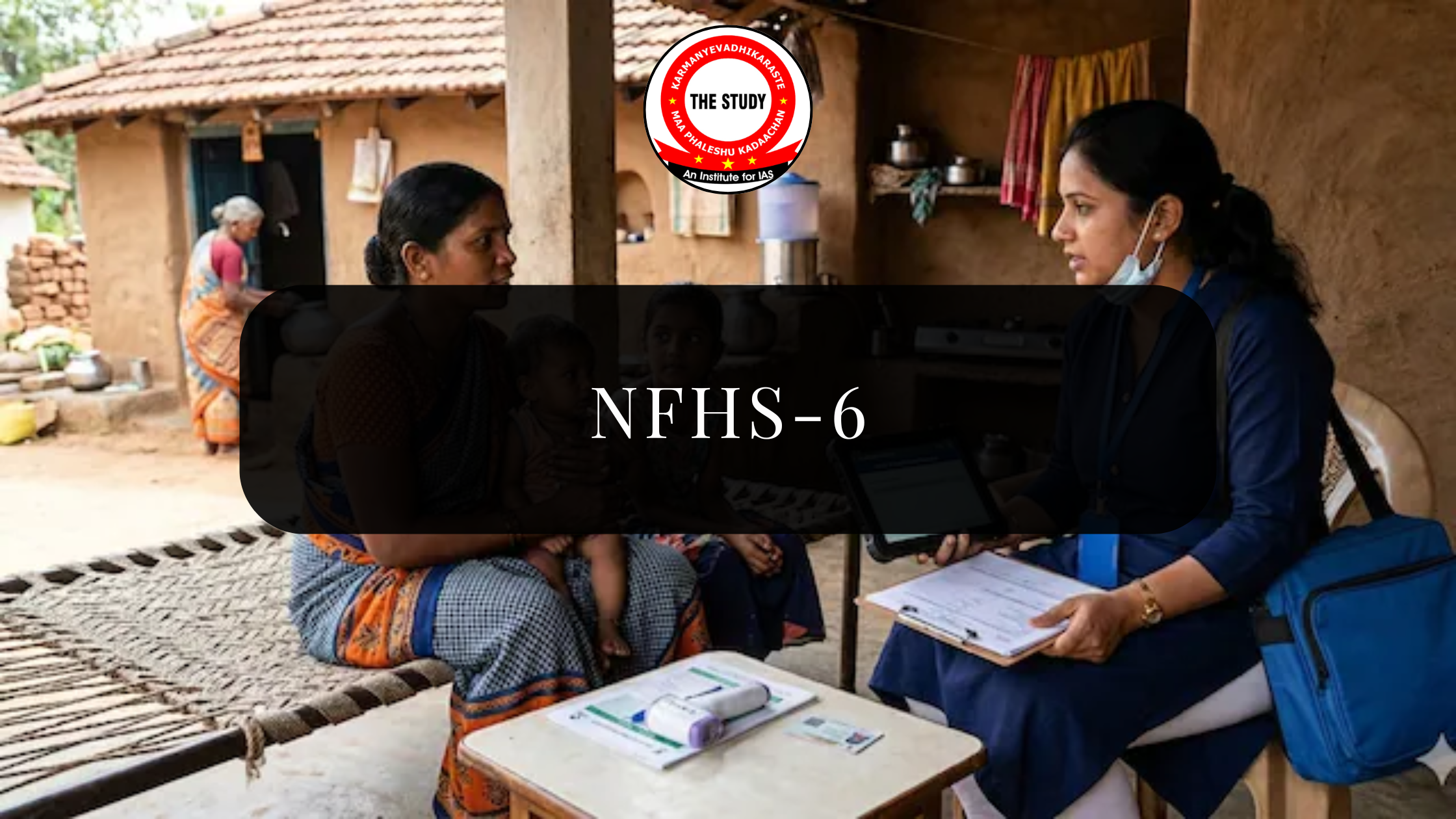
NFHS-6: Key Findings, Significance and India’s Progress in Maternal and Child Health
The National Family Health Survey-6 (NFHS-6) highlights India’s continued progress in maternal health, child health, nutrition, immunisation, and healthcare access. Conducted during 2023–24 by the Ministry of Health and Family Welfare, NFHS-6 covered 6.79 lakh households across 715 districts, making it one of India’s most important sources of demographic and public health data.
For policymakers, researchers, UPSC aspirants, and public health professionals, NFHS-6 is more than just a statistical report. It acts as a national health mirror, showing where India has improved, where gaps remain, and what needs policy attention in the coming years.
What is NFHS?
The National Family Health Survey (NFHS) is a large-scale, multi-round household survey conducted across Indian states and union territories. It collects data on population, health, nutrition, family welfare, maternal care, child health, fertility, immunisation, and healthcare access.
The survey is conducted by the Ministry of Health and Family Welfare (MoHFW), with the International Institute for Population Sciences (IIPS), Mumbai serving as the nodal agency. NFHS provides reliable and comparable data that helps policymakers set benchmarks and assess the effectiveness of health and welfare programmes.
NFHS-6: Why is it Important?
NFHS-6 is important because it provides updated evidence on India’s health and demographic status. It helps the government, researchers, and institutions understand whether public health programmes are producing measurable outcomes.
Evidence-Based Policy Making
NFHS data supports policy-making by giving clear evidence on health indicators such as institutional deliveries, antenatal care, child vaccination, nutrition, fertility, and women’s health.
Instead of relying on assumptions, policymakers use NFHS data to identify where intervention is needed.
Programme Planning and Monitoring
NFHS helps evaluate programmes linked to:
- National Health Mission
- Poshan Abhiyaan
- Mission Indradhanush
- Ayushman Bharat
- Family welfare programmes
- Maternal and child health initiatives
- Sustainable Development Goals
This makes NFHS a core data source for monitoring India’s health-sector performance.
Identifying Regional Disparities
India’s health indicators vary widely across regions, states, districts, rural areas, and urban areas. NFHS helps identify these gaps.
For example, a state may show strong vaccination coverage but weak nutrition indicators. Another region may perform well in institutional deliveries but lag in antenatal care. NFHS makes such differences visible.
Major Findings of NFHS-6
NFHS-6 shows that India has made visible gains in maternal health, child health, immunisation, and financial protection in healthcare.
Improvement in Institutional Deliveries
Institutional deliveries increased from 88.6% to 90.6% according to NFHS-6.
This is significant because institutional deliveries reduce the risk of maternal and newborn complications. They also improve access to skilled birth attendants, emergency obstetric care, postnatal care, and early newborn support.
Better Antenatal Care Coverage
NFHS-6 reported that 95.9% of pregnant women received antenatal care. The proportion of mothers receiving antenatal care in the first trimester also increased from 70% to 76.2%.
Antenatal care is critical because it helps detect pregnancy-related risks early. It also supports maternal nutrition, safe delivery planning, vaccination, and prevention of complications.
High Child Vaccination Coverage
NFHS-6 shows that vaccination coverage among children aged 12–23 months remained consistently high, above 96%.
This reflects the impact of India’s immunisation programmes and improved last-mile delivery. Strong vaccination coverage helps reduce preventable childhood diseases and supports long-term public health outcomes.
Progress in Nutrition Indicators
The article states that India has recorded a decline in stunting and severe wasting among young children as per NFHS-6. This indicates improvement in child nutrition outcomes.
However, nutrition remains a complex challenge. India continues to face the dual burden of undernutrition and rising obesity in certain sections of the population. NFHS data is important because it helps identify such emerging challenges early.
Why NFHS Matters for India’s Health System
NFHS is not just a health survey. It is a strategic tool for governance.
It Tracks Long-Term Health Progress
Because NFHS is conducted in multiple rounds, it allows comparison over time. This helps India track whether indicators are improving, stagnating, or worsening.
For example, comparing NFHS-5 and NFHS-6 helps assess progress in maternal care, child health, nutrition, fertility, and women’s empowerment.
It Supports Targeted Intervention
NFHS helps governments design targeted programmes. If a district has low immunisation, high child wasting, or poor maternal care indicators, interventions can be planned accordingly.
This makes health governance more data-driven.
It Strengthens Accountability
NFHS data allows citizens, researchers, media, and policymakers to assess whether public schemes are working. It creates a measurable basis for accountability.
NFHS-6 and Sustainable Development Goals
NFHS-6 is directly linked to India’s progress on the Sustainable Development Goals (SDGs), especially those related to health, nutrition, gender equality, and poverty reduction.
Link with SDG 2: Zero Hunger
Indicators like stunting, wasting, anaemia, and child nutrition help assess India’s progress toward reducing hunger and malnutrition.
Link with SDG 3: Good Health and Well-Being
Maternal health, child mortality, immunisation, fertility, antenatal care, and disease prevalence are central to SDG 3.
Link with SDG 5: Gender Equality
NFHS also captures indicators related to women’s empowerment, decision-making, digital access, financial inclusion, and reproductive health.
Challenges Highlighted by NFHS-Type Data
While NFHS-6 shows progress, it also reminds us that health outcomes are uneven.
Regional Inequality
Some states and districts may continue to lag behind national averages. This requires localised planning rather than one-size-fits-all policies.
Nutrition Gaps
Even when institutional healthcare improves, child nutrition may remain a challenge due to poverty, dietary diversity, sanitation, maternal education, and food security issues.
Last-Mile Delivery
The final challenge is ensuring that healthcare benefits reach rural, tribal, remote, and vulnerable populations.
READ MORE : How to Score 300+ in History Optional • World History Strategy for UPSC History Optional (Paper 1) • Modern History Strategy for UPSC Optional (Paper 2) • Medieval History Strategy for UPSC Optional • Plant-Based Meat • BHAVYA Scheme • Cooperative AI • Landslides • E20 Fuel • Deforestation • Drop Shipping • Memory Chip • US-Iran Deal • Urban Water Stress in India • Dancing Girl of Mohenjo-daro • Forest Rights Appellate Tribunal (FORAT) • RBI and Fiscal Policy
Common Mistakes to Avoid While Using NFHS Data
Treating National Average as Ground Reality Everywhere
India’s national average may hide regional disparities. Always compare national, state, district, rural, and urban data where possible.
Ignoring the Time Period
NFHS-6 was conducted during 2023–24. Data should be interpreted in that context.
Using Data Without Linking It to Policy
For UPSC and policy analysis, data becomes powerful only when linked to schemes, causes, outcomes, and solutions.
Overstating Progress
Improvement in indicators does not mean the problem is fully solved. A balanced answer should mention both progress and remaining gaps.
Expert Insights
NFHS-6 shows that India’s public health delivery system has improved in several measurable areas, especially maternal care, institutional births, antenatal care, and child immunisation.
However, the next phase of health governance should focus on quality, not just coverage. India needs better nutrition outcomes, stronger primary healthcare, improved district-level planning, and targeted intervention for vulnerable groups.
The real value of NFHS lies in its ability to convert health data into actionable policy.
Key Takeaways
- NFHS-6 shows improvement in maternal and child health indicators across India.
- Institutional deliveries increased from 88.6% to 90.6%.
- Antenatal care coverage improved, with 95.9% of pregnant women receiving ANC.
- Vaccination coverage among children aged 12–23 months remained consistently high, above 96%.
- NFHS helps track progress on health, nutrition, fertility, family welfare, and disease-related indicators.
- The survey is crucial for policy planning, programme evaluation, and identifying regional disparities.
NFHS data supports India’s progress tracking under the National Health Mission and Sustainable Development Goals.
Conclusion
NFHS-6 reflects India’s progress in maternal health, child health, immunisation, institutional deliveries, and healthcare access. At the same time, it highlights the need for continued focus on nutrition, regional disparities, and quality healthcare delivery.
For policymakers, NFHS-6 is a planning tool. For UPSC aspirants, it is a high-value current affairs topic. For India’s development journey, it is a data-driven reminder that health outcomes improve when policy, delivery, and monitoring work together.
READ MORE : How to Score 300+ in History Optional • World History Strategy for UPSC History Optional (Paper 1) • Modern History Strategy for UPSC Optional (Paper 2) • Medieval History Strategy for UPSC Optional • Plant-Based Meat • BHAVYA Scheme • Cooperative AI • Landslides • E20 Fuel • Deforestation • Drop Shipping • Memory Chip • US-Iran Deal • Urban Water Stress in India • Dancing Girl of Mohenjo-daro • Forest Rights Appellate Tribunal (FORAT) • RBI and Fiscal Policy
FAQs on NFHS-6
What is NFHS-6?
NFHS-6 is the sixth round of the National Family Health Survey. It provides updated data on India’s population, health, nutrition, fertility, family welfare, immunisation, maternal care, child health, and healthcare access.
Who conducts the National Family Health Survey?
The National Family Health Survey is conducted by the Ministry of Health and Family Welfare. The International Institute for Population Sciences, Mumbai, acts as the nodal agency for the survey.
Why is NFHS important?
NFHS is important because it provides reliable health and demographic data for policy-making, programme planning, monitoring national goals, and identifying regional disparities in health and welfare indicators.
What are the major findings of NFHS-6?
NFHS-6 shows improvement in maternal and child health indicators. Institutional deliveries increased to 90.6%, antenatal care coverage reached 95.9%, and child vaccination coverage among children aged 12–23 months remained above 96%.
How does NFHS help policymakers?
NFHS helps policymakers understand which health indicators are improving and which areas need urgent intervention. It supports evidence-based planning for health, nutrition, family welfare, and women empowerment programmes.
Is NFHS-6 useful for UPSC preparation?
Yes. NFHS-6 is highly useful for UPSC because it is relevant to topics like public health, nutrition, maternal and child health, women empowerment, demographic change, social justice, and Sustainable Development Goals.
What is the role of NFHS in tracking SDGs?
NFHS helps track India’s progress on SDGs related to health, nutrition, gender equality, and poverty reduction by providing measurable indicators across states and union territories.
Related posts :
- Majoritarianism vs Constitutionalism
- India-Bangladesh Ties
- Nordic Countries and India
- Tackling Ocean Plastic Pollution
- India-Bhutan Ties
- India-UAE Ties
- India-Netherlands Ties
- Captagon: The “Jihadi Drug”
- Bioenergy Systems
- Transforming the Brahmaputra
- India–Africa Forum Summit
- India–US Defence Ties
Subscribe to our YouTube Channel for more Valuable Content – TheStudyias
Download the App to Subscribe to our Courses –Thestudyias
The Source’s Authority and Ownership of the Article is Claimed By THE STUDY IAS BY MANIKANT SINGH
Comments (0)
Leave a Comment