MEDIEVAL INDIAN HISTORY
19 Mar 2026
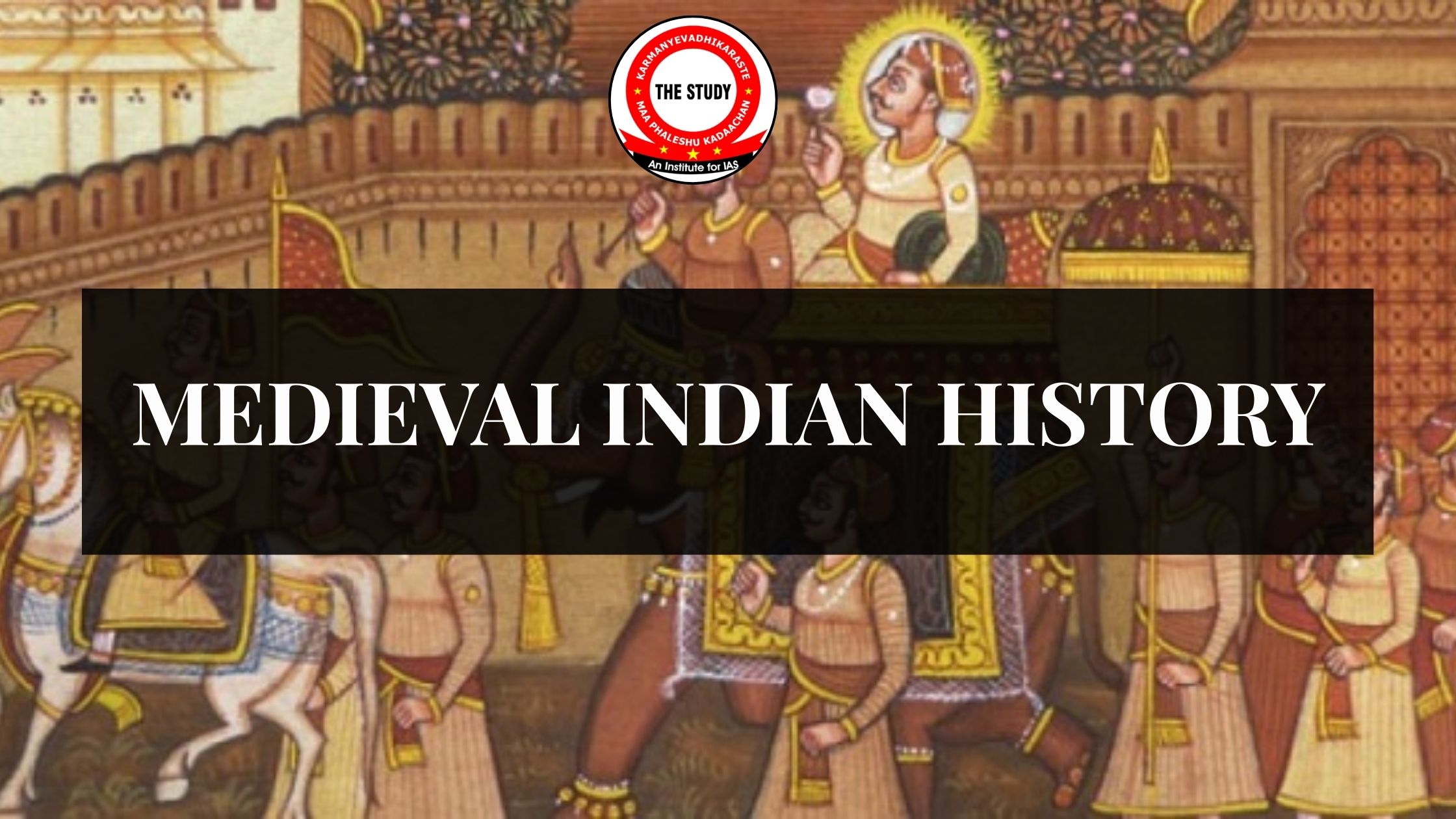
MEDIEVAL INDIAN HISTORY – Complete Notes for UPSC Preparation (8th to 18th Century CE)
1. Introduction to Medieval Indian History
Medieval Indian History is one of the most crucial and scoring areas for UPSC preparation. It spans roughly from the 8th century to the 18th century and showcases India’s transformation in politics, culture, economy, and society.
This period is often divided into four major phases:
- Early Medieval Period (750–1200 CE)
- Delhi Sultanate (1206–1526 CE)
- Mughal Empire (1526–1707 CE)
- Later Mughals & Regional Powers (1707–1757 CE)
Why Medieval Indian History Matters for UPSC
- Evolution of governance systems like Iqta and Mansabdari
- Growth of composite culture
- Development of architecture and art
- Rise of Bhakti and Sufi movements
- Expansion of trade and economy
In simple terms, this period explains how India moved from regional kingdoms to a powerful empire and then toward fragmentation.
2. Sources of Medieval Indian History
Understanding sources is essential because UPSC often asks direct questions from them.
2.1 Archaeological Sources
- Monuments (temples, mosques)
- Coins (Numismatics)
- Inscriptions
- Copper plates
These help us understand economy, religion, and administration.
2.2 Literary Sources
Important texts include:
- Kitab-ul-Hind / Tahqiq-i-Hind
- Author: Al-Biruni
- Period: Ghaznavid period (1017–1030 CE)
- Significance: Observations on Indian science, society, and religion
- Chachnama
- Author: Ali Kufi
- Period: Arab conquest of Sind
- Significance: Earliest detailed account of Arab entry into India
- Tabaqat-i-Nasiri
- Author: Minhaj-us-Siraj
- Period: Mamluk Dynasty
- Significance: History of early Delhi Sultanate
- Tarikh-i-Firoz Shahi
- Author: Ziauddin Barani
- Period: Tughlaq period
- Significance: Political history and ideology of the Sultanate
- Futuh-us-Salatin
- Author: Isami
- Period: Bahmani period
- Significance: Deccan Sultanate history
- Akbarnama / Ain-i-Akbari
- Author: Abul Fazl
- Period: Mughal (Akbar)
- Significance: Administrative details; social and economic data
- Tuzuk-i-Jahangiri
- Author: Jahangir
- Period: Mughal (Jahangir)
- Significance: Memoirs; insight into court life and nature
- Humayunnama
- Author: Gulbadan Begum
- Period: Mughal (Humayun)
- Significance: Personal account; women’s perspective
- Baburnama
- Author: Babur
- Period: Early Mughal
- Significance: First autobiography by a Mughal ruler
- Muntakhab-ut-Tawarikh
- Author: Badauni
- Period: Mughal (Akbar)
- Significance: Critical account of Akbar’s religious policies
2.3 Foreign Accounts
Travelers like:
- Al-Biruni
- Period: 11th century
- Key Observations: Indian sciences, caste system, philosophy; accompanied Mahmud of Ghazni
- Ibn Battuta
- Period: 14th century (Tughlaq period)
- Key Observations: Court of Muhammad bin Tughlaq; insights on social life, towns, and trade
- Abdur Razzaq
- Period: 15th century
- Key Observations: Vijayanagara Empire; trade at Calicut port
- Nicolo Conti
- Period: 15th century
- Key Observations: Vijayanagara; South Indian society
- Duarte Barbosa
- Period: 16th century
- Key Observations: Vijayanagara; trade and commerce
- Francois Bernier
- Period: 17th century (Aurangzeb)
- Key Observations: Mughal economy; land ownership system; factors behind decline
They provide outsider perspectives, which are extremely valuable.
3. Early Medieval India (750–1200 CE)
The early medieval period is characterized by the decline of centralized authority, rise of regional kingdoms, growth of feudal structures, and temple-centered economies. This phase directly precedes the Delhi Sultanate.
key Dynasties
- Gurjara-Pratihara Dynasty
- Region: North/West India
- Period: 8th–10th century
- Capital: Kannauj
- Pala Dynasty
- Region: Bengal & Bihar
- Period: 8th–12th century
- Capital: Pataliputra / Monghyr
- Rashtrakuta Dynasty
- Region: Deccan
- Period: 8th–10th century
- Capital: Manyakheta (Malkhed)
- Chola Dynasty
- Region: South India (Tamil Nadu)
- Period: 9th–13th century
- Capital: Thanjavur
- Rajput Kingdoms
- Region: Rajputana & North India
- Period: 8th–12th century
- Capital: Ajmer, Kannauj, etc.
- Paramara Dynasty
- Region: Malwa
- Period: 9th–14th century
- Capital: Dhara
- Chandela Dynasty
- Region: Bundelkhand
- Period: 9th–13th century
- Capital: Khajuraho
- Chalukyas of Kalyani
- Region: Deccan
- Period: 10th–12th century
- Capital: Kalyani
- Hoysala Dynasty
- Region: Karnataka
- Period: 11th–14th century
- Capital: Dwarasamudra
- Yadava Dynasty
- Region: Maharashtra
- Period: 9th–14th century
- Capital: Devagiri
3.2 Gurjara-Pratihara Dynasty (Early Medieval India)
- Founded by Nagabhata I; reached its peak under Bhoja I
- Controlled the strategic city of Kannauj — gateway to the Gangetic plain
- Maintained a strong cavalry-based army; successfully resisted Arab invasions from Sind
- Key participant in the Tripartite Struggle for control over Kannauj
- Patronized Sanskrit literature; regarded as defenders of North India
UPSC Note:Nagabhata II defeated Arab forces in the Battle of Rajasthan — important for Prelims
3.3 Pala Dynasty (Bengal & Bihar)
- Founded by Gopala (elected by nobles — rare democratic feature); peak under Dharmapala and Devapala
- Major patrons of Buddhism, especially Vajrayana tradition
- Established Vikramashila University and Odantapuri University; supported Nalanda University
- Maintained strong cultural and trade ties with Southeast Asia and Tibet
- Famous for Pala bronze sculpture (important in Indian art history)
3.4 Rashtrakuta Dynasty (Deccan Power)
- Founded by Dantidurga; overthrew the Chalukyas of Badami
- Ruled from Manyakheta
- Built the iconic Kailasa Temple under Krishna I
- Actively involved in the Tripartite Struggle; frequently intervened in North India
- Promoted trade; maintained diplomatic relations with Arab traders
- Patronized Jainism and Sanskrit literature; Amoghavarsha I authored Kavirajamarga
3.5 Chola Dynasty (Peak of Medieval Administration)
The Cholas represent one of the most advanced administrative and political systems in medieval India.
Political & Military Achievements
- Founded by Vijayalaya Chola; expanded under Rajaraja I and Rajendra I
- Rajendra I led a naval expedition to Southeast Asia; earned the title Gangaikonda
- Built Gangaikondacholapuram as a new capital
- Maintained a powerful navy controlling maritime trade routes
Administration
- Decentralized yet efficient governance — Nadu (district), Kurram (group of villages), Ur (village)
- Sabha (Brahmana assemblies) and Ur were key local institutions
- Uttaramerur Inscription explains village self-governance
- Revenue sources: land tax, trade, and tributes
Architecture & Culture
- Built Brihadeeswarar Temple and Gangaikondacholapuram Temple
- Famous for bronze sculptures (Nataraja — Shiva as cosmic dancer)
- Promoted Tamil literature — works like Kamban’s Ramayana and Sekkizhar’s Periya Puranam
UPSC Fact Check - Chola
- Uttaramerur inscription: rules of village governance
- Rajendra Chola: first Indian ruler to lead a naval expedition to Southeast Asia
- Nataraja bronze: peak of Chola art
- Brihadeeswarar Temple: UNESCO World Heritage Site
3.6 Rajput Kingdoms (Northern India)
- Dominated North & West India — included Pratiharas, Paramaras, Chandelas, Chahamanas, Solankis, Tomars
- Known for military valor, clan loyalty, and Kshatriya ideals
- Prithviraj Chauhan defeated Muhammad Ghori in the First Battle of Tarain (1191) but lost in 1192
- Internal conflicts weakened resistance to invasions
- Chandellas built Khajuraho Temples
- Solankis of Gujarat built Dilwara Temples
3.7 Tripartite Struggle (8th–10th Century)
- Conflict between Gurjara-Pratiharas, Palas, and Rashtrakutas for control over Kannauj
- Key rulers:
- Pratiharas: Nagabhata II, Bhoja I, Mahipala
- Palas: Dharmapala, Devapala
- Rashtrakutas: Dhruva, Govinda III, Amoghavarsha
Impact:
- Prolonged instability in North India
- No dynasty could permanently control Kannauj
- Weakened all three powers, paving way for later invasions
3.8 Administration & Society (Early Medieval India)
Feudal Structure
- Samanta system: local chiefs served kings in exchange for land
- Land grants: Agrahara (to Brahmanas), Devadana (to temples)
- Rise of Mahasamantas weakened central authority
- Temples became economic and administrative hubs
Social Structure
- Caste system became rigid; rise of jatis
- Decline in women’s status (practices like sati, child marriage in some regions)
- Increase in untouchability
3.9 Economy & Trade (Early Medieval India)
- Agriculture remained the backbone; expansion of irrigation
- Guilds (Shrenis) regulated trade and crafts
- Decline in long-distance trade initially; revival during Chola period
- Major ports like Kaveripattinam and Mahabalipuram connected India with Southeast Asia and Arabia
- Currency: gold (pagodas), silver coins; supported by numismatic evidence
4. Early Arab and Turkish Invasions in India (Medieval History)
4.1 Arab Conquest of Sind (712 CE)
- Led by Muhammad bin Qasim, who defeated Raja Dahir
- Regions of Sind and Multan came under Arab control, though expansion remained limited
- Marked the first introduction of Islam in the Indian subcontinent
- Early phase of Indo-Islamic cultural interaction
- Primary source: Chachnama — details governance and policies after conquest
4.2 Ghaznavid Invasions (997–1030 CE)
- Led by Mahmud of Ghazni, who conducted 17 raids into India
- Objective: economic plunder, not territorial conquest
- Major raids:
- Somnath Temple (1025 CE)
- Mathura, Nagarkot, Thanesar
- Looted immense wealth, weakening Rajput kingdoms
- Al-Biruni accompanied Mahmud; authored Kitab-ul-Hind
Key Insight: Mahmud’s invasions were loot-driven, not aimed at establishing permanent rule
4.3 Ghori Invasions (1175–1206 CE)
- Led by Muhammad Ghori, who aimed for permanent conquest of India
- First Battle of Tarain (1191): Defeated by Prithviraj Chauhan
- Second Battle of Tarain (1192): Ghori defeated Prithviraj — turning point in Indian history
- Battle of Chandawar (1194): Defeated Jaichandra
- After Ghori’s death (1206), Qutb ud-Din Aibak established the Delhi Sultanate
5. Delhi Sultanate (1206–1526 CE)
The Delhi Sultanate established permanent Muslim political authority in India, transforming administration, economy, and culture.
5.1 Dynasties of the Delhi Sultanate
- Mamluk (Slave) Dynasty (1206–1290)
- Key rulers: Qutb ud-Din Aibak, Iltutmish, Razia Sultana, Balban
- Contributions: Establishment of Sultanate, Iqta system, Delhi as capital
- Khalji Dynasty (1290–1320)
- Key rulers: Alauddin Khalji, Jalaluddin Khalji
- Contributions: Market reforms, Deccan expansion, Mongol resistance
- Tughlaq Dynasty (1320–1414)
- Key rulers: Muhammad bin Tughlaq, Firoz Shah Tughlaq
- Contributions: Administrative experiments, irrigation, welfare
- Sayyid Dynasty (1414–1451)
- Key rulers: Khizr Khan, Mubarak Shah
- Contribution: Weak central control
- Lodi Dynasty (1451–1526)
- Key rulers: Ibrahim Lodi
- Contribution: Last dynasty; ended by Babur in 1526
5.2 Mamluk (Slave) Dynasty
Qutb ud-Din Aibak (1206–1210)
- Founder of Delhi Sultanate; former slave of Muhammad Ghori
- Built Quwwat-ul-Islam Mosque and began Qutb Minar
- Known as Lakh Baksh for generosity
Iltutmish (1211–1236)
- Real consolidator of Sultanate
- Recognized by Abbasid Caliph
- Introduced Iqta system, coins: Tanka & Jital
- Created Turkan-i-Chihalgani (Group of Forty)
Razia Sultana (1236–1240)
- First and only female Sultan of Delhi
- Challenged gender norms; removed purdah
- Deposed due to opposition from nobles
Balban (1266–1287)
- Established absolute monarchy (Zil-i-Ilahi concept)
- Strengthened spy system and military
- Crushed nobles and repelled Mongols
5.3 Khalji Dynasty
Alauddin Khalji (1296–1316)
Military Achievements
- Conquered Gujarat, Ranthambore, Chittor, Malwa
- Deccan campaigns led by Malik Kafur
- Successfully resisted Mongol invasions
Economic Reforms
- Introduced market control system (Diwan-i-Riyasat)
- Fixed prices in grain, cloth, cattle, and slave markets
- Appointed Shahna (market officer) and spies
- Standardized weights & measures
UPSC Insight:
- Purpose: Maintain large army at low cost
- Strict price control worked during his reign but collapsed later
5.4 Tughlaq Dynasty
Ghiyas ud-Din Tughlaq
- Founder; built Tughlaqabad Fort
Muhammad bin Tughlaq (1325–1351)
- Known as the “Wisest Fool”
- Major failed experiments:
- Capital shift to Daulatabad
- Token currency
- High taxation in Doab
- Despite failures, highly intellectual ruler
- Visited by Ibn Battuta
Firoz Shah Tughlaq (1351–1388)
- Built canals, cities (Firozabad, Hisar, Jaunpur)
- Established hospitals (Dar-ul-Shafa)
- Promoted hereditary military system (weakened army)
- Transported Ashokan pillars to Delhi
5.5 Sayyid & Lodi Dynasties
Sayyid Dynasty
- Founded by Khizr Khan
- Weak rule after Timur’s invasion
Lodi Dynasty
- First Afghan dynasty in India
- Sikandar Lodi: shifted capital to Agra
- Ibrahim Lodi defeated in First Battle of Panipat by Babur
5.6 Iqta System (Administration)
- Land revenue assigned to officials (Iqtadars) instead of salary
- Iqtadar maintained troops and collected revenue
- Not hereditary initially; later became hereditary
- Key departments:
- Diwan-i-Wizarat (Finance)
- Diwan-i-Arz (Military)
5.7 Key Departments of Delhi Sultanate
- Diwan-i-Wizarat: Revenue & finance
- Diwan-i-Arz: Military
- Diwan-i-Insha: Royal correspondence
- Diwan-i-Risalat: Religious & foreign affairs
- Diwan-i-Qaza: Judiciary
- Diwan-i-Barid: Intelligence
- Diwan-i-Riyasat: Market control
5.8 Architecture of Delhi Sultanate
- Qutb Minar — tallest minaret (72.5 m)
- Alai Darwaza — first true arch & dome
- Firoz Shah Kotla — Ashokan pillars
- Features: arches, domes, calligraphy, Indo-Persian style
5.9 Mongol Invasions
- Major threat (1221–1306)
- Successfully repelled by Alauddin Khalji
- Led to military and economic reforms
- Some Mongols settled as “New Muslims”
5.10 Vijayanagara Empire (1336–1646)
- Founded by Harihara I and Bukka I at Hampi
- Greatest ruler: Krishnadevaraya
- Strong trade economy; exports spices, textiles
- Defeated in Battle of Talikota
- Visitors: Abdur Razzaq, Nicolo Conti
5.11 Bahmani Kingdom & Deccan Sultanates
- Founded by Alauddin Bahman Shah
- Capital: Gulbarga, later Bidar
- Prime Minister: Mahmud Gawan (reforms)
- Broke into 5 Deccan Sultanates: Ahmadnagar, Bijapur, Berar, Bidar, Golconda
Key Highlights
- Golconda: famous for diamonds (Koh-i-Noor origin)
- Bijapur: Gol Gumbaz — massive dome
6. Mughal Empire (1526–1707 CE) — Complete SEO Notes for UPSC
The Mughal Empire marks the peak of medieval Indian governance, military expansion, and cultural synthesis, making it one of the most important topics for UPSC preparation.
6.1 Babur (1526–1530) — Founder of Mughal Empire
- Founded the Mughal Empire; descendant of Timur and Genghis Khan
- First Battle of Panipat: defeated Ibrahim Lodi using artillery and Tulughma tactics
- Battle of Khanwa: defeated Rana Sanga
- Battles of Chanderi (1528) and Ghaghra (1529) consolidated power
- Authored Baburnama — first Mughal autobiography
- Introduced gunpowder warfare in India
6.2 Humayun (1530–1556)
- Son of Babur; faced instability due to division of empire
- Defeated by Sher Shah Suri at Battle of Chausa and Battle of Kanauj
- Took refuge under Shah Tahmasp I in Persia
- Regained throne in 1555; died in 1556 after falling from library steps
- Humayunnama written by Gulbadan Begum
6.3 Sher Shah Suri (1540–1545) — Administrative Pioneer
- Introduced scientific land revenue system (basis for Mughal reforms)
- Built Grand Trunk Road (Sonargaon to Peshawar)
- Introduced Rupiya (silver coin) — precursor to modern rupee
- Reformed army (dagh & chehra system)
- Developed postal system (dak chowki)
6.4 Akbar (1556–1605) — The Great
Major Battles & Expansion
- Second Battle of Panipat: victory under Bairam Khan
- Conquered Malwa, Gujarat, Bengal, Chittor, Ranthambore
- Battle of Haldighati: fought Maharana Pratap
Administrative Reforms
- Introduced Mansabdari System (Zat & Sawar ranks)
- Implemented Zabt system (land revenue)
- Raja Todar Mal: revenue reforms & Dahsala system
- Abolished Jizyah and pilgrimage tax
Religious Policy - Sulh-i-Kul
- Promoted religious tolerance
- Established Ibadat Khana for debates
- Introduced Din-i-Ilahi (1582)
- Built alliances with Rajputs
Culture & Art
- Built Fatehpur Sikri
- Patronized scholars: Abul Fazl, Tansen, Birbal
- Translation movement (Maktab Khana)
UPSC Focus: Mansabdari system = non-hereditary, rank-based bureaucracy
6.5 Jahangir (1605–1627)
- Authored Tuzuk-i-Jahangiri
- Introduced Chain of Justice (Zanjir-i-Adl) at Agra Fort
- Patron of Mughal painting (Ustad Mansur, Abu’l Hasan)
- Influenced by Nur Jahan
- British entry: Sir Thomas Roe got trade rights
6.6 Shah Jahan (1628–1658) — Golden Age of Architecture
- Built Taj Mahal (UNESCO site)
- Constructed Red Fort and Jama Masjid
- Created Peacock Throne (Takht-i-Taus)
- Deposed by Aurangzeb after war of succession
6.7 Aurangzeb (1658–1707) — Decline Begins
- Expanded Mughal Empire to maximum extent
- Reimposed Jizyah (1679)
- Deccan campaigns exhausted resources
- Executed Guru Tegh Bahadur and Sambhaji
- Compiled Fatwa-e-Alamgiri
- Policies alienated Rajputs, Marathas, Sikhs
6.8 Mughal Administration (Key Structure)
- Emperor (Padshah): supreme authority
- Wazir/Diwan: finance
- Mir Bakshi: military
- Subah → Sarkar → Pargana → Village
- Local officials: Muqaddam, Patwari
6.9 Mughal Economy & Trade
- Agriculture backbone; Dahsala system
- Introduced crops: maize, tobacco, chilli
- Major exports: textiles, indigo, spices
- Ports: Surat, Masulipatnam
- India held ~24% of world GDP (1700)
- Karkhanas (royal workshops) produced luxury goods
6.10 Mughal Architecture Highlights
- Humayun's Tomb — first garden tomb
- Buland Darwaza — tallest gateway
- Taj Mahal — peak of Mughal architecture
- Features: symmetry, domes, arches, Persian + Indian blend
7. Culture, Religion, and Society in Medieval India
7.1 Bhakti Movement
- Emphasized devotion over ritual
- Rejected caste hierarchy
- Used regional languages
Key Saints
- Kabir - Nirguna Bhakti
- Mirabai - Krishna devotion
- Tulsidas - Ramcharitmanas
- Chaitanya Mahaprabhu - Kirtan tradition
7.2 Sufi Movement
- Focus on love, devotion, and spiritual connection with God
- Centers: Khanqahs and Dargahs
Major Sufi Saints
- Khwaja Moinuddin Chishti (Ajmer)
- Nizamuddin Auliya (Delhi)
- Amir Khusrau
7.3 Bhakti-Sufi Interaction
- Promoted syncretic culture (Ganga-Jamuni Tehzeeb)
- Influenced regional languages and literature
- Saints like Kabir bridged both traditions
7.4 Sikhism (Medieval Period)
- Founded by Guru Nanak
- Guru Arjan compiled Adi Granth
- Guru Gobind Singh founded Khalsa (1699)
7.5 Art, Literature & Music
Painting
- Mughal style: Persian + Indian blend
- Peak under Jahangir
Literature
- Persian: Abul Fazl, Badauni
- Hindi: Tulsidas, Surdas
Music
- Tansen - Dhrupad tradition
- Qawwali developed by Amir Khusrau
8. Maratha Kingdom and Shivaji
8.1 Shivaji Bhonsle (1627–1680)
- Born at Shivneri Fort; trained under Dadaji Kondadev
- Captured Torna Fort (1646) — first conquest; foundation of Maratha state
- Used Guerrilla Warfare (Ganimi Kawa) — terrain-based strategy
- Surat Raids (1664, 1670) — targeted Mughal economic centers
- Treaty of Purandar with Mirza Raja Jai Singh; surrendered 23 forts
- Visited Agra (1666); detained by Aurangzeb; escaped dramatically
- Coronation (1674) at Raigarh Fort as Chhatrapati
- Died in 1680; laid foundation of a powerful Maratha state
8.2 Shivaji’s Administration
- Ashtapradhan (Council of Eight Ministers):
- Peshwa (PM), Senapati, Amatya, Mantri, Sachiv, Sumant, Nyayadhish, Pandit Rao
- Revenue system:
- Chauth (1/4 tax)
- Sardeshmukhi (extra 10%)
- Abolished Jagirdari; paid soldiers in cash
- Developed a strong navy; encouraged trade & protected merchants
- Promoted Marathi language; followed religious tolerance
8.3 Later Marathas and Peshwas
- Shambhaji (1680–1689): executed by Aurangzeb
- Rajaram & Tarabai continued resistance
- Shahu: rise of Peshwas
- Key Peshwas:
- Balaji Vishwanath
- Bajirao I — major expansion
- Maratha Confederacy centers: Pune, Gwalior, Indore, Nagpur, Baroda
- Third Battle of Panipat: defeat by Ahmad Shah Abdali
- Ended with Third Anglo-Maratha War
9. Decline of Medieval Empires
9.1 Decline of Mughal Empire (After 1707)
- Death of Aurangzeb → rapid decline
Causes:
- Long Deccan campaigns → drained treasury
- Religious policies → alienated Hindus, Sikhs, Rajputs, Marathas
- Weak successors → rise of powerful nobles
- Rise of regional states → Marathas, Hyderabad, Mysore, Awadh, Bengal
- Nadir Shah’s invasion of Delhi → looted Peacock Throne & Koh-i-Noor
- Invasions of Ahmad Shah Abdali (1748–1767)
- Rise of European companies like British East India Company
Later Mughal Rulers
- Bahadur Shah I (1707–1712): compromise with Rajputs & Marathas
- Farrukh Siyar (1713–1719): 1717 Farman to British
- Muhammad Shah Rangeela (1719–1748): Nadir Shah invasion
- Ahmad Shah (1748–1754): Abdali invasions
- Alamgir II (1754–1759): weak rule; Battle of Plassey
- Shah Alam II (1759–1806): Battle of Buxar
- Bahadur Shah II (1837–1857): Revolt of 1857; exiled
9.2 Rise of Regional Powers (18th Century)
- Hyderabad:
- Founder: Nizam-ul-Mulk Asaf Jah
- First to assert independence
- Mysore:
- Hyder Ali, Tipu Sultan
- Anglo-Mysore Wars
- Awadh:
- Founder: Saadat Khan Burhan-ul-Mulk
- Cultural hub: Lucknow
- Bengal:
- Founder: Murshid Quli Khan
- Battle of Plassey
- Marathas: most powerful post-Mughal force
- Punjab (Sikhs):
- Banda Singh Bahadur → later
- Maharaja Ranjit Singh
10. Quick Revision (UPSC)
10.1 Important Battles
- First Battle of Tarain — Prithviraj defeated Ghori
- Second Battle of Tarain — Ghori victory
- First Battle of Panipat — Mughal Empire founded
- Battle of Khanwa — Babur vs Rana Sanga
- Second Battle of Panipat — Akbar restored
- Battle of Haldighati — Akbar vs Rana Pratap
- Battle of Talikota — Vijayanagara decline
- Battle of Plassey — British rise
- Third Battle of Panipat — Maratha defeat
10.2 Administrative Innovations
- Iqta System — Iltutmish
- Market Control — Alauddin Khalji
- Dagh & Chehra — Sher Shah Suri
- Mansabdari — Akbar
- Dahsala — Raja Todar Mal
- Din-i-Ilahi — Akbar
- Ashtapradhan — Shivaji
- Chauth & Sardeshmukhi — Shivaji
- Fatwa-e-Alamgiri — Aurangzeb
10.3 Important Texts
- Baburnama — Babur
- Humayunnama — Gulbadan Begum
- Akbarnama — Abul Fazl
- Tuzuk-i-Jahangiri — Jahangir
- Kitab-ul-Hind — Al-Biruni
- Ramcharitmanas — Tulsidas
- Jnaneshwari — Jnaneshwar
10.4 Architecture Styles
- Nagara → Khajuraho, Konark
- Dravida → Brihadeeswarar Temple, Meenakshi Temple
- Vesara → Hoysala temples (Belur, Halebid)
- Indo-Islamic → Qutb Minar, Alai Darwaza
- Mughal → Taj Mahal, Humayun’s Tomb, Fatehpur Sikri
Frequently Asked Questions (FAQs)
Q1. What period is considered medieval India?: Medieval India generally covers the 8th century to the 18th century — from the decline of the Gupta Empire to the rise of British colonial power.
Q2. Why is medieval history important for UPSC?: It explains political systems (Iqta, Mansabdari), social change (Bhakti, Sufi), architectural heritage, and economic evolution — all tested in Prelims and Mains.
Q3. Which dynasties ruled during the Delhi Sultanate?: Five dynasties: Mamluk (Slave), Khalji, Tughlaq, Sayyid, and Lodi (1206–1526).
Q4. What was the Mansabdari system?: An Akbar-era administrative ranking system with dual ranks — Zat (personal) and Sawar (cavalry). It replaced the Iqta for Mughal nobles.
Q5. What were the Bhakti and Sufi movements?: Spiritual reform movements — Bhakti emphasized personal devotion in regional languages; Sufi orders promoted love, spiritual discipline, and often transcended religious barriers.
Q6. What caused the decline of the Mughal Empire?: Multiple causes: Aurangzeb's religious intolerance, prolonged Deccan wars, weak successors, Nadir Shah and Abdali invasions, rise of Marathas and Sikhs, and eventual European conquest.
Q7. Who were the major foreign travelers to medieval India?: Al-Biruni (11th c.), Ibn Battuta (14th c.), Abdur Razzaq, Nicolo Conti (15th c.), Duarte Barbosa (16th c.), Francois Bernier (17th c.).
Q8. What is the significance of the Battle of Talikota (1565)?: It ended the Vijayanagara Empire's dominance in South India — a coalition of Deccan Sultanates defeated Aliya Rama Raya; the city of Vijayanagara was sacked.
Subscribe to our YouTube Channel for more Valuable Content – TheStudyias
Download the App to Subscribe to our Courses – Thestudyias
The Source’s Authority and Ownership of the Article is Claimed By THE STUDY IAS BY MANIKANT SINGH
Comments (0)
Leave a Comment