Kalpana Dutta
11 Aug 2026
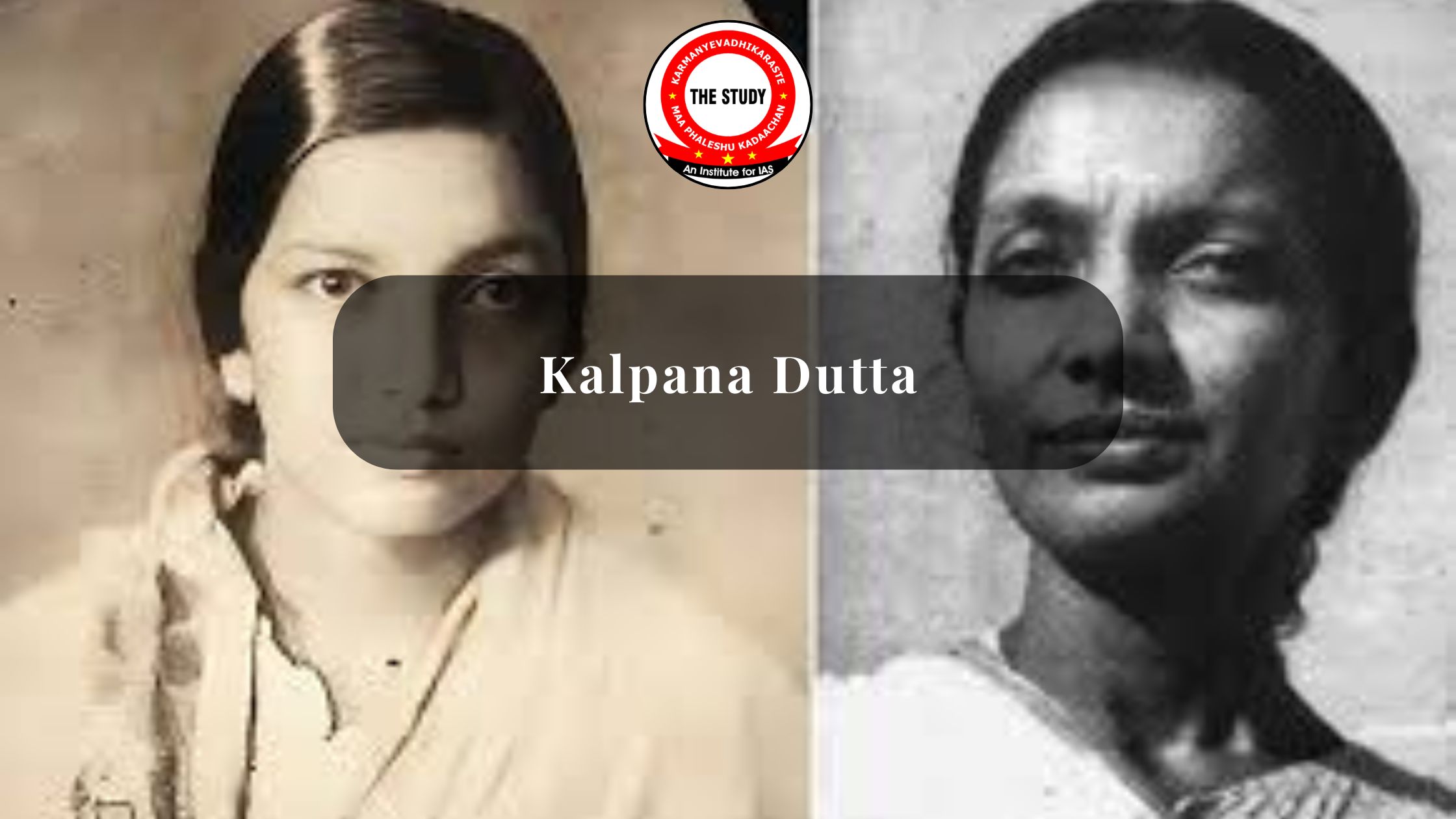
Kalpana Dutta: Revolutionary Nationalist, Chittagong Uprising & Legacy
Introduction
Kalpana Dutta (1913–1995), later known as Kalpana Joshi, was one of the prominent women revolutionaries associated with the anti-colonial movement in Bengal. She became closely associated with Surya Sen's revolutionary organisation in Chittagong and participated in the wider revolutionary movement that followed the Chittagong Armoury Raid of 1930.
Her significance goes beyond her participation in revolutionary activities. Her journey—from a young student in Bengal to an underground revolutionary, political prisoner, communist organiser and social activist—reflects the changing character of India's freedom struggle during the 1930s and 1940s.
For UPPSC and other competitive examinations, Kalpana Dutta is particularly relevant under Revolutionary Nationalism, Women's Participation in the Freedom Struggle, Bengal's Revolutionary Movement and the Chittagong Uprising.
Early Life and Education
Kalpana Dutta was born on 27 July 1913 in Sripur in the Chittagong district of Bengal Presidency, an area that is now part of Bangladesh. Her father, Binod Behari Dattagupta, was a government employee.
After completing her matriculation in Chittagong in 1929, she moved to Calcutta and joined Bethune College to study science. During her student years, she became associated with the Chhatri Sangha (Women Students Association), a platform through which several young women became exposed to nationalist and revolutionary ideas.
Her association with women such as Bina Das and Pritilata Waddedar placed her within an emerging network of politically active young women in Bengal.
From Student Activism to Revolutionary Politics
The political atmosphere of Bengal during the late 1920s was marked by growing opposition to British colonial rule. Revolutionary organisations sought to supplement the broader nationalist movement through direct action against colonial institutions.
Kalpana eventually became associated with the Indian Republican Army, Chittagong branch, led by Surya Sen, popularly known as Masterda. She joined the organisation in May 1931, after the Chittagong Armoury Raid had already taken place.
This distinction is important for examinations: Kalpana Dutta was associated with the revolutionary movement led by Surya Sen, but she did not participate in the original 18 April 1930 armoury raid itself.
What Was the Chittagong Armoury Raid?
The Chittagong Armoury Raid took place on 18 April 1930 under the leadership of Surya Sen. The objective was to strike at important colonial military and communication installations and disrupt British authority in Chittagong.
The revolutionary action involved attempts to seize arms, disrupt communications and challenge colonial administrative control. The revolutionaries subsequently moved towards the Jalalabad Hills, where British forces confronted them.
Although the uprising did not overthrow British authority, it became an important episode in the history of revolutionary nationalism in Bengal.
Kalpana's role belongs principally to the subsequent phase of this revolutionary movement.
Kalpana Dutta and Pritilata Waddedar
Kalpana Dutta and Pritilata Waddedar represent the increasing participation of women in revolutionary activities in Bengal.
In 1931, Surya Sen entrusted Kalpana and Pritilata with responsibilities connected with a planned attack on the European Club at Chittagong. Kalpana was arrested while conducting reconnaissance shortly before the planned action and was subsequently released on bail.
Pritilata later led the attack on the Pahartali European Club in September 1932 and died after taking cyanide to avoid capture.
Thus, the two women demonstrate that revolutionary nationalism was not exclusively a male movement. Women participated in intelligence gathering, communication, underground work, planning and direct revolutionary activities.
Underground Activities and Arrest
After her release on bail, Kalpana went underground and continued to remain connected with the revolutionary network.
In February 1933, British forces surrounded a revolutionary hideout at Gairala village. Surya Sen was captured during the operation, while Kalpana managed to escape. She was eventually arrested on 19 May 1933.
Her arrest became part of the subsequent legal proceedings against members of the Chittagong revolutionary movement.
For examination purposes, it is useful to remember the sequence:
Revolutionary activism → Underground work → Arrest in 1933 → Life transportation sentence → Release in 1939.
From Revolutionary Nationalism to Communist Politics
Kalpana's political journey did not end with her release from prison. She completed her graduation from the University of Calcutta in 1940 and subsequently joined the Communist Party of India (CPI).
She married Puran Chand Joshi (P.C. Joshi) in 1943, who was a major communist leader and then associated with the leadership of the CPI.
Her later political life illustrates an important transition among several anti-colonial activists: revolutionary nationalism and anti-imperialist politics increasingly intersected with socialist and communist ideas.
The communist movement itself had roots in India's wider anti-imperialist struggle and organised workers, peasants and other sections of society.
Role in Social and Political Work
After joining the communist movement, Kalpana became involved in organising activities among peasants and women. She also worked during the Bengal famine of 1943 and in relief activities connected with the upheavals surrounding Partition.
She also participated in electoral politics, contesting the 1946 Bengal Legislative Assembly election, though she was unsuccessful.
Her post-revolutionary career therefore provides a broader understanding of women's participation in India's political transformation—from underground resistance to organised social and political mobilisation.
Importance for UPPSC and Other Competitive Exams
Kalpana Dutta is important for UPPSC, UPSC, SSC and other State PCS examinations, particularly under Modern Indian History.
Aspirants should connect her with four broader themes:
- Revolutionary Nationalism in Bengal
- Chittagong Armoury Raid
- Women's participation in the freedom movement
- Transition from revolutionary nationalism to communist politics
For Mains, her story can be used to demonstrate that the freedom movement was ideologically diverse and socially broad-based, involving constitutionalists, mass nationalists, revolutionaries, socialists, communists, workers, peasants and women.
Previous Year Exam-Oriented Points
- Kalpana Dutta was associated with Surya Sen's revolutionary movement in Chittagong.
- She joined the Indian Republican Army, Chittagong branch, in 1931, after the original 1930 armoury raid.
- She was associated with Pritilata Waddedar and the revolutionary participation of women in Bengal.
- She was arrested in May 1933 and sentenced to transportation for life.
- She was released in 1939.
- She subsequently joined the Communist Party of India.
- She married P.C. Joshi in 1943.
- Her life demonstrates the transition from revolutionary nationalism to organised left-wing politics.
FAQs
1. Who was Kalpana Dutta?
Kalpana Dutta was a prominent Bengali revolutionary associated with the Chittagong revolutionary movement led by Surya Sen during India's freedom struggle.
2. Was Kalpana Dutta a participant in the 1930 Chittagong Armoury Raid?
She was not a participant in the original 18 April 1930 raid. She joined Surya Sen's revolutionary organisation in 1931 and became involved in subsequent revolutionary activities.
3. What happened to Kalpana Dutta after her arrest?
She was arrested in 1933, tried in connection with the Chittagong revolutionary cases and sentenced to transportation for life. She was released in 1939.
4. What was Kalpana Dutta's later political affiliation?
After her release and graduation, she joined the Communist Party of India in 1940.
5. Why is Kalpana Dutta important for UPPSC?
She is relevant to Modern Indian History, particularly revolutionary nationalism, the Chittagong movement, women's role in the freedom struggle and the growth of left-wing politics in India.
6. Who was P.C. Joshi?
Puran Chand Joshi, popularly known as P.C. Joshi, was a prominent leader of the Communist Party of India and became Kalpana Dutta's husband in 1943.
7. What is the most important distinction to remember for Prelims?
Do not automatically identify Kalpana Dutta as a participant in the 18 April 1930 Chittagong Armoury Raid. Her documented revolutionary involvement began with Surya Sen's organisation in May 1931, in the movement that followed the raid.
Subscribe to our Youtube Channel for more Valuable Content – TheStudyias
Download the App to Subscribe to our Courses – Thestudyias
The Source’s Authority and Ownership of the Article is Claimed By THE STUDY IAS BY MANIKANT SINGH