K Kelappan
21 Aug 2026
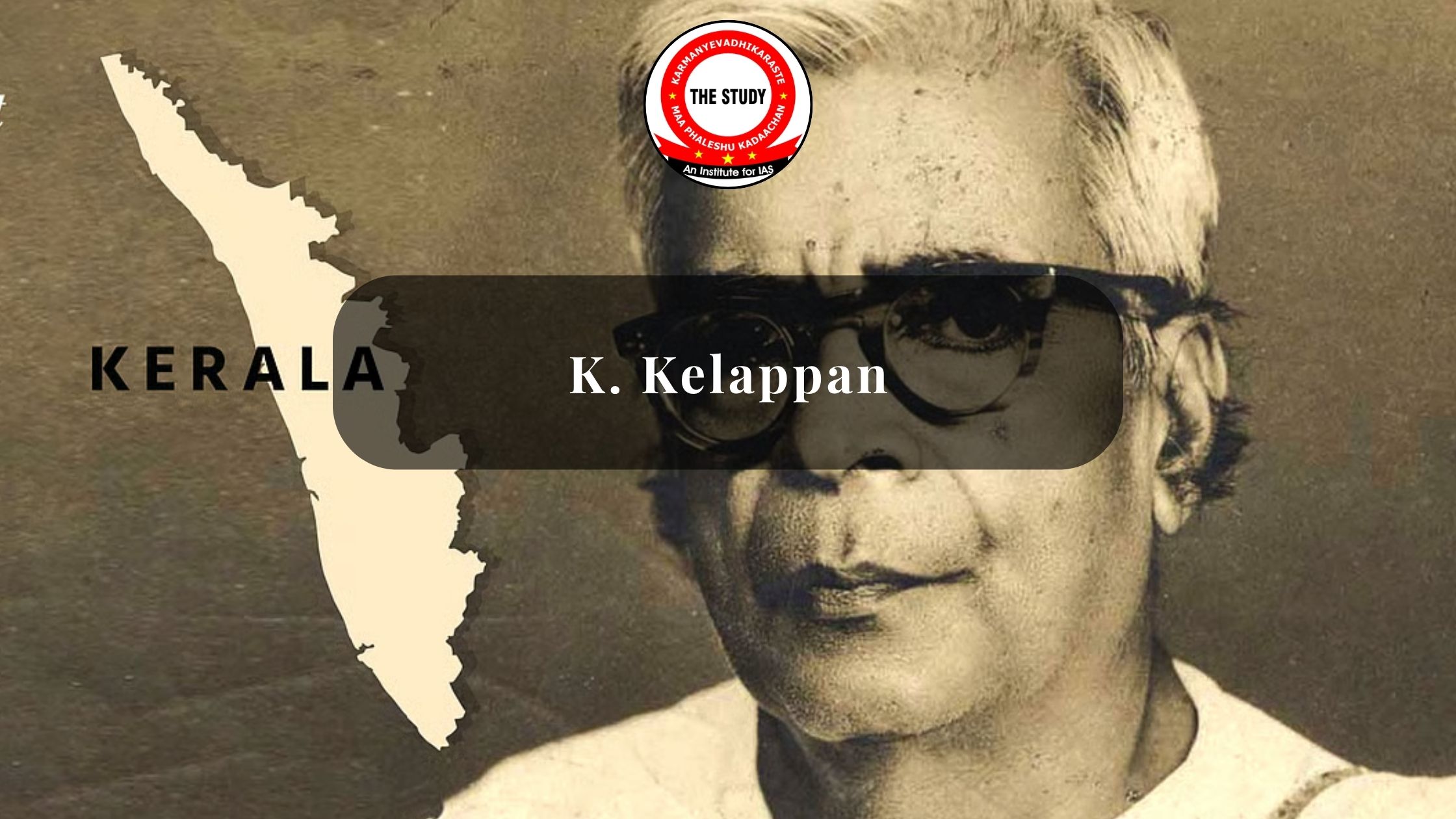
K. Kelappan: Life, Freedom Struggle, Social Reform & Importance
Introduction
Koyapalli Kelappan (K. Kelappan) was one of the most prominent leaders of Kerala's freedom movement and social reform movements. Popularly remembered as “Kerala Gandhi,” he combined Gandhian principles of non-violence, civil disobedience, social equality, khadi and constructive work with a strong campaign against untouchability and caste discrimination.
His importance for competitive examinations goes beyond his biography. Kelappan provides a useful case study of how the national movement acquired regional forms. His leadership in the Payyannur Salt Satyagraha, participation in the Vaikom Satyagraha, and leadership of the Guruvayur Satyagraha demonstrate the connection between the anti-colonial struggle and movements for social reform. The Government of India's Azadi Ka Amrit Mahotsav repository identifies him as an independence activist, educationist and journalist who played a leading role in Kerala's national movement.
For UPPSC aspirants, Kelappan is particularly relevant under Modern Indian History, Gandhian movements, Civil Disobedience, social reform and regional participation in the freedom struggle.
K. Kelappan and His Role in India's Freedom and Social Reform Movements
Who was K. Kelappan and why is he called “Kerala Gandhi”?
Koyapalli Kelappan was born in 1889 and emerged as a leading figure of the Indian National Congress in Kerala. He was also associated with educational and social reform activities and became known for his commitment to Gandhian ideals.
The title “Kerala Gandhi” reflected his close association with Gandhian methods, particularly satyagraha, non-violence, simplicity and constructive social work. The Ministry of Culture records that Kelappan fought simultaneously against colonial rule and social discrimination and later remained associated with Gandhian organisations after independence.
His political significance should therefore be understood through two parallel struggles:
- Freedom from colonial rule
- Freedom from caste-based social discrimination
This dual character makes him an important figure for understanding the broader meaning of India's national movement.
How did K. Kelappan contribute to the Vaikom Satyagraha?
The Vaikom Satyagraha (1924–25) was an important anti-untouchability movement in Travancore against restrictions imposed on lower castes using roads surrounding the Vaikom temple.
Kelappan played a prominent role in the movement. The Kerala government's educational material notes that he expressed satisfaction with the 1925 settlement under which most roads surrounding the temple were opened to people without caste distinctions. The movement subsequently influenced the wider campaign for temple entry and social equality.
For examination purposes, Vaikom should not be remembered merely as a temple-entry episode. It illustrates the intersection of:
Gandhian satyagraha + anti-untouchability + caste reform + mass mobilisation.
This connection is useful in Mains answers dealing with the social dimensions of the national movement.
What was K. Kelappan's role in the Payyannur Salt Satyagraha?
The Civil Disobedience Movement of 1930 reached Kerala through important local centres, particularly Payyannur and Kozhikode.
Kelappan led the Salt Satyagraha at Payyannur. According to the Ministry of Culture's Digital District Repository, a procession moved from Kozhikode towards Payyannur, and the salt laws were violated on 21 April 1930 by preparing salt. The participants faced severe police repression.
The movement demonstrated how Gandhi's symbolic choice of salt could be translated into powerful regional mobilisation.
Kerala's school-level historical material also identifies Kelappan as a principal leader of the Payyannur Salt Satyagraha.
Why is the Guruvayur Satyagraha associated with K. Kelappan?
The Guruvayur Satyagraha (1931–32) was an important campaign against untouchability and for opening the Guruvayur Temple to all Hindus.
Kelappan became the principal leader of the campaign. When temple authorities refused to concede the demand, he undertook a fast unto death in September 1932. The Ministry of Culture records that his fast lasted twelve days and generated considerable national attention. At Mahatma Gandhi's request, Kelappan ended the fast on 2 October 1932.
Although the fast did not immediately secure temple entry, it strengthened public support for the cause. A subsequent referendum reportedly recorded more than 77% support for temple entry. The wider struggle eventually contributed to the social environment in which temple-entry reform succeeded in Kerala in 1936.
This is an excellent example for answers on Gandhian constructive work and the relationship between political freedom and social emancipation.
How did Kelappan connect nationalism with social reform?
Kelappan's contribution cannot be reduced to anti-British politics. He believed that political freedom would remain incomplete if Indian society continued to suffer from untouchability, caste discrimination and social inequality.
His activism therefore operated on two levels:
Political: Civil Disobedience, Salt Satyagraha and resistance to colonial rule.
Social: Anti-untouchability campaigns, temple-entry movements and efforts towards social equality.
This reflects an important characteristic of the Gandhian phase of the national movement: Swaraj was linked with social reconstruction.
What was Kelappan's contribution to Kerala's wider nationalist movement?
Kelappan helped transform the national movement into a mass political movement in Kerala. His leadership in Payyannur gave the Civil Disobedience Movement a strong regional base.
The Payyannur Conference of 1928, another important development in Kerala's political history, passed resolutions supporting Poorna Swaraj and tenancy-related demands and also supported the movement for a united Malayalam-speaking region.
Thus, the political environment surrounding Kelappan involved not only independence but also:
- Agrarian concerns
- Political rights
- Social reform
- Regional identity
- Anti-colonial mobilisation
This makes his life useful for understanding the regionalisation of India's national movement.
Why is K. Kelappan important for UPPSC and other competitive examinations?
For UPPSC, UPSC, Kerala PSC and other State PCS examinations, Kelappan can be connected with several themes:
- Modern Indian History
- Gandhian phase of nationalism
- Civil Disobedience Movement
- Salt Satyagraha
- Anti-untouchability movement
- Temple-entry movements
- Regional freedom struggles
- Social reform in Kerala
- Constructive programme of Gandhi
A strong Mains answer should avoid writing only a chronological biography. Instead, use Kelappan as an example of how Gandhian nationalism combined political resistance with social transformation.
The Ministry of Culture records his death on 7 October 1971 and notes that India Post issued a commemorative stamp in his honour in 1990.
What are the Previous Year Exam-Oriented Points on K. Kelappan?
Aspirants should remember the following exam-oriented linkages:
- K. Kelappan → Kerala Gandhi
- Kelappan → Payyannur Salt Satyagraha, 1930
- Kelappan → Guruvayur Satyagraha, 1931–32
- Guruvayur → anti-untouchability and temple-entry movement
- Vaikom Satyagraha → struggle against caste-based restrictions
- Kelappan represents the regional spread of Gandhian nationalism.
- His activities demonstrate the connection between political freedom and social reform.
- Do not confuse K. Kelappan with other Kerala freedom fighters such as K. P. Kesava Menon, Muhammad Abdur Rahiman or A. K. Gopalan.
Kerala's official educational material also specifically identifies Kelappan with the Payyannur Salt Satyagraha and Guruvayur Satyagraha, making these associations especially useful for state-level examinations.
What is the Final Takeaway for UPPSC Aspirants?
K. Kelappan's significance lies not simply in the number of movements he participated in, but in what his career tells us about the nature of India's freedom struggle.
He demonstrates that nationalism was not confined to major political centres such as Bombay, Calcutta or Delhi. It reached regional societies and became intertwined with local grievances, caste reform, religious access, agrarian concerns and social equality.
For a UPPSC Mains answer, a powerful concluding line would be:
“Kelappan's legacy illustrates how Gandhian nationalism transformed the struggle for political freedom into a wider movement for social dignity and democratic participation.”
FAQs
1. Who was K. Kelappan?
K. Kelappan was a prominent Kerala freedom fighter, social reformer, educationist and journalist who became popularly known as Kerala Gandhi.
2. Why is K. Kelappan famous?
He is particularly remembered for his role in the Payyannur Salt Satyagraha, Vaikom Satyagraha and Guruvayur Satyagraha.
3. Which movement did Kelappan lead in 1930?
He led the Salt Satyagraha at Payyannur during the Civil Disobedience Movement.
4. What was Kelappan's role in Guruvayur Satyagraha?
He led the campaign for temple entry and undertook a 12-day fast in 1932 against the denial of temple access.
5. Why is Kelappan important for UPPSC?
He is an important example of regional participation in the national movement, particularly under Modern Indian History, Gandhian movements and social reform.
6. When did K. Kelappan die?
He died on 7 October 1971.
Subscribe to our Youtube Channel for more Valuable Content – TheStudyias
Download the App to Subscribe to our Courses – Thestudyias
The Source’s Authority and Ownership of the Article is Claimed By THE STUDY IAS BY MANIKANT SINGH