Is Communism Dead in India?
9 May 2026
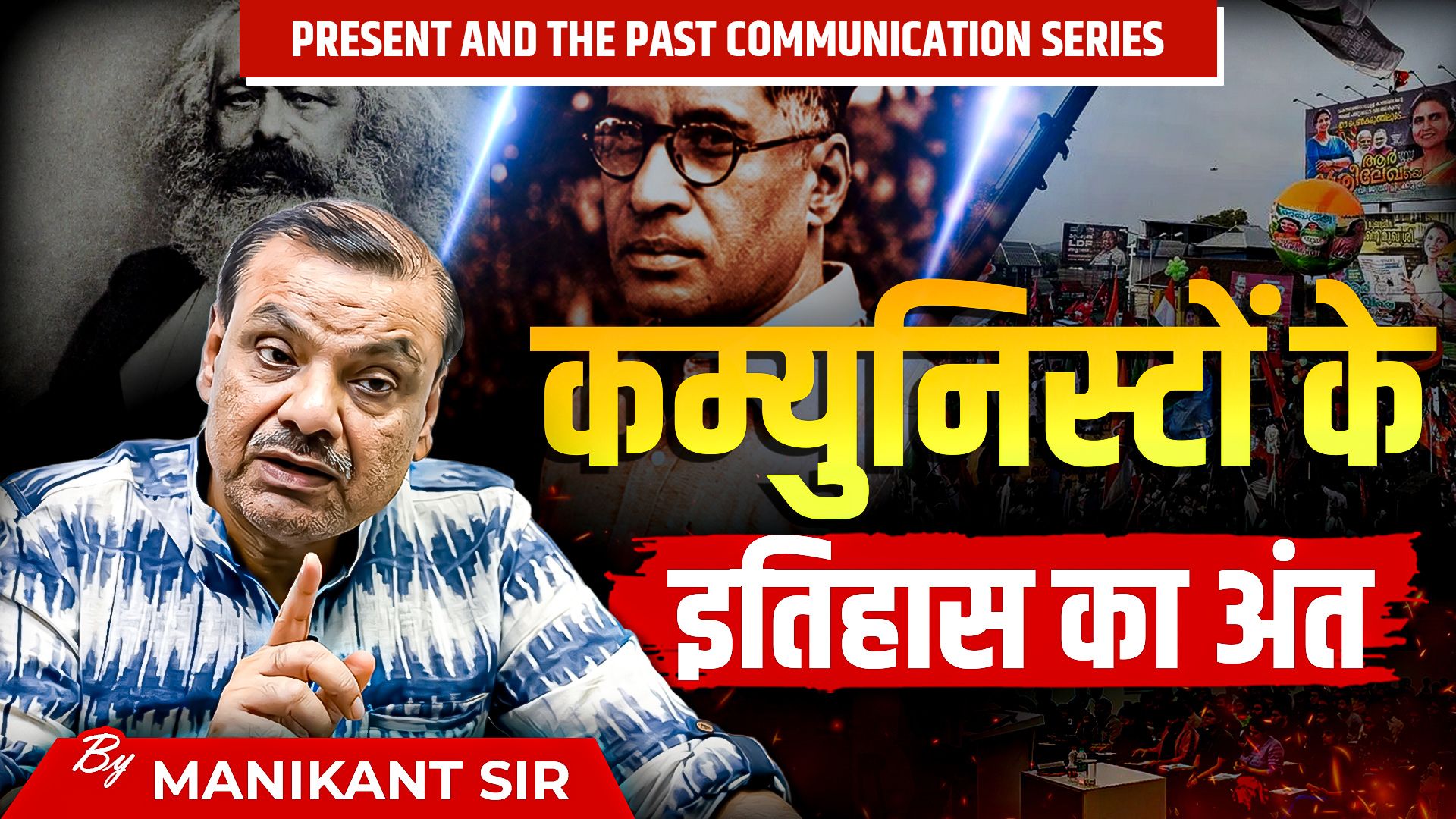
Is Communism Dead in India? A 100-Year Autopsy of the Indian Left
By Manikant Singh, Founder, The Study IAS | 33+ years of UPSC History Optional teaching
For the first time in 50 years, not a single Indian state has a Communist government. When the LDF lost Kerala in 2025, the last fortress of the Indian Left - a 100-year political experiment effectively ended. This is not just an electoral defeat. It is the collapse of an ideology that failed to adapt to the land it tried to transform.
Watch Full Video Analysis : Is Communism Dead in India?
Why Did Communism Fail in India? The Strategic Mistakes That Doomed the Left
The story of Indian Communism is not a story of bad intentions. It is a story of strategic miscalculations - decisions made at critical junctures that compounded over a century into irreversible decline. Understanding these mistakes is essential not just for History Optional, but for understanding modern Indian politics as a whole.
Watch Full Video : Collapse of Indian Communism Explained
The Origins: 1925 and the Kanpur Conference
The Communist Party of India was formally constituted at the All India Communist Conference in Kanpur in 1925, chaired by M. Singaravelu of Madras. Key figures present included Shripad Amrit Dange, Shaukat Usmani, and Nalini Gupta. The movement had ideological roots going back to M.N. Roy (Manabendra Nath Roy), who attended the Second Communist International in Moscow and engaged Lenin himself in a foundational debate.
It is worth noting - and this is a detail aspirants often miss - that both the CPI and the RSS were founded in 1925, ideologically polar opposites, both completing 100 years simultaneously. One has just lost its last government. The other has never been more politically influential. History rarely offers such a clean comparative.
Watch full Video : Birth of CPI Explained
The Lenin–Roy Debate: India's First Strategic Blunder
At the Second Communist International, Lenin proposed a dual strategy for colonial countries: first align with nationalist (bourgeois) parties to achieve national liberation, then in a second stage, overthrow those parties and complete the Communist transformation.
Watch why M.N. Roy disagreed with Lenin’s strategy for India
M.N. Roy disagreed and he was right.
Roy argued that the bourgeois class is inherently opportunistic. Once power reaches their hands, they will never let it go. Give the Congress an inch, and they will not return the state. Lenin overruled Roy. Indian Communists followed Lenin's line, not Roy's.
As the historical scholarship on Indian Communism - particularly Shashi Joshi and Bhagwan Josh's three-volume History of the Indian Communist Movement and Praful Bidwai's Phoenix Movement - consistently argues: adopting Roy's position would have been far more appropriate to Indian conditions. This was the first of several strategic failures.
Why the Chinese Model Succeeded Where India Failed
The contrast with Mao Zedong's approach is instructive. Both the Chinese Communist Party (1921) and the CPI (1925) emerged around the same time. But Mao made a decisive adaptation that Indian Communists never did.
Watch the difference between Chinese and Indian Communist strategies
Marx, Lenin, and Stalin all held a prejudice against peasants. Their view: peasants own private property and therefore lack revolutionary consciousness. The proletariat - the industrial working class - was the true revolutionary force.
Mao looked at China's reality - over 90% peasants, negligible industrialisation - and reversed this entirely. He declared: "In China, the peasant IS the proletariat." He said revolution would move from the village to the city, not the reverse. This single strategic reorientation was one of the primary reasons Communism succeeded in China.
Indian Communists never made this shift. India had comparable agrarian demographics. The caste-oppressed peasantry of Beed, of Bihar, of coastal Andhra - this was fertile ground for a mobilisation that never came.
The Caste Question: Communism's Blind Spot in India
Praful Bidwai identifies this as one of Communism's most catastrophic Indian failures: the refusal to seriously engage with caste as a category of exploitation.
Marxist theory privileges class as the primary axis of oppression. But in India, caste IS class - and more. Dr. Ambedkar made this precise argument in his famous disagreement with Indian Communist leaders. His point: a landless Brahmin and a landless Dalit are not equals. The Brahmin carries centuries of social capital, cultural confidence, and psychological dignity. The Dalit carries centuries of the opposite.
Communists insisted: if both are propertyless, both are proletariat - equal in the revolutionary frame. Ambedkar rejected this as a misreading of Indian social reality. No agreement was ever reached between Ambedkar and the Communist Party. That failure to forge an Ambedkar-Left coalition may be the single largest missed opportunity in Indian political history.
Watch how caste became the biggest blind spot of Indian Communism
India offered multiple, layered sites of exploitation, caste, gender, region, religion. Communism had the ideological framework to address all of them. It addressed almost none systematically.
1942: The Betrayal That Cost a Generation
When the Quit India Movement of 1942 swept the nation, the CPI did not join. On instructions from Moscow, which had formed a wartime alliance with Britain against Nazi Germany - Indian Communists refused to oppose the British government.
How the 1942 decision damaged Communist credibility forever
This was not a tactical miscalculation. It was a moral catastrophe in the eyes of ordinary Indians. When the entire nation was in the streets demanding freedom, the Communist Party was watching from the sidelines. The credibility damage was generational.
The Post-Independence Dilemma: Armed Revolution or Parliamentary Politics?
After 1947, a hardline faction declared Indian independence "false" and launched the Telangana Armed Uprising attempting a Soviet-style revolution against the newly formed democratic government. Nehru suppressed it. The movement collapsed.
Only then did the CPI pivot to parliamentary politics and here, ironically, they achieved something historically remarkable. The CPI became the first Communist party in the world to contest and win through democratic elections, forming a government in Kerala in 1957. This was a genuinely world-historic achievement, subsequently undermined when Nehru, under pressure from Indira Gandhi invoked Article 356 to dismiss the elected government. This remains the first and most egregious misuse of President's Rule in Indian constitutional history.
The internal split came in 1964: CPI and CPM. The CPM considered itself the more orthodox Marxist formation. It won Bengal in 1977 and governed for 34 years. A further faction broke off to form the Naxalite movement led by Charu Majumdar, Kanu Sanyal returning to armed revolution and the politics of the jungle.
The Missed Opportunities: Two Decisions That Changed Everything
First: In 1996, when a United Front government was being assembled, Bengal Chief Minister Jyoti Basu was offered the Prime Ministership. The CPM central committee refused arguing it would "dilute the ideology." Shashi Joshi calls this "a classical case of a missed opportunity." A Communist Prime Minister of India would have reshaped national politics irreversibly.
Watch why Jyoti Basu never became Prime Minister
Second: In 2004, the Left supported the UPA government from outside with 60 seats — enough leverage to extract genuine ministerial power. Instead, they chose to stay outside the government. When the Indo-US Nuclear Deal of 2008 came up, they withdrew support entirely. The Congress survived with other allies. The Left was seen as obstructionist and ideologically rigid. Their decline accelerated from that precise moment.
Why the Left Could Not Survive the 1991 Liberalisation
Shashi Tharoor's analysis, which Manikant Singh finds particularly sharp identifies three structural reasons for the Left's post-liberalisation collapse:
1. Failure to understand Aspiring India. After 1991, a new service economy, gig economy, and digital economy emerged. The IT worker, the Swiggy delivery partner, the software engineerm, these were workers too, but capitalism was offering them opportunity. The Left kept telling them capitalism was the enemy. They stopped listening.
2. The welfare monopoly was broken. The Left's speciality was welfare politics land reform, workers' rights, public health. Post-liberalisation, every party adopted welfare as a strategy. Direct Benefit Transfer, electoral freebies, MGNREGA welfare was no longer a Left monopoly. Their distinguishing value proposition evaporated.
3. Two new forces they could not counter. Regionalism, the rise of state-specific aspirations and regional parties, found no natural home in Communist ideology. And the rise of BJP brought religion into the centre of Indian politics. Communism, which treats religion as "the opium of the masses," had no language for a society increasingly energised by temple politics, Ram Mandir, and Hindu cultural assertion.
Watch why liberalisation weakened Communist politics in India
The Legacy: What Did Indian Communism Actually Achieve?
Before writing the obituary, the record deserves acknowledgment:
- Operation Barga in Bengal: Land reform that redistributed land to sharecroppers — something Bihar has never achieved to this day.
- Kerala's human development model: The Communist governments built a public health and education infrastructure that became a national benchmark.
- Trade union organisation: Worker rights, minimum wage enforcement, and labour law consciousness in states like Kerala and West Bengal owe much to decades of Left mobilisation.
- Tripura's development trajectory: The CPI(M)'s governance transformed one of India's most underdeveloped states.
These are not small achievements. The failure was not in governance where they held power, it was in the failure to expand that power nationally, and to evolve ideologically as India changed.
The Final Verdict: An Ideology That Refused to Think Like an Indian
The deepest failure of Indian Communism was its persistent alienness. It was directed from Moscow, theorised in European frameworks, and applied without sufficient modification to a civilization defined by caste, devotion, and regional identity. Mao Indianised Communism for China. Indian Communists never Indianised it for India.
At 100 years, with no government left in any state, the Indian Left faces an existential question: can an ideology survive when it refuses to learn from the land it seeks to transform?
History suggests the answer.
Watch whether Communism can revive in India again
FAQ: Communism in India
Q1. What was the Lenin–Roy controversy and why does it matter for History Optional?
The 1920 debate at the Second Communist International centred on whether colonial Communist parties should first ally with nationalist movements (Lenin's position) or directly pursue independent Communist organisation (Roy's position). Lenin's line prevailed. Most historians of Indian Communism now argue that Roy's approach was better suited to Indian conditions, making this a key analytical question in History Optional papers on the Indian national movement.
Q2. Why did the CPI not participate in the Quit India Movement of 1942?
The Soviet Union had allied with Britain against Germany following Operation Barbarossa in 1941. Following Moscow's directives, the CPI refused to oppose the British war effort, effectively abstaining from India's most mass-based anti-colonial uprising. This decision severely damaged the CPI's nationalist credibility for decades.
Q3. What was the Telangana Armed Struggle and why did it fail?
Between 1946 and 1951, Communist cadres in Telangana launched an armed peasant uprising against landlords and the Nizam's rule. After Indian independence, Nehru's government suppressed the movement militarily. Its failure forced the CPI to abandon insurrectionary tactics and contest the 1951 general elections — making it the first Communist party anywhere to formally embrace parliamentary democracy.
Q4. How did the 1964 split between CPI and CPM happen?
Ideological differences over relations with the Soviet Union versus China, and over the question of parliamentary versus revolutionary tactics, led to a formal split. The CPM positioned itself as more orthodox and initially China-leaning, while the CPI maintained a more moderate, Soviet-aligned stance. The split permanently fragmented the Indian Left's electoral base.
Q5. What was the significance of the 1957 Kerala election for world political history?
The 1957 Kerala victory under E.M.S. Namboodiripad made the CPI the first Communist party in the world to come to power through free and fair democratic elections. This was a landmark in demonstrating that Communism could coexist with constitutional democracy — a fact often overlooked in Cold War historiography.
Q6. What is Operation Barga and what was its significance?
Operation Barga (1978–79) was a land reform programme implemented by the CPM government in West Bengal that registered sharecroppers and granted them legal rights over land they cultivated. It is considered one of the most successful land reform initiatives in post-independence India and directly improved the livelihoods of millions of rural poor — a concrete policy achievement of Left governance.
Q7. Why did the Left's withdrawal of support from UPA in 2008 prove so damaging to itself?
When the Left withdrew support over the Indo-US Nuclear Deal, they were seen as prioritising ideological rigidity over governance responsibility. The UPA survived without them, demonstrating the Left's political dispensability. Voters concluded that the Left could not be a reliable governing partner at the national level, accelerating their electoral decline in subsequent elections.
Q8. Is Indian Communism truly dead, or can it revive?
The current decline is structural, not merely cyclical. The loss of Kerala in 2025 means, for the first time, no Communist government exists in any Indian state. However, the LDF-UDF oscillation in Kerala means a return is possible there. The deeper question is whether the Left can reconstitute itself ideologically, engaging with caste, aspiration, religion, and regional identity in ways the old CPI/CPM never did. Without that reinvention, electoral revival will remain limited to isolated pockets.
For History Optional mentorship, essay frameworks, and UPSC-specific analysis of Modern Indian political thought, visitThe Study IAS. Subscribe to Manikant Singh's YouTube channel for weekly lectures on History, Political Theory, and Current Affairs for UPSC.
Comments (0)
Leave a Comment