IMEC and the West Asia Crisis
4 Jun 2026
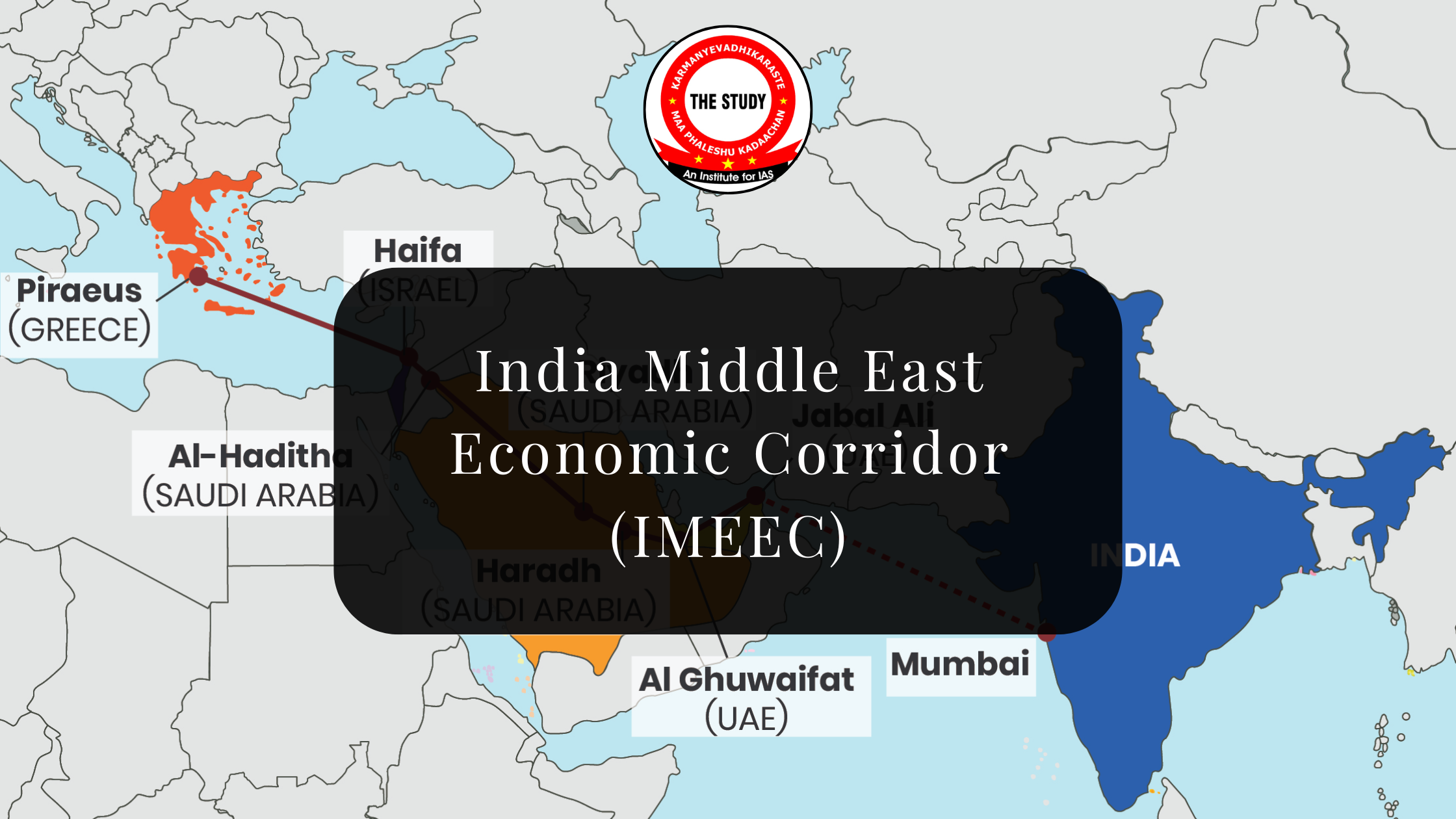
IMEC and the West Asia Crisis: Why India’s Trade Route to Europe Faces a Strategic Roadblock
The India-Middle East-Europe Economic Corridor (IMEC) was projected as a major connectivity breakthrough for India’s trade with Europe. Announced during the G20 Summit in New Delhi in September 2023, IMEC aims to connect India with the Gulf, West Asia and Europe through a combination of maritime routes, railways, roads, energy links and digital connectivity. The official IMEC framework includes an Eastern Corridor connecting India to the Gulf and a Northern Corridor connecting the Gulf to Europe.
However, the recent Iran crisis and wider West Asian instability have created serious concerns for India’s IMEC ambitions. The crisis has increased shipping risks, delayed infrastructure planning, complicated diplomatic negotiations and weakened confidence in long-term trade corridors passing through the region.
What is IMEC?
The India-Middle East-Europe Economic Corridor, commonly known as IMEC, is a proposed connectivity project designed to strengthen trade and economic integration between India, the Gulf region and Europe.
It is expected to include:
- Maritime connectivity
- Railway networks
- Road transport routes
- Energy infrastructure
- Digital connectivity
- Logistics and trade facilitation systems
The corridor is divided into two major parts: the Eastern Corridor, connecting India to the Gulf, and the Northern Corridor, connecting the Gulf to Europe.
Why is IMEC Important for India?
IMEC is important because it gives India a strategic trade route to Europe that can reduce logistics costs, improve export competitiveness and strengthen India’s position in global supply chains.
According to an official Indian government statement, IMEC could reduce logistics costs by up to 30% and transportation time by up to 40%.
Strategic Importance for India
IMEC can help India:
- Improve trade connectivity with Europe
- Reduce excessive dependence on traditional maritime routes
- Strengthen relations with Gulf countries
- Expand access to European markets
- Build resilient supply chains
- Counter China’s Belt and Road Initiative through a democratic connectivity alternative
Why Has the West Asia Crisis Affected IMEC?
The West Asia crisis has affected IMEC because the corridor depends heavily on political stability, port security, railway development, cross-border coordination and investor confidence in the region.
IMEC is not just a trade route. It is an infrastructure-heavy geopolitical project. Any conflict in West Asia can delay financing, planning, execution and operational trust.
Strait of Hormuz Disruption and Regional Shipping Risk
The Strait of Hormuz is one of the world’s most important energy and trade chokepoints. Recent reports indicate that the Iran crisis has severely affected navigation and shipping confidence in the region. Reuters reported that the Strait of Hormuz has seen restricted movement and severe shipping uncertainty amid the Iran conflict.
This affects IMEC in two ways.
First, Gulf economies such as the UAE and Saudi Arabia are key IMEC partners. Any regional shipping crisis increases risk perception around ports, logistics hubs and trade infrastructure.
Second, even if every IMEC segment does not physically pass through Hormuz, the broader regional crisis increases insurance costs, energy costs, freight uncertainty and investor hesitation.
Important Correction for Publication
It is safer not to write that the entire IMEC route is directly blocked by the Strait of Hormuz. The accurate framing is that the Hormuz crisis increases regional shipping and infrastructure risk for Gulf-linked connectivity projects, including IMEC.
Infrastructure Development Gets Delayed
IMEC requires massive infrastructure coordination across multiple countries. This includes rail connectivity, port upgrades, logistics parks, customs systems, digital networks and energy infrastructure.
During war or crisis, governments prioritise security over infrastructure expansion. Investors also become cautious because long-term returns depend on stability.
This creates delays in:
- Feasibility studies
- Financing arrangements
- Cross-border rail planning
- Port capacity expansion
- Customs coordination
- Private-sector participation
The India-Italy Joint Declaration in May 2026 reaffirmed commitment to IMEC and called for concrete steps through the first IMEC Ministerial meeting in 2026. This shows that the project remains alive, but the crisis has made execution more complicated.
INSTC as an Alternative Also Faces Iran-Linked Risks
The International North-South Transport Corridor (INSTC) is often discussed as an alternative or complementary route to IMEC. INSTC connects India with Iran, Central Asia, Russia and Europe through a multimodal network.
However, INSTC also faces a problem: Iran is central to the corridor. India’s Ministry of External Affairs has described INSTC as an important initiative involving India, Russia and Iran.
This means that when Iran becomes the centre of a regional crisis, INSTC also faces operational and diplomatic complications.
Why INSTC Cannot Fully Replace IMEC
INSTC is important, but it cannot fully replace IMEC because:
- It depends heavily on Iran.
- It faces sanctions-related constraints.
- It connects India more strongly with Russia and Central Asia than with the Gulf-Europe economic axis.
- It has different geopolitical implications.
- Its expansion becomes difficult when Iran is under military or diplomatic pressure.
Therefore, India needs both corridors, but neither can remain insulated from West Asian instability.
Nuclear Negotiations and Diplomatic Deadlock
The Iran crisis is also linked to disputes over Iran’s nuclear programme. The issue should be framed carefully.
The publication-safe version is this: the core dispute is not Iran “ceding nuclear warheads.” The verified concern is Iran’s nuclear enrichment, uranium stockpile, inspection access and weaponisation risk. Reuters has reported that recent US-Iran discussions have focused on Iran’s highly enriched uranium stockpile and nuclear programme safeguards.
Why This Matters for IMEC
If nuclear negotiations fail, the region remains unstable. That affects:
- Gulf security
- Israel-Iran tensions
- US military posture
- Shipping routes
- Oil prices
- Investor confidence
- Long-term infrastructure corridors like IMEC
A corridor like IMEC cannot move at full speed when key regional actors are in conflict or preparing for escalation.
Israel-Iran Hostility and Regional Volatility
Israel and Iran remain locked in a deep strategic rivalry. This rivalry affects the entire West Asian security environment.
For IMEC, this matters because Israel is expected to be a crucial link in the northern corridor connecting the Gulf to Europe. If Israel remains in an active conflict environment, IMEC’s European connection becomes harder to operationalise.
Impact on Trade Aspirations
India’s trade aspirations are affected because businesses need predictable routes. Exporters, logistics firms and investors avoid corridors where war risk, insurance costs and route uncertainty are high.
Even a technically viable corridor becomes commercially unattractive if the surrounding security environment is unstable.
American Positioning and Regional Power Politics
The United States is one of the key supporters of IMEC. IMEC also fits into the larger US strategy of building alternative connectivity frameworks that reduce dependence on China-led infrastructure networks.
However, the US is also deeply involved in West Asian security politics. Its approach toward Iran, Israel, Gulf allies and maritime security directly shapes the environment in which IMEC develops.
When US-Iran tensions rise, IMEC becomes exposed to broader power competition.
Why This Creates a Strategic Problem for India
India wants IMEC for trade, logistics and economic connectivity. But the corridor runs through a region where the US, Iran, Israel, Saudi Arabia and other actors are involved in overlapping security rivalries.
This creates a strategic dilemma for India: the corridor is economically attractive but geopolitically fragile.
How the Crisis Affects India’s Trade Aspirations
The West Asia crisis affects India’s trade aspirations in multiple ways.
Higher Logistics Costs
War risk increases freight rates, insurance premiums and route uncertainty. This reduces the cost advantage IMEC was expected to provide.
Delayed Export Competitiveness Gains
IMEC was expected to help Indian exporters reach Europe faster. If the corridor is delayed, those gains also get delayed.
Weaker Investor Confidence
Private investors and logistics companies need political certainty before committing capital to long-term infrastructure.
Risk to Energy and Supply Chains
West Asia remains critical for energy flows. Any escalation can raise crude oil prices and increase India’s import bill.
Diplomatic Balancing Pressure
India has strong ties with the Gulf, Israel, Iran, Europe and the US. A prolonged regional crisis forces India to balance all sides carefully.
Why IMEC Still Matters Despite the Crisis
The crisis does not make IMEC irrelevant. In fact, it proves why resilient trade corridors are necessary.
IMEC remains important because it can:
- Strengthen India-Europe trade
- Build India-Gulf economic integration
- Improve supply-chain resilience
- Support energy and digital connectivity
- Reduce dependence on traditional chokepoints
- Enhance India’s strategic role in global connectivity
The issue is not whether India needs IMEC. The issue is how to make IMEC viable in a conflict-prone region.
Way Forward for India
India needs a realistic and layered strategy.
Build Multiple Trade Corridors
India should not depend only on IMEC or INSTC. It should develop multiple routes across the Gulf, Central Asia, Europe, Africa and maritime Asia.
Strengthen Gulf Partnerships
India must continue deepening ties with the UAE and Saudi Arabia because they are central to IMEC’s success.
Keep Iran Engagement Open
Even while working on IMEC, India cannot ignore Iran because of INSTC, Chabahar and Central Asian connectivity.
Push for Infrastructure Resilience
IMEC must be designed with alternative ports, backup routes, digital tracking systems and crisis-response logistics.
Maintain Strategic Autonomy
India should avoid being locked into any one bloc. Its connectivity strategy must remain trade-first, security-aware and diplomatically balanced.
Common Mistakes to Avoid
Calling IMEC Fully Operational
IMEC is not fully operational. It is still in planning, coordination and development stages.
Treating Hormuz as the Only Risk
The Strait of Hormuz is important, but IMEC’s crisis is broader. It includes Israel-Iran tensions, Gulf security, financing, diplomatic trust and infrastructure uncertainty.
Saying Iran Has Nuclear Warheads
This is not publication-safe. The issue should be described as Iran’s nuclear programme, uranium enrichment, stockpile and inspection-related concerns.
Treating INSTC as a Clean Alternative
INSTC is useful, but it is not free from risk because Iran is central to the route.
Ignoring India’s Diplomatic Balancing
India has stakes with all sides: Gulf countries, Israel, Iran, Europe and the US. This makes the issue complex.
Expert Insights
IMEC is a high-value but high-risk corridor. Its promise lies in faster India-Europe trade, lower logistics cost and stronger Gulf integration. Its weakness lies in geography: it depends on a region where trade routes, ports, pipelines and rail networks can quickly become strategic targets.
India’s best approach is not to abandon IMEC but to de-risk it. That means building parallel routes, keeping INSTC alive, strengthening maritime capacity, maintaining Gulf partnerships and avoiding overdependence on any single corridor.
Key Takeaways
- IMEC is a proposed multimodal corridor connecting India, the Middle East and Europe.
- The corridor was announced at the 2023 G20 Summit in New Delhi.
- IMEC signatories include India, the UAE, Saudi Arabia, the EU, France, Germany, Italy and the United States.
- West Asian instability directly affects IMEC because key corridor partners are located in the Gulf and Eastern Mediterranean region.
- The Strait of Hormuz crisis has raised shipping, insurance, energy and infrastructure risks.
- INSTC is an alternative route, but Iran’s role in the corridor makes it vulnerable during the current crisis.
India’s trade aspirations need route diversification, diplomatic balancing and infrastructure resilience.
Conclusion
The West Asia crisis has exposed the strategic vulnerability of IMEC. India’s proposed trade route to Europe depends on a region where conflict, nuclear negotiations, maritime security and great-power politics directly affect infrastructure development.
However, IMEC remains strategically important for India. It can improve trade with Europe, deepen Gulf partnerships and strengthen India’s role in global connectivity.
The real task for India is not to choose between IMEC and INSTC, but to build a diversified corridor strategy. In an unstable global order, the country with multiple routes, flexible diplomacy and resilient infrastructure will have the real trade advantage.
FAQs
What is IMEC?
IMEC stands for India-Middle East-Europe Economic Corridor. It is a proposed multimodal trade and connectivity corridor linking India with the Gulf, West Asia and Europe through maritime, rail, road, energy and digital infrastructure.
When was IMEC announced?
IMEC was announced during the G20 Summit in New Delhi in September 2023. It was launched as a major connectivity initiative involving India, Gulf countries, Europe and the United States.
Why is the West Asia crisis affecting IMEC?
The West Asia crisis is affecting IMEC because the corridor depends on regional stability, secure shipping routes, investor confidence, port infrastructure and cross-border coordination among Gulf and Eastern Mediterranean countries.
Does the Strait of Hormuz directly block IMEC?
Not necessarily. The safer view is that the Hormuz crisis increases regional shipping and infrastructure risk. It affects Gulf-linked trade confidence, insurance costs and logistics planning, even if every IMEC segment does not physically pass through Hormuz.
What is the alternative to IMEC?
The International North-South Transport Corridor, or INSTC, is often seen as an alternative or complementary route. It connects India with Iran, Russia, Central Asia and Europe through a multimodal network.
Why is INSTC also affected by the Iran crisis?
INSTC is affected because Iran is a central country in the corridor. Any sanctions, war risk, port disruption or diplomatic pressure on Iran can affect the route’s expansion and reliability.
Why is IMEC important for India?
IMEC is important because it can reduce logistics costs, improve India-Europe trade, strengthen India-Gulf economic ties and enhance India’s role in global supply chains.
What should India do to protect its trade aspirations?
India should build multiple trade corridors, strengthen Gulf partnerships, keep engagement with Iran open, develop alternative ports and maintain strategic autonomy in West Asian diplomacy.
Related posts :
- Majoritarianism vs Constitutionalism
- India-Bangladesh Ties
- Nordic Countries and India
- Tackling Ocean Plastic Pollution
- India-Bhutan Ties
- India-UAE Ties
- India-Netherlands Ties
- Captagon: The “Jihadi Drug”
- Bioenergy Systems
- Transforming the Brahmaputra
- India–Africa Forum Summit
- India–US Defence Ties
Subscribe to our YouTube Channel for more Valuable Content – TheStudyias
Download the App to Subscribe to our Courses –Thestudyias
The Source’s Authority and Ownership of the Article is Claimed By THE STUDY IAS BY MANIKANT SINGH
Comments (0)
Leave a Comment