How to prepare indian History Through Themes instead of chronology
19 Sept 2026
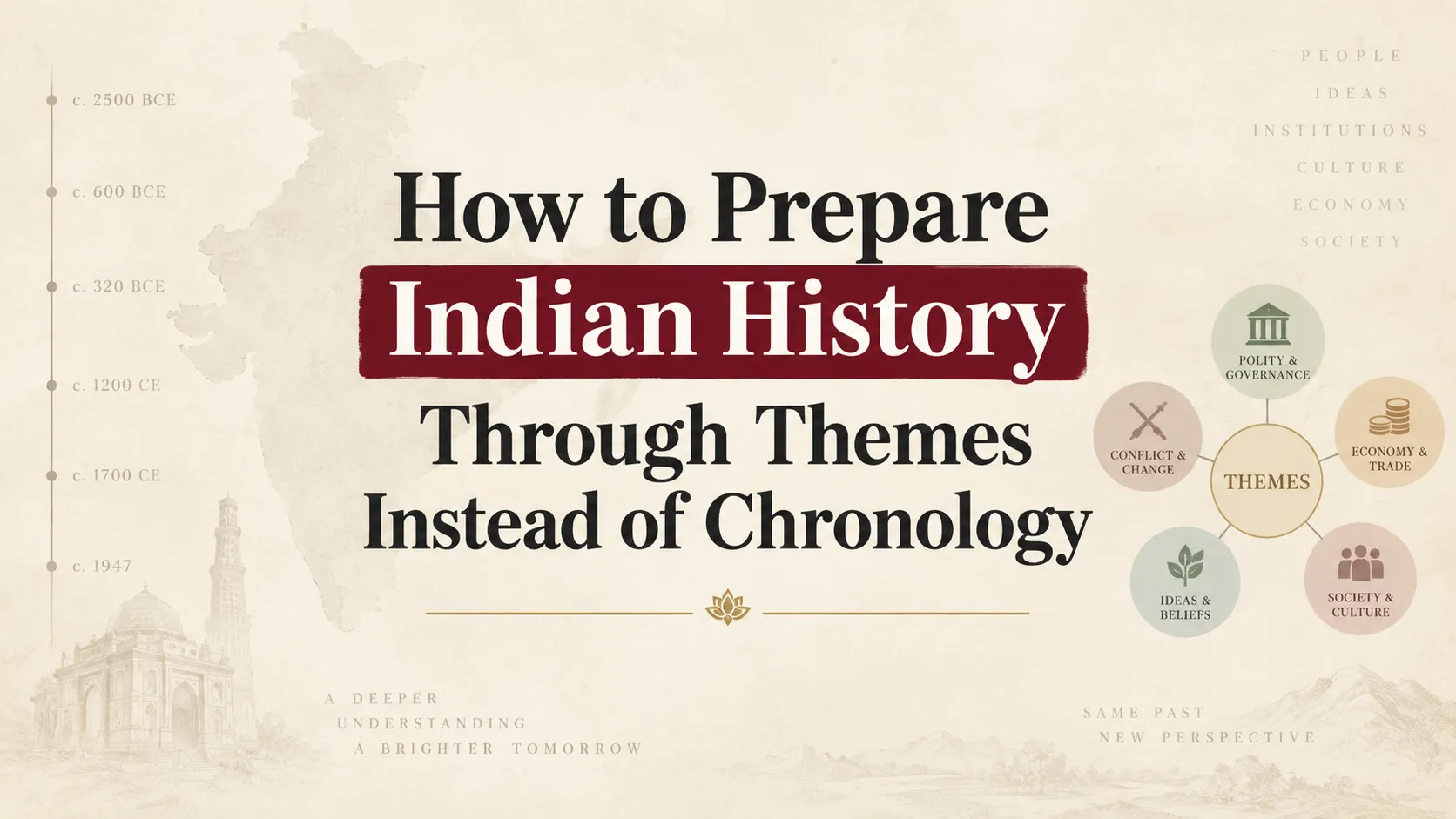
How to prepare indian History Through Themes instead of chronology
For many aspirants , medieval indian history can gradually become one of the more complex areas of history preparation
The difficulty is not limited to remembering rulers and dynasties .An aspirant also has to understand political developments , social conditions, economic systems , literature, reliogious movements etc and the changes that took place across different periods .
Another challenge is chronology . Students often try to remeber when a particular ruler ruled , what happened during that period , and how those events relate to developments under other dynasties.
When all of this information is studied only as a long sequence of events, it can become difficult to connect and revise.
This is where thematic approch to Medieval History can help . Instead of studying every dynasty as an isolated unit.
Why is medieval indian History Difficult to prepare ?
Medieval indian History contains several interconnected dimensions .An Aspirant may have to study :
Political and administrative developments
Social structures and changes
Economics activities and revenue systems
Religious movements and traditions
Art and Architecture
Literature and languages
Science and technology
Trade , agriculture and urban development
The challenge becomes greater when these developments have to be remembered along with their respective periods and historical contexts .
For example , While studying a particular dynasty , an aspirant may separately make notes on its administration , economy, society, religion and cultural developments.
This can result in a large amount of information being stored separately rather than being connected through broader themes.
What Is the Thematic Approach to Medieval History?
A thematic approach means organising historical information around broad subjects rather than studying every ruler or dynasty as a completely separate unit.
For example, Medieval Indian History can be organised into themes such as:
Political and administrative history
Economic history
Social history
Religious developments
Art and culture
Literature
Science and technology
Agriculture and trade
The purpose is not to abandon chronology. Instead, chronology and themes can be used together.
Chronology helps answer: “When did it happen?”
Thematic study helps answer: “What developed, how did it change, and how does it compare with developments in other periods?”
This combination can make revision more structured and help aspirants identify connections across different periods.
How to Prepare Medieval Indian History Through Themes
1. Build a Basic Chronological Framework First
Chronology remains important for understanding history.
Before creating detailed thematic notes, aspirants should develop a broad timeline of major periods, dynasties, rulers and important developments. The objective at this stage is not to memorise every date.
Instead, the aspirant should know the broad historical sequence.
Once this framework is clear, thematic notes can be placed within the correct historical context.
For example:
Timeline → Dynasty/Period → Theme → Major Development
This prevents thematic preparation from becoming disconnected from chronology.
2. Divide Medieval History Into Major Themes
After creating a basic timeline, divide the subject into broad themes.
For example:
Political and Administrative History
Administration
Military organisation
State formation
Governance
Economic History
Agriculture
Land revenue
Trade
Markets
Crafts and production
Social History
Social structure
Caste and community
Gender relations
Everyday life
Create Theme-Wise Notes Across Medieval Periods
This is where the thematic approach becomes particularly useful.
Suppose the theme is Literature. Instead of keeping literary developments scattered across separate dynasty-wise notebooks, an aspirant can organise relevant developments period-wise under the same theme.
For example:
Literature → Historical Period → Language/Tradition → Important Works or Authors → Major Developments
The same method can be applied to other themes.
For Economy, notes can be organised around:
Agriculture → Revenue → Trade → Markets → Crafts → Urbanisation
For Architecture:
Period/Dynasty → Architectural features → Materials → Important structures → Regional characteristics
The exact categories may vary according to the topic, but the basic idea remains the same: bring related information together without losing its historical context.
Compare Medieval Dynasties and Historical Periods Theme-Wise
Theme-wise notes become more useful when they are used for comparison.
Instead of studying the administration of different dynasties independently, an aspirant can compare them under the same theme.
Connect Different Themes
History becomes easier to understand when themes are not treated as completely isolated categories.
For example:
Agricultural expansion → Production → Revenue collection → Markets → Urban development
Similarly, developments in religious traditions can be studied alongside changes in literature, language and cultural practices.
These connections can help an aspirant move beyond simple memorisation and understand how different aspects of historical development interacted with one another.
Use PYQs to Identify Important Themes
Previous Years' Questions (PYQs) can make thematic preparation more focused.
Instead of looking at a PYQ only as an individual question, ask:
“Which broader theme is this question testing?”
For example, a question related to architecture may also require understanding political patronage, regional developments or cultural interactions.
Similarly, a question on religious movements may have connections with social and cultural developments.
This approach helps aspirants organise their notes around concepts and recurring themes rather than creating isolated answers for every questions
Revise Through Tables, Mind Maps and Short Notes :
Once the thematic notes are ready, revision becomes easier when information is converted into visual or compact formats.
Useful methods include:
One-page revision sheets
Comparison tables
Mind maps
Flowcharts
Theme-wise timelines
Short factual notes
For example, an architecture mind map could follow this structure:
Architecture → Period → Features → Materials → Important Examples → Regional Variations
Chronology vs Thematic Approach: Which One Should You Use?
The choice does not have to be between chronology and thematic study.
Both approaches serve different purposes.
Conclusion :
Preparing Medieval Indian History does not have to mean memorising a long list of rulers, dates and isolated events. A thematic approach can help aspirants organise information around broader areas such as administration, economy, society, religion, literature and art and culture.
However, thematic preparation should not replace chronology. Chronology provides the historical framework, while themes help aspirants organise, compare and connect developments across different periods.
FAQs: Prepare indian History Through Themes instead of chronology
Q.1 Is a thematic approach better than chronological study for Medieval Indian History?
They serve different purposes. Chronology helps establish the sequence and context of historical developments, while thematic study helps organise, compare and connect developments across different periods. Using both together can provide a more structured approach.
Q.2 What are the major themes in Medieval Indian History?
Important themes can include political and administrative history, economy, society, religion, art and culture, literature, science and technology, agriculture and trade.
Q.3 Should beginners use a thematic approach?
Yes, but beginners should first develop a basic understanding of the chronological framework. Theme-wise preparation becomes more meaningful when the student knows the broad sequence of historical periods.
Q.4 How can PYQs help with thematic preparation?
PYQs can help aspirants identify broader areas that require deeper understanding. Instead of preparing every question separately, students can identify the theme behind a question and add relevant information to their thematic notes.