Gandhi-Irwin Pact (1931): Background, Terms, Significance and Criticism
20 Nov 2026
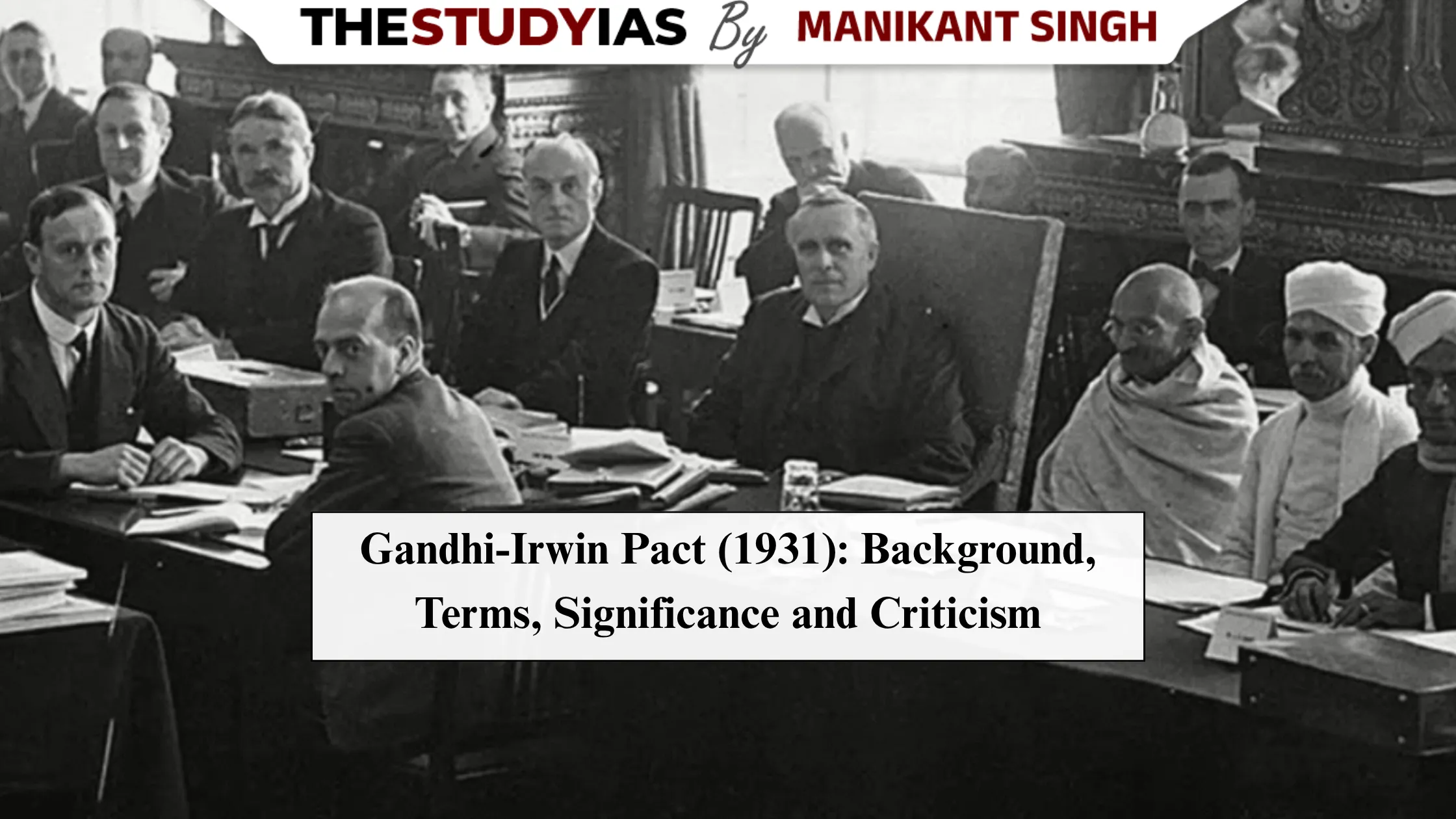
Gandhi-Irwin Pact (1931): Background, Terms, Significance and Criticism
The Gandhi-Irwin Pact of 1931 was an important turning point in India's freedom struggle, marking a temporary truce between the Indian National Congress and the British colonial government. Signed between Mahatma Gandhi and Lord Irwin, the agreement brought the Civil Disobedience Movement to a temporary halt and opened the door for Congress participation in the Second Round Table Conference in London.
The pact reflected the British government's willingness to negotiate with the nationalist leadership amid growing political mobilisation, while Gandhi sought concessions for political prisoners, civil liberties and the continuation of peaceful political activity. However, the agreement also generated criticism, particularly over the limited nature of the concessions and the fate of revolutionary prisoners.
Background of the Gandhi-Irwin Pact
The Gandhi-Irwin Pact emerged against the backdrop of the Civil Disobedience Movement, which began in 1930 following the Indian National Congress's declaration of Purna Swaraj (Complete Independence) as its goal.
At the Lahore Session of the Indian National Congress in December 1929, under the presidency of Jawaharlal Nehru, the Congress formally adopted the demand for complete independence. Subsequently, Mahatma Gandhi launched the Civil Disobedience Movement in March 1930 with the Dandi March, challenging the British monopoly over salt.
The movement witnessed widespread participation across India. People broke salt laws, boycotted foreign goods, refused to pay certain taxes and participated in demonstrations against colonial authority. The British government responded with arrests, repression and restrictions on political activities. Gandhi and several Congress leaders were imprisoned.
Meanwhile, the British government had convened the First Round Table Conference (1930) in London to discuss constitutional reforms. However, the Indian National Congress did not participate, making the conference less representative of India's nationalist political aspirations. As the movement continued and the political situation became increasingly difficult to manage, the British government recognised the need for negotiations with Congress leadership.
These developments eventually led to discussions between Mahatma Gandhi and Viceroy Lord Irwin, culminating in the Gandhi-Irwin Pact on 5 March 1931.
What Was the Gandhi-Irwin Pact?
The Gandhi-Irwin Pact was a political agreement signed on 5 March 1931 between Mahatma Gandhi, representing the Indian National Congress, and Lord Irwin, the Viceroy of India.
The agreement was intended to resolve the immediate political confrontation between the Congress and the British government arising from the Civil Disobedience Movement. It established a framework for the suspension of the movement and the participation of Congress in the Second Round Table Conference. The pact was not an agreement granting independence to India. Instead, it was a negotiated settlement involving reciprocal commitments by the Congress and the British government.
Major Terms of the Gandhi-Irwin Pact
The Gandhi-Irwin Pact involved commitments from both the British government and the Indian National Congress.
Concessions Made by the British Government
The British government agreed to several concessions intended to ease political repression and facilitate the return of Congress to constitutional negotiations.
Release of political prisoners: The government agreed to release prisoners detained for participation in the Civil Disobedience Movement, subject to the condition that they had not been convicted of violent offences.
Withdrawal of prosecutions: The government agreed to withdraw certain prosecutions related to the movement where applicable.
Return of confiscated property: Confiscated property that had not been sold was to be restored to its original owners, subject to the terms of the agreement.
Permission to make salt: People living in coastal areas were permitted to manufacture salt for personal use, subject to conditions and regulations.
Permission for peaceful picketing: Peaceful picketing of liquor shops and foreign cloth shops was permitted, provided it did not involve intimidation or coercion.
Relaxation of restrictions: Certain restrictions imposed during the movement were to be withdrawn as part of the settlement.
Commitments Made by the Indian National Congress
The Congress also agreed to certain commitments as part of the negotiated settlement.
Suspension of the Civil Disobedience Movement: The Congress agreed to suspend the movement.
Participation in the Second Round Table Conference: Gandhi agreed to represent the Congress at the Second Round Table Conference in London.
Withdrawal of boycott activities: The Congress agreed to discontinue certain forms of boycott and civil disobedience associated with the movement.
The pact was therefore a reciprocal arrangement in which the Congress suspended mass civil disobedience in return for specific concessions and the opportunity to participate in constitutional negotiations.
Significance of the Gandhi-Irwin Pact
Recognition of the Indian National Congress as a Negotiating Force
One of the most important outcomes of the pact was the recognition of the Indian National Congress as a major political force with which the British government had to negotiate. The agreement demonstrated that mass mobilisation and organised political resistance could compel the colonial government to engage directly with nationalist leadership.
Temporary End to the Civil Disobedience Movement
The pact resulted in the temporary suspension of the Civil Disobedience Movement. This created a political opening for dialogue between the Congress and the British government, although it did not resolve the fundamental conflict over India's independence.
Congress Participation in the Second Round Table Conference
The pact enabled the Indian National Congress to participate in the Second Round Table Conference (1931) in London, with Mahatma Gandhi representing the organisation. This was significant because Congress had boycotted the First Round Table Conference. Its participation in the second conference reflected the importance of nationalist representation in discussions concerning India's constitutional future.
Political Prisoners and Civil Liberties
The agreement brought relief to many political prisoners and helped restore certain political activities, including peaceful picketing. Although the concessions were limited, they provided some relief from the repression associated with the Civil Disobedience Movement.
Demonstration of Gandhian Negotiation Strategy
The pact reflected Gandhi's approach of combining mass mobilisation with negotiations. It demonstrated that civil resistance could be used not only to challenge colonial authority but also to create conditions for political dialogue.
Criticism of the Gandhi-Irwin Pact
Despite its significance, the Gandhi-Irwin Pact faced considerable criticism from nationalist groups, revolutionaries and sections of the public.
Failure to Secure Complete Independence
The pact did not secure the demand for Purna Swaraj. The British government made limited concessions but did not commit to granting complete independence or establish a definitive framework for ending colonial rule. This led critics to argue that the Congress had suspended a powerful mass movement without achieving its central political objective.
Controversy over Bhagat Singh, Rajguru and Sukhdev
One of the most significant criticisms of the pact concerned the failure to secure the commutation of the death sentences of Bhagat Singh, Rajguru and Sukhdev. The three revolutionaries were sentenced to death in the Lahore Conspiracy Case and were executed on 23 March 1931, shortly after the pact was signed.
Many nationalist youth and supporters of revolutionary nationalism expected Gandhi to make the commutation of their sentences a condition of the agreement. The failure to secure this outcome generated widespread disappointment and criticism. However, the issue was not formally included as a binding condition of the pact, and Gandhi's negotiations did not result in the British government's decision to commute their sentences.
Limited Nature of British Concessions
The concessions made by the British government were largely restricted to the immediate political situation. The agreement did not fundamentally alter the colonial constitutional structure, British control over governance or the broader economic and political conditions of colonial rule. Critics therefore viewed the pact as a temporary compromise rather than a substantial victory for the nationalist movement.
Disappointment among Some Nationalist Groups
Sections of the nationalist movement, including some revolutionary groups and younger Congress supporters, felt that the agreement represented an insufficient compromise. They believed that the movement's momentum had been weakened by its suspension without achieving independence. The pact also highlighted differences within the nationalist movement regarding the balance between negotiations, mass mobilisation and revolutionary action.
Outcome of the Gandhi-Irwin Pact
Following the signing of the pact, the Civil Disobedience Movement was suspended, and Gandhi travelled to London to participate in the Second Round Table Conference in 1931. However, the conference failed to achieve a meaningful agreement on India's constitutional future. Differences over representation, minority safeguards, federal arrangements and the extent of political autonomy prevented a consensus.
After Gandhi returned to India, political tensions increased again. The British government adopted a more repressive approach, and the Civil Disobedience Movement was relaunched in 1932. Gandhi and other Congress leaders were again arrested, marking the breakdown of the temporary settlement. The pact, therefore, did not end the freedom struggle, but it represented an important phase in the relationship between mass nationalist mobilisation and negotiations with the colonial government.
Conclusion
The Gandhi-Irwin Pact was a significant political development in India's freedom struggle. Although it did not secure independence or resolve the fundamental constitutional conflict between India and Britain, it demonstrated the political influence of the Civil Disobedience Movement and the importance of the Indian National Congress in negotiations with the colonial state.
The agreement reflected Gandhi's strategy of combining peaceful resistance with negotiation. Its limitations, particularly the failure to secure major constitutional concessions and the controversy surrounding Bhagat Singh's execution, also revealed the complexities and differing expectations within the nationalist movement.
For the UPSC Civil Services Examination, the Gandhi-Irwin Pact is important for understanding the relationship between mass movements, constitutional negotiations, Gandhian strategy and the evolution of India's freedom struggle.
UPSC Prelims Practice Questions
Q1. Consider the following statements regarding the Gandhi-Irwin Pact:
It was signed on 5 March 1931.
The Indian National Congress agreed to participate in the Second Round Table Conference.
The British government agreed to grant complete independence to India under the pact.
Which of the statements given above is/are correct?
(A) 1 and 2 only
(B) 2 and 3 only
(C) 1 and 3 only
(D) 1, 2 and 3
Q2. With reference to the Gandhi-Irwin Pact, consider the following:
Gandhi agreed to suspend the Civil Disobedience Movement.
The British government agreed to release political prisoners convicted of violent offences.
The agreement permitted people in coastal areas to manufacture salt for personal use, subject to conditions.
Which of the statements is/are correct?
(A) 1 and 3 only
(B) 1 and 2 only
(C) 2 and 3 only
(D) 1, 2 and 3
Q3. The Gandhi-Irwin Pact is most closely associated with which of the following developments in the Indian National Movement?
(A) Launch of the Quit India Movement
(B) Suspension of the Civil Disobedience Movement and participation in the Second Round Table Conference
(C) Acceptance of the Cabinet Mission Plan
(D) Formation of the Interim Government
Q4. Consider the following statements:
The First Round Table Conference was attended by the Indian National Congress.
Gandhi represented the Indian National Congress at the Second Round Table Conference.
The Gandhi-Irwin Pact was signed before the Second Round Table Conference.
Which of the statements given above is/are correct?
(A) 2 and 3 only
(B) 1 and 2 only
(C) 1 and 3 only
(D) 1, 2 and 3
Q5. Which of the following was NOT a provision associated with the Gandhi-Irwin Pact?
(A) Withdrawal of certain prosecutions related to the Civil Disobedience Movement
(B) Permission for peaceful picketing
(C) Restoration of confiscated property that had not been sold
(D) Acceptance of the demand for Purna Swaraj by the British government
UPSC Mains Practice Questions
GS Paper 1 - Modern Indian History
10 Marks | 150 Words
Explain the circumstances that led to the signing of the Gandhi-Irwin Pact of 1931.
Discuss the major terms of the Gandhi-Irwin Pact and their implications for the Civil Disobedience Movement.
The Gandhi-Irwin Pact represented a tactical compromise rather than a decisive political victory. Discuss.
15 Marks | 250 Words
Critically examine the significance and limitations of the Gandhi-Irwin Pact in the Indian freedom struggle.
How did the Gandhi-Irwin Pact reflect the changing relationship between mass mobilisation and constitutional negotiations during India's freedom struggle?
The Gandhi-Irwin Pact demonstrated both the political strength of Gandhian movements and the limitations of negotiations under colonial rule. Analyse.
Frequently Asked Questions (FAQs)
When was the Gandhi-Irwin Pact signed?
The Gandhi-Irwin Pact was signed on 5 March 1931 between Mahatma Gandhi and Lord Irwin, the Viceroy of India.
Why was the Gandhi-Irwin Pact signed?
It was signed to end the immediate political confrontation arising from the Civil Disobedience Movement, secure certain concessions from the British government and facilitate Congress participation in the Second Round Table Conference.
What were the major terms of the Gandhi-Irwin Pact?
The British government agreed to release certain political prisoners, restore confiscated property that had not been sold, permit limited salt manufacture in coastal areas and allow peaceful picketing. Congress agreed to suspend the Civil Disobedience Movement and participate in the Second Round Table Conference.
Did the Gandhi-Irwin Pact achieve India's independence?
No. The pact did not grant independence or establish a binding commitment to complete independence. It was a temporary political settlement between Congress and the British government.
Why was the Gandhi-Irwin Pact criticised?
It was criticised for its limited concessions, failure to secure independence and failure to obtain the commutation of the death sentences of Bhagat Singh, Rajguru and Sukhdev.
What was the outcome of the Gandhi-Irwin Pact?
It led to the temporary suspension of the Civil Disobedience Movement and Congress participation in the Second Round Table Conference. The conference failed to achieve a meaningful constitutional settlement, and the movement was subsequently relaunched in 1932.
Comments (0)
Leave a Comment