Dr Rajendra Prasad: First President of India, Life, Freedom Struggle and Legacy
20 Nov 2026
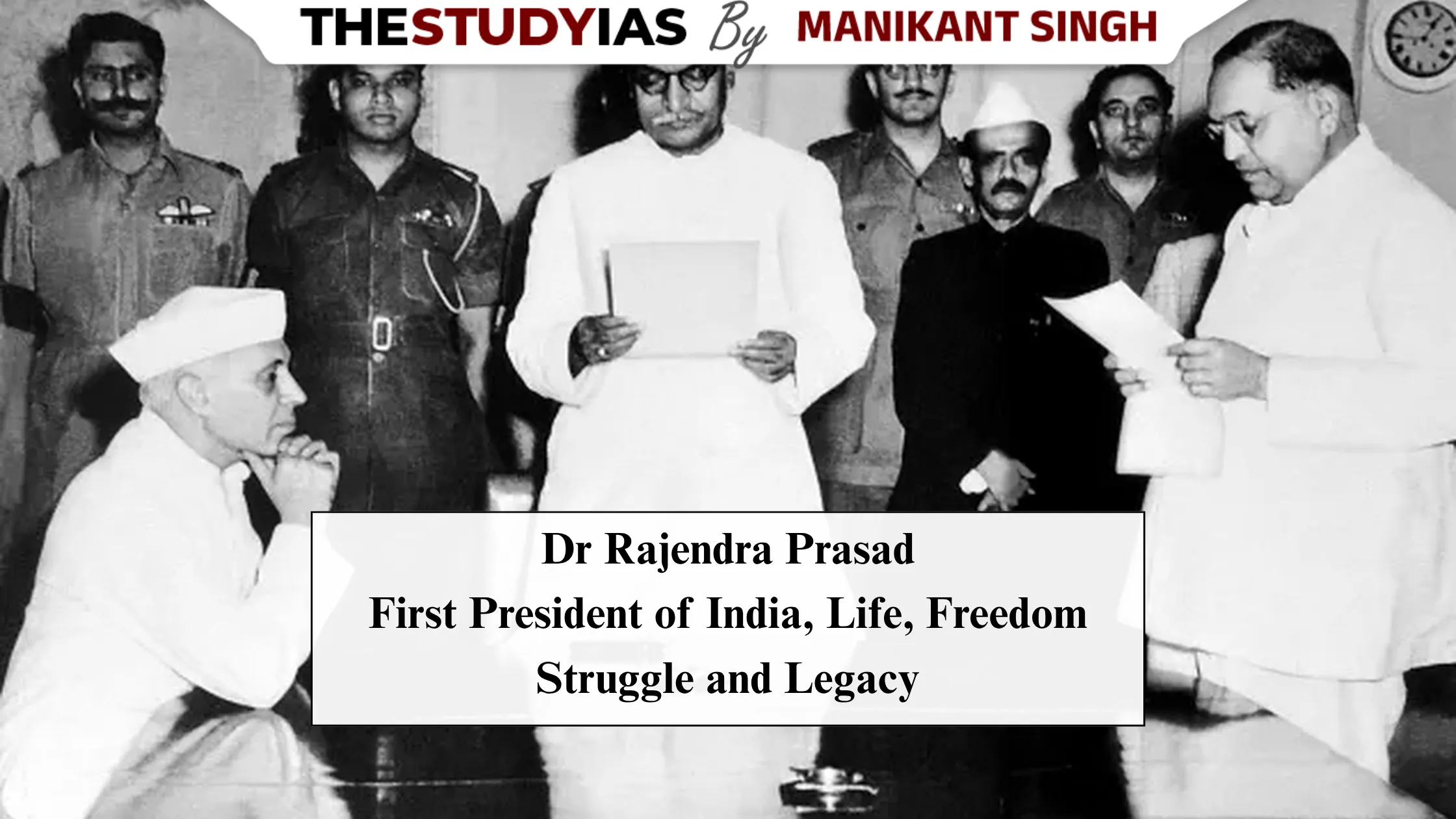
Dr Rajendra Prasad: First President of India, Life, Freedom Struggle and Legacy
Dr Rajendra Prasad occupies a distinctive place in India's political and constitutional history. As the first President of independent India, he helped shape the country's early constitutional institutions during a period marked by political transition, nation-building and the establishment of democratic governance. Beyond his presidency, he was a freedom fighter, lawyer, scholar and an influential figure in the Indian National Congress and the Constituent Assembly.
His life reflects the journey from the freedom struggle to the formation of the Republic of India, making him an important personality for understanding modern Indian history and India's constitutional development.
Early Life and Education
Dr. Rajendra Prasad was born on 3 December 1884 in Ziradei, Bihar, in a family that valued education, discipline and traditional learning. From an early age, he demonstrated exceptional academic ability, eventually becoming one of the most distinguished students of his generation.
He pursued higher education at the University of Calcutta and later developed a successful career in law. His legal training provided him with a strong foundation in reasoning, argumentation and public affairs. However, his professional success gradually took a backseat as he became increasingly drawn towards India's national movement. His educational journey and intellectual discipline helped shape his later role as a political leader, constitutional figure and public servant.
Dr. Rajendra Prasad and the Indian Freedom Struggle
Rajendra Prasad's involvement in India's freedom struggle became significantly deeper after his association with Mahatma Gandhi. The Champaran movement of 1917 proved to be a turning point in his political life.
Champaran Satyagraha and Association with Gandhi
During the Champaran Satyagraha of 1917, Gandhi mobilised support for indigo cultivators in Bihar who were subjected to exploitative agricultural arrangements under colonial rule. Rajendra Prasad joined Gandhi's efforts and witnessed the power of organised, peaceful resistance and grassroots mobilisation.
This experience influenced his political outlook and strengthened his commitment to public service. He increasingly adopted Gandhian methods, including non-violence, civil resistance and constructive social work.
Role in the Non-Cooperation Movement
During the Non-Cooperation Movement (1920–22), Rajendra Prasad supported Gandhi's call to boycott British institutions, promote indigenous products and encourage national education. He helped mobilise people in Bihar and gradually reduced his involvement in his legal profession to dedicate himself to the national cause.
His participation reflected the broader transformation of the Indian National Movement from an elite political campaign into a mass movement involving students, peasants and ordinary citizens.
Participation in the Civil Disobedience Movement
Rajendra Prasad also actively participated in the Civil Disobedience Movement, particularly during the Salt Satyagraha. In Bihar, he helped organise resistance to colonial salt laws and mobilised public participation in the movement.
His involvement in nationalist activities led to imprisonment at various stages of the freedom struggle. Through his organisational work, political leadership and commitment to Gandhian principles, he became an important figure within the Indian National Congress.
Leadership in the Indian National Congress
Rajendra Prasad emerged as an influential leader within the Indian National Congress. His political leadership, organisational ability and commitment to the nationalist cause earned him the confidence of fellow Congress leaders.
He presided over the 1934 Bombay session of the Indian National Congress. Following the resignation of Subhas Chandra Bose in 1939, Rajendra Prasad was again entrusted with the responsibility of leading the Congress during a politically challenging period.
His leadership was characterised by a relatively restrained political style, an emphasis on organisational unity and a strong commitment to the broader objectives of India's independence.
Role in the Constituent Assembly
One of the most significant contributions of Rajendra Prasad to India's constitutional history was his role as the President of the Constituent Assembly.
He was elected President of the Constituent Assembly in December 1946 and presided over its deliberations during the process of drafting the Constitution of India. The Assembly debated fundamental questions concerning democracy, federalism, fundamental rights, governance, representation and the institutional structure of the Indian state.
As President, Rajendra Prasad played an important role in conducting proceedings, maintaining parliamentary discipline and facilitating deliberations among members representing different political, social and ideological perspectives.
His role was institutionally different from that of the Drafting Committee Chairman, Dr. B. R. Ambedkar, who led the Drafting Committee responsible for preparing and refining the constitutional draft. Rajendra Prasad's contribution was primarily through his leadership and stewardship of the Constituent Assembly.
His presidency of the Assembly continued until the Constitution came into force on 26 January 1950, when India became a Republic.
Dr. Rajendra Prasad as the First President of India
26 January 1950 - 13 May 1962
On 26 January 1950, Dr. Rajendra Prasad became the first President of the Republic of India. His appointment marked the transition from colonial rule and the interim constitutional arrangements to a constitutional republic governed under the newly adopted Constitution. He served as President for two consecutive terms, from 1950 to 1962, becoming the only Indian President to serve two full terms in office.
As the constitutional head of state, he worked during the formative years of India's democratic institutions. His presidency coincided with the establishment of parliamentary democracy, the first general elections of 1951–52, the development of constitutional conventions and the consolidation of the new Republic.
His conduct in office reflected an emphasis on institutional dignity, constitutional responsibilities and restraint. In a newly established democratic system, the relationship between the President, Prime Minister and Parliament was still evolving. Rajendra Prasad's presidency contributed to the development of early constitutional practices.
Relationship with Jawaharlal Nehru
The relationship between Rajendra Prasad and Prime Minister Jawaharlal Nehru reflected the evolving nature of India's constitutional system. Both leaders had different perspectives on some political, social and constitutional matters, including aspects of reform and the role of the President.
Their interactions illustrated the importance of constitutional conventions, executive accountability and the distinction between the constitutional head of state and the elected government. The early years of the Republic helped establish the working relationship between the President and the Prime Minister within India's parliamentary framework.
Contribution to Nation-Building
Rajendra Prasad's contribution to India extended beyond the freedom struggle and the presidency. He was associated with public welfare, education, agricultural concerns and efforts to strengthen the country's social and economic foundations.
In 1946, he served in the Interim Government as Minister responsible for Food and Agriculture. During this period, food security and agricultural production were important national priorities, particularly given the challenges facing the country in the aftermath of colonial rule and wartime disruptions.
He supported efforts to improve agricultural production and encouraged the public to contribute towards addressing food shortages. His association with agriculture reflected the importance of food security in India's early nation-building agenda. His public life was also closely associated with educational initiatives, voluntary work and the broader Gandhian emphasis on self-reliance and community participation.
Books Written by Dr. Rajendra Prasad
Rajendra Prasad was also a prolific writer who documented his experiences, political observations and reflections on India's history and freedom struggle. His writings offer insights into the national movement, colonial policies and the political developments that shaped modern India.
Some of his notable works include:
India Divided - A detailed examination of the partition of India and the political developments associated with the demand for Pakistan.
Atmakatha - His autobiography, offering insights into his personal life, education, political journey and experiences during the freedom struggle.
Satyagraha at Champaran - An account of the Champaran movement and its significance in India's national struggle.
Mahatma Gandhi and Bihar: Some Reminiscences - Reflections on Gandhi's association with Bihar and the nationalist movement.
Bapu Ke Kadmon Mein - Writings and reflections associated with his relationship with Gandhi and the Gandhian movement.
His literary contributions make him an important source for understanding India's political history through the experiences of a leading participant in the national movement.
Awards and Recognition
In recognition of his contribution to the nation, Dr. Rajendra Prasad was awarded the Bharat Ratna in 1962, India's highest civilian honour. The award recognised his extraordinary contribution to India's freedom struggle, constitutional development and public service.
After completing his second term as President in 1962, he retired from public life and spent his final years at Sadaqat Ashram in Patna.
Death and Legacy
Dr. Rajendra Prasad passed away on 28 February 1963. His life remains an example of how education, political commitment, humility and public service can contribute to the development of a democratic nation. His legacy is particularly significant in three areas: India's freedom struggle, the leadership of the Constituent Assembly and the establishment of the constitutional office of the President during the early years of the Republic.
As India's first President, he helped establish the dignity and institutional character of the highest constitutional office. His two-term presidency also demonstrated the importance of continuity, constitutional responsibility and institutional stability in a newly independent country. Dr. Rajendra Prasad's contribution remains an important part of India's modern history and constitutional evolution.
Frequently Asked Questions (FAQs)
Who was Dr. Rajendra Prasad?
Dr. Rajendra Prasad was India's first President, a freedom fighter, lawyer, writer and President of the Constituent Assembly.
When did Dr. Rajendra Prasad become the first President of India?
He became the first President of India on 26 January 1950, when India became a Republic.
How long did Dr. Rajendra Prasad serve as President?
He served as President from 26 January 1950 to 13 May 1962, completing two consecutive terms.
What was Dr. Rajendra Prasad's role in the Constituent Assembly?
He served as the President of the Constituent Assembly and presided over its deliberations during the framing of the Constitution of India.
When did Dr. Rajendra Prasad receive the Bharat Ratna?
He received the Bharat Ratna in 1962.
Comments (0)
Leave a Comment