Deepfakes, Elections, and the Death of Truth: Can Indian Democracy Survive AI?
24 Aug 2026
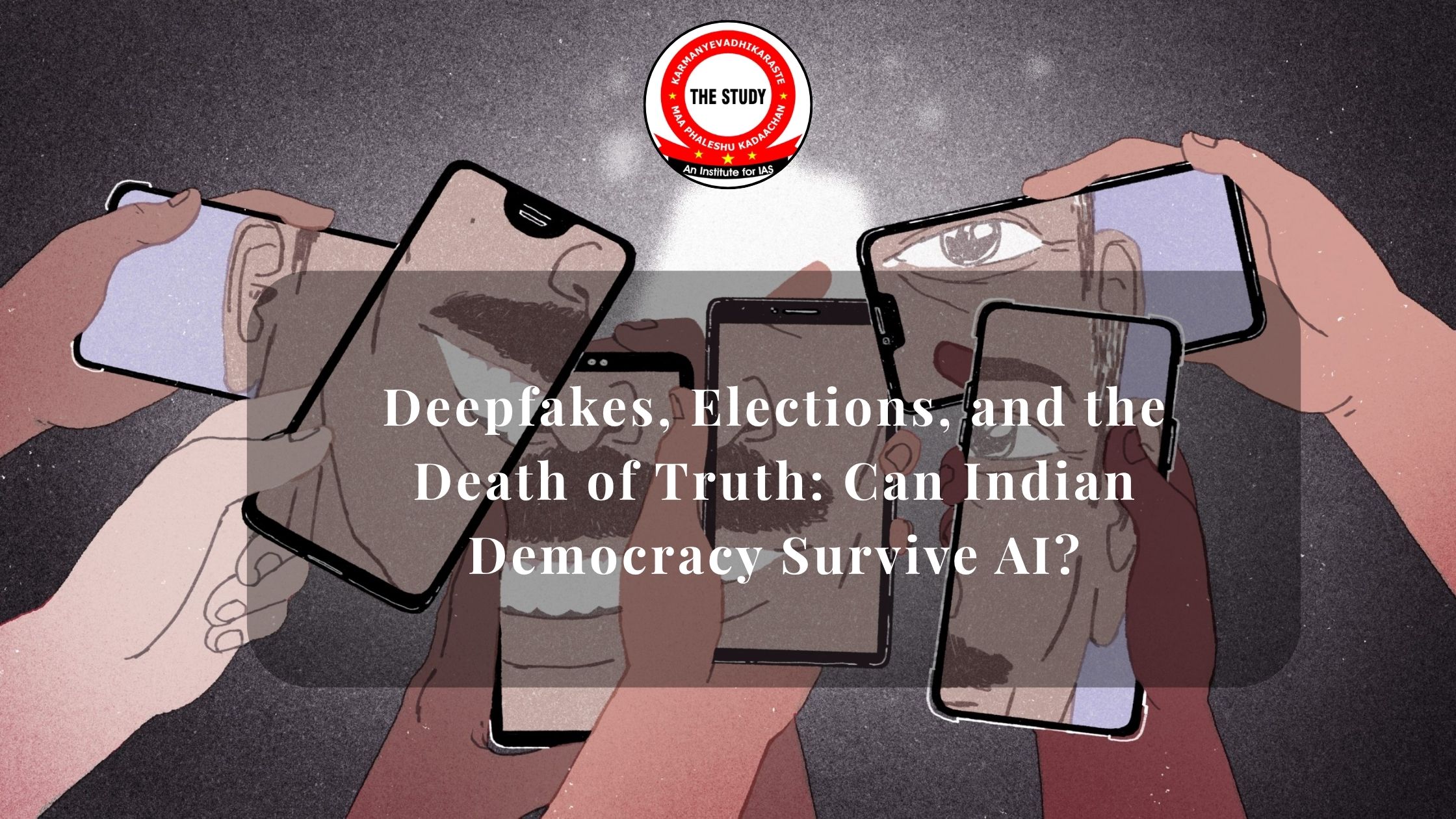
Deepfakes, Elections, and the Death of Truth: Can Indian Democracy Survive AI?
Introduction
Imagine a voter receiving a video in which a political leader appears to make a shocking statement. The face looks real. The voice sounds familiar. The background is authentic. Thousands of people have already shared it.
By the time anyone proves that the video was fabricated, the political damage may already be done.
This is the deeper danger of deepfakes. They do not merely create false information; they can destroy confidence in genuine information. In an election, where public opinion can shift rapidly, the time required to verify a claim may be far longer than the time required to make it viral.
India experienced growing concern over AI-generated political content during the 2024 Lok Sabha elections. The Election Commission subsequently advised political parties to avoid deepfakes and AI-generated distorted content, and in January 2025 directed parties to clearly label AI-generated campaign material.
India has since strengthened its regulatory approach. The IT Rules were amended in February 2026 to introduce a specific framework for synthetically generated information, including labelling and identification requirements.
The question is therefore no longer whether AI will influence Indian democracy.
It already can. The real question is whether India's democratic institutions can adapt faster than synthetic misinformation.
Why Can Deepfakes Become a Serious Threat to Indian Democracy—and How Can India Respond?
1. What Exactly Is a Deepfake and Why Is It Different From Ordinary Fake News?
A deepfake is synthetic or manipulated audio-visual content created using AI techniques to make a person appear to say or do something that they never actually said or did.
Traditional misinformation requires fabrication of a claim.
Deepfakes can fabricate evidence itself.
That distinction is crucial.
A false WhatsApp message can be questioned. A seemingly authentic video can create the psychological impression that “I saw it with my own eyes.”
Deepfakes can therefore attack three things simultaneously:
Truth → trust → democratic decision-making.
They can also produce the opposite problem , the “liar's dividend.” Once society knows that realistic videos can be fabricated, a genuine recording can also be dismissed as fake.
Thus, AI creates a dangerous double effect:
False content becomes believable, while real content becomes deniable.
2. Why Are Elections Particularly Vulnerable to Deepfakes?
Elections create the perfect environment for misinformation: high political emotion, competing narratives, enormous digital audiences and limited time for verification.
A fabricated video targeting a candidate could:
- Damage reputation
- Influence undecided voters
- Trigger communal or social tensions
- Manipulate campaign narratives
- Suppress voter participation
- Create confusion immediately before polling
The Election Commission recognised this risk during the 2024 Lok Sabha elections and issued directions concerning responsible use of social media and AI-generated manipulated content. In January 2025, it specifically asked recognised political parties to label AI-generated images, videos and audio used in campaigning.
The key issue is speed.
A correction may reach people hours or days after the original deepfake has already shaped perceptions.
Therefore:
In the age of AI, electoral integrity depends not only on preventing falsehood but also on reducing the verification gap.
3. Can India’s Existing Laws Control Deepfakes?
India does not regulate deepfakes through a single “Deepfake Act”.
Instead, several legal and regulatory instruments operate together, including the Information Technology Act, 2000, IT Rules, election-related regulations, criminal law and provisions dealing with privacy, impersonation and unlawful content.
The regulatory framework has recently become more specific.
The 2026 amendments to the IT Rules introduced provisions concerning “synthetically generated information” and require platforms to take measures including labelling or identifiers for permissible synthetic content, alongside stronger due-diligence obligations.
The framework also strengthens obligations for significant social media intermediaries, including user declarations and technical verification mechanisms for certain synthetic content.
This is a major development for UPSC preparation because it demonstrates an important governance principle:
Technology changes faster than conventional regulation, requiring continuous regulatory adaptation.
4. Why Is Regulation Alone Not Enough to Protect Democracy?
Imagine a deepfake appearing at 8 a.m. on election day.
Even if the platform has a legal obligation to remove unlawful content, the misinformation may already have been downloaded, edited, reposted and circulated across multiple platforms.
This creates an enforcement problem.
India therefore needs a four-layer defence:
Prevention: Platform safeguards, provenance tools and campaign rules.
Detection: AI-based and forensic detection systems.
Rapid response: Election authorities and platforms coordinating during election periods.
Public resilience: Citizens capable of questioning and verifying suspicious content.
The fourth layer is often ignored.
A technologically sophisticated democracy still remains vulnerable if citizens automatically forward emotionally compelling content.
5. How Can AI Help Fight the Deepfake Problem It Creates?
The answer is not to reject AI.
The same technology that generates synthetic content can help identify it.
AI systems can analyse inconsistencies in:
- Facial movements
- Audio patterns
- Lip synchronisation
- Lighting
- Metadata
- Compression artefacts
- Digital provenance
But detection itself is not foolproof. As generative models improve, detection becomes an arms race.
Therefore, India should move beyond simply asking:
“Is this video fake?”
It should increasingly ask:
“Can we verify where this content came from?”
This makes content provenance, metadata, watermarking, cryptographic authentication and trusted source verification increasingly important.
MeitY's framework already moves in this direction by requiring identifiers or metadata for specified synthetically generated information.
6. Does Deepfake Regulation Risk Undermining Freedom of Speech?
This is where the policy challenge becomes genuinely difficult.
A government must combat harmful synthetic misinformation without acquiring excessive power to decide what constitutes “truth”.
Overbroad regulation could produce:
- Chilling effects on legitimate political speech
- Excessive platform censorship
- Suppression of satire and parody
- Political misuse of content-removal mechanisms
- Reduced space for dissent
Therefore, deepfake governance must satisfy proportionality, transparency, due process and accountability.
The goal should not be:
“The government decides what citizens can believe.”
It should be:
“Citizens receive reliable information about the authenticity and provenance of content so that they can decide for themselves.”
That distinction is fundamental to democratic governance.
7. What Are the Quick Facts for UPPSC Prelims, Previous Year Exam-Oriented Points and FAQ?
Quick Facts for UPPSC Prelims
- Deepfake = AI-generated or manipulated synthetic media that can realistically impersonate people.
- Election Commission of India issued advisories concerning AI-generated and manipulated campaign content.
- ECI's January 2025 advisory called for clear labelling of AI-generated campaign content.
- IT Rules, 2021 provide the principal intermediary due-diligence framework.
- The 2026 IT Rules amendments introduced specific provisions relating to synthetically generated information.
- Synthetic-content governance involves labelling, metadata/identifiers, due diligence and grievance mechanisms.
- Deepfakes threaten both information integrity and public trust.
- Digital literacy is an important non-regulatory response.
Previous Year Exam-Oriented Points
Prepare these themes:
- AI and electoral integrity.
- Deepfakes and freedom of speech.
- Election Commission and social media.
- AI-generated misinformation and national security.
- Platform accountability.
- Digital literacy and responsible citizenship.
- AI regulation versus innovation.
- Privacy, consent and impersonation.
- Content provenance and watermarking.
- Ethical use of AI in democracy.
FAQ
Are all AI-generated videos deepfakes?
No. AI-generated content is broader. Deepfakes generally refer to realistic synthetic or manipulated media involving impersonation or fabricated events.
Should deepfakes be completely banned?
Not all synthetic content is harmful. Satire, education, art and legitimate creative uses can exist. The regulatory focus should be on harmful, deceptive and unlawful applications.
Can AI completely solve the deepfake problem?
No. Detection tools themselves face rapidly evolving generative technologies. Provenance, regulation and public verification must complement detection.
What is the biggest democratic danger?
Not simply fake content, but the erosion of citizens' ability to distinguish reliable evidence from manufactured evidence.
Subscribe to our Youtube Channel for more Valuable Content – TheStudyias
Download the App to Subscribe to our Courses – Thestudyias
The Source’s Authority and Ownership of the Article is Claimed By THE STUDY IAS BY MANIKANT SINGH
Comments (0)
Leave a Comment