Complete Timeline of Indian History for UPSC
18 Mar 2026
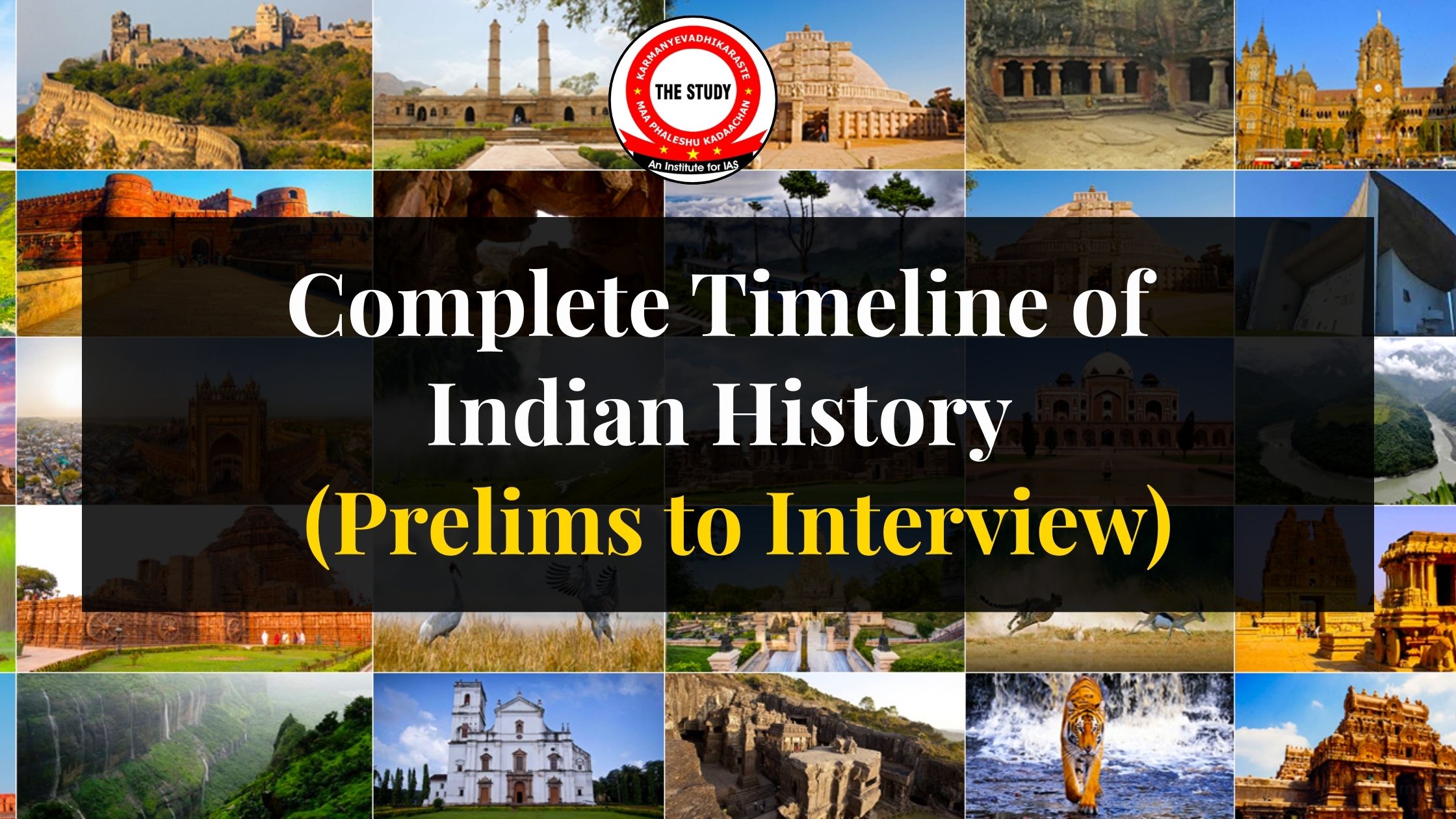
Complete Timeline of Indian History for UPSC (Prelims to Interview)
Preparing for the Civil Services Examination requires a clear understanding of historical chronology. A well-organised timeline helps aspirants connect events, understand historical developments, and improve answer writing.
History questions in the UPSC examination often test not only knowledge but also the ability to link events across time periods. For example, the evolution of governance in ancient India influences the development of political institutions in later centuries. Therefore, a strong chronological understanding is essential.
This guide presents the Complete Timeline of Indian History for UPSC (Prelims to Interview) in a structured and easy-to-remember format. It covers ancient, medieval, modern, and post-independence India while highlighting major milestones relevant for UPSC preparation.
Let’s begin by understanding why chronology is crucial for UPSC preparation.
Importance of Chronology in UPSC History Preparation
Chronology forms the backbone of historical understanding. When aspirants study history through timelines, they can easily visualise how events evolved over time. The Complete Timeline of Indian History for UPSC (Prelims to Interview) helps candidates connect different periods and themes.
Role in Prelims
In the preliminary examination, many questions are based on chronological order. Examples include:
- Arranging historical events in correct sequence
- Identifying rulers and dynasties
- Matching reforms with time periods
A strong grasp of chronology helps eliminate incorrect options quickly.
Role in Mains
For the mains examination, chronology helps build structured answers.
For instance, when writing about the Indian National Movement, candidates must clearly explain:
- Early nationalist phase
- Extremist phase
- Gandhian phase
- Final phase of independence
Chronological clarity strengthens analytical arguments in answers.
Role in Interview
During the UPSC personality test, candidates are often asked conceptual questions about historical developments.
A clear timeline helps candidates explain historical processes confidently. This is why the Complete Timeline of Indian History for UPSC (Prelims to Interview) is an essential resource for aspirants.
Timeline of Ancient Indian History
Ancient India forms the foundation of Indian civilisation. The period witnessed the emergence of urban cultures, philosophical traditions, and early political institutions. Understanding this timeline is an essential part of the Complete Timeline of Indian History for UPSC (Prelims to Interview).
Prehistoric Period (Before 2500 BCE)
The prehistoric period refers to the time before written records existed. Major phases include:
- Paleolithic Age (Old Stone Age)
- Mesolithic Age (Middle Stone Age)
- Neolithic Age (New Stone Age)
During these stages, humans gradually learned agriculture, domestication of animals, and the use of tools.
Indus Valley Civilisation (2500–1900 BCE)
The Indus Valley Civilisation was one of the earliest urban civilisations in the world. Important features include:
• Planned Cities – Grid pattern streets
• Drainage System – Advanced sanitation
• Trade – Links with Mesopotamia
• Script – Undeciphered writing system
Major sites include Harappa, Mohenjo-daro, and Lothal.
Vedic Period (1500–600 BCE)
The Vedic period marks the arrival of Indo-Aryan culture in the Indian subcontinent. Two phases are usually identified:
- Early Vedic Period
- Later Vedic Period
During this time, society became more complex and political institutions such as kingdoms developed.
Mauryan Empire (321–185 BCE)
The Mauryan Empire was the first major empire in Indian history. Key rulers include:
- Chandragupta Maurya
- Bindusara
- Ashoka
Ashoka’s reign is especially significant for the spread of Buddhism and the promotion of moral governance.
Gupta Age (320–550 CE)
The Gupta period is often called the Golden Age of India. Achievements include:
- Advances in mathematics and astronomy
- Flourishing art and literature
- Strong political administration
Scholars such as Aryabhata made important contributions during this time.
Timeline of Medieval Indian History
Medieval Indian history witnessed major political and cultural transformations. Understanding this period is essential in the Complete Timeline of Indian History for UPSC (Prelims to Interview).
Early Medieval Period (600–1200 CE)
After the Gupta Empire declined, several regional kingdoms emerged. Important dynasties included:
- Chalukyas
- Pallavas
- Rashtrakutas
- Cholas
These kingdoms contributed to temple architecture, maritime trade, and cultural development.
Delhi Sultanate (1206–1526)
The Delhi Sultanate marked the beginning of Muslim political dominance in northern India.
Major dynasties included:
• Slave Dynasty – 1206–1290
• Khilji Dynasty – 1290–1320
• Tughlaq Dynasty – 1320–1414
• Sayyid Dynasty – 1414–1451
• Lodi Dynasty – 1451–1526
Administrative reforms and expansion of trade networks were important developments during this time.
Mughal Empire (1526–1707)
The Mughal Empire began with Babur’s victory in the First Battle of Panipat in 1526.
Key rulers include:
- Babur
- Humayun
- Akbar
- Jahangir
- Shah Jahan
- Aurangzeb
Akbar’s policies of religious tolerance and administrative reforms strengthened the empire.
Decline of Mughal Power
After Aurangzeb’s death, the Mughal Empire gradually weakened.
Regional powers such as:
- Marathas
- Sikhs
- Rajputs
began asserting independence.
Timeline of Modern Indian History
Modern Indian history is extremely important for UPSC because it forms the basis of India’s freedom struggle. This section of the Complete Timeline of Indian History for UPSC (Prelims to Interview) highlights major milestones.
Arrival of Europeans (1498 onwards)
European traders began arriving in India in the late 15th century.
Key events include:
- Portuguese arrival in 1498 under Vasco da Gama
- Establishment of trading posts by Portuguese, Dutch, English, and French
- Competition among European powers (Carnatic Wars for dominance)
- 1600 – Charter granted to British East India Company by Queen Elizabeth I
- 1615–18 – Embassy of Sir Thomas Roe to Jahangir securing trade rights
- Establishment of factories at Surat (1612), Madras (1639), Bombay (1668), and Calcutta (1690)
- Decline of Mughal Empire creating favourable conditions for European expansion
British Expansion (1757–1857)
The British East India Company gradually expanded its political power.
Important milestones include:
- Battle of Plassey (1757) – beginning of British political control
- Battle of Buxar (1764) – decisive victory establishing dominance in Bengal
- 1765 – Grant of Diwani rights in Bengal by Mughal emperor (real beginning of British rule)
- Introduction of British administrative systems
- 1773 – Regulating Act (first parliamentary control over Company)
- 1784 – Pitt’s India Act (dual control of Company and Crown)
- Expansion policies and wars (Mysore Wars, Maratha Wars, Anglo-Sikh Wars)
- Reforms under Warren Hastings (judicial & revenue reforms)
- Permanent Settlement (1793) by Lord Cornwallis
- Ryotwari System by Thomas Munro
- Mahalwari System by Holt Mackenzie
- Subsidiary Alliance by Lord Wellesley
- Doctrine of Lapse by Lord Dalhousie
- Introduction of railways (1853), telegraph, and postal system
- Economic exploitation and deindustrialisation of India
Revolt of 1857
The Revolt of 1857 was the first major uprising against British rule.
Causes included:
- Political grievances (annexation policies like Doctrine of Lapse)
- Economic exploitation (heavy taxation, destruction of handicrafts)
- Military grievances (discontent among sepoys)
- Cultural and religious conflicts
Key features:
- Leadership of Bahadur Shah II, Rani Lakshmibai, Nana Sahib, Tantia Tope
- Major centres: Delhi, Kanpur, Lucknow, Jhansi
- Nature debated as Sepoy Mutiny vs First War of Independence
Consequences:
- 1858 – Government of India Act (end of Company rule, beginning of Crown rule)
- Policy of non-interference in religious matters
- Reorganisation of army
- Beginning of modern nationalist consciousness
Although the revolt failed, it marked the beginning of organised resistance.
Indian National Movement (1885–1947)
The freedom struggle evolved through several phases, including moderate, extremist, revolutionary, and Gandhian phases, along with socio-religious reform movements.
Early Nationalism (Moderate Phase)
• 1885 – Formation of Indian National Congress
• Leaders like Dadabhai Naoroji, Gopal Krishna Gokhale
• Demand for constitutional reforms and economic critique (Drain Theory)
Extremist Phase
• Leaders like Bal Gangadhar Tilak, Bipin Chandra Pal, Lala Lajpat Rai
• 1905 – Swadeshi and Boycott Movement (Partition of Bengal)
• 1907 – Surat Split
• 1909 – Morley-Minto Reforms (separate electorates)
Gandhian Era
• Arrival of Mahatma Gandhi in 1915
• 1917 – Champaran Satyagraha
• 1918 – Kheda Satyagraha, Ahmedabad Mill Strike
• 1919 – Rowlatt Act & Jallianwala Bagh Massacre
• 1920–22 – Non-Cooperation Movement
• 1930 – Civil Disobedience Movement (Dandi March)
• 1942 – Quit India Movement
Revolutionary Nationalism
• Activities of Bhagat Singh, Chandra Shekhar Azad
• Hindustan Socialist Republican Association (HSRA)
• Role of Subhas Chandra Bose and Indian National Army (INA)
Constitutional Developments
• 1919 – Government of India Act
• 1935 – Government of India Act (provincial autonomy, federal structure)
• 1946 – Cabinet Mission Plan
• Interim Government formation
Towards Independence
• 1940 – Lahore Resolution and role of Muhammad Ali Jinnah
• 1946 – Direct Action Day
• Communal tensions and partition process
• 1947 – Indian Independence Act and Partition of India
Socio-Religious Reform Movements
- 1828 – Brahmo Samaj founded by Raja Ram Mohan Roy
- 1849 – Paramhansa Mandali (early reform group in Maharashtra)
- 1866 – Prarthana Samaj founded by Atmaram Pandurang
- 1873 – Satyashodhak Samaj founded by Jyotirao Phule
- 1875 – Arya Samaj founded by Swami Dayanand Saraswati
- 1875 – Theosophical Society (in India later led by Annie Besant)
- 1887 – Dev Samaj founded by Shiv Narayan Agnihotri
- 1897 – Ramakrishna Mission founded by Swami Vivekananda
Timeline of Post-Independence India (1947–Present)
The post-independence phase of India marks the transformation of the country from a newly independent nation into one of the world’s largest democracies and fastest-growing economies. After gaining independence in 1947, India faced major challenges such as political integration, economic development, social justice, and institution-building. Over the decades, India has evolved through constitutional reforms, economic transformations, and global engagement.
1. Constitution and the Foundation of Indian Democracy
One of the most significant achievements after independence was the creation of a democratic constitutional framework.
The Constitution of India came into force on 26 January 1950, marking India’s transition from a dominion to a sovereign democratic republic. The Constitution established a comprehensive governance structure and guaranteed fundamental rights to citizens.
Key Democratic Institutions
India’s democratic system is built on strong institutions that ensure checks and balances.
- Parliament of India – The highest legislative body responsible for making laws and representing the people. It consists of the Lok Sabha and the Rajya Sabha.
- Supreme Court of India – The highest judicial authority that safeguards the Constitution and protects fundamental rights.
- Federal Governance System – India adopted a federal structure where powers are divided between the central government and state governments.
This democratic framework enabled India to conduct regular elections and maintain political stability despite its diversity.
2. Political Consolidation and Nation Building
After independence, India faced the critical task of integrating hundreds of princely states into a unified nation. This process was led by Sardar Vallabhbhai Patel, who successfully integrated most princely states into the Indian Union.
Important developments in nation-building included:
- Reorganisation of States (1956) based on linguistic lines.
- Establishment of democratic institutions across states.
- Expansion of education, infrastructure, and public welfare programs.
These steps strengthened national unity and administrative efficiency.
3. Economic Planning and Early Development (1950s–1980s)
In the early decades after independence, India followed a mixed economy model that combined state planning with private sector participation.
The government introduced Five-Year Plans to promote industrial growth, agricultural development, and poverty reduction.
Key priorities during this period included:
- Development of heavy industries
- Expansion of public sector enterprises
- Investment in irrigation and agriculture
- Strengthening of scientific research and education
A major agricultural transformation occurred during the Green Revolution in India in the late 1960s and 1970s. This movement increased agricultural productivity through high-yield seeds, irrigation, fertilisers, and modern farming techniques, making India largely self-sufficient in food grains.
4. Economic Reforms of 1991
A major turning point in India’s economic history came in 1991, when the country faced a severe balance-of-payments crisis. To address the crisis and modernise the economy, the government introduced liberalisation, privatisation, and globalisation (LPG) reforms.
These reforms were implemented under Prime Minister P. V. Narasimha Rao and Finance Minister Manmohan Singh.
Major Features of the 1991 Reforms
- Reduction of government control over industries
- Encouragement of private sector investment
- Opening the economy to foreign trade and investment
- Deregulation of markets
Impact of the Reforms
The reforms significantly transformed India’s economy by:
- Increasing economic growth
- Expanding global trade
- Attracting foreign investment
- Developing new sectors such as information technology and services
As a result, India gradually integrated into the global economy.
5. India in the 21st Century
In the 21st century, India has emerged as an important global power due to rapid economic growth, technological advancement, and expanding geopolitical influence.
- Economic Growth
India has become one of the fastest-growing major economies, with strong growth in sectors such as:
- Information technology
- Digital services
- Manufacturing
- Renewable energy
Indian technology companies and startups have also gained global recognition.
- Technological and Space Achievements
India has made remarkable progress in science and space technology through the work of the Indian Space Research Organisation.
Major milestones include:
- Chandrayaan‑3 – Successful lunar mission that made India the first country to land near the Moon’s south pole.
- Expansion of satellite programs for communication, navigation, and weather monitoring.
These achievements have strengthened India’s global scientific reputation.
6. India’s Role in Global Affairs
Today, India plays a significant role in international diplomacy, trade, and global governance.
Key features of India’s global engagement include:
- Active participation in organisations such as the United Nations and G20
- Strategic partnerships with major powers
- Leadership in climate change negotiations and renewable energy initiatives
India’s growing economic strength and diplomatic influence continue to shape global politics.
The timeline of post-independence India reflects a remarkable journey from colonial rule to a vibrant democratic republic. Through constitutional governance, economic reforms, technological progress, and global engagement, India has emerged as a major force in world affairs.
For UPSC aspirants, understanding this phase is crucial because it connects history with contemporary politics, governance, and international relations. The developments after 1947 continue to shape India’s present and future trajectory.
Powerful Chronology Tips for UPSC
Here are some practical tips to remember historical timelines.
- Use visual timelines.
- Practice chronological questions.
- Revise events regularly.
- Create short notes.
- Use mind maps.
- Connect events with themes.
These techniques make the Complete Timeline of Indian History for UPSC (Prelims to Interview) easier to remember.
Conclusion
Understanding historical chronology is one of the most effective ways to master history for the UPSC examination. The Complete Timeline of Indian History for UPSC (Prelims to Interview) provides a structured overview of major events across different periods.
By studying history through timelines, aspirants can connect events, analyse developments, and present balanced answers in both prelims and mains examinations.
With consistent revision and smart preparation strategies, mastering the timeline of Indian history becomes an achievable goal for every UPSC aspirant.
If this guide on the Complete Timeline of Indian History for UPSC (Prelims to Interview) helped you, consider saving it for revision and sharing it with fellow aspirants preparing for the Civil Services Examination. Consistent learning and structured timelines will strengthen your preparation journey.
FAQs on Complete Timeline of Indian History for UPSC
1. Why is chronology important for UPSC history preparation?
Chronology helps aspirants understand historical developments and answer questions accurately.
2. Which period is most important for UPSC?
Modern Indian history and the national movement are particularly important.
3. How can I remember historical timelines easily?
Using charts, maps, and regular revision helps improve memory.
4. Is ancient history important for prelims?
Yes. Ancient history questions frequently appear in the prelims exam.
5. How much time should I spend on history preparation?
Aspirants should allocate at least three to four months for thorough preparation.
6. Are timelines useful for mains answer writing?
Yes. Chronological clarity helps structure answers effectively.
Subscribe to our YouTube Channel for more Valuable Content – TheStudyias
Download the App to Subscribe to our Courses – Thestudyias
The Source’s Authority and Ownership of the Article is Claimed By THE STUDY IAS BY MANIKANT SINGH
Comments (0)
Leave a Comment