Chittagong Armoury Raid
18 Aug 2026
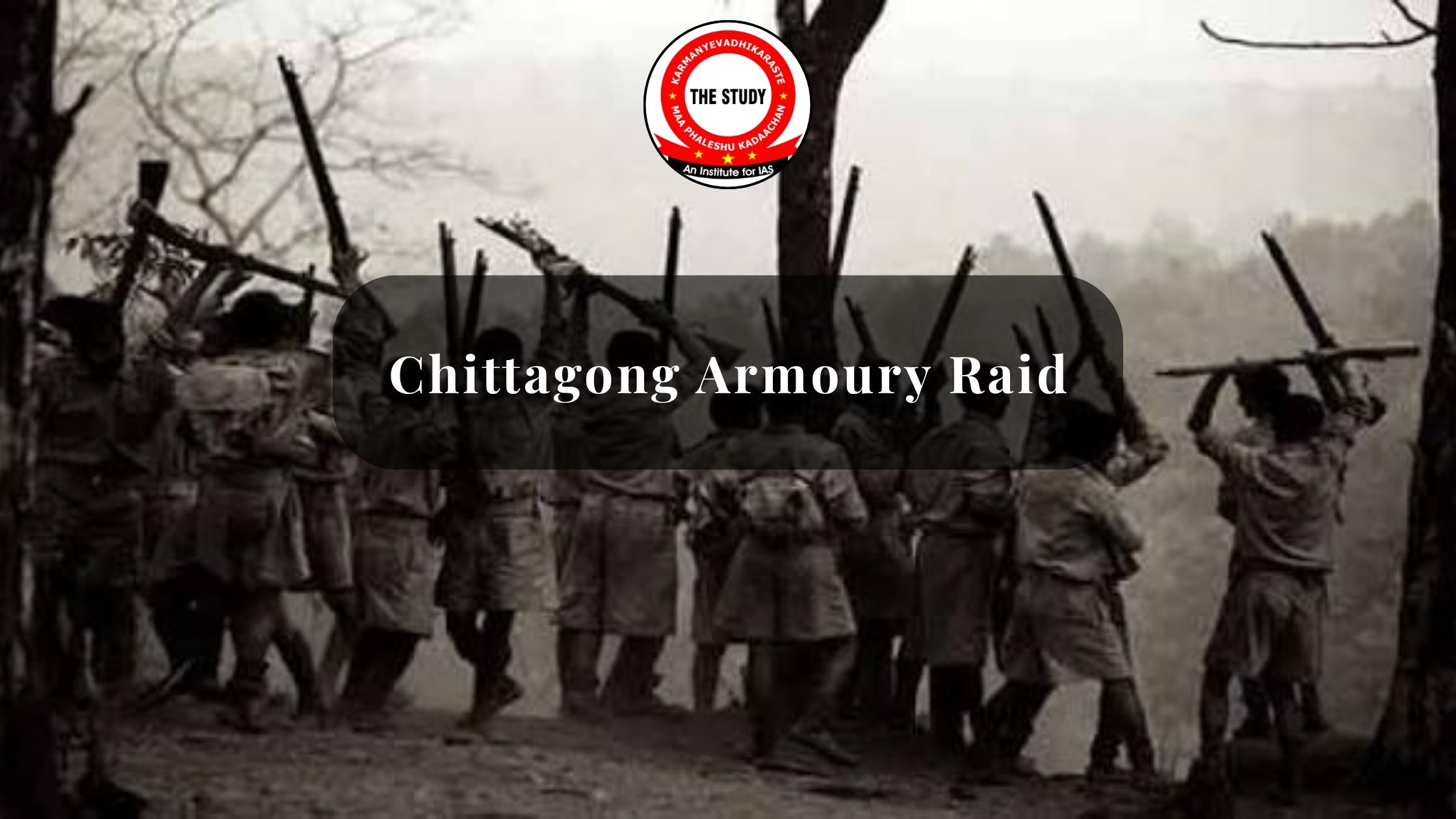
Chittagong Armoury Raid: Background, Events, Revolutionaries & Significance for UPPSC
Introduction
The Chittagong Armoury Raid of 18 April 1930 was one of the most ambitious revolutionary actions of the Indian freedom struggle. Led by Surya Sen, popularly known as Masterda, the uprising attempted to strike at the military and communication infrastructure of British rule in Chittagong, then part of Bengal and now located in Bangladesh.
The objective was not simply to seize weapons. The revolutionaries planned to capture the major armouries, disrupt telephone and telegraph communications, obstruct railway movement and isolate Chittagong from the wider colonial administration. After the initial operations, Surya Sen and his comrades gathered at the police armoury, hoisted the national flag and proclaimed a Provisional Revolutionary Government.
Although the revolutionaries failed to secure ammunition and could not sustain control over Chittagong, the episode demonstrated the organisational capacity, courage and sacrifice of Bengal's revolutionary movement. It also brought several women revolutionaries, including Kalpana Dutta and Pritilata Waddedar, into the wider national consciousness.
For UPPSC and UPSC aspirants, the Chittagong Armoury Raid is important because it connects revolutionary nationalism, Bengal's freedom movement, youth participation, women revolutionaries and the broader national movement of the 1920s–30s.
Chittagong Armoury Raid: Events, Leaders, Impact & Exam Relevance
What was the Chittagong Armoury Raid and why was it planned?
The raid was an armed revolutionary action undertaken on 18 April 1930 in Chittagong under the leadership of Surya Sen.
The immediate objective was to weaken British authority by:
- Capturing the police armoury.
- Capturing the Auxiliary Force armoury.
- Obtaining arms for the revolutionary organisation.
- Cutting telephone and telegraph communications.
- Disrupting railway movement.
- Isolating Chittagong from the colonial administrative network.
- Creating conditions for a wider revolutionary uprising.
The plan reflected the belief among revolutionary nationalists that British rule could be challenged through organised armed resistance.
The revolutionaries succeeded in capturing the armouries but failed to locate the ammunition, which significantly reduced the military effectiveness of the operation. They nevertheless disrupted communications and railway movement.
Who was Surya Sen and what was his role?
Surya Kumar Sen (1894–1934) was a schoolteacher and revolutionary nationalist from Chittagong. He became popularly known as Masterda.
Before leading the raid, Sen had participated in the Non-Cooperation Movement and was imprisoned during 1926–28. He subsequently became associated with revolutionary activities and emerged as an important organiser in Chittagong.
His importance lies not merely in leading one operation but in his ability to organise young men and women into a disciplined underground network.
For examination purposes, remember:
Surya Sen → Masterda → Chittagong → Revolutionary movement → Armoury Raid, 1930.
What happened on 18 April 1930?
The revolutionary groups carried out coordinated operations against the police and Auxiliary Force armouries.
Ganesh Ghosh led the attack on the police armoury, while Lokenath Bal took charge of the Auxiliary Force armoury. Communications were disrupted and railway movement was obstructed.
However, the revolutionaries could not obtain the ammunition stored at the armouries. After completing the planned operations, they assembled near the police armoury, where Surya Sen hoisted the national flag and proclaimed a Provisional Revolutionary Government. The official Ministry of Culture account records that approximately 65 people participated in the plan.
This makes the event particularly significant: it was conceived as an attempt at a mini-insurrection, rather than an isolated act of political violence.
What happened after the raid at Jalalabad Hills?
The revolutionaries subsequently moved towards the Jalalabad Hills.
On 22 April 1930, British Indian forces confronted a large section of the revolutionary group. Twelve revolutionaries were killed in the ensuing battle, while others escaped and went underground.
The failure to obtain adequate ammunition and the British military response meant that the revolutionaries could not transform the raid into a sustained uprising.
However, the movement continued through underground networks for several years.
What was the role of Kalpana Dutta and Pritilata Waddedar?
The Chittagong movement is particularly important for understanding women's participation in revolutionary nationalism.
Kalpana Dutta became associated with Surya Sen's revolutionary group while she was a student. She later went underground and participated in efforts to support the revolutionary network. She was eventually sentenced to life imprisonment and was released in 1939.
Pritilata Waddedar also became an important member of the Chittagong revolutionary movement. In 1932, she led the attack on the Pahartali European Club, a site associated with racial discrimination against Indians. The attack became one of the most remembered episodes of the later phase of the Chittagong revolutionary movement.
Thus, the Chittagong movement should not be studied only through Surya Sen. For a high-quality answer, connect Surya Sen + Kalpana Dutta + Pritilata Waddedar + youth mobilisation + women in revolutionary nationalism.
How did the British respond, and what happened to Surya Sen?
After the raid, the British administration intensified its search for the revolutionaries. Surya Sen remained underground and continued organising resistance.
He was eventually arrested on 16 February 1933. After his trial, he was executed on 12 January 1934.
Many other participants were arrested and received long prison sentences or transportation.
The repression demonstrates the enormous risks faced by revolutionary nationalists, but it also shows that the movement survived the failure of its initial military objective.
What is the historical significance of the Chittagong Armoury Raid?
The raid should neither be described simply as a "successful uprising" nor dismissed as a failed military operation.
Its significance can be understood through five dimensions:
1. Revolutionary nationalism: It represented the continuation of armed resistance against colonial rule.
2. Organisational capability: The coordinated attack on armouries and communication infrastructure demonstrated considerable planning.
3. Youth participation: Students and young people formed an important component of the revolutionary network.
4. Women's participation: Figures such as Kalpana Dutta and Pritilata Waddedar expanded the conventional understanding of women's participation in India's freedom struggle.
5. Psychological impact: Even though the revolutionaries could not sustain control over Chittagong, the operation challenged the image of unquestioned British authority.
For Mains, the best approach is to place the raid within the broader history of revolutionary nationalism rather than treating it as an isolated incident.
Why is the Chittagong Armoury Raid important for UPPSC and other competitive exams?
The topic is relevant to UPPSC, UPSC, SSC and other state-level examinations, particularly under Modern Indian History and the revolutionary movement.
For Prelims, focus on factual linkages:
- Year: 1930
- Date: 18 April
- Place: Chittagong, Bengal Presidency
- Leader: Surya Sen
- Popular name: Masterda
- Major participants: Ganesh Ghosh, Lokenath Bal and others
- Associated revolutionaries: Kalpana Dutta, Pritilata Waddedar
- Jalalabad Hills battle: 22 April 1930
- Surya Sen executed: 12 January 1934
For Mains, go beyond facts and explain its place in the revolutionary strand of Indian nationalism. The official government account specifically records the attempt to seize arms, destroy communications and isolate Chittagong.
The Ministry of Culture's historical repository is particularly useful for verifying these core facts.
What are the Previous Year Exam-Oriented Points?
Aspirants should prepare the topic through statement-based elimination, because competitive examinations can connect several revolutionary movements in one question.
Remember these distinctions:
- Chittagong Armoury Raid — 1930
- Leader — Surya Sen
- Jalalabad Hills — 22 April 1930
- Pahartali European Club attack — 1932
- Pritilata Waddedar — associated with the later Chittagong revolutionary movement
- Kalpana Dutta — participant in the Chittagong revolutionary movement
- The revolutionaries failed to secure ammunition, despite capturing the armouries.
Also, do not confuse the Chittagong Armoury Raid with other revolutionary episodes such as the Kakori action, Alipore Conspiracy Case, or Central Legislative Assembly bombing. A comparative timeline is often the easiest way to retain them.
FAQs
1. Who led the Chittagong Armoury Raid?
The raid was led by Surya Sen, popularly known as Masterda.
2. When did the Chittagong Armoury Raid take place?
It took place on 18 April 1930.
3. What was the main objective of the raid?
The revolutionaries aimed to seize arms, disrupt communications and railway movement, and isolate Chittagong from the British administrative system.
4. Did the revolutionaries obtain ammunition?
No. They captured the armouries but failed to locate the ammunition.
5. Who were Kalpana Dutta and Pritilata Waddedar?
Both were important women associated with the Chittagong revolutionary movement. Kalpana Dutta participated in the movement led by Surya Sen, while Pritilata later led the attack on the Pahartali European Club.
6. When was Surya Sen executed?
Surya Sen was executed on 12 January 1934.
7. Why is the raid important for Modern Indian History?
It represents an important episode of revolutionary nationalism, demonstrating the role of organised youth resistance, underground networks and women revolutionaries in the freedom struggle.
8. What is the best way to prepare this topic for UPPSC?
Memorise the 1930 timeline, map the major personalities to the events, connect the raid with Bengal's revolutionary movement, and practise one Prelims statement-based question and one Mains analytical answer.
Exam takeaway: Do not study the Chittagong Armoury Raid as a list of names and dates. The stronger approach is to understand why it happened, how it was organised, why it failed militarily, how the movement continued, and what it reveals about revolutionary nationalism in late-colonial India. That framework turns a small Modern History topic into usable material for both Prelims and Mains.
Subscribe to our Youtube Channel for more Valuable Content – TheStudyias
Download the App to Subscribe to our Courses – Thestudyias
The Source’s Authority and Ownership of the Article is Claimed By THE STUDY IAS BY MANIKANT SINGH
Comments (0)
Leave a Comment