C. V. Raman Death Anniversary (21 November): Life, Raman Effect, Scientific Contributions and UPSC Relevance
10 Nov 2026
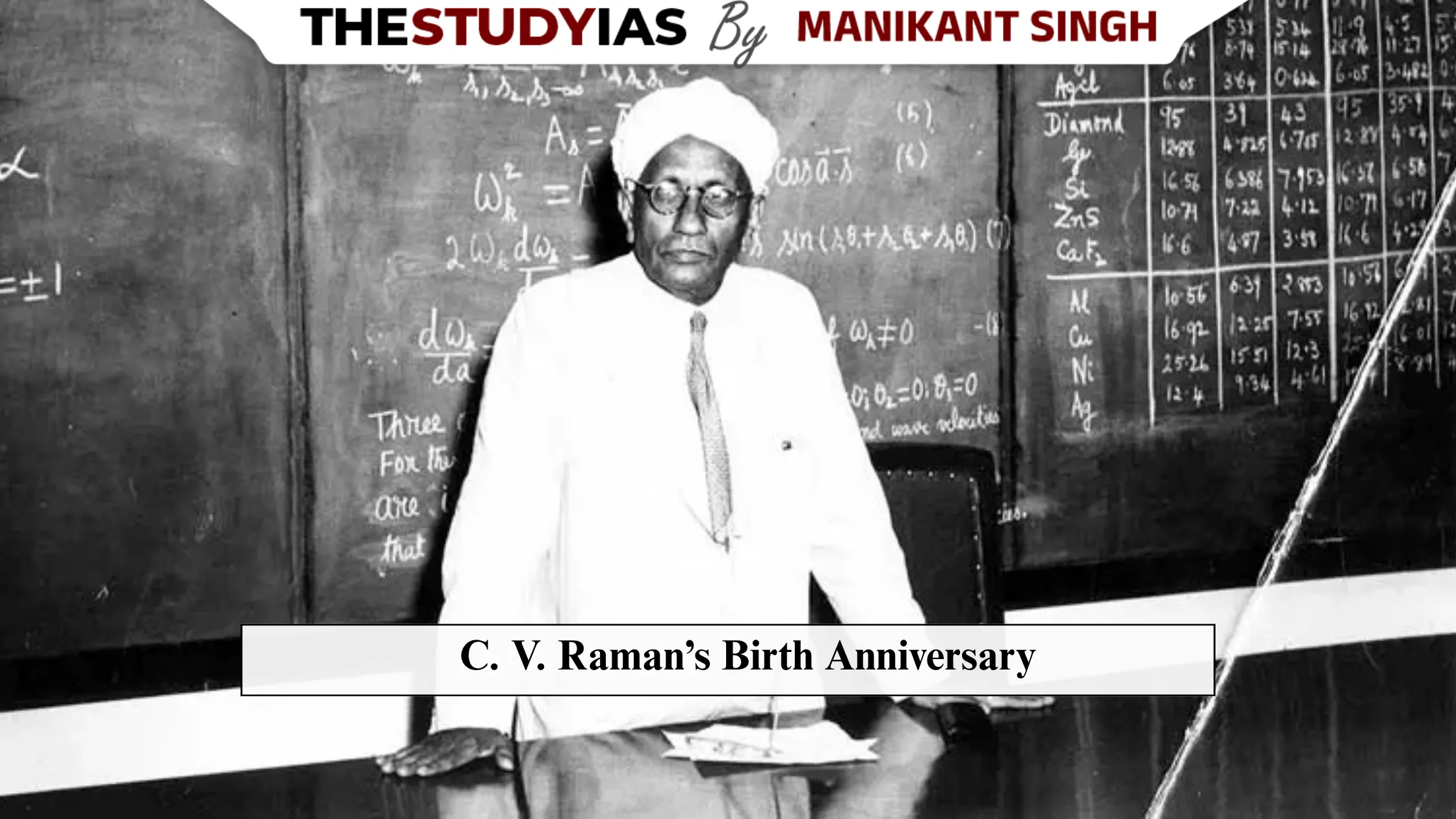
C. V. Raman Death Anniversary (21 November): Life, Raman Effect, Scientific Contributions and UPSC Relevance
21 November marks the death anniversary of Sir Chandrasekhara Venkata Raman, popularly known as C. V. Raman, one of India's most distinguished physicists and the first Indian scientist to receive the Nobel Prize in a scientific discipline. He passed away on 21 November 1970, leaving behind a remarkable legacy in the field of physics, particularly in the study of light scattering.
His discovery of the Raman Effect in 1928 transformed the understanding of how light interacts with matter and earned him the Nobel Prize in Physics in 1930. His contributions also played an important role in strengthening India's scientific research institutions.
From a UPSC CSE perspective, this topic is relevant to GS Paper III, particularly Science and Technology, scientific research, innovation and India's achievements in science. It also connects with GS Paper IV through scientific temper, curiosity and the spirit of inquiry.
Early Life and Education of C. V. Raman
C. V. Raman was born on 7 November 1888 in Tiruchirappalli, Tamil Nadu, then part of the Madras Presidency.
His father, Chandrasekhara Iyer, was a lecturer in mathematics and physics, which provided Raman with an academic environment from an early age.
Raman demonstrated exceptional academic ability and developed an early interest in physics, optics and acoustics.
He joined Presidency College, Madras, in 1902 and completed his B.A. in 1904, securing first place and a gold medal in physics. He obtained his M.A. degree in physics in 1907 with distinction.
In the same year, he joined the Indian Finance Department as an Assistant Accountant General in Calcutta. Despite his administrative responsibilities, he continued conducting scientific research during his spare time.
His determination to pursue science eventually led him to leave government service and dedicate himself to academic research.
Scientific Career and Major Contributions
1. Research at the Indian Association for the Cultivation of Science (IACS)
While working in the Indian Finance Department, Raman conducted experiments at the Indian Association for the Cultivation of Science (IACS), Calcutta. He investigated the properties of light, acoustics and the behaviour of musical instruments. His early research helped establish his reputation as a promising physicist.
2. Professor at the University of Calcutta
In 1917, Raman left his government position and joined the University of Calcutta as the Palit Professor of Physics. This marked an important phase in his scientific career, allowing him to devote himself entirely to research and teaching.
3. Research on Acoustics and Musical Instruments
Raman conducted extensive studies on the vibrations and acoustics of Indian musical instruments, including the violin, mridangam and other stringed instruments. His research demonstrated how scientific principles could explain the production and characteristics of musical sound.
4. Discovery of the Raman Effect
Raman's most significant contribution was the discovery of the Raman Effect, which established a new way of studying the interaction between light and matter.
The discovery became a milestone in modern physics and spectroscopy.
What is the Raman Effect?
The Raman Effect is a phenomenon in which a small fraction of light changes its wavelength and frequency when it is scattered by molecules of a substance. When monochromatic light, such as light from a single-frequency source, passes through a transparent material, most of the scattered light retains its original frequency. However, a small portion undergoes a change in frequency due to interactions with the molecules.
This change in frequency provides information about the molecular structure and chemical composition of the material.
Scientific Importance of the Raman Effect
The Raman Effect became the foundation of Raman Spectroscopy, an analytical technique used to study the molecular composition and structure of materials.
Its applications include:
Chemistry: Identifying chemical compounds and studying molecular structures.
Pharmaceuticals: Analysing drug composition and checking the quality of medicines.
Medicine: Supporting research into biological tissues and disease-related molecular changes.
Forensic Science: Identifying unknown substances and analysing evidence.
Material Science: Studying semiconductors, minerals, nanomaterials and advanced materials.
Space Research: Analysing the chemical and mineral composition of planetary surfaces through spectroscopic instruments.
The discovery demonstrated how fundamental scientific research can lead to applications across multiple disciplines.
Nobel Prize in Physics (1930)
In recognition of his groundbreaking research on the scattering of light and the discovery of the Raman Effect, C. V. Raman was awarded the Nobel Prize in Physics in 1930. He became the first Indian to receive the Nobel Prize in a scientific discipline. His achievement was particularly significant because the research was carried out in India, demonstrating the potential of scientific research within the country.
The Nobel Prize brought international recognition to Indian scientific research and inspired future generations of scientists.
Other Awards and Honours
C. V. Raman received several national and international honours for his contributions to science.
The Bharat Ratna, awarded in 1954, recognised his exceptional contribution to Indian science.
Institution Building and Contribution to Indian Science
C. V. Raman was not only a pioneering researcher but also an institution builder who believed in developing a strong scientific research ecosystem in India.
1. Indian Academy of Sciences (1934)
Raman founded the Indian Academy of Sciences in 1934 to promote scientific research, encourage scientific discussion and strengthen the scientific community in India.
2. Raman Research Institute (1948)
He established the Raman Research Institute (RRI) in Bengaluru in 1948 after retiring from the Indian Institute of Science. The institute was established to continue fundamental research in physics and related scientific fields.
3. Indian Institute of Science (IISc)
Raman joined the Indian Institute of Science, Bengaluru, in 1933 as its first Indian Director. He served in this position until 1937 and continued his academic association with the institution thereafter.
4. Indian Journal of Physics (1926)
He founded the Indian Journal of Physics in 1926 to provide a platform for publishing scientific research and encouraging the growth of physics in India. These contributions helped establish a stronger foundation for scientific research and higher education in the country.
National Science Day and the Raman Effect
India celebrates National Science Day on 28 February every year to commemorate the discovery of the Raman Effect. The Government of India officially designated 28 February as National Science Day in 1986, and the first observance took place in 1987.
The day aims to:
Promote scientific awareness among citizens.
Encourage scientific temper and innovation.
Recognise the contribution of scientists to national development.
Inspire students to pursue scientific research.
Highlight the role of science and technology in addressing societal challenges.
C. V. Raman's death anniversary is observed on 21 November, whereas National Science Day is celebrated on 28 February to commemorate the discovery of the Raman Effect.
C. V. Raman's Relevance for UPSC CSE
The life and achievements of C. V. Raman are relevant to multiple areas of the UPSC Civil Services Examination.
Prelims Pointers
Mains Relevance
Important Mains Question:
"How did C. V. Raman's discovery of the Raman Effect contribute to the development of modern physics and strengthen India's scientific research tradition? Discuss."
Frequently Asked Questions (FAQs)
1. When is C. V. Raman's death anniversary observed?
C. V. Raman's death anniversary is observed on 21 November. He passed away on 21 November 1970 in Bengaluru, Karnataka. He was an eminent Indian physicist known for discovering the Raman Effect and receiving the Nobel Prize in Physics in 1930.
2. What is the Raman Effect?
The Raman Effect is the change in the wavelength or frequency of a small fraction of light when it is scattered by molecules of a substance. It forms the scientific basis of Raman Spectroscopy, which is used to study molecular structures and chemical compositions.
3. When did C. V. Raman receive the Nobel Prize?
C. V. Raman received the Nobel Prize in Physics in 1930 for his work on the scattering of light and the discovery of the Raman Effect. He became the first Indian to receive the Nobel Prize in a scientific discipline.
4. Why is National Science Day celebrated on 28 February?
National Science Day is celebrated on 28 February to commemorate C. V. Raman's discovery of the Raman Effect on 28 February 1928. The Government of India declared the date as National Science Day in 1986.
5. Which constitutional article promotes scientific temper in India?
Article 51A(h) of the Indian Constitution identifies the development of scientific temper, humanism, and the spirit of inquiry and reform as a Fundamental Duty of every citizen.
Conclusion
C. V. Raman's life represents the importance of curiosity, independent thinking and scientific research. His discovery of the Raman Effect not only earned international recognition but also demonstrated India's ability to contribute to fundamental scientific knowledge.
His legacy extends beyond a Nobel Prize. Through his research, teaching and institution-building efforts, he helped strengthen India's scientific foundation. His life continues to remind us that scientific progress depends on questioning, experimentation and the courage to explore the unknown.
For more UPSC-oriented articles and preparation resources, explore The Study IAS.
Subscribe to our Youtube Channel for more Valuable Content –TheStudyias
Download the App to Subscribe to our Courses –Thestudyias
The Source’s Authority and Ownership of the Article is Claimed ByTHE STUDY IAS BY MANIKANT SINGH
Comments (0)
Leave a Comment