Bhogaraju Pattabhi Sitaramayya
28 Aug 2026
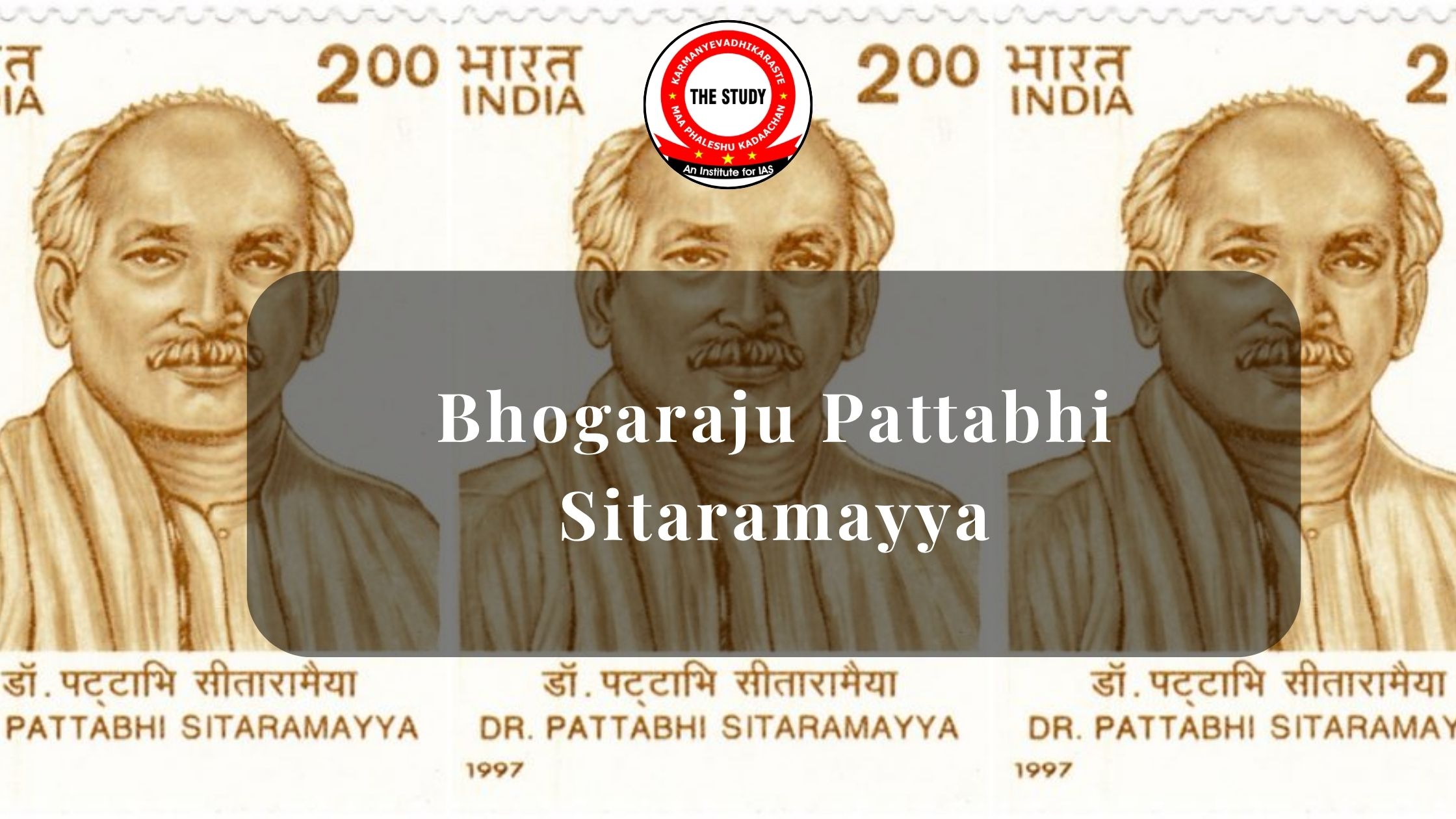
Bhogaraju Pattabhi Sitaramayya
Introduction
Bhogaraju Pattabhi Sitaramayya is one of those freedom fighters whose contribution goes far beyond a single political event. He was a Gandhian, Congress organiser, journalist, institution builder, historian and constitutional figure who remained active across several phases of India's national movement.
For UPSC aspirants, however, the most important point is not to memorise his biography as a list of dates. Sitaramayya should be understood through three interconnected themes:
Gandhian nationalism + Congress organisation + political and institutional development in Andhra.
He also occupies an important place in modern Indian history because of the 1939 Tripuri Congress presidential election, where he was Mahatma Gandhi's preferred candidate but was defeated by Subhas Chandra Bose. He later wrote the monumental History of the Indian National Congress, making him both a participant in and chronicler of India's freedom struggle.
For a new aspirant, his life provides a useful case study of how the national movement was built not only through mass protests, but also through press, political organisation, economic institutions and intellectual work.
Why Is Bhogaraju Pattabhi Sitaramayya Important for Understanding India's Freedom Movement?
Who Was Bhogaraju Pattabhi Sitaramayya?
Bhogaraju Pattabhi Sitaramayya was born on 24 November 1880 at Gundugolanu in present-day Andhra Pradesh. He studied medicine at Madras Medical College and obtained his M.B. and C.M. degrees in 1901. He subsequently practised as a physician at Masulipatnam (Machilipatnam).
His early political orientation was influenced by the assertive nationalism of the Lal-Bal-Pal trio. He later joined the Home Rule movement associated with Annie Besant and eventually became a committed Gandhian.
This evolution is important because it mirrors a broader transformation within Indian nationalism—from early constitutional politics and assertive nationalism towards Gandhian mass mobilisation.
How Did Sitaramayya Contribute to the National Movement?
Sitaramayya became associated with the Indian National Congress from an early stage and joined the All India Congress Committee in 1916. He eventually gave up his medical practice and devoted himself to political and organisational work. He also served on the Congress Working Committee for several years.
His contribution was particularly significant in Andhra, where he used journalism, public meetings and political organisation to spread nationalist ideas.
In 1919, he started the English nationalist weekly Janmabhumi, which continued until 1930. Through the newspaper and public mobilisation, he helped popularise ideas of nationalism, swadeshi and resistance to colonial rule.
This makes him a useful example for UPSC answers on the role of the press in the freedom struggle.
What Was Sitaramayya's Role in the Civil Disobedience Movement?
Sitaramayya actively participated in the Civil Disobedience Movement.
On the eve of the Salt Satyagraha in 1930, he toured villages in the East Krishna region and explained the movement to local people. In April 1930, he led volunteers to the coast near Masulipatnam and broke the colonial salt law by making salt.
The British arrested him and sentenced him to imprisonment along with a fine. He was arrested again in 1933 while participating in picketing against foreign cloth.
His activities demonstrate how the Civil Disobedience Movement moved beyond major urban centres and became connected with local mobilisation and constructive political work.
Why Is the 1939 Tripuri Congress Election Important?
The 1939 Tripuri Congress presidential election is the most frequently remembered political episode associated with Sitaramayya.
Mahatma Gandhi supported Sitaramayya as his preferred candidate against Subhas Chandra Bose.
Bose won the election.
The result exposed deep differences within the Congress regarding the future direction of the national movement, particularly over leadership, strategy, the pace of confrontation with British rule and the relationship between the Congress organisation and its radical wing.
The Indian National Congress itself describes the Tripuri election as one of the most controversial presidential contests in its history.
For UPSC, avoid reducing the episode to “Gandhi versus Bose.”
A better analysis is:
Tripuri reflected an internal ideological and strategic debate within a broad nationalist organisation.
This makes Sitaramayya's defeat historically significant even though he did not win the election.
What Was Sitaramayya's Contribution as a Historian?
Perhaps his most enduring intellectual contribution was his History of the Indian National Congress.
The first volume, covering 1885–1935, was published in 1935 as part of the Congress's Golden Jubilee period. A second volume covering 1935–1947 followed in 1947.
The work is valuable because Sitaramayya was not merely an outside historian. He was a participant in the national movement and had access to many Congress records, personalities and events.
For History Optional aspirants, this creates an important methodological point:
A primary participant's account can be valuable evidence, but it should still be read critically because historical interpretation can reflect the author's political position and institutional context.
Why Is Sitaramayya's Institution-Building Work Important?
Sitaramayya believed that nationalism also required economic and institutional capacity.
He helped establish Andhra Bank in 1923 at Masulipatnam and was associated with other institutional initiatives, including insurance organisations.
This dimension is often overlooked.
The freedom struggle was not only about demonstrations and imprisonment. Nationalists also attempted to develop indigenous institutions, economic organisation, national education and swadeshi-oriented enterprise.
His life therefore connects political nationalism with economic nationalism.
What Did Sitaramayya Do During and After the Quit India Movement?
Sitaramayya participated in Individual Satyagraha during 1940–41 and was again imprisoned during the Quit India Movement.
After his release, he became a member of the Constituent Assembly in 1946, participating in the constitutional transition from colonial rule to independent India.
He subsequently served as President of the Indian National Congress at the Jaipur session in 1948.
He was later appointed Governor of Madhya Pradesh, serving from 1952 to 1957 according to government biographical records.
His post-independence career demonstrates the transition of several freedom fighters from anti-colonial mobilisation to institution-building within the new republic.
Why Is Bhogaraju Pattabhi Sitaramayya Important for UPPSC and Other Competitive Exams?
For UPSC GS-I and History Optional, Sitaramayya can be linked with:
- Gandhian phase of nationalism
- Home Rule Movement
- Role of the nationalist press
- Civil Disobedience Movement
- Salt Satyagraha
- Congress organisation
- Tripuri Crisis of 1939
- Quit India Movement
- Economic nationalism
- Constituent Assembly
For UPPSC, he is particularly relevant to questions concerning Andhra's contribution to the national movement, Congress history, Gandhian nationalism and regional political mobilisation.
A strong Mains answer should not simply list his achievements. Use him as an example of the multi-dimensional nature of the freedom struggle.
What Are the Quick Facts for UPPSC Prelims, Previous Year Exam-Oriented Points and FAQ?
Quick Facts for UPPSC Prelims
- Full name: Bhogaraju Pattabhi Sitaramayya
- Born: 24 November 1880
- Birthplace: Gundugolanu, present-day Andhra Pradesh
- Profession: Physician initially
- Janmabhumi: Nationalist weekly founded in 1919
- AICC: Joined in 1916
- 1939: Gandhi's preferred Congress presidential candidate; defeated by Subhas Chandra Bose at Tripuri.
- History of the Indian National Congress: Major two-volume historical work covering 1885–1935 and 1935–1947.
- Congress President: Jaipur Session, 1948
- Governor: Madhya Pradesh
- Died: 17 December 1959.
Previous Year Exam-Oriented Points
Prepare him through these themes:
- Congress organisation and Gandhian nationalism.
- Role of the nationalist press.
- Salt Satyagraha in Andhra.
- Tripuri Congress crisis.
- Gandhi-Bose differences.
- Economic nationalism and indigenous institutions.
- Quit India Movement.
- Constituent Assembly.
- Congress historiography.
- Regional contributions to the national movement.
FAQ
Was Sitaramayya a doctor?
Yes. He trained as a physician before devoting himself increasingly to nationalist politics.
Why is he associated with the Tripuri Congress?
He was Gandhi's preferred candidate in the 1939 Congress presidential election but lost to Subhas Chandra Bose.
What is his most famous historical work?
History of the Indian National Congress, covering the Congress from its foundation through the freedom struggle.
What was Janmabhumi?
It was an English nationalist weekly launched by Sitaramayya in 1919.
Was his contribution limited to politics?
No. He contributed through journalism, institution-building, historical writing, Congress organisation and public mobilisation.
Subscribe to our Youtube Channel for more Valuable Content – TheStudyias
Download the App to Subscribe to our Courses – Thestudyias
The Source’s Authority and Ownership of the Article is Claimed By THE STUDY IAS BY MANIKANT SINGH
Comments (0)
Leave a Comment