Bahadur Shah Zafar
28 Aug 2026
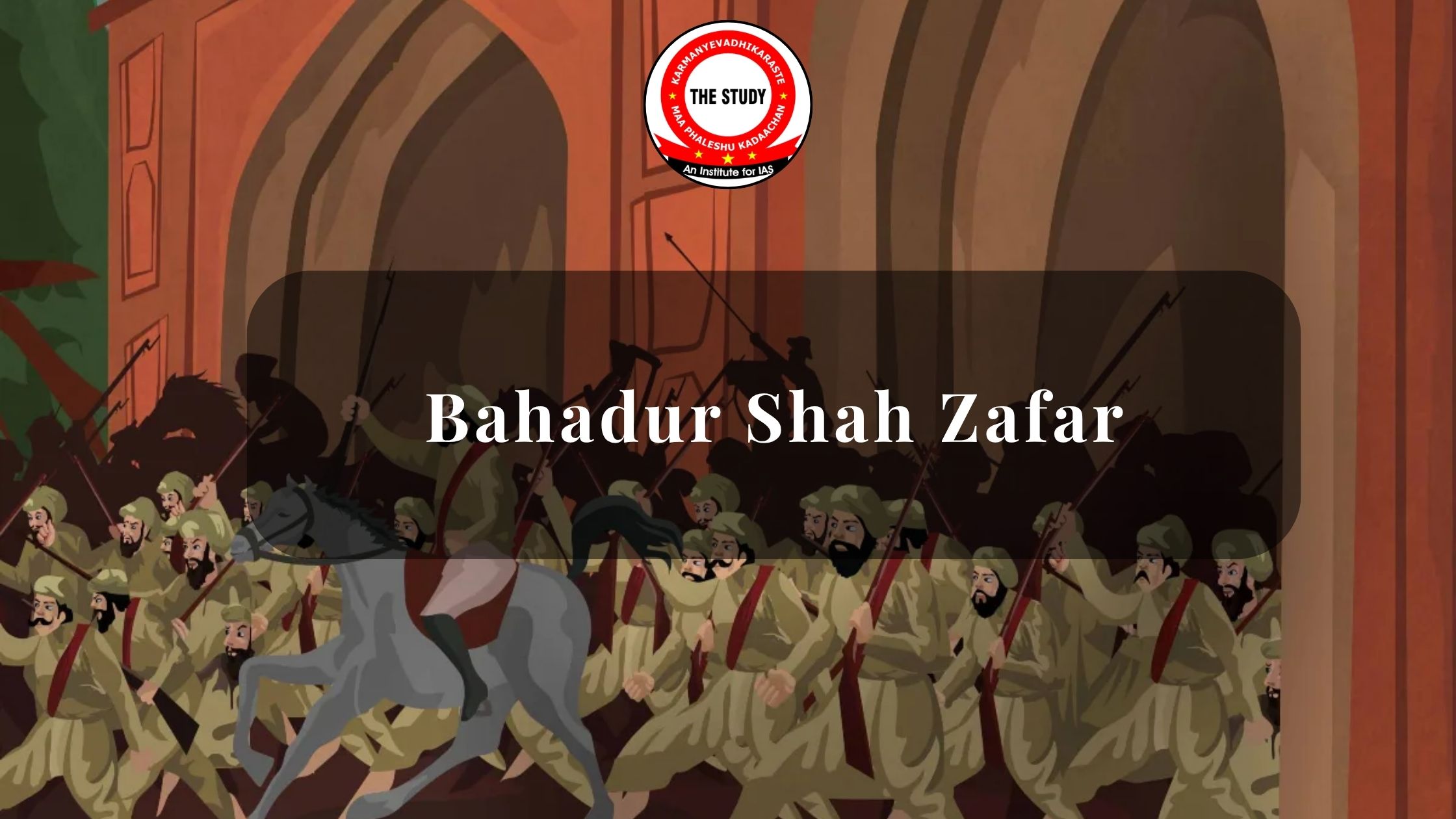
Bahadur Shah Zafar: The Last Mughal Emperor and the Symbol of 1857
Introduction
Bahadur Shah Zafar is often remembered as the last Mughal emperor, but reducing him to a powerless ruler at the end of the Mughal Empire misses his historical significance. He was a poet, cultural figure and symbolic head of the Revolt of 1857, a rebellion that transformed the relationship between the British East India Company and the Indian population.
Born in 1775, Zafar became emperor in 1837 at a time when Mughal political authority had already shrunk dramatically. The British controlled Delhi, while the emperor's authority was largely confined to the Red Fort and its immediate surroundings.
Yet in 1857, rebel soldiers who entered Delhi turned to Zafar for legitimacy. His name provided a political centre to a fragmented uprising.
His story therefore connects three themes essential for UPSC preparation:
decline of Mughal power + colonial expansion + the Revolt of 1857.
For a new aspirant, the key is not to memorise Zafar's biography separately. Instead, understand why rebels chose him, what role he actually played, and why his exile became a powerful symbol of the end of an era.
Why Does Bahadur Shah Zafar Remain Important in Modern Indian History?
Who Was Bahadur Shah Zafar and How Did He Become Mughal Emperor?
Bahadur Shah Zafar, whose original name was Abu Zafar Siraj-ud-din Muhammad, was born in Delhi in 1775. He succeeded his father, Akbar Shah II, as the Mughal emperor in 1837.
By then, the Mughal Empire was largely a political memory.
The East India Company had emerged as the dominant power in India after victories at Plassey (1757) and Buxar (1764), followed by territorial expansion across northern and central India.
The Mughal emperor retained prestige, but not substantial sovereign power.
The British even controlled the emperor's finances and gradually reduced his political status.
Thus, Zafar became emperor not at the beginning of Mughal decline, but almost at its terminal stage.
What Was Bahadur Shah Zafar's Position Before the Revolt of 1857?
Zafar's position illustrates the difference between symbolic authority and actual political power.
The British Resident exercised considerable influence in Delhi. The emperor had limited control over administration outside the Red Fort.
The Company also increasingly sought to end the remaining privileges associated with the Mughal dynasty.
Lord Dalhousie's policies further demonstrated the expanding confidence of the British colonial state. The annexation of Awadh in 1856, although not directly related to Zafar's succession, contributed to the political and military environment in which the 1857 revolt erupted.
Therefore, by 1857:
Mughal sovereignty had become nominal, while British sovereignty was increasingly becoming territorial and administrative.
Why Did the Rebels of 1857 Choose Bahadur Shah Zafar?
This is probably the most important exam-oriented question.
When rebel sepoys from Meerut reached Delhi on 11 May 1857, they approached Bahadur Shah Zafar and sought his leadership.
Why?
Because the Mughal emperor still possessed enormous political and symbolic legitimacy.
The revolt involved soldiers, zamindars, rulers, peasants and other groups with different grievances. There was no single modern nationalist organisation coordinating them.
Zafar could therefore serve as a common political symbol.
His acceptance helped transform a military mutiny into a broader challenge to Company authority.
However, an important UPSC nuance is necessary:
Zafar became the symbolic leader of the revolt, but he was not the central organiser of the entire uprising.
Leadership remained decentralised, with figures such as Nana Sahib, Rani Lakshmibai, Kunwar Singh and Begum Hazrat Mahal playing important regional roles.
What Role Did Bahadur Shah Zafar Play During the Revolt?
Zafar initially hesitated because he understood the limited resources available to him and the enormous military power of the British.
After the rebels occupied Delhi, however, he became the nominal head of the uprising.
His court became a political centre where different rebel groups sought legitimacy.
His sons and members of the royal household were also involved in the events surrounding the revolt.
But Zafar's actual capacity to command military operations was limited.
The Delhi leadership suffered from:
- Lack of unified command
- Shortage of resources
- Poor coordination
- Internal disagreements
- Limited military organisation
This distinction between symbolic leadership and operational leadership is highly useful in a Mains answer.
Why Did the Revolt Fail and What Happened to Zafar?
The British eventually recaptured Delhi in September 1857.
Zafar fled and took refuge at Humayun's Tomb, where he was captured by Major William Hodson.
His sons Mirza Mughal, Mirza Khizr Sultan and Mirza Abu Bakr were killed by Hodson.
Zafar was subsequently tried by the British and found guilty on charges including rebellion.
He was exiled to Rangoon (present-day Yangon, Myanmar), where he died in 1862.
His exile represented more than the punishment of one individual.
It symbolised the destruction of the last political remnant of Mughal sovereignty in India.
Why Is Bahadur Shah Zafar Also Important as a Poet and Cultural Figure?
Zafar's historical importance is not limited to politics.
He was an accomplished Urdu poet and became associated with Delhi's rich literary culture.
His court attracted important literary figures, including Mirza Ghalib, Zauq and Momin Khan Momin.
This makes Zafar significant to the cultural history of nineteenth-century India.
His poetry frequently reflected themes of loss, separation, political decline and exile, giving his later life a powerful cultural resonance.
For examination purposes, however, avoid turning an answer on Zafar into a biography of Urdu literature.
Use his literary identity briefly to show how Delhi remained a major centre of Indo-Islamic cultural synthesis even during the decline of Mughal political authority.
How Should UPSC Aspirants Analyse Bahadur Shah Zafar in the Context of 1857?
The best way is to place him inside the larger structure of the revolt.
Use this analytical chain:
Decline of Mughal authority → British expansion → military and political grievances → Revolt of 1857 → search for legitimacy → Zafar's symbolic leadership → British suppression → end of Mughal dynasty.
Also remember that historians differ over the character of 1857.
It has been described variously as a sepoy mutiny, rebellion, civil uprising and the first war of independence, depending on the historian and analytical framework.
Therefore, avoid simplistic statements such as “Zafar led India's first war of independence.”
A better formulation is:
Bahadur Shah Zafar provided the revolt with a powerful symbolic and dynastic centre, even though he lacked the administrative and military capacity to direct the entire uprising.
Why Is Bahadur Shah Zafar Important for UPPSC and Other Competitive Exams?
For UPSC History Optional and GS-I, Zafar is relevant to:
- Decline of the Mughal Empire
- British expansion
- Revolt of 1857
- Nature and causes of 1857
- Delhi during the revolt
- Colonial transformation
- Indo-Islamic cultural history
For UPPSC, he is particularly useful in questions on the Revolt of 1857 in Uttar Pradesh, because major centres such as Meerut, Kanpur, Lucknow, Bareilly and Jhansi were connected with the wider uprising.
In an answer, Zafar can be used as evidence that 1857 attempted to revive older political legitimacy while simultaneously challenging colonial rule.
What Are the Quick Facts for UPPSC Prelims, Previous Year Exam-Oriented Points and FAQ?
Quick Facts for UPPSC Prelims
- Name: Abu Zafar Siraj-ud-din Muhammad
- Popular name: Bahadur Shah Zafar
- Born: 1775, Delhi
- Father: Akbar Shah II
- Became emperor: 1837
- Last Mughal emperor
- Revolt of 1857: Rebels proclaimed him their emperor/leader at Delhi.
- Delhi recaptured by British: September 1857
- Captured: Humayun's Tomb
- Exiled to: Rangoon
- Died: 1862
- Major literary language: Urdu
Previous Year Exam-Oriented Points
Prepare Zafar through these themes:
- Mughal decline and British supremacy.
- Causes and nature of the Revolt of 1857.
- Delhi as the centre of the revolt.
- Symbolic versus actual leadership.
- Role of Bahadur Shah Zafar.
- British suppression of the revolt.
- End of the Mughal dynasty.
- Cultural and literary life of nineteenth-century Delhi.
FAQ
Was Bahadur Shah Zafar a powerful emperor in 1857?
No. His political authority was largely symbolic by that period.
Why did the rebels approach him?
The Mughal name still carried considerable legitimacy and could provide a common political symbol to the fragmented revolt.
Did Zafar plan the Revolt of 1857?
There is insufficient basis for presenting him as the organiser of the entire revolt. His role became more prominent after the rebels reached Delhi.
Where was Zafar buried?
He died in Rangoon in 1862 and was buried there.
Why is he important beyond the Mughal dynasty?
His life represents the transition from the symbolic survival of Mughal sovereignty to the consolidation of direct British imperial rule.
Subscribe to our Youtube Channel for more Valuable Content – TheStudyias
Download the App to Subscribe to our Courses – Thestudyias
The Source’s Authority and Ownership of the Article is Claimed By THE STUDY IAS BY MANIKANT SINGH
Comments (0)
Leave a Comment