Are India’s Himalayan Highways Turning Our Mountains Into Mass Graves?
24 Aug 2026
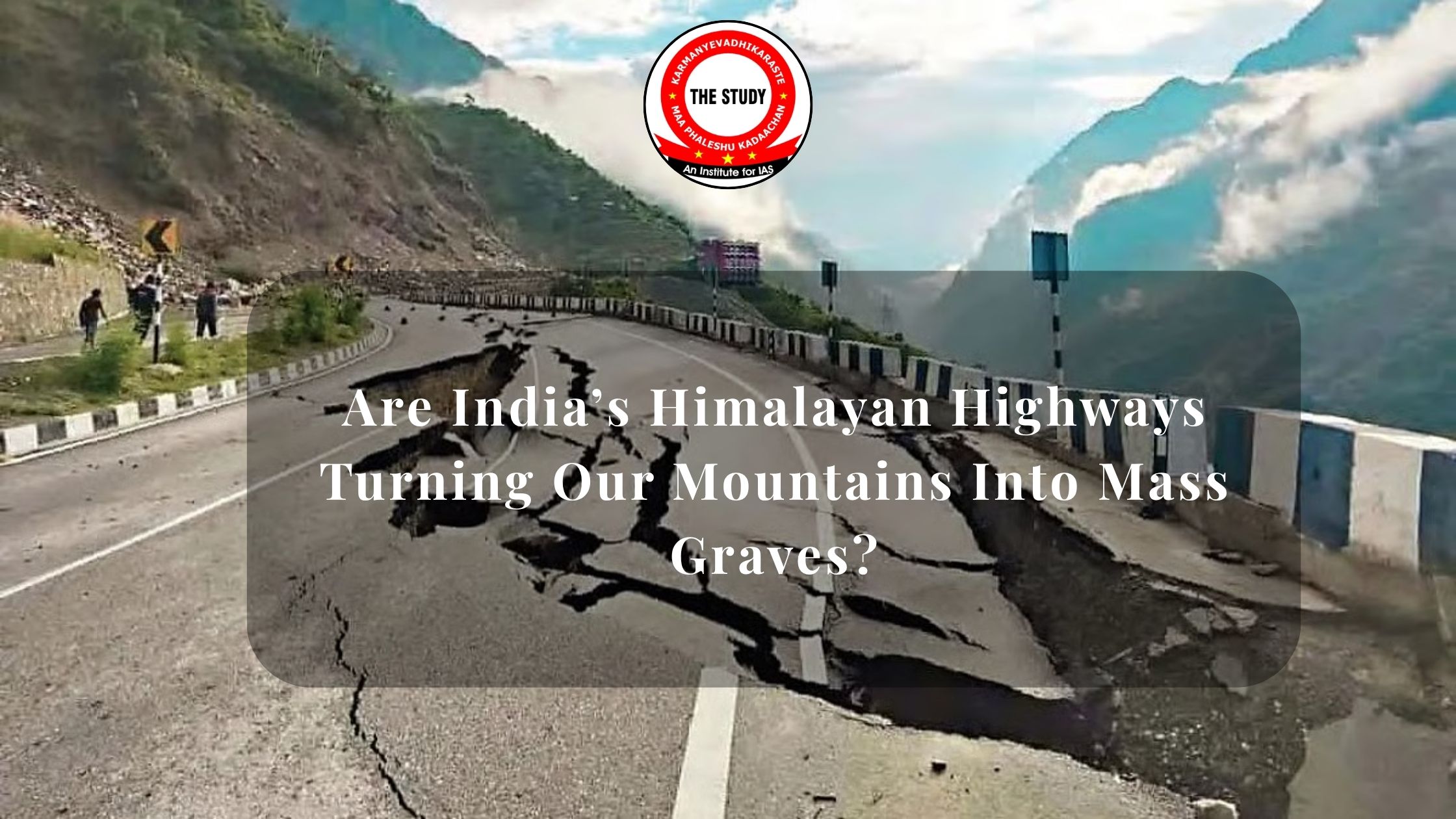
Are India’s Himalayan Highways Turning Our Mountains Into Mass Graves?
Introduction
A highway in the Himalayas is much more than a road.
It can connect a remote village to a hospital, move soldiers towards the border, carry agricultural produce to markets, enable tourism and reduce the isolation of mountain communities. For a country with difficult borders and scattered settlements, better connectivity in the Himalayas is not optional.
But there is a dangerous contradiction.
The same road that improves accessibility can also cut into an unstable mountain slope, alter drainage, accelerate erosion and expose people and infrastructure to landslides if it is poorly planned or executed.
This is why the debate around Himalayan highways should not be reduced to “development versus environment.” The real question is:
How can India build strategic and economic connectivity without converting geological vulnerability into avoidable human vulnerability?
The Himalayas are young, tectonically active and characterised by steep slopes, fragile geology and high seismic risk. Extreme rainfall, cloudbursts, flash floods and landslides can occur naturally. But infrastructure, tourism and settlement patterns can determine how much damage a natural event ultimately causes.
Recent research on the Char Dham corridor has reported a strong association between road expansion and landslide frequency, while UPSC-oriented analyses have increasingly highlighted carrying capacity, slope stability and sustainable infrastructure as central Himalayan policy questions.
The tragedy is not that India is building roads in the mountains.
The tragedy would be building roads as if mountains behave like plains.
Why Is Himalayan Road Development Becoming a Disaster Management Crisis?
1. Why Are the Himalayas Particularly Vulnerable to Road Construction?
The Himalayas are among the world's youngest major mountain systems and remain geologically active. Their steep terrain, fractured rocks, seismicity, high-altitude conditions and intense rainfall create a naturally unstable environment.
A road requires a relatively stable corridor. A mountain does not necessarily provide one.
Road construction can involve:
- Cutting into slopes
- Removing vegetation
- Excavating rock
- Altering natural drainage
- Dumping construction debris
- Increasing slope loading
- Disturbing groundwater pathways
- Creating exposed surfaces vulnerable to erosion
This does not mean every road causes landslides. Natural factors remain important. But when human intervention reduces the stability of an already vulnerable slope, a heavy rainfall event can become the trigger for failure.
This is the crucial UPSC concept:
Hazard may be natural; disaster risk is often socially and institutionally created.
2. Is Road Widening Actually Increasing Landslide Risk?
This is one of the most important contemporary questions.
A 2025 peer-reviewed study examining the Char Dham highway found that expansion of roads was associated with increased landslide frequency and magnitude in the Garhwal Himalayas.
An analysis cited by UPSC-focused sources examined 309 fully or partially road-blocking landslides along a 247-km stretch after exceptionally heavy rainfall and reported that road widening had a substantial relationship with landslide occurrence.
However, an aspirant should avoid writing:
“Road construction is the sole cause of Himalayan landslides.”
That is scientifically and administratively too simplistic.
Rainfall, geology, slope angle, seismic activity, river erosion, snow and land-use change all matter.
The more defensible argument is:
Road construction can amplify susceptibility and exposure when engineering does not adequately account for Himalayan geology and hydrology.
That balanced formulation is far stronger in a UPSC answer.
3. Why Is the Char Dham Highway Project at the Centre of the Debate?
The Char Dham Mahamarg Vikas Pariyojana seeks to improve connectivity to Yamunotri, Gangotri, Kedarnath and Badrinath in Uttarakhand.
Its objectives are legitimate:
pilgrimage connectivity + tourism + local economic development + emergency access + strategic mobility.
But the project has also generated concerns about slope cutting, debris disposal, landslides and ecological carrying capacity.
The controversy reached the Supreme Court, which constituted a High-Powered Committee to examine environmental concerns associated with the project. The government, meanwhile, has maintained that the February 2021 Chamoli disaster was a natural event and told Parliament that available scientific evidence did not establish a direct contribution from Char Dham construction to that disaster.
This disagreement is itself an important lesson for UPSC:
Policy debates should distinguish between correlation, causation and accountability.
A sophisticated answer recognises both:
- legitimate national-security and connectivity needs, and
- the need for scientifically assessed environmental safeguards.
4. Are Climate Change and Extreme Weather Making the Roads More Dangerous?
Yes, but climate change should not become a catch-all explanation.
The Himalayan risk landscape is changing because extreme rainfall, temperature changes, glacier dynamics and hydrological variability interact with existing geological vulnerabilities.
A road may remain stable under normal rainfall but fail when an extreme event saturates the slope.
The sequence can look like:
Extreme rainfall → water infiltration → increased pore-water pressure → reduced slope strength → landslide → road blockage → disruption of rescue and relief.
This creates a dangerous feedback loop.
A landslide can block a road, while the blocked road can delay ambulances, rescue teams, food supplies and disaster response.
Recent UPSC analyses have emphasised that Himalayan disasters increasingly arise from the interaction of extreme weather and unscientific development, rather than from a single isolated cause.
5. Why Is “Cut-and-Fill” Construction Dangerous in Mountain Terrain?
One of the most important engineering issues is the way roads are carved into slopes.
Excessive cutting can create very steep exposed faces. If these are not properly stabilised, rainfall and weathering can weaken them.
The problem becomes worse when drainage is inadequate.
Mountain roads need to manage water carefully because water is often the immediate trigger that converts a vulnerable slope into a failed slope.
Therefore, sustainable Himalayan road engineering should emphasise:
- Proper slope geometry
- Retaining structures where scientifically justified
- Rock bolting and netting where appropriate
- Bio-engineering
- Cross-drainage
- Slope monitoring
- Controlled excavation
- Safe debris disposal
- Regular maintenance
A highway is not “complete” when its asphalt is laid.
In the Himalayas, slope stability is part of road infrastructure itself.
6. Can India Stop Building Roads in the Himalayas?
No—and this is where simplistic environmental arguments fail.
The Himalayan region contains sensitive border areas. Connectivity is essential for defence logistics, civilian evacuation, local markets, healthcare and disaster response.
Remote communities should not be condemned to poor infrastructure in the name of environmental protection.
The solution is therefore not:
“No roads.”
It is:
“Right road, right alignment, right engineering, right carrying capacity.”
Strategic roads may be necessary even in difficult terrain. But the planning standard must be higher than in relatively stable areas.
India also needs to consider alternatives such as:
- Tunnels where geologically feasible
- Viaducts in suitable terrain
- Smaller but more resilient road designs
- Ropeways for selected applications
- Better public transport
- Multi-modal connectivity
- Improved existing corridors rather than indiscriminate widening
The objective should be connectivity with resilience, not connectivity at any cost.
7. Why Are Himalayan Roads Also a Strategic and Humanitarian Necessity?
The environmental debate should never ignore geography.
The Himalayan frontier includes India's borders with China, Pakistan, Nepal and Bhutan. In several areas, roads are essential for troop mobility, logistics and border-area development.
The Border Roads Organisation has therefore played an important role in improving connectivity in difficult terrain.
But strategic importance makes environmental planning more important, not less.
A road repeatedly destroyed by landslides is strategically weaker than a slightly more expensive road designed for long-term resilience.
The same principle applies to disaster management.
During an emergency, roads are lifelines. But if roads themselves become unstable, they can become bottlenecks.
This is why Himalayan infrastructure should be treated as critical infrastructure requiring disaster-resilient design.
8. What Are the Quick Facts for UPPSC Prelims, Previous Year Exam-Oriented Points and FAQ?
Quick Facts for UPPSC Prelims
- Himalayas are a young fold mountain system.
- The region is highly vulnerable to earthquakes, landslides, flash floods and cloudbursts.
- Char Dham: Yamunotri, Gangotri, Kedarnath and Badrinath.
- Char Dham highway: major connectivity project in Uttarakhand.
- BRO: responsible for important strategic road infrastructure in difficult frontier terrain.
- Landslide risk depends on factors such as slope, lithology, rainfall, drainage and land-use changes.
- Road cutting can increase slope instability when inadequately designed.
- Carrying capacity should include ecological, geological, infrastructure and social dimensions.
- Sustainable mountain infrastructure requires risk assessment before construction, not merely disaster response afterwards.
Previous Year Exam-Oriented Points
For UPSC/UPPSC, prepare these dimensions:
- Himalayan fragility.
- Landslides and road construction.
- Char Dham Highway.
- Carrying capacity of mountain regions.
- Climate change and extreme rainfall.
- Disaster-resilient infrastructure.
- Strategic connectivity versus ecological conservation.
- Environmental Impact Assessment.
- BRO and border infrastructure.
- Community participation in mountain governance.
FAQ
Are all Himalayan landslides caused by road construction?
No. Landslides are influenced by natural factors such as geology, rainfall, slope and seismicity. Human activity can increase susceptibility or exposure.
Should India stop infrastructure development in the Himalayas?
No. Connectivity is essential for defence, livelihoods, healthcare and disaster response. The goal should be resilient and scientifically planned infrastructure.
Why is road widening controversial?
Because widening can require extensive slope cutting and vegetation removal, potentially increasing instability if engineering and drainage are inadequate.
What is the best alternative to Himalayan road expansion?
There is no single alternative. Depending on terrain, solutions may include better alignment, tunnels, viaducts, public transport, ropeways and strengthening existing roads.
What is the biggest policy lesson?
Mountain infrastructure must be planned according to carrying capacity and hazard vulnerability, rather than treating connectivity as an isolated engineering project.
Subscribe to our Youtube Channel for more Valuable Content – TheStudyias
Download the App to Subscribe to our Courses – Thestudyias
The Source’s Authority and Ownership of the Article is Claimed By THE STUDY IAS BY MANIKANT SINGH
Comments (0)
Leave a Comment