Alamgir II
10 Aug 2026
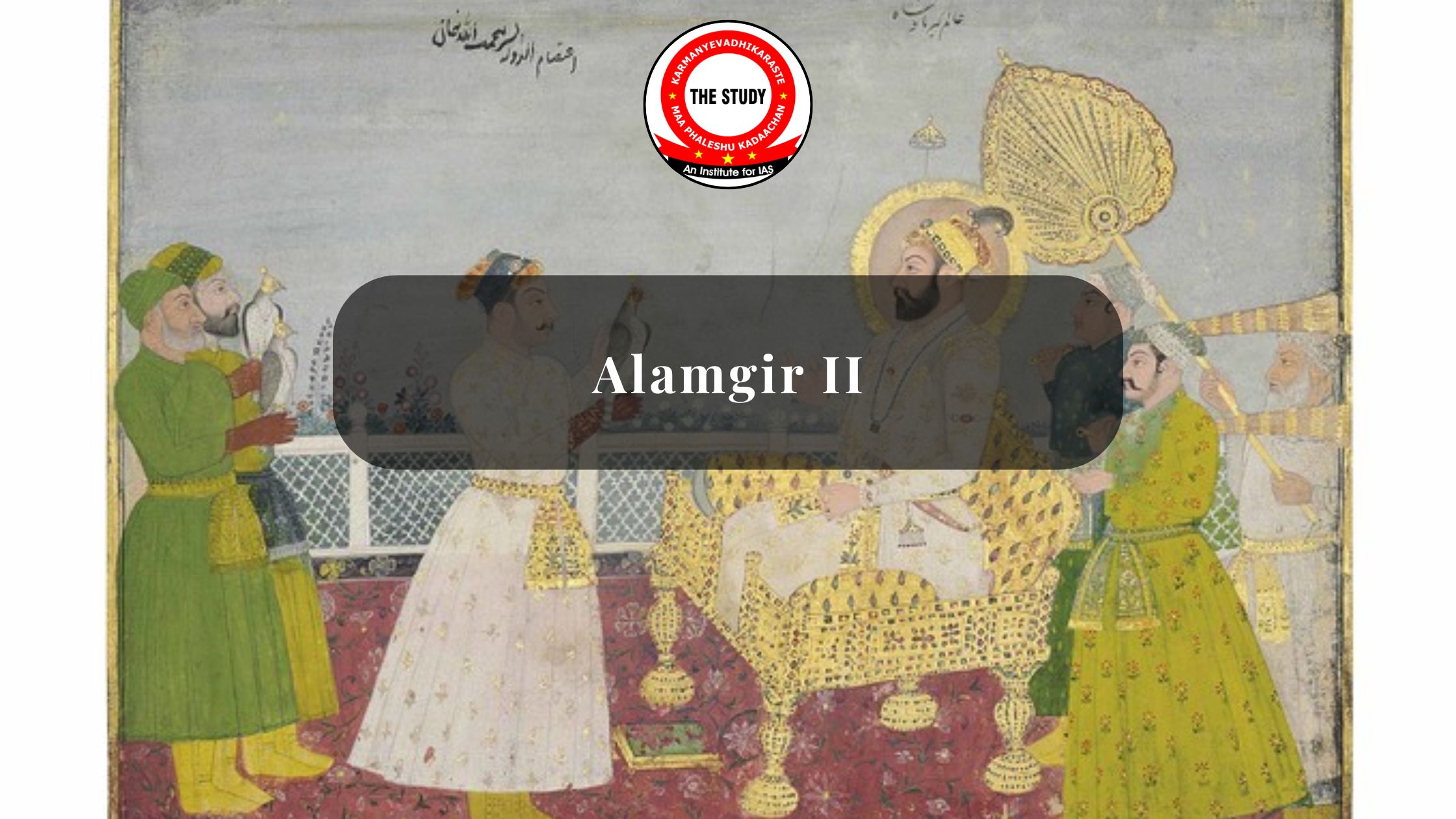
Alamgir II: Biography, Reign, Administration, Death and Historical Significance
Alamgir II was the eighteenth Mughal emperor of India and ruled from 1754 to 1759. His reign occurred during one of the most turbulent periods in Mughal history, when the authority of the emperor had declined dramatically and powerful regional forces were competing for influence over northern India. Unlike Aurangzeb, who was also known as Alamgir I, Alamgir II exercised very limited independent power and largely remained a figurehead amid intense court politics.
Born as Aziz-ud-Din in 1699, Alamgir II belonged to the Mughal royal family and was a son of Prince Muhammad Mu'azzam, later known as Emperor Bahadur Shah I. He spent much of his life away from the imperial throne before being placed on it by the powerful noble Imad-ul-Mulk in 1754. His five-year reign was marked by political instability, Maratha expansion, Afghan intervention, factional rivalry, and the growing influence of the British East India Company. His assassination in 1759 further demonstrated how vulnerable the Mughal monarchy had become.
Who Was Alamgir II?
Alamgir II became emperor at a time when the Mughal throne still carried enormous symbolic prestige but possessed far less practical authority than it had during the seventeenth century. The empire that once stretched across much of the Indian subcontinent was fragmenting into powerful regional states, while the Mughal court itself was increasingly controlled by military nobles and competing factions.
His reign is therefore best understood not as a period of imperial expansion but as a chapter in the decline of effective Mughal authority. The emperor remained important as a source of political legitimacy, yet powerful nobles, Marathas, Afghans, and emerging European powers increasingly shaped events.
His Place in Mughal History
Alamgir II is sometimes overshadowed by more famous Mughal rulers such as Akbar, Shah Jahan, Aurangzeb, and Bahadur Shah I. Nevertheless, his reign is extremely important for understanding the transformation of eighteenth-century India.
By the middle of the eighteenth century, the Mughal emperor was no longer the unquestioned political authority of the subcontinent. Regional powers such as the Marathas, Jats, Sikhs, Awadh, Bengal, and Hyderabad had gained substantial autonomy. Meanwhile, the British East India Company was rapidly increasing its military and political influence.
Alamgir II's short reign sits directly in the middle of this transition. His story is essentially the story of an emperor caught between a prestigious imperial title and a rapidly shrinking ability to exercise real power.
Early Life of Alamgir II
Birth and Family Background
Alamgir II was born Aziz-ud-Din on 6 June 1699. He was a member of the Mughal ruling family and belonged to the generation that followed Emperor Aurangzeb.
His father was Prince Muhammad Mu'azzam, who later became Emperor Bahadur Shah I. This placed Alamgir II within the direct imperial family, although he did not initially appear destined to occupy the throne.
The Mughal succession system was highly unstable because there was no fixed rule requiring the eldest son to inherit the throne. Rival princes frequently competed for power, and nobles could play a decisive role in determining which member of the royal family became emperor.
Life Before Becoming Emperor
Alamgir II spent decades away from the center of imperial power. Unlike princes who became dominant political figures early in life, he remained relatively obscure during much of the eighteenth century.
This changed dramatically after the deposition of Ahmad Shah Bahadur in 1754. The powerful noble Imad-ul-Mulk selected Aziz-ud-Din as the new emperor and placed him on the Mughal throne under the title Alamgir II.
His accession illustrates an important feature of late Mughal politics: becoming emperor did not necessarily mean controlling the empire. In Alamgir II's case, the individual who controlled the machinery of government was initially far more powerful than the emperor himself.
The Mughal Empire in Crisis
The Mughal Empire had already entered a period of serious decline before Alamgir II became emperor. The death of Aurangzeb in 1707 was followed by succession struggles, provincial rebellions, fiscal difficulties, and the growing independence of regional powers.
The devastating invasion of Nadir Shah in 1739 further exposed Mughal weakness. Delhi was invaded and enormous wealth was carried away. A few years later, Afghan ruler Ahmad Shah Abdali, also known as Ahmad Shah Durrani, repeatedly invaded northern India.
By 1754, the Mughal Empire was therefore more like a weakened central institution surrounded by increasingly powerful regional states than the centralized empire created by earlier Mughal rulers.
Alamgir II Becomes Mughal Emperor
Accession in 1754
Alamgir II ascended the Mughal throne in 1754 after Ahmad Shah Bahadur was removed from power. The appointment was largely the result of the influence of Imad-ul-Mulk, a powerful noble and military commander.
The choice was politically convenient because Alamgir II was an experienced member of the royal family but lacked an independent power base strong enough to immediately challenge Imad-ul-Mulk.
The emperor therefore possessed the traditional symbols of sovereignty—court ceremony, imperial titles, and dynastic legitimacy—while actual political authority remained concentrated among powerful nobles.
Imad-ul-Mulk and the Politics of the Court
Imad-ul-Mulk became the dominant political figure during the early part of Alamgir II's reign. His influence reflected the transformation of Mughal politics into a contest among military and aristocratic factions.
The emperor's inability to fully control his own ministers was a major weakness. Imad-ul-Mulk pursued his own political interests, sometimes making decisions that conflicted with the emperor's preferences.
This created an unstable relationship between the throne and the court. Alamgir II attempted to recover some independence, but the political environment was extremely difficult.
Limited Imperial Authority
One of the defining characteristics of Alamgir II's reign was the limited authority of the emperor.
The Mughal emperor continued to possess considerable symbolic importance. Regional rulers could benefit from imperial recognition, titles, and formal legitimacy. However, the emperor increasingly depended on powerful nobles and regional military forces.
It was a little like having the title of captain while someone else controlled the ship. Alamgir II occupied the highest ceremonial position, but many of the crucial political decisions were being made elsewhere.
Administration and Political Conditions During Alamgir II's Reign
Declining Mughal Power
The Mughal government during Alamgir II's reign faced severe financial and military problems. The central administration lacked the resources needed to impose its authority across distant provinces.
Provincial governors had become increasingly independent, while regional powers maintained their own armies and revenue systems. The imperial court in Delhi was therefore surrounded by political actors who could not easily be controlled.
The result was an increasingly decentralized political landscape in northern India.
Maratha Influence
The Marathas had emerged as one of the most powerful political forces in eighteenth-century India. Their expansion into northern India placed enormous pressure on the weakened Mughal government.
Maratha leaders increasingly intervened in the politics of Delhi and the surrounding regions. At different moments, the Mughal court depended upon Maratha military assistance, demonstrating how far imperial power had declined.
The growing Maratha influence eventually became one of the central factors behind the conflict that culminated in the Third Battle of Panipat in 1761.
Afghan Pressure
The rise of Ahmad Shah Abdali created another major threat. Abdali repeatedly invaded northern India and sought to establish Afghan influence over the region.
His interventions were closely connected with the struggle between Afghan, Maratha, Mughal, and regional interests. Delhi and the surrounding territories became a political chessboard on which several powerful forces competed.
The Mughal emperor was often unable to determine the outcome independently.
British East India Company
At the same time, the British East India Company was becoming an increasingly important political and military power.
The Battle of Plassey in 1757 was especially significant because it enabled the Company to gain decisive influence in Bengal. Although Plassey did not directly involve Alamgir II's court in Delhi, it demonstrated the changing balance of power in India.
The Mughal decline was therefore taking place alongside the rise of European commercial powers that were transforming themselves into territorial and political authorities.
Alamgir II and Shah Alam II
Relationship With His Son
Alamgir II's son was Prince Ali Gauhar, who later became Emperor Shah Alam II. Their relationship is important because Shah Alam II eventually became one of the longest-reigning Mughal emperors of the later period.
Ali Gauhar was politically ambitious and increasingly dissatisfied with the influence of Imad-ul-Mulk. The prince eventually left Delhi and sought to build his own political base.
This created another layer of tension within an already unstable Mughal court.
Shah Alam's Political Ambitions
Prince Ali Gauhar understood that remaining in Delhi under the control of Imad-ul-Mulk was dangerous. He moved eastward and attempted to establish himself independently.
After his father's death, he eventually became emperor as Shah Alam II. His later reign would include some of the most important events in the final century of Mughal political history, including the Battle of Buxar in 1764 and the growing authority of the East India Company.
Conflict Within the Mughal Court
The conflict between the emperor, his son, and Imad-ul-Mulk reflected the larger fragmentation of Mughal political authority.
Instead of a unified imperial administration, the court had become a network of competing interests. Every alliance was temporary, and military power frequently mattered more than formal rank.
This atmosphere contributed directly to the tragedy that eventually ended Alamgir II's life.
Ahmad Shah Abdali and the Third Battle of Panipat
Afghan Intervention
Ahmad Shah Abdali became a major force in northern Indian politics during the 1750s. His invasions were motivated by both strategic and economic interests, while Indian powers attempted to either resist or cooperate with him depending on circumstances.
The weakening of Mughal authority made northern India vulnerable to repeated foreign interventions. Delhi could no longer reliably defend itself against major external armies.
The Road to Panipat
The struggle between the Marathas and Abdali eventually culminated in the Third Battle of Panipat on 14 January 1761.
Although Alamgir II had already died by this point, the political conditions of his reign formed part of the background to the conflict. The Mughal Empire's weakness had created a power vacuum, and both the Marathas and Afghans sought to fill it.
The battle was fought between the Maratha army and the Afghan coalition led by Ahmad Shah Abdali.
Consequences for the Mughal Empire
The Afghan victory at Panipat was devastating for the Marathas and temporarily altered the balance of power in northern India. However, it did not restore the Mughal Empire to its former strength.
Instead, the political fragmentation of India continued. The British East India Company increasingly emerged as the power best positioned to exploit the divisions among regional states.
For students of history, this is an important distinction: the decline of the Mughal Empire was not caused by one battle or one ruler. It was the cumulative result of succession struggles, administrative weakness, regional autonomy, military competition, fiscal problems, and the rise of new powers.
Death of Alamgir II
Political Conspiracy
By 1759, Alamgir II had become increasingly uncomfortable with the dominance of Imad-ul-Mulk. The emperor sought support from other political forces, including Ahmad Shah Abdali.
This attempt to regain political independence increased tensions at court. Imad-ul-Mulk regarded the emperor's actions as a threat to his own position.
The atmosphere eventually became extremely dangerous for Alamgir II.
Assassination in 1759
Alamgir II was assassinated on 29 November 1759. Historical accounts generally connect his death with a conspiracy involving Imad-ul-Mulk and his supporters.
The emperor was reportedly lured out of the protection of the palace and killed. His assassination demonstrated the extraordinary weakness of the Mughal throne: by this stage, even the emperor's personal security could not be guaranteed.
Aftermath
Following Alamgir II's death, the Mughal succession once again became uncertain. Shah Jahan III was briefly placed on the throne, while Alamgir II's son, Ali Gauhar, was outside Delhi.
Ali Gauhar later assumed the imperial title as Shah Alam II. His reign would eventually bring the Mughal emperor into direct contact with the expanding power of the British East India Company.
Legacy of Alamgir II
Why His Reign Was Important
Alamgir II was not a powerful emperor in the conventional sense. Nevertheless, his reign is historically important because it reveals the depth of Mughal political decline.
His five years on the throne demonstrate how the emperor's position had changed. During the reigns of Akbar and Aurangzeb, the emperor could command armies, appoint officials, collect revenue, and shape policy across enormous territories. By Alamgir II's time, powerful nobles and regional states could determine political outcomes independently.
Alamgir II in the Context of Mughal Decline
It would be misleading to blame Alamgir II personally for the decline of the Mughal Empire. Most of the structural problems he inherited had developed over several decades.
The empire had already suffered from:
- Succession conflicts
- Weak central leadership
- Provincial independence
- Financial difficulties
- Military challenges
- Maratha expansion
- Afghan invasions
- European commercial and military expansion
Alamgir II inherited this troubled landscape rather than creating it.
Historical Assessment
Historians generally regard Alamgir II as a weak and largely powerless ruler, but that assessment needs context. His limited authority was partly a consequence of the broader political transformation of eighteenth-century India.
He was an emperor trapped inside a collapsing political structure. His title remained prestigious, but the institutional foundations that had once supported Mughal sovereignty had substantially eroded.
His assassination provides one of the clearest examples of this transformation.
Important Personalities
Several personalities should be studied alongside Alamgir II:
- Imad-ul-Mulk – powerful Mughal noble and political figure.
- Ahmad Shah Abdali – Afghan ruler who intervened repeatedly in northern India.
- Shah Alam II – Alamgir II's son and later Mughal emperor.
- Ahmad Shah Bahadur – Alamgir II's predecessor.
- Robert Clive – associated with the British victory at Plassey.
- Maratha leaders – major political forces in northern India.
Understanding their relationships is more useful than memorizing isolated names.
Key Events to Remember
The most important examination points concerning Alamgir II are his accession in 1754, the dominance of Imad-ul-Mulk, the growing involvement of the Marathas and Afghans, the rise of the British East India Company during the same period, and his assassination in 1759.
His reign should therefore be studied as part of the larger topic of Later Mughal History and the Rise of Regional Powers rather than as an isolated biography.
Conclusion
Alamgir II was a later Mughal emperor whose reign from 1754 to 1759 illustrates the dramatic transformation of Indian politics during the eighteenth century. Born Aziz-ud-Din, he inherited the prestigious Mughal throne at a time when real imperial power had already been weakened by succession disputes, provincial independence, financial problems, military challenges, and the rise of regional powers.
His political dependence on Imad-ul-Mulk, the growing influence of the Marathas, repeated Afghan interventions under Ahmad Shah Abdali, and the emergence of the British East India Company all demonstrate the fragmented nature of eighteenth-century India. His assassination in 1759 was a particularly striking sign of the Mughal monarchy's vulnerability.
Although Alamgir II was not an architect of major territorial expansion or administrative reform, his reign is valuable for understanding the decline of Mughal authority and the rise of competing powers in India. For students, the best way to remember him is to place his reign between the earlier decline of the Mughal Empire and the major turning points of Plassey, Panipat, and Buxar.
Frequently Asked Questions About Alamgir II
1. Who was Alamgir II?
Alamgir II was the eighteenth Mughal emperor of India, ruling from 1754 to 1759. His original name was Aziz-ud-Din, and he became emperor after Ahmad Shah Bahadur was deposed. His reign occurred during a period of severe Mughal political decline.
2. Who was the most powerful person during Alamgir II's reign?
Imad-ul-Mulk was one of the most powerful political figures during Alamgir II's reign. He played a major role in placing Alamgir II on the throne and initially exercised greater practical political authority than the emperor himself.
3. How did Alamgir II die?
Alamgir II was assassinated on 29 November 1759. His death was connected to a political conspiracy involving powerful court figures, particularly Imad-ul-Mulk and his supporters.
4. Who succeeded Alamgir II?
After Alamgir II's death, Shah Jahan III was briefly placed on the Mughal throne. Alamgir II's son, Ali Gauhar, later became emperor as Shah Alam II and ruled for several decades.
5. Why is Alamgir II important in Indian history?
Alamgir II is important because his reign represents an advanced stage of Mughal political decline. During his rule, powerful regional states, the Marathas, Afghan forces, and the British East India Company increasingly influenced Indian politics, while the Mughal emperor's independent authority became severely restricted.
Subscribe to our Youtube Channel for more Valuable Content – TheStudyias
Download the App to Subscribe to our Courses – Thestudyias
The Source’s Authority and Ownership of the Article is Claimed By THE STUDY IAS BY MANIKANT SINGH
Read More :